Unichain and Base are both Ethereum Layer 2 networks built on the OP Stack inside the Optimism Superchain, and both charge gas in ETH. Unichain is optimized for DeFi trading with one-second blocks, Flashblock preconfirmations, and a TEE block builder; Base is a general-purpose L2 incubated by Coinbase with a broader consumer app ecosystem and two-second block times. Choosing between them is mostly a question of which applications are used, not which wallet or token standard is held.
Both chains share the same security model family — EVM equivalence, Ethereum data availability, sequencer-based execution, and fault-proof roadmaps — so skills and assets transfer directly between them. The Unichain topic page covers Flashblocks, chain ID 130, gas tokens, and Stage 1 rollup status in depth; the head-to-head differences start with the block-building layer.
Key Takeaways
-
Unichain and Base are both OP Stack, EVM-equivalent Superchain L2s that use ETH for gas; neither requires a new wallet or token standard.
-
Unichain targets DeFi trading speed with one-second blocks and roughly 200 ms Flashblock preconfirmations; Base targets a broad general-purpose app ecosystem with two-second blocks.
-
Unichain uniquely runs a TEE-based external block builder (Rollup-Boost with Flashbots) providing verifiable ordering and revert protection; Base uses standard OP Stack sequencing.
-
Neither chain is universally better: Unichain suits frequent swapping and liquidity use, while Base suits a wider range of consumer, social, and general dApp activity.
Unichain vs. Base: Ethereum L2 Comparison at a Glance
| Feature |
Unichain |
Base |
| Launch / builder |
Uniswap Labs; mainnet February 2025 |
Coinbase incubation; mainnet August 2023 |
| Tech stack |
OP Stack, Optimism Superchain; an optimistic rollup settled on Ethereum mainnet |
OP Stack, Optimism Superchain; a layer 2 rollup settled on Ethereum mainnet |
| Chain ID |
130 |
8453 |
| Block time |
1 second, plus ~200 ms Flashblock preconfirmations |
2 seconds |
| Block building |
TEE external builder (Rollup-Boost, Flashbots); revert protection |
Standard OP Stack sequencer path |
| Primary focus |
DeFi trading, swaps, cross-chain liquidity |
General-purpose apps, consumer onboarding, payments |
| Gas token |
ETH (Unichain ETH) |
ETH (Base ETH) |
| Flagship apps |
Uniswap v2/v3/v4, DeFi and liquidity apps |
Coinbase products plus broad DeFi, social, and gaming apps |
| Rollup stage |
Stage 1 with permissionless fault proofs |
Stage 1 since April 2025; permissionless ZK fault proofs (5-day challenge) |
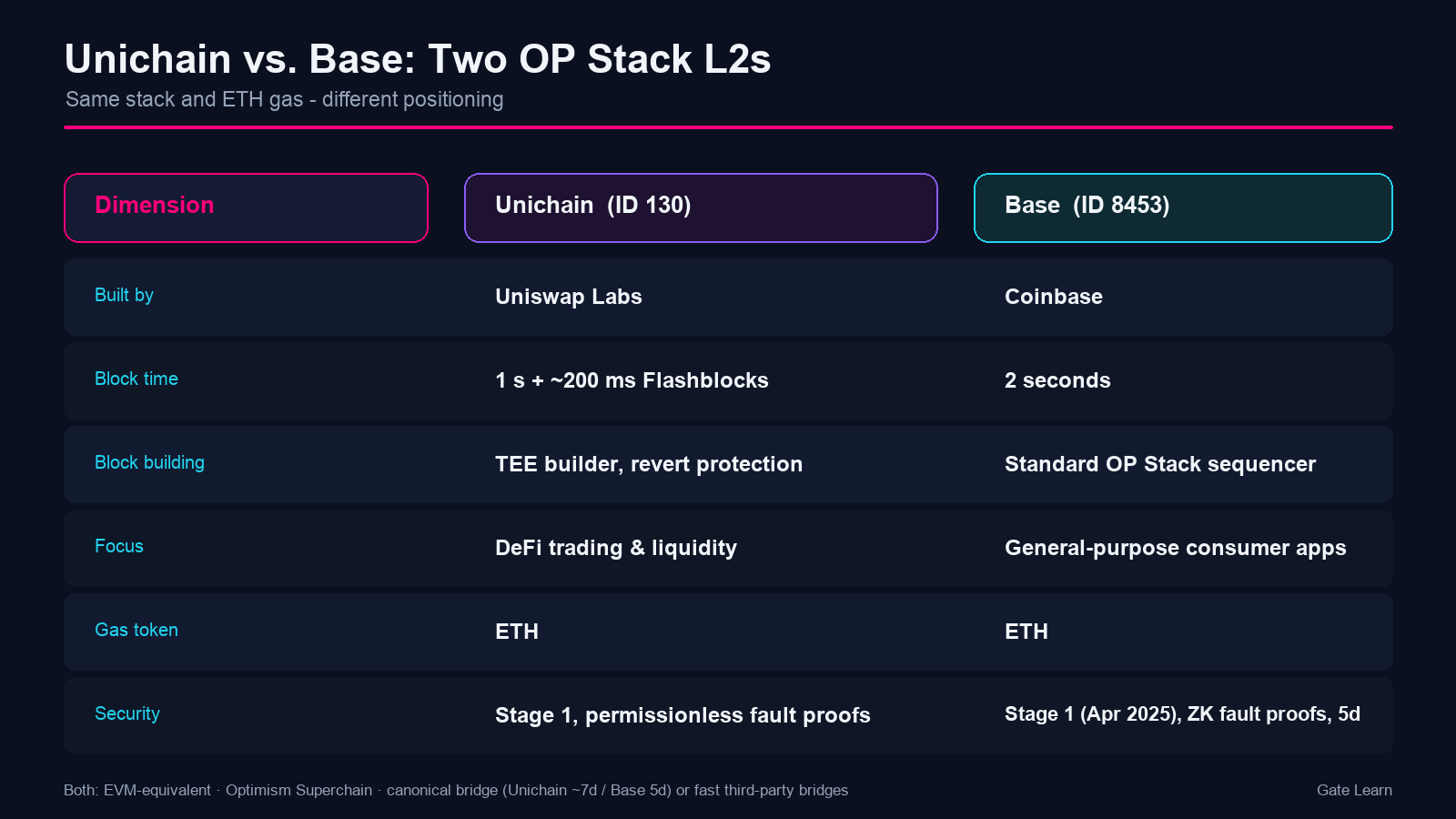
The table captures the main differences in an Ethereum layer 2 comparison; the explanations below cover what each row means in practice.
What Is Unichain? Key Features Explained
Unichain is an Ethereum layer 2 built for decentralized finance, launched by Uniswap Labs, where the Uniswap protocol's v2, v3, and v4 deployments are first-class citizens. By moving execution off Ethereum, it lowers gas costs and transaction costs while Ethereum remains the settlement layer. Its chain-level design is tuned for market activity: one-second canonical blocks, Flashblocks at roughly 200 millisecond intervals as an early inclusion signal, and lower latency intended to increase arbitrage frequency and support deep liquidity while reducing value lost to MEV. Block production uses a Trusted Execution Environment builder developed with Flashbots, a first for L2 mainnets, with the aim of making ordering more verifiable and reducing front running and MEV extraction.
Unichain is a Stage 1 rollup with permissionless fault proofs, using fraud proofs as the inherited Ethereum security mechanism so anyone can challenge an invalid state posted to Ethereum. Production operation of sequencers, RPC, monitoring, and incident response moved to Optimism under the OP Enterprise arrangement announced in October 2026, while chain ID 130, contracts, balances, and governance arrangements remained unchanged.
What Is Base? An Optimistic Rollup Overview
Base is an Ethereum layer 2 incubated by Coinbase and built on the same OP Stack as an optimistic rollup, also aligned with the Optimism Superchain. It positions itself as a general-purpose network for decentralized applications, and its familiar tooling and EVM compatibility make it easy for Ethereum teams to deploy with the Solidity contracts and workflows they already use. Base mainnet uses chain ID 8453, two-second block times, and ETH as gas.
Like other Superchain members, Base benefits from shared OP Stack standards and tooling. Base reached Stage 1 decentralization in April 2025 after permissionless fault proofs went live in October 2024, according to the Base blog; L2BEAT currently lists Base as a Stage 1 optimistic rollup with a five-day ZK fault-proof challenge period. Its scale advantage is distribution: the Coinbase connection gives it a large retail on-ramp, which tends to produce a wider variety of apps and assets than a chain purpose-built for trading. In practice, Base is aimed at broad app distribution across multiple chains rather than one chain optimized around trading.
Block Speed and MEV Protection: How Different Are They?
The technical gap centers on trading-sensitive infrastructure. Unichain's one-second blocks and Flashblock preconfirmations reduce the time between signing a swap and learning its status, which matters for competitive trading, liquidity provision, and arbitrage. The TEE-based block builder adds two properties Base does not expose at the chain level by default: verifiable transaction ordering inside a trusted execution environment, and revert protection that stops failing transactions from being packaged purely for fees, while planned TEE-based block building also makes ordering verifiable and helps limit front running.
For ordinary transfers or occasional swaps, a one-second versus two-second block time is rarely decisive; both are dramatically faster than Ethereum L1. The difference matters most to active traders, MEV-sensitive flows, and protocol integrations that stream pending state through Flashblocks WebSocket endpoints, especially DeFi users and smart contracts that react to pending state.
Ecosystem, Apps, Bridging, and Cross Chain Capabilities
Unichain's ecosystem concentrates on swapping, liquidity, and market infrastructure, with Uniswap protocol deployments as the anchor and liquidity programs focused on swaps, money markets, and yield strategies. Base's ecosystem is broader and more consumer-oriented, partly because of Coinbase's on-ramp and user base. Both support the same wallets (any EVM wallet, including Uniswap Wallet), the same token standards, and similar bridge options.
Bridging works the same way on both chains: the canonical OP Stack bridge is secure but withdrawals wait out each chain's fault-proof challenge window (about seven days on Unichain and five days on Base), whereas fast bridges such as Across or Superbridge deliver in minutes by relying on liquidity providers to front funds on the destination chain; after token approval, you confirm the bridge transaction in your wallet, and relayers then fulfill the transfer on the destination chain, while third party bridges add extra smart-contract and liquidity risk. Native Superchain interoperability, beginning with ETH transfers without a bridge, is being rolled out across OP Stack chains rather than being exclusive to one network, with cross chain messaging as part of how OP Stack chains can communicate and move assets or state more directly across the Superchain. That includes native bridges, native interop, and broader cross chain interoperability across OP Stack chains. Both networks also support ways to bridge assets and execute cross chain swaps for tokens moving between chains, with liquidity pools affecting route quality.
Which Should You Choose?
Choose Unichain when the primary activity is frequent swapping, liquidity provision, or using DeFi apps built around Uniswap and fast execution, especially where MEV protection and revert protection matter; it is the more efficient solution for users prioritizing decentralized finance execution and lower transaction costs. Choose Base when access to a wider range of consumer, social, gaming, and payment applications matters more, or when moving funds from Coinbase products is the main route in, since it generally fits broader production workloads and consumer app usage better.
There is no need to choose permanently: assets can move between the two chains through bridges today and, as native interoperability ships, increasingly without one. Both use ETH for gas, so users bridging in should usually bring a small amount of ETH on the destination network regardless of the chain selected.
Summary
Unichain and Base are sibling OP Stack Ethereum layer 2 networks in the Optimism Superchain, both aligned with Ethereum's scaling roadmap rather than competing technical architectures: same EVM equivalence, same ETH gas model, similar bridge mechanics. Unichain differentiates on trading infrastructure — one-second blocks, about 200 ms Flashblock preconfirmations, and a TEE builder with revert protection — while Base differentiates on the breadth of its general-purpose, consumer-linked ecosystem. At a high level, their security and decentralization are broadly shared at the OP Stack level, while the practical choice still follows the applications used, and bridging keeps both options open, with Superchain alignment also extending to shared governance and ecosystem funding mechanisms.
FAQ
What is the main difference between Unichain and Base?
Unichain is a DeFi-trading-focused OP Stack L2 from Uniswap Labs with one-second blocks, Flashblock preconfirmations, and a TEE block builder; Base is a general-purpose OP Stack L2 incubated by Coinbase with a broader consumer app ecosystem and two-second blocks. Both are EVM-equivalent Superchain chains using ETH for gas.
Do Unichain and Base use the same gas token?
Yes. Both networks pay gas in ETH — Unichain ETH on chain ID 130 and Base ETH on chain ID 8453. Neither network uses UNI or a separate network token for standard transaction fees. On Unichain, ETH is the fee token, while UNI is the governance token used for protocol decisions rather than gas.
Is Unichain faster than Base?
At the block level, yes: Unichain produces one-second blocks with roughly 200 millisecond Flashblock preconfirmations, while Base uses two-second blocks. For everyday transfers the difference is small; it matters most for active trading and MEV-sensitive transactions.
Can I use the same wallet on Unichain and Base?
Yes. Any EVM-compatible wallet works on both networks after adding or selecting the correct chain — chain ID 130 for Unichain and 8453 for Base. The same 0x address is used, but balances and history remain separate per network, so the selected network should always be verified before sending.
Which chain is better for DeFi, Unichain or Base?
For Uniswap-centric swapping and liquidity activity that benefits from fast preconfirmations and TEE-based MEV protection, Unichain is purpose-built. Unichain mainnet is the production network purpose-built for DeFi activity. For DeFi alongside a wider set of consumer applications and Coinbase-linked on-ramps, Base offers a larger general-purpose ecosystem and may still be preferable if you want OP Mainnet-style Superchain app breadth rather than a DeFi-specialized chain. Bridge access means users are not locked to one choice.