Preface
The investment thesis for AI over the past several years has been straightforward: models growing ever more powerful require ever more compute, creating growth opportunities across chips, data centers, cloud platforms, and software.
But as the industry shifts to discourse around “more prudent AI development” and “stricter safety boundaries,” investors are now asking a different question: If the pace of AI truly becomes more cautious, which companies are likely to feel the impact first?
This isn’t just a case of “AI stocks are headed for trouble”—the AI industry is far from monolithic. Nvidia, AMD, and Broadcom focus primarily on compute and networking infrastructure; TSMC is upstream in leading-edge processes and chip fabrication; Microsoft, Alphabet, Amazon, and Oracle provide cloud and AI platforms; Salesforce, Adobe, and other enterprise software players depend much more on AI-driven application monetization.
In fact, some companies could even see new opportunities as AI use becomes more measured—just look at cybersecurity firms like CrowdStrike and Palo Alto Networks.
So the real question is: If AI’s growth rate slows, which part of the value chain is the most sensitive?
On September 14, 2026, discussion around AI’s development pace had already made its way into equity markets. Reuters reported that Anthropic CEO Dario Amodei’s call for a slowdown in AI development triggered marked volatility in related equities; markets grew concerned that reduced AI spending would hit chip demand, but certain software and security companies proved notably more resilient.
Still, day-to-day market swings aren’t this article’s focus.
What’s far more relevant for the long term: If the industry really pivots from “maximizing AI capabilities” to balancing capabilities, costs, safety, and commercial returns, how will profit models across the value chain shift?
Key Takeaways
-
A slowdown in AI development does not mean all AI stocks face the same headwinds
-
Chips and data center infrastructure are acutely sensitive to swings in AI capital expenditures
-
Cloud platforms are insulated by both infrastructure and application revenues
-
Enterprise software providers depend on whether AI truly translates into productivity and customer spend
-
Cybersecurity firms could benefit from rising enterprise focus on AI risk management
-
Evaluating AI stocks means closely tracking customer CapEx sensitivity, revenue diversity, AI monetization, and cost structures
Scenario 1: Why Chip Companies Feel AI Investment Shifts First
Chipmakers usually bear the brunt when the AI investment cycle changes.
The reason is clear: chip demand tightly tracks compute demand, which directly connects to model training, inference, and data center scale-out.
Nvidia is a textbook case—frontier AI models scaling up drives greater need for GPUs, which boosts capex and bolsters Nvidia’s data center business.
But if marquee AI labs ease up on model training or delay large-scale cluster deployments, market worries quickly focus on whether GPU order growth will decelerate.
AMD’s logic is similar. It too rides the AI acceleration trend, but compared to Nvidia, its fortunes are more closely tied to growing its AI GPU market share. So investors track both the AI spending cycle writ large and the evolving product and customer mix.
Broadcom stands apart. In addition to its AI accelerator business, Broadcom benefits from networking and custom silicon; for Broadcom, the impact of AI investment depends on data center construction pace and how quickly clients turn to custom ASICs.
Bottom line: even “chipmakers” aren’t created equal. Companies depending most heavily on hyperscale AI clusters are most exposed to CapEx swings. Players with diversified semiconductor portfolios have more cushion in downcycles.
Scenario 2: TSMC’s “Quantity” Versus “Structure” Challenge
Looking further upstream, TSMC is distinct. It’s not any one AI vendor, but the advanced foundry for a broad range of chip design clients—so AI cycles tend to affect it more indirectly. Slowdowns in AI might not kill AI chip demand outright, but they could still alter the trajectory of advanced node order growth.
Structural AI compute demand may remain robust: even if training growth slows, inference, networking, custom ASICs, and high-performance computing could continue to consume significant advanced capacity.
For TSMC, then, the key question is: Will overall AI CapEx fall, or will only its structure change?
This distinction is critical for investors. An industry pivot from hyperscale training to inference, Agents, and more efficient models doesn’t mean compute demand vanishes—it may just migrate from one kind of chip to another.
This is why caution in AI development usually doesn’t spell a simple, sector-wide chill for semiconductor manufacturers.
Microsoft, Alphabet, Amazon, and Oracle are positioned differently from Nvidia. While all have poured capital into AI data centers, they also boast revenue engines in cloud services, advertising, software, databases, enterprise services, and more.
Their income streams are thus more diversified. Microsoft, for example, has Azure, Office, enterprise solutions, and beyond; Alphabet supports cloud, ads, and search; Amazon runs AWS alongside e-commerce; Oracle leverages databases and enterprise cloud to generate consistent cash flows.
So if the AI buildout becomes more measured, cloud platforms can feel contradictory effects: infrastructure investment may slow, but as enterprise AI adoption rises, these platforms could still see revenue from inference, model access, data processing, and SaaS.
This means you can’t analyze cloud providers by CapEx alone.
You need to focus on: AI CapEx → Cloud Utilization → Enterprise Revenue
If physical buildout slows but existing infrastructure is increasingly utilized for AI workloads, cloud providers can still harvest significant returns.
Conversely, persistent CapEx growth without corresponding AI revenues or user migration will only amplify valuation concerns.
Scenario 4: Enterprise Software—It’s Not About the Models, It’s About Productivity
Salesforce, Adobe, and their enterprise software peers run on a completely different business logic.
Their issue isn’t “How many GPUs does AI need?” but rather: Are clients truly willing to pay more for AI? A new chat window tacked onto a product isn’t likely to drive higher ARPU. But if AI automates customer service, generates sales leads, analyzes data, processes documents, or streamlines workflows, it can directly enhance enterprise productivity.
That’s why software players must increasingly shift from a “Does it have AI?” mindset to “Will AI drive actual revenue?”
Salesforce investors need to see if AI Agents are truly being deployed in enterprises and turning into new subscriptions. For Adobe, the focus is whether generative AI deepens business engagement with Creative Cloud and enterprise customers—not just hype.
So, more cautious AI development isn’t necessarily a negative for all software companies. If investors dial back their expectations for ever-stronger models and start demanding real productivity gains from AI, established enterprise vendors with sticky workflows could earn more rational valuations.
Scenario 5: Why Cybersecurity Could Become a Standout Beneficiary
As AI becomes ever more powerful and enterprises deploy it more carefully, an unexpected consequence may be that security vendors grow even more valuable. More enterprise AI brings heightened risks spanning identity, data, models, Agents, and tool integrations.
According to a recent IBM study, roughly a quarter of malicious breaches already involve AI, and AI-driven attacks are more expensive than the global data breach average. Meanwhile, organizations leveraging AI and automation for security operations see marked reductions in breach costs.
So spending on careful AI usage doesn’t always take the form of “cutting AI budgets”—sometimes it shifts: less unchecked expansion, more investment in identity management, data security, model monitoring, and access controls. This bodes well for cybersecurity names like CrowdStrike and Palo Alto Networks.
Of course, this doesn’t guarantee all security vendors will outperform—client budgets, competition, product cycles, and valuations all still matter. What is clear, though, is this: The more important AI becomes, the more essential risk management becomes.
In a more measured AI age, security could become a critical outlet for AI-related spend.
Why Sensitivity Differs for Chips, Cloud, and Software
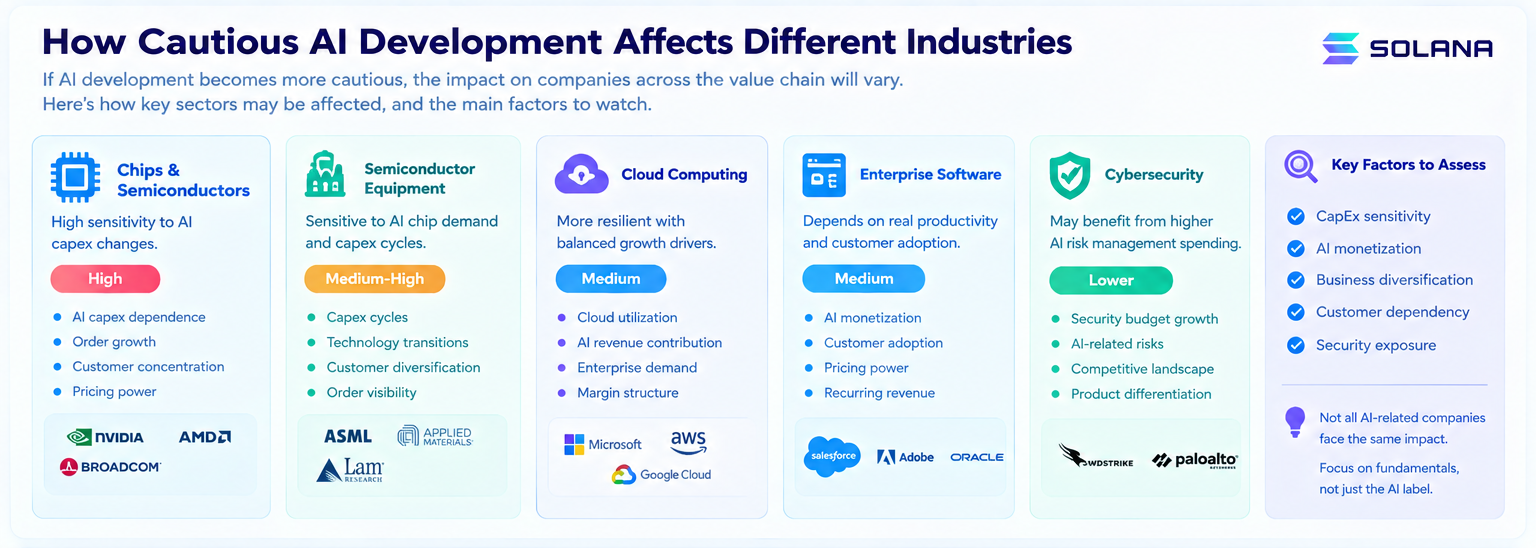
Taking all the above together: there are clear, structural sensitivity differences across the AI value chain.
-
Chipmaker profits are most tightly leveraged to AI CapEx cycles
-
Cloud platforms are exposed to both CapEx and real-world AI workload growth
-
Software providers depend on whether AI is delivering customer value
-
Security firms may see incremental tailwinds from AI risk management spend
So, a more prudent AI cycle does not mean “AI stocks fall together”—instead, it spells a reordering of internal valuations.
Investors once paid up for “future massive compute needs,” but moving forward, markets will increasingly demand answers to:
-
Is AI revenue genuine?
-
What’s the ROI on AI spend?
-
Is customer stickiness real?
-
Are security outlays keeping pace?
-
Can stronger models translate to fatter profits?
Market focus will naturally shift from “Who looks most like an AI company?” to “Who can best turn AI into cash flow?”
Using Four Metrics to Compare AI Stocks
In a world of more deliberate AI development, four key metrics stand out for comparing companies:
-
CapEx Sensitivity: How closely tied are a company’s revenues and orders to AI capital expenditure? Nvidia, AMD, and Broadcom are prime examples.
-
AI Monetization: Is AI already a source of real, recurring revenue—as opposed to just a product demo? Microsoft, Google, Salesforce, and Adobe are best judged this way.
-
Business Diversification: Can a company’s non-AI lines deliver stable cash flow if the AI cycle cools? Big cloud and integrated tech houses have the upper hand here.
-
Risk/Security Exposure: As AI risk increases, enterprise security budgets loom larger. For cybersecurity firms, this is a distinctive investment angle compared to chipmakers.
Is Slower AI Development Bearish or a Valuation Reset?
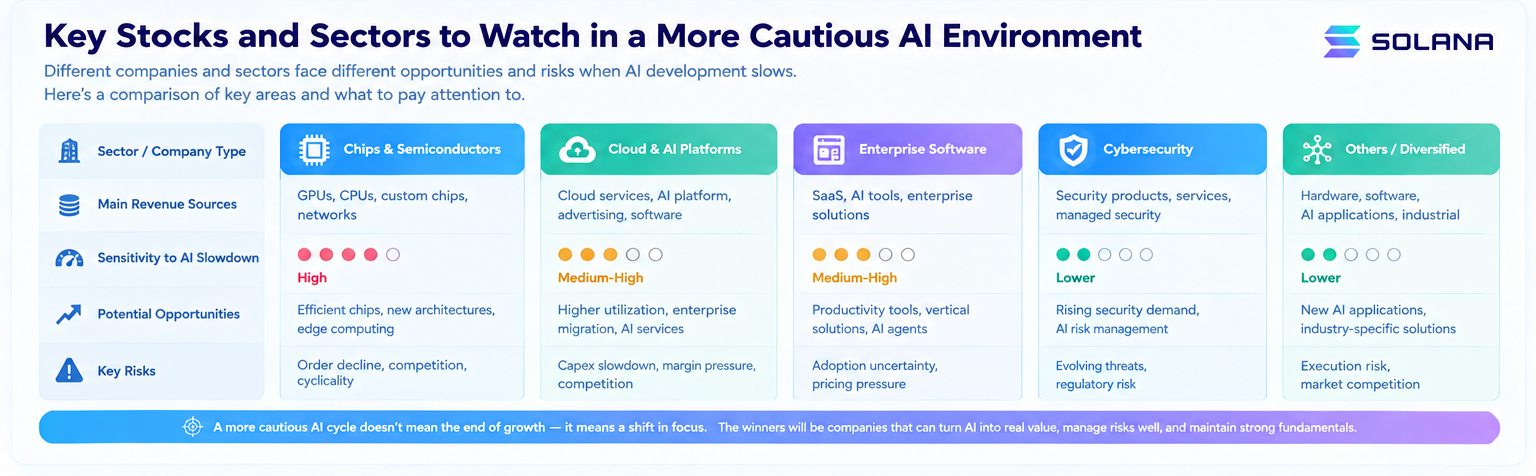
This is the article’s main conclusion. If the AI industry truly shifts from a high-speed arms race to prudent development, hardware and infrastructure companies’ valuations may react first. But if AI’s long-term trajectory remains upward—albeit with more focus on safety, efficiency, and ROI—the real outcome may be not “the end of the AI bull market,” but a structural reset in AI sector valuations.
Companies with high CapEx, lofty growth forecasts, and big customer concentration are most exposed to changes in AI budgets. Companies with broad enterprise bases, established cash flows, and diversified lines are better equipped to absorb shocks. Security vendors, governance software, and firms helping enterprises cut AI costs may surface as new centers of value.
In short: the future of AI stock research will look more and more like traditional fundamentals-driven analysis.
It’s no longer just “Does this company have AI?”
The critical questions become:
-
How much revenue does AI contribute?
-
What are the true costs of AI?
-
Are AI clients renewing?
-
What’s the profit margin on AI-driven business?
-
How much further must be spent on AI risk management?
As these issues become central, AI stock valuations will shift away from “long-term capability speculation” to “real, near-term commercial performance.”
FAQ
Does more cautious AI development automatically spell trouble for Nvidia?
Not necessarily. Nvidia’s business is highly sensitive to AI CapEx, so slower cluster expansions can mean short-term headwinds. But if demand merely shifts to inference, Agents, and more efficient computing, structural growth may hold even if the drivers look different over time.
Why might cloud providers weather a cautious AI cycle better than chipmakers?
Because companies like Microsoft, Alphabet, Amazon, and Oracle operate multiple business lines—so even if AI CapEx pauses, they can still generate revenue from inference, databases, enterprise software, and other cloud-based demand.
Why could cybersecurity firms benefit from more measured AI use?
Because prudent AI adoption usually means greater needs for identity management, access control, model oversight, data protection, and robust security operations. As AI risks grow, budgets aren’t always cut—they often migrate from “stronger models” to “safer deployment.”
What will matter most for AI stocks in the future?
Beyond surface-level “AI concept” labels, it comes down to AI revenue, CapEx returns, cloud adoption rates, customer retention, profit margins, and security costs. Ultimately, value comes from AI’s ability to deliver ongoing cash flow and investment returns.
Would an AI slowdown mean the end of the investment cycle?
More likely, we’ll see the structure of investment change rather than the cycle terminate. Efficiency gains in training, growth in inference workloads, broader Agent applications, and rising security outlays could all fuel AI investment moving from raw hashrate expansion to richer, more diversified infrastructure and applications.