AI crypto tools are software and infrastructure that combine artificial intelligence, blockchain data, and automation to support market research, on-chain analysis, asset management, or trade execution. Unlike traditional market data platforms, which primarily display prices, trading volume, and technical indicators, these tools seek to lower the barrier to understanding and using blockchain applications through natural-language interaction, data integration, and intelligent agent execution mechanisms.
As AI Agent technology develops, artificial intelligence applications in the crypto market are taking different directions. Some products use address labels, on-chain transaction records, and protocol metrics to help users research fund flows. Others organize fragmented information through AI search, social data, and market sentiment analysis. Another category seeks to connect AI Agents with wallets, smart contracts, and external services to enable more automated on-chain operations.
For ordinary users, what matters is not whether a platform uses AI as a concept, but what practical problems it can solve, whether its data sources can be verified, and what risks may arise during use. Nansen, Arkham, Dune, Kaito AI, Cookie.fun, Bankr, Giza, HeyAnon, ElizaOS, and Virtuals Protocol represent different technical approaches in this market.
Key Takeaways
-
AI crypto tools are moving from information queries toward task execution. On-chain data analysis, AI search, natural-language interaction, and automated trading are gradually forming distinct product categories.
-
Nansen, Arkham, and Dune represent three approaches to on-chain data research. They focus on wallet behavior, entity attribution, and custom data queries, respectively.
-
Kaito AI and Cookie.fun focus more on the information layer of the crypto market. Kaito AI emphasizes cross-source information retrieval and market narrative research, while Cookie.fun primarily focuses on the AI Agent ecosystem and social attention.
-
Bankr, Giza, and HeyAnon are exploring DeFAI applications. Through natural-language interaction, strategy automation, or protocol integration, they seek to reduce the complexity of some on-chain operations.
-
ElizaOS and Virtuals Protocol focus on AI Agent infrastructure and ecosystem development. They emphasize development frameworks and agent economic networks, respectively.
-
AI capabilities do not guarantee investment returns. Data reliability, wallet permissions, smart contract risks, and execution conditions remain key considerations when using these tools.
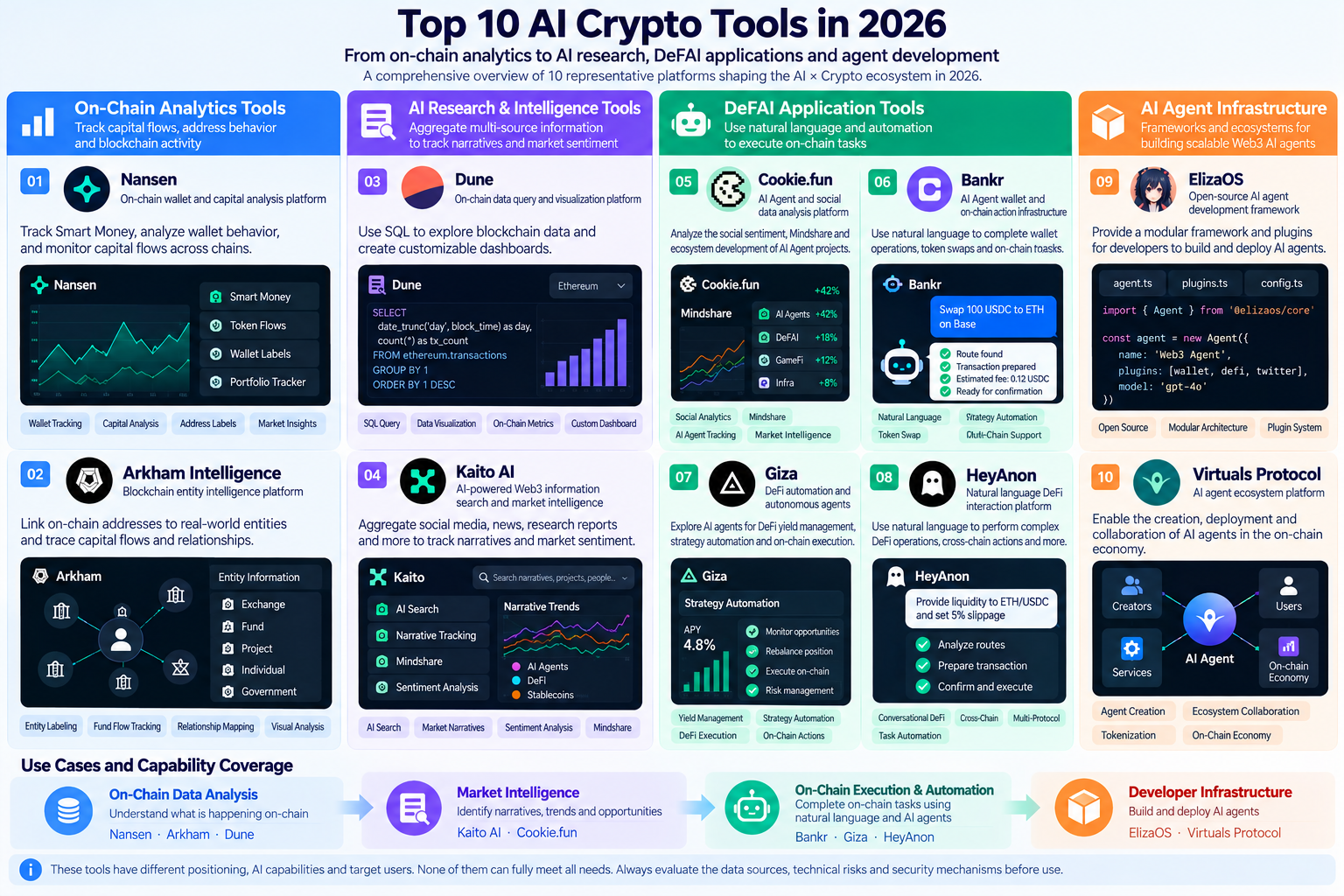
AI crypto tools are not a single, standardized product category. Some platforms primarily provide on-chain data queries, some use AI to analyze market information, and others are designed specifically for AI Agent development and automated execution.
The following overview categorizes these tools by product positioning and use case. It does not represent a ranking by token market capitalization, investment value, or platform security.
| Tool or Platform |
Core Positioning |
Main Use Cases |
Product Category |
| Nansen |
On-chain wallet and fund flow analysis |
Smart Money, fund flows, address research |
On-chain data analysis |
| Arkham Intelligence |
Blockchain entity intelligence |
Address attribution, entity relationships, fund tracking |
On-chain data analysis |
| Dune |
On-chain data queries and visualization |
SQL queries, protocol metrics, research dashboards |
Data research infrastructure |
| Kaito AI |
AI crypto information retrieval and market intelligence |
Narrative tracking, Mindshare, market research |
AI information analysis |
| Cookie.fun |
AI Agent and social data analysis |
Agent ecosystems, social momentum, market attention |
AI ecosystem data |
| Bankr |
AI Agent wallet and on-chain operations infrastructure |
Natural-language interaction, trading, Agent wallets |
AI Agent application |
| Giza |
DeFi automation and autonomous agents |
Strategy execution, yield management |
DeFAI |
| HeyAnon |
Natural-language DeFi interaction |
Asset swaps, cross-chain operations, protocol interactions |
DeFAI |
| ElizaOS |
Open-source AI Agent development framework |
Agent development, plugin integration, automated tasks |
Development infrastructure |
| Virtuals Protocol |
AI Agent ecosystem and economic infrastructure |
Agent creation, collaboration, and on-chain economics |
Agent ecosystem platform |
Note that Nansen, Arkham, and Dune are not entirely AI-native products. They are included because on-chain data capabilities form an important foundation for AI crypto research. The scope of available features, pricing methods, and supported networks may change with future versions.
What Is Nansen? How Can You Analyze On-Chain Funds Through Smart Money?
Nansen is an on-chain data analytics platform for the crypto market. It primarily helps users understand the flow of on-chain assets through wallet address labels, holdings information, and fund flow analysis.
Traditional blockchain explorers can display transaction records, address balances, and smart contract interactions, but users typically need to determine the relationships between different addresses themselves. By organizing wallet labels and historical transaction behavior, Nansen makes some complex data easier to use for market research.
Smart Money is one of Nansen's representative analytical concepts. The platform categorizes certain wallets according to specific criteria, helping users observe fund flows among these address groups. For example, when funds flow into a token, researchers can further examine the related wallets' historical transactions, changes in holdings, and asset transfer paths.
However, a Smart Money label does not mean that every transaction by a related address has predictive value. Wallet classifications may contain errors, and on-chain fund inflows may involve internal transfers, market making, or other business activities. Nansen is therefore more suitable for identifying research leads and observing market participant behavior than for generating definitive buy or sell signals.
Suitable for: On-chain researchers, active traders, and project analysts.
What Is Arkham Intelligence? How Can You Track Wallet Addresses and Fund Flows?
Arkham Intelligence is an analytics platform focused on blockchain entity intelligence and address attribution. It primarily helps users research the potential parties behind on-chain transactions through address labels, fund flow paths, and visualization tools.
Although blockchain transaction records are public, wallet addresses typically do not directly reveal their real-world controllers. If researchers only see a large asset transfer, they may find it difficult to determine whether it represents an exchange's internal fund movement, an institutional trade, or a transfer by an ordinary user. Arkham seeks to provide additional context for these transactions through entity labels and address relationship analysis. Users can examine the sources, destinations, and related transaction activity of funds involving exchange wallets, project treasuries, or other known addresses.
Unlike Nansen, which places greater emphasis on wallet behavior and fund research, Arkham is distinguished by entity identification and relationship investigations. This approach can provide a different analytical perspective for users researching large transfers, changes in exchange funds, or potentially anomalous transactions. However, address attribution is not always accurate. Transactions between multiple addresses do not necessarily mean that they belong to the same entity, and labeling an address as an institutional wallet does not mean that all of its transactions represent an institution's investment direction.
Suitable for: On-chain intelligence researchers, fund flow analysts, and blockchain security researchers.
What Is Dune? How Can AI Lower the Barrier to On-Chain Data Analysis?
Dune is a platform for blockchain data queries and visualization. It allows users to analyze on-chain transactions, smart contract events, and protocol activity through SQL, then organize the query results into data dashboards. Compared with analytics tools that primarily provide predefined metrics, Dune's advantage is that users can define their own research questions. For example, researchers can analyze the number of active addresses for a DeFi protocol, the volume of stablecoin transfers, changes in token holders, or trading activity across different networks.
This flexibility makes Dune an important tool for Web3 data research. For users who need to track project fundamentals over time or prepare research reports, custom queries can provide a more transparent data calculation process. AI-assisted tools can further lower the barrier to using SQL by helping researchers understand data table structures, develop query logic, or interpret query results. However, AI-generated queries are not necessarily accurate. Manual review is still required, particularly when queries involve contract events, cross-chain data, or token decimals. Dune's core value is not predicting token prices, but enabling on-chain research to be based on queryable and verifiable data.
Suitable for: Web3 data analysts, researchers, developers, and project operations teams.
Kaito AI is an information retrieval and research platform for the Web3 market. It uses artificial intelligence to integrate information from sources including social media, governance forums, research reports, industry news, podcasts, and conference content, helping users improve the efficiency of crypto market research. Information in the crypto market is highly fragmented. An important change in a project may first appear on a developer forum, then be discussed by research institutions, and only later appear in news reports and market trading data. Although traditional search tools can find some public information, they often cannot directly present the relationships between different information sources.
Through search and data analysis capabilities designed specifically for Web3, Kaito AI helps researchers organize this information more efficiently. Its Kaito Pro product offers features including MetaSearch, market sentiment tracking, Mindshare analysis, smart alerts, and an event calendar.
For example, when areas such as AI Agents, RWA, or stablecoin payments receive increased attention, researchers can use Kaito to analyze changes in related discussions, observe the relative attention received by different projects, and search for important events affecting market sentiment. Mindshare is primarily used to measure the relative level of attention received by a project or narrative within a specific information environment. It can help researchers observe changes in market attention, but it does not directly reflect protocol revenue, actual user growth, or a token's intrinsic value.
Note that Kaito stopped its previous Yaps incentivized posting and related leaderboard model in January 2026. Therefore, when researching Kaito AI in 2026, users should focus on Kaito Pro's information retrieval and market intelligence capabilities rather than treating the discontinued Yaps mechanism as a current core feature.
Suitable for: Crypto researchers, market analysts, content researchers, and Web3 project operations teams.
What Is Cookie.fun? How Can You Analyze Social Momentum in the AI Agent Ecosystem?
Cookie.fun is a crypto data platform launched by Cookie DAO. It focuses on the AI Agent ecosystem, social discussions, and market attention toward projects.
Unlike Kaito AI, which emphasizes cross-source information retrieval, Cookie.fun focuses more on building comparable ecosystem data around AI Agent projects. Users can observe the social performance, market attention, and ecosystem development of different agent projects through relevant metrics. The AI Agent sector has strong social distribution characteristics. Some projects may quickly attract market attention after launching new products, releasing technical updates, or generating community discussion. However, this attention does not necessarily directly reflect actual product usage.
The Mindshare and related social metrics provided by Cookie.fun can serve as supplementary information for observing changes in market narratives. For example, users can compare changes in the attention received by different Agent projects and further investigate whether those changes are related to product launches, user activity, or on-chain transactions. However, social data can be affected by marketing campaigns, bot accounts, and short-term sentiment. Researchers should not assess project quality solely based on social rankings, and should not equate increasing Mindshare with a token's potential to rise.
Suitable for: AI Agent sector researchers, community analysts, and Web3 content operations teams.
Bankr is crypto wallet, trading, and automation infrastructure for AI Agents. It supports the integration of on-chain capabilities through APIs, SDKs, and related tools.
Traditional crypto trading requires users to connect a wallet, select a network, confirm transaction parameters, and complete a signature. Bankr explores an approach that allows developers or users to organize these operations through more natural interactions and enables AI Agents to call related wallet and trading tools. For example, a user or agent can request an asset balance query, prepare a token swap, or execute a specific on-chain task, after which the system calls the relevant services to process the request. Bankr's infrastructure also supports developers in configuring wallets for Agents, integrating trading functions, and managing related execution processes.
Bankr's applications are no longer limited to conversational trading. Its development tools also cover Agent wallets, token issuance, tool plugins, and payment for computing services, reflecting the trend of AI Agents expanding from single-purpose trading assistants into infrastructure for autonomous economic activity.
However, natural-language interaction does not eliminate trading risks. An AI Agent may misunderstand a user instruction or make errors involving asset names, network selection, or transaction parameters. For operations involving real funds, users must still check the transaction target, contract address, amount, slippage, and approval permissions. Developers should also limit the scope of an Agent's access to funds and avoid directly giving a primary private key to an untrusted model or external service.
Suitable for: AI Agent developers, on-chain automation users, and Web3 application teams.
What Is Giza? How Can AI Agents Participate in Automated DeFi Yield Management?
Giza is a project exploring the combination of artificial intelligence and blockchain automation. Its related technical areas include autonomous agents, strategy execution, and DeFi fund management. In traditional DeFi scenarios, users need to continuously monitor lending rates, liquidity changes, and protocol yields before deciding whether to adjust their fund allocations. For users who need to monitor multiple protocols frequently, these operations can require significant time.
DeFAI, the combination of DeFi and AI, seeks to reduce the complexity of these repetitive operations through intelligent agents. Based on predefined objectives and execution conditions, an Agent can monitor market information, assess strategy status, and execute certain on-chain tasks after receiving appropriate authorization. In stablecoin yield management, for example, an automated system can assess whether a position needs to be adjusted based on protocol yields, capital utilization, and predefined risk conditions. However, an actual strategy cannot compare nominal annualized yields alone. It must also consider smart contract risks, liquidity, transaction fees, and asset depegging risks. The direction represented by Giza is to move AI beyond research assistance and further into the on-chain execution process. However, whether an automated strategy can create long-term value depends on its execution reliability and risk controls across different market conditions, not merely on its ability to complete transactions.
Suitable for: Advanced DeFi users, automated strategy researchers, and AI financial application developers.
What Is HeyAnon? How Can Natural Language Simplify Complex DeFi Operations?
HeyAnon is an AI interaction protocol for DeFi. It seeks to combine natural-language processing, market information integration, and on-chain operations so that users can complete some complex DeFi tasks through conversation. The difficulty of using DeFi applications lies not only in understanding financial mechanisms, but also in the differences between the operations of various protocols. For example, a user may need to swap assets first, then transfer them across chains, and subsequently provide collateral to a lending protocol. Each step involves different contracts, transaction parameters, and risks.
HeyAnon's design objective is to convert these operations into more easily understood task flows. Its public documentation covers DeFi operations including asset swaps, cross-chain transfers, staking, and lending. It also integrates protocol data, market information, and social sources to help users obtain relevant context before executing tasks. While Bankr places greater emphasis on Agent wallets and developer infrastructure, HeyAnon's positioning is closer to conversational DeFi operations and information aggregation.
However, multi-step on-chain operations also mean that risks may compound. For example, cross-chain delays, price changes, or the failure of one transaction may affect the outcome of subsequent tasks. When using conversational DeFi tools, users should pay particular attention to whether transactions require step-by-step confirmation, whether permissions can be revoked, and what state assets will be left in if execution fails.
Suitable for: DeFi users, on-chain automation researchers, and natural-language interaction application developers.
What Is ElizaOS? How Can You Build Your Own Web3 AI Agent?
ElizaOS is an open-source development framework for building AI Agents. It enables developers to create agents with specific functions through model integration, plugin systems, and connections to external tools.
Unlike platforms such as Nansen and Kaito AI, which primarily serve research users, ElizaOS is closer to development infrastructure. Developers can use the framework to build market research assistants, community bots, automated workflows, or Agents that can call blockchain services.
A complete Web3 AI Agent typically consists of multiple components, including a language model, data interfaces, a task management system, wallet tools, and external services. ElizaOS helps developers organize these components through a modular design and expand functionality according to different application requirements. For example, developers can build a research Agent that monitors DeFi protocol data, queries data regularly, organizes changes, and generates reports. If the Agent is further connected to wallet and trading tools, developers can explore automated execution under restricted conditions. However, the framework itself does not guarantee an Agent's security. When on-chain assets are involved, developers must independently design identity verification, transaction approval, wallet permissions, and exception-handling mechanisms.
Suitable for: AI developers, Web3 technical teams, and projects seeking to build custom Agents.
Virtuals Protocol is a crypto protocol focused on the creation, deployment, and ecosystem collaboration of AI Agents. It explores how agents can participate in on-chain economic activity and how developers and users can build service relationships around Agents. Traditional AI applications are typically managed centrally by platforms, with users primarily paying for services through subscriptions or APIs. Virtuals Protocol explores an approach that gives AI Agents clearer on-chain economic relationships and supports collaboration between agents through related infrastructure.
Under this model, an AI Agent is no longer merely a chatbot. It may also perform specialized tasks such as information research, content generation, or data processing. Different agents can establish collaborative relationships through service calls and payment mechanisms, forming a more complex application ecosystem. However, an AI Agent's technical value must be analyzed separately from the market performance of its related token. An Agent having a token or receiving significant social attention does not mean that it already has stable revenue or genuine commercial demand.
When evaluating Virtuals Protocol and similar ecosystems, users should focus on the Agents that are actually operating, developer activity, verifiable service usage, and sources of revenue, rather than assessing ecosystem development solely based on the number of tokens issued or short-term trading activity.
Suitable for: AI Agent ecosystem researchers, Web3 developers, and crypto project analysts.
By use case, these 10 platforms can be divided into four main areas: on-chain data analysis, AI information research, DeFAI automation applications, and AI Agent infrastructure.
| User Need |
Tools to Research First |
Main Considerations |
| Analyze Smart Money and fund flows |
Nansen |
Wallet labels, fund behavior, changes in holdings |
| Investigate address ownership and fund relationships |
Arkham |
Entity attribution, transaction paths, address associations |
| Build on-chain research data dashboards |
Dune |
SQL queries, protocol metrics, data visualization |
| Track market trends and narrative changes |
Kaito AI |
AI search, Mindshare, information retrieval |
| Observe attention toward the AI Agent ecosystem |
Cookie.fun |
Social momentum, Agent data, market attention |
| Use natural language to execute on-chain tasks |
Bankr |
Agent wallets, trading tools, automated operations |
| Explore automated DeFi yield strategies |
Giza |
Strategy execution, fund management, risk conditions |
| Simplify complex DeFi interactions |
HeyAnon |
Natural-language operations, cross-protocol tasks |
| Develop custom AI Agents |
ElizaOS |
Open-source framework, plugins, tool integration |
| Research the AI Agent economic ecosystem |
Virtuals Protocol |
Agent creation, service collaboration, on-chain economics |
For ordinary users, it is advisable to begin with data analysis tools that do not require wallet permissions. After becoming familiar with the basic structure of on-chain addresses, protocol metrics, and market information, users can gradually explore automated trading functions. For researchers, a more effective approach is often to combine multiple platforms. For example, users can first identify changes in market attention toward a sector through Kaito AI, then use Cookie.fun to observe the social performance of related AI Agent projects, and subsequently use Nansen, Arkham, or Dune to examine fund flows and actual on-chain activity.
This research process can connect market narratives, social attention, and on-chain behavior, reducing the risk of judgmental bias caused by relying on a single data metric. Developers also need to distinguish between research Agents and execution Agents. The former primarily read data and generate analytical results, while the latter may involve asset permissions and smart contract calls and therefore require more stringent security controls.
AI crypto tools can improve research and operational efficiency, but their risks are mainly concentrated in four areas: data accuracy, model reliability, wallet permissions, and smart contract security.
-
Although on-chain data is public, that does not mean all data can be interpreted accurately. Address labels, entity attribution, and fund usage may be uncertain. If an AI generates an analysis based on incorrect data, it may further amplify judgmental bias.
-
AI models may generate inaccurate or outdated information. For example, a model may misunderstand a protocol's yield mechanism, confuse tokens on different networks, or incorrectly interpret changes in social attention as fund inflows. Data involving project revenue, token supply, and on-chain transactions should therefore be verified against original sources whenever possible.
-
Automated execution increases wallet authorization risks. When an AI Agent can initiate transactions, incorrect instructions, malicious inputs, or excessive approval amounts may result in the loss of real assets. Users should prioritize products with transaction confirmation, permission limits, and approval revocation mechanisms.
-
The tools themselves may also carry technical risks, including smart contract vulnerabilities, third-party API failures, data service interruptions, and dependence on model services.
For products still in the testing phase, users should not assess reliability solely based on AI feature demonstrations or community attention. Operations involving real funds should be managed separately from experimental research environments.
The development of AI crypto tools is showing three notable directions.
The first is a shift from data presentation to intelligent research. In the past, users needed to query market data, wallet addresses, and project announcements separately before organizing their own research conclusions. As AI search and information analysis capabilities develop, platforms such as Kaito AI are attempting to integrate fragmented information into more direct research results.
The second is a shift from natural-language interaction to automated execution. Applications represented by Bankr, Giza, and HeyAnon are no longer limited to answering questions. They seek to connect wallets, DeFi protocols, and external tools so that certain on-chain operations can be executed based on user intent or predefined strategies.
The third is a shift from individual agents to multi-Agent collaboration. Infrastructure such as ElizaOS and Virtuals Protocol explores agent development, tool connections, and economic collaboration. As programmable payments, on-chain identity, and account abstraction develop, future AI Agents may independently call services and complete settlements under more clearly defined authorization conditions.
However, whether these trends can create long-term commercial value still depends on genuine user demand. The ability to generate research reports, initiate transactions, or issue related tokens does not necessarily mean that a product has sustainable revenue. Data quality, execution reliability, usage costs, and user retention will become important indicators of the long-term competitiveness of AI crypto tools.
Conclusion
In 2026, AI crypto tools cover multiple areas, including on-chain data analysis, market intelligence, social research, DeFi automation, and agent development.
Nansen, Arkham, and Dune provide different approaches to on-chain data research. Kaito AI and Cookie.fun help users observe market narratives, information distribution, and attention toward the AI Agent ecosystem. Bankr, Giza, and HeyAnon explore natural-language interaction and automated on-chain execution. ElizaOS and Virtuals Protocol further expand the development and ecosystem collaboration capabilities of AI Agents.
For ordinary users, the first step when choosing a tool should be to clarify the objective: analyzing fund flows, researching market trends, or automatically executing a specific task. Different products have significant differences in functionality, technical requirements, and security risks.
As AI and blockchain infrastructure continue to converge, competition between tools may gradually shift from the number of features to data reliability, execution security, and genuine utility. Products that can effectively combine information research, task decisions, and controlled execution may be more likely to generate sustained demand.
FAQ
AI crypto tools are software and infrastructure that combine artificial intelligence with blockchain data, crypto market research, or on-chain operations. They are primarily used to improve the efficiency of information analysis, asset research, and automated execution.
Representative platforms include Nansen, Arkham, Dune, Kaito AI, Cookie.fun, Bankr, Giza, HeyAnon, ElizaOS, and Virtuals Protocol. They cover different research, trading, and development use cases.
What Is Kaito AI?
Kaito AI is an AI information retrieval and market intelligence platform for Web3. It provides features including cross-source search, market sentiment analysis, Mindshare tracking, and smart alerts.
What Is the Difference Between Kaito AI and Cookie.fun?
Kaito AI focuses more on cross-source information retrieval, market narratives, and sentiment research. Cookie.fun focuses more on the AI Agent ecosystem, project social data, and market attention. The two platforms can be used for different levels of information analysis.
What Is the Difference Between Nansen and Arkham?
Nansen places greater emphasis on wallet behavior, Smart Money, and on-chain fund analysis. Arkham focuses more on entity attribution, address associations, and fund flow investigations.
Dune's core positioning is as a blockchain data query and visualization platform, not a dedicated AI Agent product. It can provide a structured on-chain data foundation for AI-assisted research.
Can AI Agents Automatically Complete Crypto Transactions?
Some AI Agent applications support transaction preparation, wallet operations, or automated strategy execution. Their specific capabilities depend on the product's features, supported networks, and user permissions. Automated execution does not guarantee profitability.
What Is DeFAI?
DeFAI refers to the combination of DeFi and AI. It generally means using artificial intelligence and automation to support information analysis, strategy management, and on-chain operations in decentralized finance.
Data research tools typically do not require users to provide private keys. Applications involving on-chain execution may require a wallet connection or authorization, but users should not provide a primary private key directly to an untrusted AI Agent.
You can choose based on your research objectives, technical capabilities, data needs, and risk tolerance. Beginners are advised to start by learning about data analysis tools. Users who need automated trading should carefully review wallet permissions, transaction verification, and security mechanisms.