As the Ethereum scaling ecosystem continues to develop, the number of Layer 2 networks has grown rapidly. Although Rollup technology has improved transaction efficiency, it has also introduced new challenges: assets are spread across different chains, users need to bridge frequently, and application liquidity is split into separate markets. How to enable collaboration between chains while preserving scalability has gradually become an important focus for the industry.
Superchain and Polygon AggLayer are two multi-chain solutions that emerged in this context. As important strategic directions for the Optimism and Polygon ecosystems, both aim to solve interoperability challenges in the multi-chain era. However, they differ significantly in technical architecture, design philosophy, and ecosystem goals, making them two of the most closely watched approaches in blockchain infrastructure today.
What Is Superchain?
Superchain is a multi-chain collaboration architecture proposed by Optimism. It is designed to connect multiple Layer 2 networks through unified technical standards.
The core foundation of Superchain is OP Stack. Any network built with OP Stack can become part of the Superchain and share upgrade mechanisms, developer tools, and infrastructure standards.
Conceptually, Superchain is not a standalone blockchain. It is an ecosystem made up of multiple Layer 2 networks built on the same underlying framework.
Base, World Chain, Ink, and OP Mainnet are all important members of the Superchain ecosystem.
What Is Polygon AggLayer?
Polygon AggLayer is a cross chain aggregation layer launched by Polygon. It is designed to connect different blockchain networks and create a unified liquidity experience.
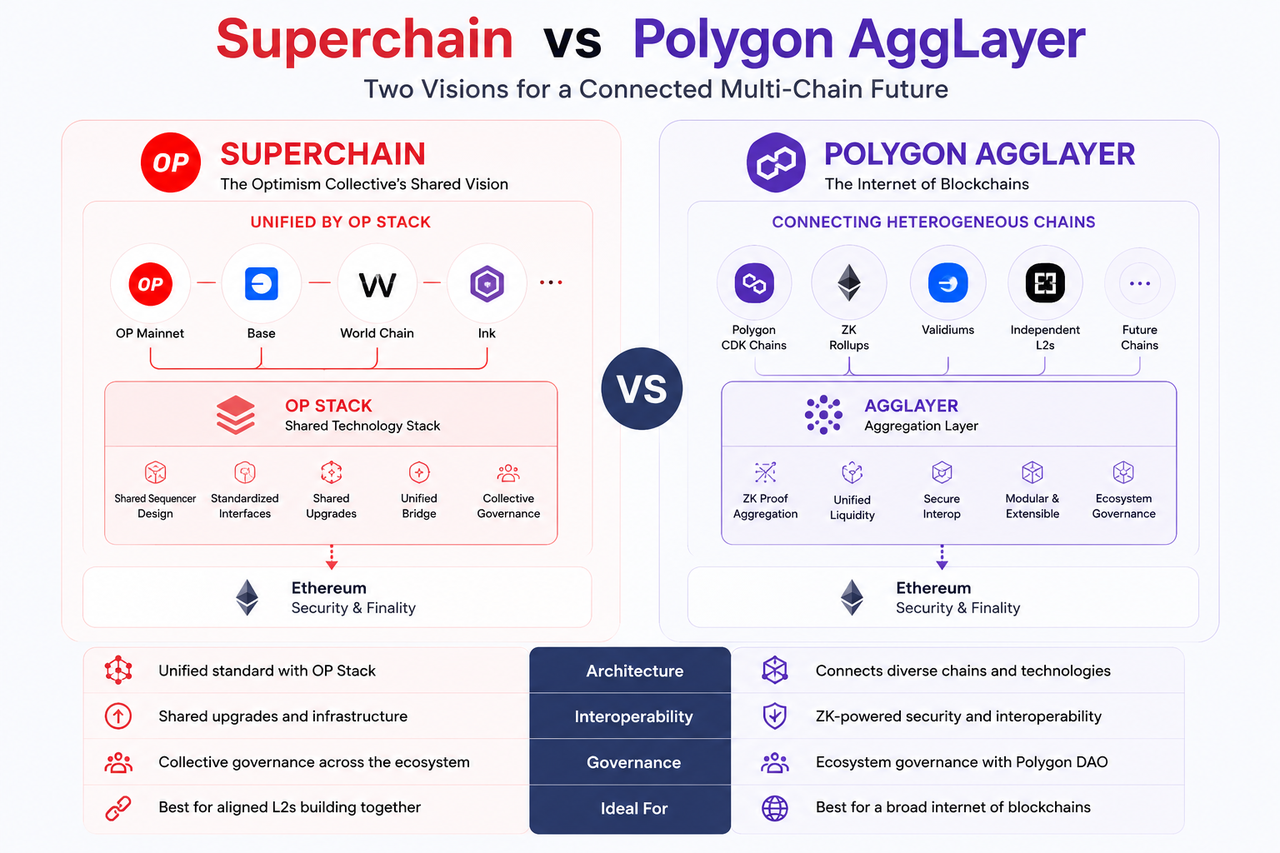
Unlike systems that serve only a specific technical framework, AggLayer aims to connect many types of blockchains, including:
Through aggregated zero knowledge proofs and a unified state verification mechanism, AggLayer enables different networks to share security and interact across chains.
Its goal is to make users feel as though they are using one unified network rather than several isolated blockchains.
How Do Superchain and AggLayer Differ in Design Philosophy?
The most fundamental difference between the two comes from how they understand the future of multi-chain systems.
Superchain takes the view that the best way to enable multi-chain collaboration is to establish unified standards.
If all networks adopt OP Stack, cross chain communication, upgrades, and developer tools can remain highly consistent, reducing overall complexity.
AggLayer, by contrast, starts from the assumption that the multi-chain ecosystem already exists and that not all networks will adopt the same architecture in the future.
Its goal is therefore to connect different types of chains so heterogeneous networks can operate together without having to standardize their underlying technology.
In simple terms:
This is the core strategic difference between the two.
How Do Superchain and AggLayer Differ in Technical Architecture?
At the technical implementation level, the two follow completely different architectural paths.
Superchain Architecture
Superchain is based on OP Stack.
All member chains use a unified framework, including:
This model helps improve compatibility and development efficiency.
AggLayer Architecture
AggLayer is based on aggregated proofs and a unified settlement mechanism.
Different networks do not need to use the same execution environment. They only need to be able to generate verifiable proofs in order to connect to AggLayer.
This model allows more types of chains to participate in ecosystem collaboration.
As a result, AggLayer generally has a broader compatibility scope than Superchain.
How Do Superchain and AggLayer Differ in Multi-Chain Interoperability?
multi-chain interoperability is one of the most important use cases for both approaches.
Superchain enables collaboration between chains through unified standards.
Because all networks share the same technical framework, cross chain interactions are relatively straightforward.
Developers can use unified interfaces to transfer assets and deploy applications.
AggLayer, on the other hand, attempts to solve interoperability between heterogeneous chains.
Even when the underlying technologies are completely different, AggLayer aims to enable seamless interaction through proof aggregation and state synchronization.
In theory:
How Do Superchain and AggLayer Differ in Security Models?
Security is a key foundation for multi-chain architecture.
Superchain’s Security Source
Superchain member chains usually rely on Ethereum for final settlement and security.
Because the chains share OP Stack standards, the ecosystem can maintain overall security through unified upgrade mechanisms.
AggLayer’s Security Source
AggLayer relies more heavily on zero knowledge proof systems.
Network state changes are verified through cryptographic proofs, reducing reliance on intermediary bridge mechanisms.
This design aims to reduce cross chain bridge attack risks and improve verification efficiency.
Both models use Ethereum as an important security foundation, but they follow different implementation paths.
How Do Superchain and AggLayer Differ in Developer Ecosystems?
Superchain and AggLayer attract developers in different ways.
Superchain’s Advantages
For teams already familiar with OP Stack, development and deployment costs are relatively low.
Unified standards make the toolchain more mature.
Ecosystem projects can also share infrastructure more easily.
AggLayer’s Advantages
AggLayer offers greater flexibility.
Development teams can join the ecosystem without abandoning their existing technical architecture.
For existing independent chains or ZK Rollup projects, migration costs are lower.
As a result, the two approaches appeal to somewhat different developer groups.
Key Differences Between Superchain and AggLayer
| Comparison Dimension |
Superchain |
Polygon AggLayer |
| Initiator |
Optimism |
Polygon |
| Core Goal |
Unified standards |
Connecting heterogeneous chains |
| Technical Foundation |
OP Stack |
Aggregated proofs |
| Network Type |
Homogeneous chain ecosystem |
Heterogeneous chain ecosystem |
| Interoperability Method |
Standardized collaboration |
Proof aggregation |
| Security Model |
Rollup settlement |
ZK verification |
| Developer Barrier |
Relatively low |
More flexible |
| Representative Networks |
Base, World Chain |
Polygon CDK ecosystem |
Which Approach Better Fits the Future?
The industry has not yet reached a single answer.
Superchain’s strengths lie in unified standards and development efficiency.
If many networks adopt OP Stack, the entire ecosystem will gain stronger consistency and coordination.
AggLayer’s strengths lie in openness and compatibility.
As the blockchain ecosystem continues to expand, different technical approaches are likely to coexist, so demand for heterogeneous chain connectivity will also continue to grow.
The future multi-chain ecosystem may include both standardized alliances and cross ecosystem connection layers. The two models are not necessarily mutually exclusive.
Conclusion
Superchain and Polygon AggLayer both aim to solve liquidity fragmentation and interoperability challenges in the multi-chain era, but they take different development paths. Superchain uses OP Stack to establish unified technical standards and aims to form a coordinated Layer 2 alliance. AggLayer uses aggregated proofs to connect different types of blockchain networks and promote seamless collaboration between heterogeneous chains.
At their core, Superchain focuses more on standardized expansion, while AggLayer focuses more on open interconnection. Together, they represent two important directions for the blockchain industry’s exploration of the multi-chain era.
FAQs
Is Polygon AggLayer a Cross-Chain Bridge?
No. Polygon AggLayer is not a traditional cross chain bridge. It is an aggregation layer architecture that enables collaboration between different chains through unified verification and proof mechanisms.
Do Superchain and AggLayer Both Depend on Ethereum?
Yes. Both are closely connected to the Ethereum ecosystem and use Ethereum’s security and settlement capabilities as an important foundation.
What Is the Relationship Between Superchain and OP Stack?
OP Stack is the underlying technical framework for building the Superchain. All Superchain member chains are developed and operated based on OP Stack.
Can AggLayer Only Connect Polygon Networks?
No. AggLayer’s long term goal is to connect different types of blockchain networks, not only projects within the Polygon ecosystem.