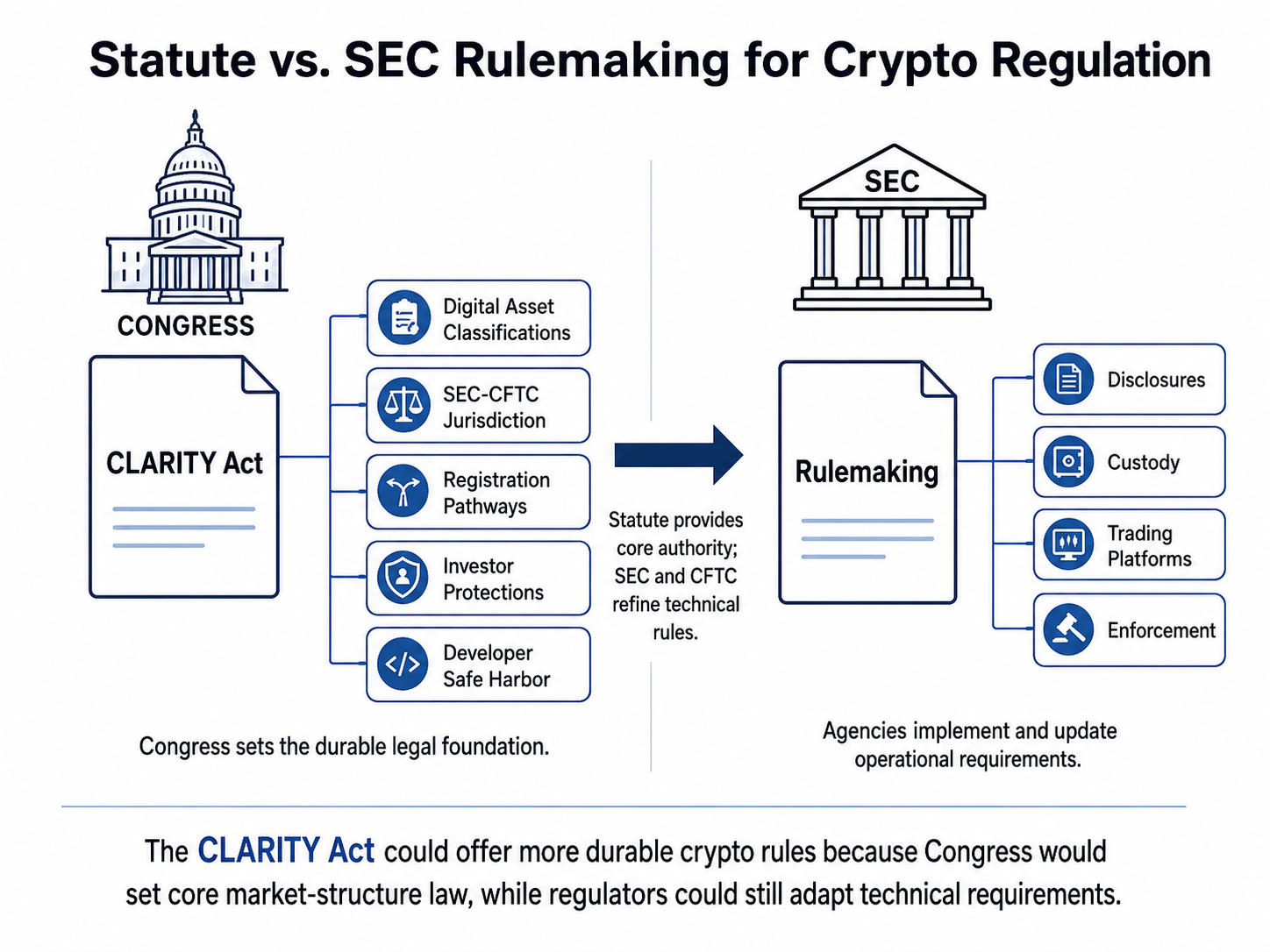
Durable U.S. crypto regulation is not merely an advance in SEC rulemaking. The Digital Asset Market Clarity Act seeks to replace the piecemeal regulation of digital assets by placing token classifications, SEC-CFTC jurisdiction, registration pathways, investor protections, anti-money laundering obligations, and protections for developers who do not control customer funds into federal statute. Its evolving Senate framework merges work from the Banking and Agriculture Committees, although the final market structure legislation may still change. Looking ahead, regulators could revise technical requirements, but altering the underlying statutory framework would require congressional action. Canada’s Clarity Act, under which the federal government judges whether a referendum question and majority are sufficiently clear, is unrelated to U.S. crypto regulation. Internal Revenue Code Sections 864(b)(2)(B) and 475 address separate tax issues involving trading safe harbors and actively traded commodities, while the number of cryptocurrencies with CFTC-regulated futures contracts remains a changing market fact rather than a provision of the CLARITY Act.
TL;DR
-
The Digital Asset Market Clarity Act seeks to replace piecemeal crypto regulation with a federal digital asset market framework.
-
The bill divides oversight between the Securities and Exchange Commission and Commodity Futures Trading Commission.
-
Digital assets meeting specified blockchain and decentralization conditions could be regulated as digital commodities.
-
SEC and CFTC rulemaking would implement the statute, but regulators could not lawfully override its core jurisdictional boundaries.
-
Durable rules could reduce uncertainty for investors, token issuers, developers, trading platforms, advisers, and other crypto industry participants.
Why Is a Statute More Durable Than SEC Rulemaking?
A federal statute is generally more durable because Congress establishes the underlying legal authority, definitions, and regulatory boundaries. Altering those provisions normally requires another bill to pass the House and Senate and receive presidential approval.
An SEC rule operates under authority that Congress has already granted. The Securities and Exchange Commission can use notice-and-comment rulemaking to create disclosure, custody, registration, trading, and investor-protection requirements. A future commission can nevertheless amend or repeal those rules through another administrative process.
Formal SEC regulations are more stable than agency speeches, staff guidance, informal interpretations, or enforcement positions. They are still more sensitive to a shift in commission leadership than provisions written directly into federal law.
| Regulatory mechanism |
Primary function |
Main route for change |
Relative durability |
| Federal statute |
Establishes agency jurisdiction, definitions, rights, and duties |
New legislation or judicial invalidation |
Highest |
| SEC or CFTC rule |
Implements statutory requirements |
New rulemaking or court review |
Strong but policy-sensitive |
| Agency interpretation |
Explains how existing law applies |
Revised interpretation or judicial rejection |
Moderate |
| Staff guidance |
Communicates regulatory expectations |
Withdrawal or replacement |
Limited |
| Enforcement action |
Applies a legal theory to particular circumstances |
Settlement, litigation, appeal, or policy shift |
Case-specific |
The significance of the CLARITY Act crypto market structure is therefore not that it would prevent every future regulatory change. Its importance lies in transferring foundational digital asset policy from agency interpretation into statute.
What Is the Digital Asset Market Clarity Act?
The Digital Asset Market Clarity Act is proposed U.S. market structure legislation designed to establish clear rules for digital assets, including token classification, trading-platform registration, disclosures, customer-asset protections, and the respective authority of the SEC and CFTC.
H.R. 3633 was introduced in the House of Representatives on May 29, 2025. The House passed the bill on July 17, 2025, by a vote of 294 to 134. The legislative process then shifted to the Senate, where the Senate Banking and Agriculture Committees have jurisdiction over different parts of the proposed framework.
The CLARITY Act addresses a central problem in the U.S. crypto industry: existing securities and commodities statutes were not written for blockchain networks that combine capital raising, token distribution, decentralized infrastructure, governance, and continuous secondary-market trading.
A token may initially be offered through an investment contract but later function as an asset used for network fees, staking, governance, payments, or access to digital services. The law therefore needs to distinguish the circumstances of an offering from the continuing regulatory status of the asset.
How Is the CLARITY Act Moving Through Congress?
The House passed the Digital Asset Market Clarity Act in July 2025 before the legislative process moved to the Senate Banking and Agriculture Committees. Their work covers different areas, including securities regulation, digital commodities, investor protections, and CFTC jurisdiction.
Any Senate version must be reconciled with the House bill before Congress can send identical text to the White House. Committee markup, requests for industry feedback, and negotiations involving Republicans and Democrats could still change the bill’s definitions, exemptions, and enforcement scope.
The process matters because the final date and wording of approval will determine whether the CLARITY Act creates durable rules or leaves important decisions to regulators.
How Would the CLARITY Act Divide SEC and CFTC Jurisdiction?
The CLARITY Act would divide jurisdiction according to the asset and activity involved. The SEC would continue to oversee digital asset securities and investment-contract transactions, while the CFTC would receive primary authority over qualifying digital commodity spot markets.
The SEC regulates securities offerings, exchanges, broker-dealers, investment advisers, and capital formation. The CFTC regulates commodity derivatives and has enforcement authority over fraud and manipulation in certain commodity spot-market circumstances.
The CLARITY Act’s SEC and CFTC jurisdictional boundaries are intended to replace overlapping interpretations with a clearer statutory path.
Under the House framework, the CFTC would regulate registered digital commodity exchanges, brokers, and dealers. The bill also provides for joint and separate rulemaking by the SEC and CFTC, including provisional registration and coordination over digital asset markets.
CFTC exclusive jurisdiction would not necessarily apply to every token or transaction. Digital asset securities, tokenized securities, and investment contracts could remain subject to SEC oversight. The distinction would depend on the statutory classification test and the facts surrounding the asset, issuer, network, and transaction.
How Would Digital Assets Become Digital Commodities?
The CLARITY Act would allow certain digital assets to fall within the digital commodity class when they satisfy statutory conditions concerning blockchain operation, issuer control, and network maturity.
This structure recognizes that the legal character of an initial token offering may differ from the status of the asset after the network develops. An asset initially distributed through a securities transaction would not necessarily remain subject to the same regulatory treatment forever.
The proposed framework evaluates factors such as:
-
Whether a single person or affiliated group controls the blockchain system
-
Whether the issuer can unilaterally alter the network
-
Whether ownership and governance are sufficiently distributed
-
Whether the network operates for a functional purpose
-
Whether required representations and disclosures are publicly available
-
Whether the asset remains connected to an investment contract
The treatment of digital commodities, stablecoins, and DeFi boundaries under the CLARITY Act is important because statutory classifications could determine which regulator has authority over secondary trading.
The bill does not simply declare every cryptocurrency other than Bitcoin a commodity. Digital asset status would depend on the applicable legal test, network circumstances, and how the asset is offered or traded.
How Could the Mature Blockchain Test Change Token Oversight?
The Mature Blockchain Test could allow some tokens to move from securities-related oversight toward treatment as digital commodities when control over the network becomes sufficiently distributed.
Regulators could consider whether an issuer still controls upgrades, governance, validation, token supply, or other critical infrastructure. Public disclosures and representations would also affect the assessment.
The test would not automatically convert every token into a commodity. The outcome would depend on the network’s development, the issuer’s continuing control, and whether the asset remains connected to an investment contract.
Why Could SEC Rules Change Across Administrations?
SEC rules can change because commissioners exercise authority delegated by Congress and may adopt different positions on capital formation, investor protections, enforcement, and crypto market infrastructure.
One commission may support narrow exemptions and extensive registration requirements. Another may create safe harbors, simplified disclosures, or new pathways for blockchain-based markets. Leadership changes can also affect enforcement priorities, approval processes, settlement policy, and the interpretation of securities laws.
The SEC has already used interpretations and policy initiatives to clarify how federal securities laws apply to digital commodities, stablecoins, airdrops, protocol mining, staking, wrapped assets, and investment contracts. In March 2026, the commission issued a crypto asset interpretation covering several of these areas.
SEC Chair Paul Atkins has also described a regulatory framework that would draw heavily from congressional work on the CLARITY Act, while supporting bipartisan legislation as the more durable foundation for digital asset markets.
Agency action can provide useful clarity before Congress completes the legislative process. It cannot permanently determine the CFTC’s jurisdiction or override future statutory language.
Would the CLARITY Act Remove Regulatory Discretion?
The CLARITY Act would constrain regulatory discretion without eliminating it.
Congress would establish the scope of SEC and CFTC authority, while the regulators would convert those instructions into operational requirements. The agencies could still make rules concerning:
-
Registration applications and approval procedures
-
Issuer and platform disclosures
-
Customer-asset custody and segregation
-
Trading records and market surveillance
-
Capital and reporting requirements
-
Conflicts of interest
-
Broker, dealer, and adviser conduct
-
Anti-fraud enforcement
-
Transitional relief and exemptions
The legal sequence would remain straightforward: Congress creates the statutory framework, regulators implement it, and courts determine whether agency rules remain within the authority granted by the bill.
Future regulators could change technical rules. They could not lawfully disregard explicit statutory protections, asset classifications, or jurisdictional limits.
How Could the CLARITY Act Protect Developers and Self-Custody?
The CLARITY Act could protect developers who create software or infrastructure without controlling customer funds or acting as financial intermediaries.
Regulators would still examine whether developers or their agents can execute trades, move assets, control smart contract upgrades, select tokens, collect intermediary rewards, or make investment representations.
The bill could also preserve an individual’s ability to hold digital assets in self-hosted wallets or cold storage. This benefit would protect direct ownership without exempting users or platforms from anti-fraud, sanctions, tax, or other applicable laws.
How Does the GENIUS Act Relate to the CLARITY Act?
The GENIUS Act and CLARITY Act address connected but different parts of U.S. crypto regulation.
The GENIUS Act established a federal framework for permitted payment stablecoins in 2025. The CLARITY Act has a wider market structure scope covering digital commodities, digital asset securities, issuers, trading platforms, and SEC-CFTC jurisdiction. The SEC has subsequently used the GENIUS Act’s statutory definition of a digital asset in its discussion of tokenized securities.
Together, the two measures represent a shift from piecemeal enforcement toward legislation designed specifically for digital asset markets. However, stablecoin regulation does not resolve how other tokens, exchanges, developers, and decentralized protocols should be classified.
The GENIUS Act may support stablecoin adoption by establishing clearer rules for permitted payment stablecoins. However, claims of unprecedented growth require current, dated market data and should not be attributed to the legislation alone.
Could Clear Rules Bring Crypto Development Back to the U.S.?
Clear market structure legislation could make the United States more attractive to crypto companies, developers, advisers, investors, and infrastructure providers.
Regulatory uncertainty has encouraged some companies to restrict U.S. services, delay product launches, or invest capital in jurisdictions offering clearer rules. The CLARITY Act could reduce that risk by defining SEC authority, CFTC jurisdiction, and registration paths.
The legislation could benefit domestic innovation, but it cannot guarantee that crypto development will return from offshore markets. Banking access, tax policy, compliance costs, enforcement practices, and market demand would also influence future investment decisions.
Could Durable Market Structure Legislation Become Outdated?
Yes. Statutory durability can preserve regulatory defects as well as regulatory certainty.
Blockchain infrastructure, token models, and trading systems may develop faster than Congress can update a statute. Rigid definitions could exclude future technology, while broad definitions could give regulators more discretion than Congress intended.
Other risks include:
-
Gaps between SEC and CFTC jurisdiction
-
Delayed agency rulemaking
-
Inconsistent registration requirements
-
Conflicts between federal and state law
-
Unclear transition periods
-
Expensive compliance obligations
-
Judicial disagreement over statutory terms
-
Rules that favor large companies over smaller developers
The strongest approach would establish durable jurisdiction and investor protections while allowing regulators to update technical standards through transparent rulemaking.
Conclusion
The CLARITY Act could deliver more durable crypto rules by placing digital asset market structure, CFTC jurisdiction, SEC authority, investor protections, and registration pathways in federal statute. These core decisions would be harder to reverse through a change in regulatory leadership than SEC interpretations or enforcement policies.
Durability does not guarantee perfect or permanent rules. The bill’s future effect would depend on its final text, Senate committee markup, congressional approval, White House action, agency implementation, and judicial interpretation. A workable framework requires Congress to establish clear legal boundaries while allowing the SEC and CFTC to adapt technical requirements as digital asset markets develop.
FAQ
No. The U.S. CLARITY Act concerns digital asset market structure and SEC-CFTC jurisdiction. Canada’s Clarity Act followed the 1995 Quebec referendum and governs the conditions for lawful secession negotiations.
What does Canada’s Clarity Act require?
Canada’s law requires a clear referendum question and a clear majority before the federal government may negotiate secession. It does not establish a fixed numerical majority, and lawful secession would require negotiations and constitutional amendments that consider minority and Aboriginal rights.
Does the CLARITY Act contain digital asset tax rules?
The CLARITY Act primarily addresses market structure, not comprehensive crypto taxation. Internal Revenue Code Sections 864 and 475 involve separate tax issues and should not be presented as provisions of the bill.
Is the PARITY Act part of the CLARITY Act?
No. The PARITY Act is a separate digital asset tax proposal. It should not be merged with the CLARITY Act’s rules for securities, commodities, exchanges, developers, and market oversight.