For intermediate readers tracking rollup architecture, post-quantum cryptography, and staking decentralization, the useful distinction is what changes when an L2 stops inheriting Ethereum settlement. Background on ZK rollups, zk-SNARKs vs zk-STARKs, and validity proof systems helps separate proof tech from the settlement-layer question.
Key Takeaways
- Starknet today is an Ethereum validity rollup; “independent L1” means owning settlement and security rather than inheriting Ethereum’s.
- Discussion of L1 autonomy is tied to crypto-agility and post-quantum migration pace, especially surfaces that still depend on Ethereum.
- Staking decentralization improves who runs the network on the L2 path; it is not the same as becoming an independent L1.
- Any L2-to-L1 move would need governance approval and would rewire bridges, data availability, and upgrade assumptions for users and apps.
What Is the Difference Between an L2 and an Independent L1?
An L2 inherits settlement, data-availability anchoring, and much of its security narrative from a base chain; an independent L1 supplies those properties itself. For Starknet as a validity rollup, Ethereum verifies STARK proofs and hosts the bridge and blob-based data path that make L2 state updates enforceable on L1.
| Dimension |
L2 (validity rollup) |
Independent L1 |
| Settlement |
Finality sits on Ethereum after proof verification |
Network settles on its own consensus and state machine |
| Data availability (DA) |
State diffs often posted to Ethereum (e.g., blobs) |
DA provided by the chain’s own validators or DA design |
| Bridge |
Canonical bridge to Ethereum is a core trust and messaging surface |
Bridging to Ethereum becomes optional cross-chain infrastructure |
| Upgrade / security migration control |
Upgrades constrained by L1 contracts and Ethereum crypto timelines |
Security stack and migration pace are governed primarily by the L1 itself |
The table is a role map, not a product ranking. Under the L2 model, users gain Ethereum-backed settlement guarantees in exchange for coupling to Ethereum’s bridge syscalls, blob commitments, and upgrade schedule. Under an independent L1 model, that coupling is optional, and the chain must stand alone for consensus, DA, and client security assumptions.
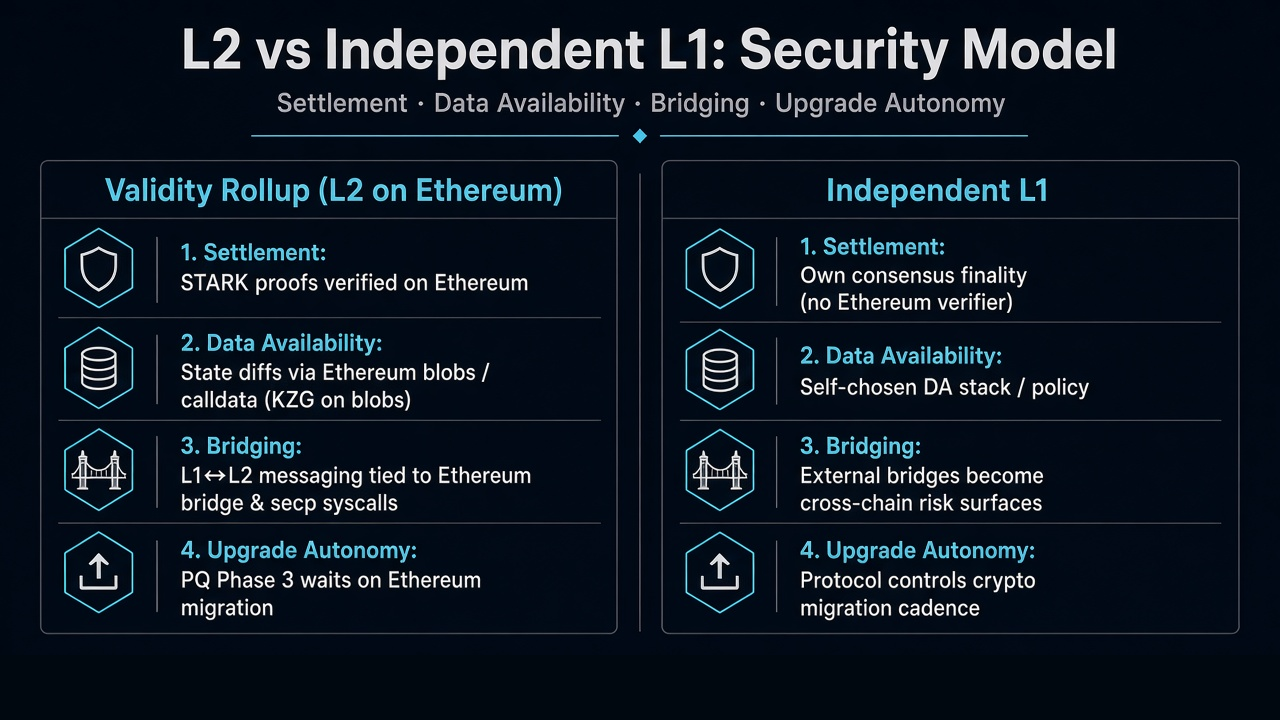
Figure 1. Security-model contrast between a validity-rollup L2 and an independent L1 across settlement, DA, bridging, and upgrade autonomy.
Why Would Starknet Discuss Moving From L2 to an Independent L1?
The core motive is crypto-agility: controlling how fast security-critical cryptography can migrate under pressure from quantum computing and post-quantum cryptography. Starknet already uses STARK proofs, which rely on hash-based assumptions rather than elliptic-curve arithmetic at the proving layer, but several L2 surfaces still inherit Ethereum’s elliptic-curve dependencies.
As long as Starknet settles on Ethereum, bridge messaging and blob data availability follow Ethereum’s cryptographic choices. If Ethereum’s post-quantum migration takes longer on those surfaces, an independent L1 architecture becomes a way to set its own migration pace rather than wait for every base-layer dependency to move first.
That discussion remains evaluative. Starknet’s public roadmap still describes a validity rollup that settles on Ethereum, and protocol-level changes require Starknet governance—not a silent switch of labels from L2 to L1.
Which Technical Layers, Including Stark Proofs, Change in an L2-to-L1 Transition?
Settlement, data availability, bridging, and upgrade authority redefine the product when an L2 becomes an independent L1. Execution (Cairo, STARK proving) can remain familiar while the trust root moves from “Ethereum verified this batch” to “this network’s validators finalized this block.”
On settlement, proof verification would no longer be the primary Ethereum contract checkpoint for Starknet state. On DA, the network would need its own availability guarantees instead of relying on EIP-4844 blobs anchored by Ethereum commitments. On bridging, the Ethereum bridge stops being the canonical L2 exit hatch and becomes one cross-chain path among others, with different trust, latency, custody, and failure modes.
Upgrade control also shifts. L2 users depend on L1 verifier contracts, messaging syscalls, and Ethereum client crypto; an independent L1 concentrates upgrades in its own governance and clients—speeding crypto-agility while concentrating responsibility for consensus, DA, and bridges.
Is Starknet’s Post-Quantum Cryptography Roadmap the Same as Becoming an L1?
No. Starknet’s post-quantum (PQ) roadmap hardens cryptographic surfaces; becoming an independent L1 is a settlement-architecture option that may reduce external dependencies those surfaces still have. The topics overlap where Ethereum coupling blocks PQ completion, but they are not identical projects.
| Phase |
Control scope |
Focus |
| Phase 1 |
Starknet-controlled |
Migrate Pedersen-related hash surfaces toward BLAKE2 across state commitment, address derivation, and related anchors so new activity can rest on PQ-friendlier primitives |
| Phase 2 |
Starknet-controlled (dApp adoption varies) |
Extend PQ-secure storage paths and tooling to legacy contracts without forcing every team onto the same migration clock |
| Phase 3 |
Depends on Ethereum migration |
Bridge secp256k1/r1 syscalls for L1↔L2 messaging and blob DA anchored by KZG remain tied to Ethereum until those base-layer surfaces migrate |
Phase 3 explains why L1 autonomy enters the conversation. Removing secp bridge syscalls without breaking the Ethereum bridge is blocked until Ethereum migrates; blob/KZG DA transparency likewise sits on Ethereum’s path, even while STARK proofs protect state-transition soundness. An independent L1 would not auto-complete Phases 1–2, but it would change who owns the remaining DA and messaging surfaces. Details are outlined in Starknet’s quantum readiness roadmap (2026-06-30).
How Is the Staking Decentralization Path Different From Becoming an Independent L1?
Staking decentralization answers who produces, attests, and eventually proves blocks on Starknet; becoming an independent L1 answers where settlement and security ultimately root. A fully decentralized L2 can still settle on Ethereum, so the two roadmaps must not be collapsed into one headline.
Starknet’s staking path is staged: validators stake (and may accept delegation), then take on attestation, later block validation, and eventually fuller network operation, with proving decentralization planned as a later step. That validator role decentralizes operations; it is not a settlement change. See the Starknet staking protocol overview and the Starknet decentralization roadmap.
Independent L1 status would additionally redefine settlement, DA, and the Ethereum bridge’s role. Users should treat staking participation, commission rules, and lockups as L2 decentralization mechanics—not as proof that Starknet has become an independent L1.
What Risks to Existing Systems Should Users and Developers Check If an L2 Moves Toward L1?
Bridge, finality, client, and governance assumptions should be re-checked before treating any L2-to-L1 proposal as “same app, new label.” Assets and messages that previously exited through a canonical Ethereum bridge would follow new trust and timing rules after a settlement change.
Users should verify which bridge is considered canonical, how withdrawals and message proofs change, and whether historical L2 exits remain enforceable. Developers should reassess RPC/client trust, DA retrieval, upgrade keys or governance parameters, and whether contracts that call Ethereum messaging syscalls still behave as designed.
Both groups should confirm governance approval plus client and bridge release notes—not infer a live L1 switch from staking milestones or PQ Phase 1–2 hash migrations alone. Crypto-agility can motivate the discussion; it does not remove operational, bridge, or governance risk.
Summary
Starknet today is an Ethereum validity rollup: STARK proofs and Ethereum settlement define the L2 security model. An independent L1 would mean Starknet owns settlement, DA, and much of its security migration schedule instead of inheriting those properties from Ethereum.
Post-quantum work and staking decentralization are related but distinct. PQ Phases 1–2 harden Starknet-controlled surfaces; Phase 3’s bridge secp syscalls and blob/KZG DA dependencies show why Ethereum coupling still matters—and why L1 autonomy is discussed for crypto-agility. Staking stages change operator roles without making Starknet an independent L1. Any real transition remains governance-gated and needs fresh checks on bridges, finality, and upgrade control.
FAQ
What does it mean for an L2 like Starknet to become an independent L1?
It means a network that used a base chain such as Ethereum for proof verification and data availability would instead provide finality and security-upgrade pacing through its own consensus. For Starknet, the operating model remains an Ethereum validity rollup; independent L1 status is an architecture direction under evaluation and would require governance—not a completed migration.
Is Starknet an L2 or an independent L1?
Starknet operates as an Ethereum validity rollup (Layer 2): state updates are backed by STARK proofs verified in Ethereum’s settlement path, with related data often posted to Ethereum. Public discussion of becoming an independent L1 is evaluative and does not mean mainnet has already left Ethereum settlement.
Does staking decentralization mean Starknet has become an independent L1?
No. Staking gradually hands block attestation, validation, and network operation to validators while Starknet can still settle on Ethereum. Becoming an independent L1 would change the settlement and security root itself, including how data availability and bridging relate to Ethereum.
How does Starknet’s post-quantum Phase 3 relate to an L2-to-L1 move?
Phase 3 lists Ethereum-tied bridge secp syscalls and blob/KZG data availability that Starknet cannot unilaterally remove while remaining an L2 bridge to Ethereum. L1 autonomy is discussed as a way to control migration pace on those external dependencies; finishing PQ Phases 1–2 is not the same decision as changing settlement architecture, and both remain governance-gated.
What should users and developers verify before treating an L2-to-L1 transition as live?
Confirm governance approval, client and bridge release notes, how finality and data availability are defined after the change, and whether existing assets or messages still follow the prior Ethereum-enforced path. Re-check deposit and withdrawal flows if the canonical bridge role changes. Do not treat staking milestones or PQ hash migrations alone as proof that independent L1 settlement is already in effect.