Stablecoin cross-border payments refer to a payment method that uses digital assets pegged to fiat currency values, such as USDC and USDT, to transfer and settle funds across different countries or regions through blockchain networks. Compared with traditional cross-border remittances that rely on coordination among multiple financial institutions, stablecoins can enable around-the-clock asset transfers through on-chain networks. However, once a transaction reaches final confirmation, it usually cannot be directly reversed.
This irreversibility increases certainty in fund settlement, but it also creates new business challenges. Cross-border e-commerce transactions may involve product returns, corporate procurement may involve delivery disputes, and consumers may lose funds due to entering an incorrect address, selecting the wrong network, or encountering fraud. If a payment system lacks refund and dispute resolution mechanisms, even fast on-chain transfers may not meet the requirements for fund security and consumer protection in complex commercial transactions.
As a result, the development of stablecoin cross-border payments is expanding beyond simply improving transfer efficiency to include refunds, transaction arbitration, smart contract escrow, and cross-border fund management. Merchant-initiated refunds, payment service provider coordination, and on-chain escrow protocols offer different solutions, but their applicable conditions and risks vary.
Key Takeaways
-
Stablecoin cross-border payments have on-chain transaction finality. Once confirmed, transactions usually cannot be directly reversed, but the recipient can still issue a refund through a new transfer.
-
Stablecoin refunds differ from traditional credit card chargebacks. Stablecoin refunds generally rely on merchant cooperation, payment platform rules, or preconfigured escrow mechanisms, while chargebacks are handled according to the dispute resolution procedures of card payment networks.
-
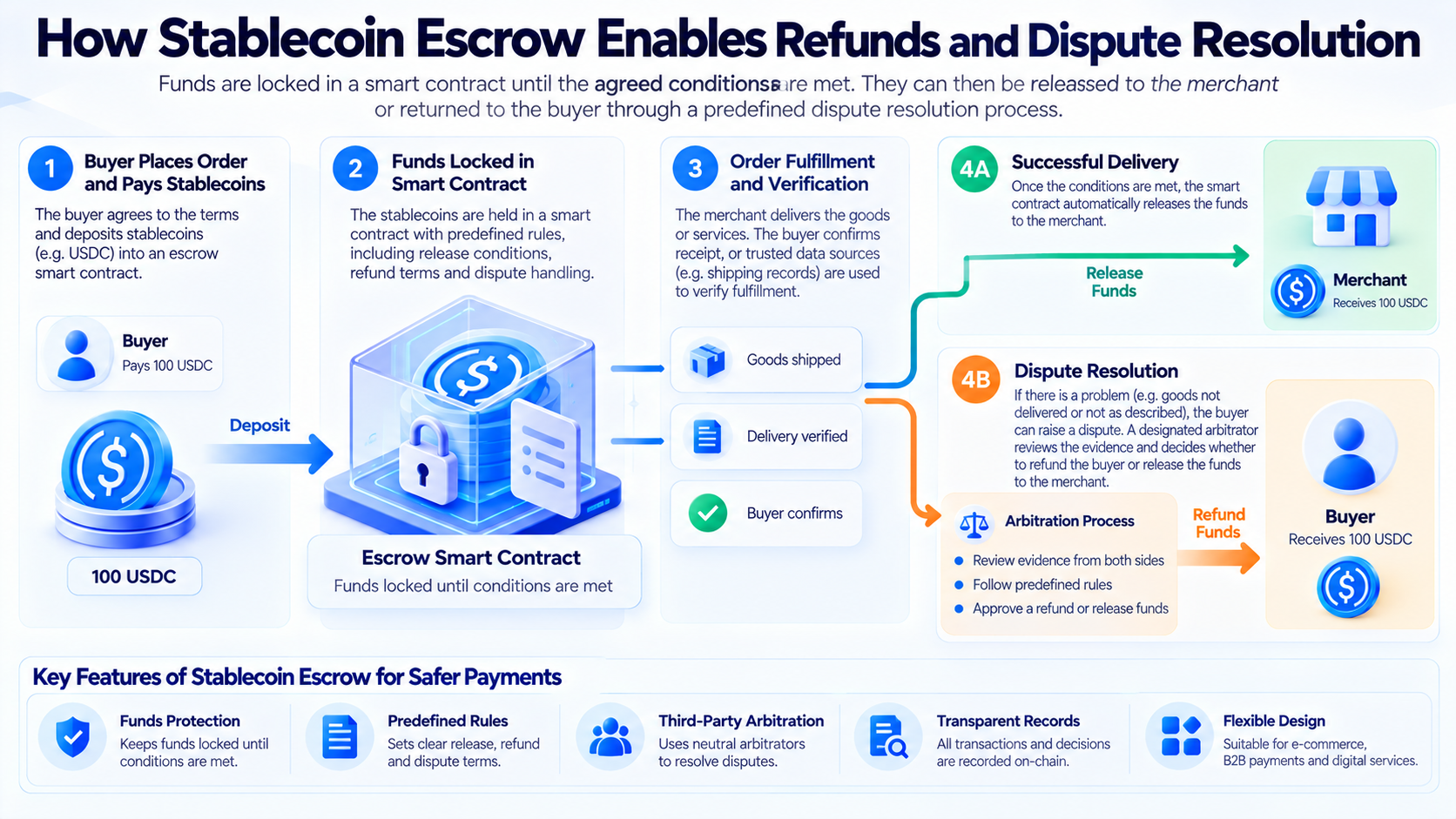
Smart contract escrow can lock funds before transaction obligations are fulfilled and determine whether funds are released based on confirmation from both parties, delivery conditions, or arbitration results.
-
On-chain payment solutions such as Refund Protocol aim to integrate refund periods, transaction arbitration, and fund return mechanisms into smart contracts to provide additional protection for stablecoin payments.
-
Cross-border refunds involve not only on-chain fund transfers but may also be affected by fiat on- and off-ramping, exchange rate fluctuations, bank settlement, and compliance reviews. They therefore require comprehensive payment status management and risk control systems.
Why Can Stablecoin Cross-Border Payments Usually Not Be Reversed After Completion?
Stablecoins are commonly issued on blockchain networks such as Ethereum, Solana, and Tron. When a payer sends stablecoins to a designated address, the transaction must be validated by the network and receive final confirmation after the relevant conditions are met. Once a transaction enters an irreversible settlement state, the original transfer record cannot be deleted or modified unilaterally by the payer.
This mechanism differs significantly from traditional card payments. Card transactions involve issuers, acquirers, and payment networks, which have established dispute resolution and chargeback rules. When consumers identify unauthorized transactions, undelivered goods, or other situations that meet dispute criteria, they can raise an objection with the card issuer in accordance with applicable procedures. The relevant institutions then handle the matter based on evidence and payment rules.
Standard on-chain stablecoin transfers do not have a unified native chargeback mechanism. Even if the payer discovers that a merchant has not fulfilled its contractual obligations, the payer cannot directly require the blockchain to deduct funds from the recipient's address. Therefore, completing an on-chain payment is not the same as final fulfillment of a commercial transaction.
However, transaction irreversibility does not mean funds can never be returned. If the recipient agrees to issue a refund, they can initiate a new stablecoin transfer. If the transaction funds remain in escrow, they may also be returned to the payer under predefined rules. The real challenge is establishing a reliable refund path for commercial transactions without changing blockchain finality.
For example, a consumer pays an overseas merchant 100 USDC and discovers that the product is out of stock after the transaction is confirmed. The merchant can send 100 USDC back to the consumer's wallet address. The blockchain will retain both the original payment record and the refund record; the original transaction does not disappear because of the refund.
What Is the Difference Between Stablecoin Refunds and Traditional Card Chargebacks?
Although both refunds and chargebacks may result in consumers receiving funds back, they differ in who initiates them, how they are processed, and how funds are controlled.
Stablecoin refunds are usually initiated by merchants or executed by payment service providers according to merchant instructions and platform rules. When consumers cancel an order or request a return, merchants need to confirm that the refund conditions are met before returning funds through a new on-chain transfer or an internal platform balance adjustment.
Card chargebacks are generally initiated by cardholders through card issuers. Payment networks process disputes according to established rules, and merchants can submit transaction records, delivery documentation, and other materials in their defense. The final outcome depends on the dispute type, evidence, and applicable rules. Not all disputes automatically result in a refund.
| Comparison Item |
Stablecoin Refund |
Card Chargeback |
| Primary initiator |
Merchant or payment service provider |
Cardholder through the card issuer |
| Method of returning funds |
New on-chain transfer or platform balance adjustment |
Processed according to payment network rules |
| Whether the original transaction can be reversed |
Usually cannot |
Funds may be adjusted under payment rules |
| Whether merchant cooperation is required |
Usually required, except with escrow mechanisms |
Merchants may participate in dispute defense |
| Basis for processing |
Merchant terms, platform rules, smart contracts |
Card network rules and applicable laws |
| Key limitations |
Recipient non-cooperation, insufficient funds, incorrect addresses |
Dispute eligibility, evidence, and processing deadlines |
Stablecoin refunds also present a practical issue: the recipient may no longer hold the original payment asset. After receiving USDC, a cross-border merchant may have already converted it into local fiat currency to pay suppliers, salaries, or other operating expenses. If a consumer later requests a refund, the merchant may need to purchase stablecoins again and bear the related conversion costs.
In addition, the original payment and refund may occur at different times, and exchange rates and service fees may change. Even if the merchant returns the same amount of stablecoins, the amount of local fiat currency ultimately received by the consumer may not equal the original payment amount.
Therefore, stablecoin payment products should clearly define refund conditions, returned assets, fee responsibilities, and processing timeframes before a transaction occurs. On-chain receipt of funds should not be treated as the sole indicator that a commercial transaction has ended.
How Do Merchants and Payment Service Providers Handle Stablecoin Refunds and Exceptional Transactions?
In real commercial settings, stablecoin refunds are not simply a matter of sending assets back to the original address. Merchants, payment service providers, and fund management systems must work together. Especially in cross-border e-commerce, digital service subscriptions, and corporate procurement, payment records, order status, and fund status must remain consistent to avoid duplicate refunds, incorrect amounts, or reconciliation issues.
For example, after a consumer uses USDC to purchase overseas goods and requests a return, the merchant must first verify the original order, payment amount, transaction hash, payment network, and refund conditions. After confirming that the goods have been returned or that the refund policy requirements are met, the merchant can initiate a new stablecoin transfer through the payment system. Once the refund is completed, the system should also record the refund transaction hash, the actual amount received, and the processing status, and link them to the original order.
If exceptional situations arise, such as payment in the wrong asset, through the wrong network, or a risk-related block, processing becomes more complex. Some funds may not yet have been credited to the merchant's account. Other funds may have already received on-chain confirmation but cannot be properly identified due to the asset type, network, or address involved. In such cases, it is necessary to determine whether order recovery, refunds, or other exception handling options are supported based on the scope of funds the payment service provider can control.
Using Gate Pay as an example, merchants can use the exceptional payment management feature in the backend to process certain transactions involving incorrect assets, incorrect networks, and risk-related blocks. Eligible Blocked exceptional transaction records support refund applications and require review. Some incorrect payments can be restored to normal order status through order recovery. For assets or networks not supported by the platform, funds may not be recoverable.
These mechanisms show that payment platforms can provide additional exception handling capabilities beyond on-chain settlement. However, their scope depends on whether funds remain identifiable and controllable, as well as on specific product rules. For assets already sent to wallet addresses outside the platform's control, payment service providers generally cannot guarantee recovery.
How Does Smart Contract Escrow Resolve Transaction Disputes in Stablecoin Payments?
Smart contract escrow is a mechanism that temporarily locks funds before a transaction is completed and determines entitlement to the funds based on agreed conditions. It can reduce the risk that buyers pay in advance but do not receive goods or services, while also providing sellers with proof that payment funds are ready.
In a traditional stablecoin transfer, the buyer sends assets directly to the seller's address, and control of the funds transfers once the transaction is confirmed. Under an escrow model, the buyer first transfers stablecoins to a smart contract, and the seller cannot freely withdraw the funds for the time being. Only after predefined conditions are met will the contract release the assets to the seller or return them to the buyer.
For example, an importing company needs to pay an overseas supplier 10,000 USDC. The parties can agree that, after the buyer pays, the funds first enter an escrow contract; the supplier completes shipment and submits the relevant documentation; and the contract releases the funds only after the buyer confirms receipt. If the goods are not delivered as agreed, either party can request a refund or enter a dispute resolution process according to the contract rules.
The advantage of escrow is that it separates fund settlement from commercial fulfillment. Although on-chain transactions are irreversible, funds remain subject to smart contract restrictions before conditions are met and do not immediately enter an account that the seller can freely control simply because the buyer paid in advance.
However, smart contracts cannot automatically determine every real-world commercial fact. Whether goods are damaged, whether services meet agreed standards, and whether shipping delays constitute a breach of contract may all require external evidence and human judgment. Therefore, some escrow solutions introduce third-party arbitration, confirmation from both parties, or trusted data sources to help determine how funds should be released.
At the same time, smart contracts may contain code vulnerabilities, incorrect permission configurations, or inadequate fund-locking rules. Escrow mechanisms can reduce certain counterparty risks, but they do not guarantee absolute fund security.
How Does Refund Protocol Enable On-Chain Refunds and Dispute Arbitration?
Refund Protocol is a non-custodial, smart contract-based refund and dispute resolution solution designed to add fund locking, refunds, and third-party arbitration capabilities to ERC-20 token payments. The solution was proposed by Circle Research in April 2025 and primarily addresses the lack of native chargeback mechanisms in standard stablecoin transfers.
Its core approach is not to allow arbitrators to control user assets at will, but to limit arbitration authority to a predefined scope. Once funds enter the escrow contract, the system records the recipient address, payment amount, and refund address. Arbitrators can set a fund-locking period, approve refunds when conditions are met, or allow recipients to withdraw funds early according to agreements between the parties.
For example, when a consumer pays 100 USDC through Refund Protocol, the funds first enter an escrow contract instead of being transferred directly to a wallet the merchant can freely use. If the merchant delivers the goods as expected, the funds can be released as agreed. If the consumer finds that the goods were not delivered, they can request dispute resolution and have the funds returned to the preregistered refund address if conditions are met.
This design reduces the risk that arbitrators directly misappropriate escrowed funds because they cannot send assets to addresses of their choice or indefinitely prevent recipients from withdrawing funds. Even in the event of a dispute, fund handling must still follow the restrictions preset in the contract.
However, this solution also has limitations related to cost and applicability. Compared with a standard ERC-20 transfer, escrow payments require additional contract calls and fund withdrawal operations, which may increase Gas fees. The lockup period and fund status for different orders must also be managed separately, further increasing system complexity.
More importantly, Refund Protocol is a research-oriented open-source solution. Its public code has not yet undergone a security audit and does not provide security guarantees. It is therefore more suitable as a technical example of an on-chain refund mechanism rather than as a mature commercial payment product that can be deployed without risk.
Why Do Stablecoin Cross-Border Refunds Also Involve Exchange Rates, Fiat On- and Off-Ramping, and Bank Settlement?
Although stablecoin cross-border payments can transfer assets through blockchains, real commercial transactions often also involve fiat currency conversion and local bank settlement. Payers may use local currency to purchase stablecoins, while recipients may convert stablecoins into another fiat currency after receiving them.
As a result, refunds are not always simple reverse on-chain transfers. They may require asset conversion, fund allocation, and bank disbursements to be completed again.
Suppose a European consumer uses euros to purchase $100 worth of USDC and then pays an overseas merchant. After the transaction is canceled, the merchant agrees to return 100 USDC. Although the stablecoin amount is the same as the original payment, the consumer may still be affected by exchange rate changes, conversion spreads, and service fees when converting the refund back into euros.
For corporate cross-border settlement, the refund process may be even more complex. After receiving stablecoins, suppliers may have already converted the funds into local fiat currency and used them for operating expenses. If the buyer requests a refund, the supplier needs to raise funds again, and the payment service provider may also need to rearrange cross-border conversion and local bank transfers.
In addition, cross-border payments may fail because of issues at different stages, including bank account verification, compliance reviews, on-chain settlement, or fiat settlement. Payment systems therefore need to separately record on-chain transaction status and off-chain fund status to avoid treating stablecoin receipt, bank disbursement, and final receipt as the same event.
Comprehensive refund management also needs to clearly define which asset will be used for refunds, which point in time determines the exchange rate, who bears the fees, and how the final received amount is calculated. Only when these rules are sufficiently clear can new disputes over inconsistent refund amounts between cross-border transaction parties be reduced.
How Can Stablecoin Cross-Border Payments Establish More Comprehensive Consumer Protection Mechanisms?
For stablecoin payments to enter use cases such as cross-border e-commerce, corporate procurement, and international trade in services, they cannot rely only on fast on-chain settlement and lower transaction costs. Consumers and merchants also need to understand how funds will be handled and what channels are available for assistance when transaction issues arise.
First, transaction information verification should be strengthened before payment, including the recipient address, blockchain network, stablecoin type, and merchant identity. For larger corporate payments, measures such as address allowlists, multi-party approvals, phased payments, and transaction limits can be used to reduce operational errors and fraud risks.
Second, payment systems need to establish complete order and fund records. An on-chain transaction hash can prove that a transfer occurred, but it cannot independently prove that goods were delivered or services were fulfilled. Therefore, order numbers, contract conditions, payment records, delivery records, and refund information should be linked together to provide a basis for subsequent dispute resolution.
Third, different fund protection mechanisms can be used for different transaction types. For lower-risk digital service transactions, merchant refunds and platform exception handling may be sufficient. For cross-border procurement involving larger amounts and longer delivery cycles, smart contract escrow, phased settlement, or third-party guarantees may be considered.
Finally, payment service providers should clearly define the scope of refund eligibility, processing timeframes, fee responsibilities, and dispute resolution paths. For transactions that have completed on-chain settlement but have not yet completed fiat disbursement, exception handling mechanisms should also be established to identify the stage at which funds are held.
Consumer protection for stablecoin cross-border payments does not necessarily need to fully replicate the card chargeback system. A more practical approach is to combine blockchain's verifiable settlement capabilities with merchant refunds, smart contract escrow, payment platform rules, and necessary legal remedies to establish a protection system suited to the characteristics of digital asset transactions.
Summary
The on-chain irreversibility of stablecoin cross-border payments does not mean that refunds and transaction disputes cannot be resolved. Rather, it means that fund returns and consumer protection must be established beyond the underlying blockchain settlement layer.
For standard commercial transactions, merchants can issue refunds through new stablecoin transfers, while payment service providers can offer order verification, exceptional payment handling, and fund return services. For transactions with higher fulfillment risk, smart contract escrow can set conditions before funds are released and address disputes through confirmation from both parties or third-party arbitration. Solutions such as Refund Protocol further demonstrate the technical direction of on-chain refund mechanisms, but their security and commercial maturity still require independent evaluation.
At the same time, cross-border refunds involve more than just the amount of stablecoins. They also involve fiat currency conversion, exchange rate changes, fees, and bank settlement. Even after an on-chain refund is completed, final receipt of fiat currency may still require additional processing time.
The future competitive focus of stablecoin cross-border payments is not only faster fund transfers, but also the establishment of reliable refund, dispute resolution, and risk control systems. Only by combining settlement efficiency with commercial trust mechanisms can stablecoins serve cross-border e-commerce, corporate procurement, and international fund management more broadly.
FAQ
Can I still receive a refund after a stablecoin cross-border payment is completed?
Yes, but a confirmed on-chain transaction usually cannot be directly reversed. Merchants can return funds through a new stablecoin transfer, and some payment service providers also support refunds that meet specific conditions.
Can USDT or USDC sent to the wrong address be recovered?
Not necessarily. If funds have been sent to an incorrect address that cannot be controlled, they are usually difficult to recover. Whether a remedy is available depends on the entity controlling the recipient address, the blockchain network, the payment service provider, and the specific transaction circumstances. Recovery cannot be guaranteed.
Do stablecoin payments have a Chargeback mechanism similar to card payments?
Standard on-chain stablecoin transfers usually do not have the native chargeback mechanism available in card payment systems. However, merchant refunds, payment platform dispute handling, and smart contract escrow can provide additional transaction protection under different conditions.
How does smart contract Escrow protect both parties in cross-border transactions?
Escrow can lock funds during a transaction and release or return assets based on delivery conditions, confirmation from both parties, or arbitration results. This can reduce certain counterparty risks, but smart contract vulnerabilities and risks in dispute rule design still remain.
Is Refund Protocol suitable for all USDC payments?
No. Refund Protocol requires the payment process to actively use the relevant smart contract. Standard USDC transfers do not automatically receive refund protection. Its public research implementation should also not be considered a mature commercial product that has completed a security audit.
Why might the fiat amount received after a stablecoin refund differ?
Because the refund may involve converting fiat currency again. Exchange rate changes, conversion spreads, service fees, and bank charges can all affect the final amount received, even if the refunded stablecoin amount is the same as the original payment.
Does Gate Pay support refunds for exceptional stablecoin payments?
Gate Pay supports refunds for certain eligible exceptional payments, such as specific Blocked transaction records. Refund applications require review. Other incorrect asset or incorrect network cases may require order recovery, manual assistance, or may be unresolvable because the relevant assets and networks are unsupported.