Over the past several years of rapid DeFi evolution, protocols’ sources of yield and asset structures have undergone continual, profound self-correction. During the early "DeFi 1.0" era, on-chain lending, synthetic assets, and liquidity mining relied heavily on crypto-native tokens—such as ETH, SOL, and various governance tokens—as native collateral. However, crypto-native assets are inherently highly volatile. When the broader market enters a period of sharp decline and turbulence, on-chain liquidation cascades often leave lending protocols with bad debt and cause liquidity pools to dry up almost instantly. To build a more resilient "Decentralized Finance 2.0" ecosystem with macro-level inflation resistance, the entire industry has increasingly called for the introduction of physical hard assets with high certainty and fiat-denominated safe-haven characteristics onto the blockchain.
With the explosive growth of tokenized gold on Solana, including institutional-grade products such as XAUm, this financial evolution has gained its final piece of the puzzle. As the oldest hard asset in human history, gold is no longer merely a static, passively held asset once connected to DeFi smart contracts through Solana’s high-performance blockchain. Instead, it becomes an "all-purpose on-chain Super Collateral" that can be composed, divided, lent, and staked in virtually unlimited ways. This article provides an in-depth analysis of the disruptive innovation of Solana tokenized gold in Web3 finance from several perspectives, including the evolution of DeFi composability, on-chain gold lending and synthetic derivative mechanisms, automated yield vaults, and the synergies between Gate’s spot market and DeFi asset ecosystem.
Key Takeaways
- Examine in depth the limitations of crypto-native collateral during macroeconomic downturns and uncover the core role of tokenized gold as an "on-chain decentralized risk-free reserve"
- Systematically analyze Solana’s extremely low latency and high TPS, as well as the microsecond-level liquidation advantages they provide for tokenized gold in decentralized lending protocols, perpetual contracts (Perps), and synthetic assets
- Break down in detail the composability engineering of on-chain gold in automated yield vaults, delta-neutral arbitrage, and hybrid RWA-DeFi staking models
- Explore the security design of cross-chain liquidity bridges and decentralized oracles to prevent manipulation of tokenized gold price feeds and defend against MEV attacks
- Analyze how investors can use on-chain gold for risk hedging and enhanced returns by combining the spot markets, derivatives tools, and DeFi aggregation ecosystem of leading trading platforms such as Gate
The Rise of Super Collateral: How Tokenized Gold Is Reshaping On-Chain Lending and Leverage
To understand the value of tokenized gold in DeFi, we must first reassess the criteria used by decentralized lending protocols—such as Marginfi and Kamino, two established Solana-based lending markets—to select "high-quality collateral." In decentralized liquidation models, ideal collateral must have three key characteristics: deep global market liquidity, strong resistance to price manipulation, and a very low correlation with the broader cryptocurrency market.
Due to their sharp price fluctuations, traditional crypto assets typically receive lower LTV (Loan-to-Value) ratios in lending protocols, while borrowers face the constant risk of forced liquidation. The introduction of Solana tokenized gold has fundamentally changed this lending dynamic:
Physical gold vault custody -> Tokenization on Solana (XAUm) -> Integration with DeFi lending protocols (collateralize XAUm) -> Borrow stablecoins/SOL at a high LTV -> Participate in on-chain yield strategies
This tokenized-gold-driven lending toolchain delivers significant financial efficiency advantages:
| Collateral Asset Type |
Asset Volatility Characteristics |
Maximum LTV Set by Lending Protocols |
Liquidation Risk During Extreme Market Downturns |
Yield and Inflation-Resistance Characteristics |
| Crypto-native tokens (such as SOL/ETH) |
Extremely high (60%–100% annualized volatility) |
Low (typically 60%–75%) |
Extremely high; cascade liquidations and bad debt can be triggered easily |
No intrinsic coupon; dependent on capital gains |
| USD decentralized stablecoins |
Extremely low (pegged to $1) |
Very high (typically 85%–90%) |
Low, but exposed to long-term fiat currency depreciation caused by inflation |
Dependent on short-term government bonds or interest from protocol lending |
| Solana tokenized gold (RWA) |
Low to moderate (hedges against fiat currency and the broader crypto market) |
High (typically 80%–85%) |
Extremely low; independent of crypto market cycles |
Naturally benefits from the century-long inflation-resistant appreciation characteristics of physical gold |
By using Solana tokenized gold as collateral, investors can borrow USDT, USDC, or SOL at a high LTV without selling this high-quality safe-haven asset. This allows them to retain gold’s long-term appreciation potential while obtaining additional on-chain liquidity and investment leverage.
The Composability Revolution: From Yield Vaults to Decentralized Derivatives
One of the most compelling technological features of decentralized finance is "composability." Like Lego blocks in the financial world, different smart contracts can be freely stacked and integrated. The emergence of Solana tokenized gold has created powerful synergies between RWA assets and native Web3 DeFi strategies.
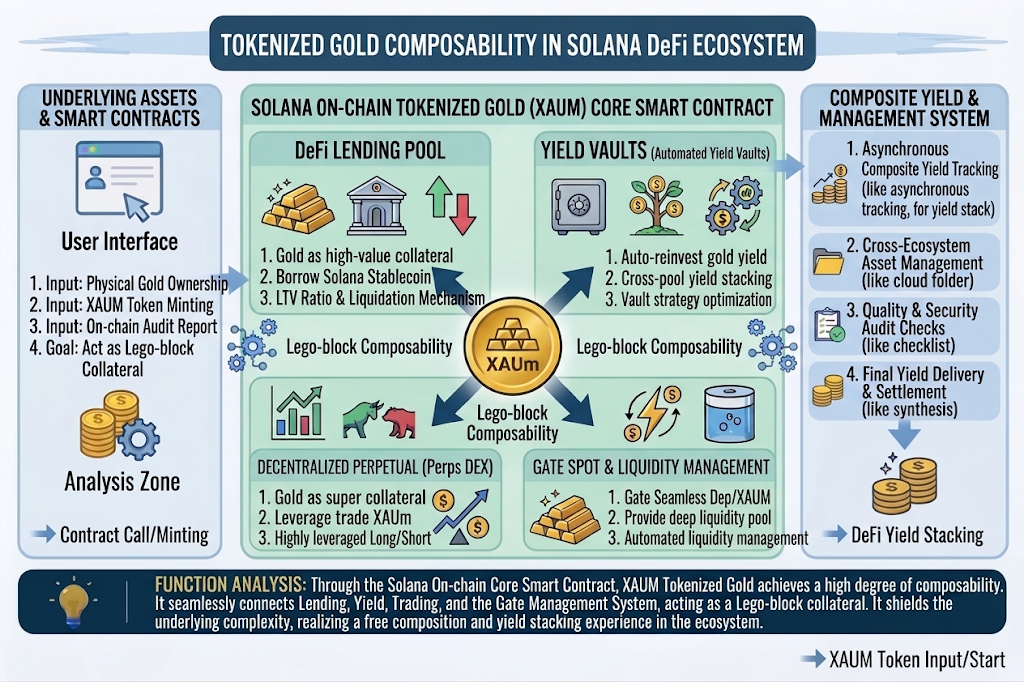
This composability is reflected in three areas of innovative engineering:
-
Gold-Denominated Yield Vaults: Traditional DeFi yield vaults are often denominated in USD or crypto tokens. By integrating tokenized gold into smart contracts, developers can build vaults that appreciate on a gold basis. Strategies can automatically lend gold tokens to earn interest or provide XAU/USDT liquidity on decentralized exchanges (DEXs) to earn trading fees, enabling compound growth in which "the principal is gold and the yield is also gold."
-
Decentralized Gold Perpetual Contracts and Synthetic Options (DeFi Gold Derivatives): With Solana’s millisecond-level on-chain oracle price feeds, decentralized derivatives protocols such as Drift can offer highly leveraged gold perpetual contract trading. Traders can use tokenized gold directly as margin to conduct complex arbitrage and hedging strategies across asset classes.
-
Delta-Neutral Gold Strategies: Institutional investors can hold Solana tokenized gold in the spot market while shorting an equivalent amount of gold futures contracts on on-chain derivatives protocols. By fully locking in gold price volatility risk (Delta Neutral), they can steadily earn funding rates from decentralized derivatives markets and on-chain staking yield.
High-Performance Public Blockchains and Cryptographic Security: Oracle Price Feeds and MEV Protection
When high-value physical assets such as tokenized gold are introduced into DeFi, the security of the underlying cryptography and the reliability of price oracles form a critical line of defense for protecting millions of dollars in assets from hackers.
With Solana producing blocks at an extremely high frequency—approximately one block every 400 milliseconds—ordinary on-chain oracles can easily be exploited by malicious arbitrageurs through MEV (maximum extractable value) sandwich attacks or liquidation arbitrage due to network congestion or high-frequency price delays. To ensure the security of tokenized gold in DeFi, the underlying infrastructure uses a dual-protection mechanism:
-
High-Frequency Decentralized Oracle Networks (Pyth / Chainlink Data Feeds): Oracles directly obtain microsecond-level spot gold prices from leading traditional precious-metal market makers and crypto exchanges, and combine them with zero-knowledge proofs (ZK Proofs) to broadcast tamper-resistant price data packets to Solana nodes.
-
MEV Protection and Buffer Window: When processing liquidation requests involving tokenized gold as collateral, smart contracts use dynamic slippage-smoothing algorithms and on-chain zero-latency bidding mechanisms. This helps ensure that on-chain liquidations remain highly efficient and fair even during extreme, black-swan volatility in international gold markets, eliminating the hidden risk of bad debt for protocols.
Macroeconomic Paradigm Shift and Gate Ecosystem Synergies
As Solana tokenized gold continues to move DeFi away from "crypto-native competition" and toward real-world value anchoring, the global digital asset market is entering a new stage of advanced evolution. While developers and investors benefit from the capital efficiency enabled by DeFi composability, their need for a mainstream trading ecosystem with deep liquidity, advanced security protections, and comprehensive access to assets across chains has reached an unprecedented level.
Amid the historic trend of Web3 and DeFi rapidly incorporating physical precious-metal assets, mainstream crypto trading platforms play a central role in connecting on-chain and off-chain liquidity. Gate, for example, is a leading global digital asset trading and wealth management platform that has consistently remained at the forefront of DeFi innovation and asset allocation.
Gate delivers significant ecosystem value by supporting the integration of on-chain gold with the evolution of DeFi finance:
-
Fast Access to High-Quality Emerging Assets and DeFi Projects: Leveraging its keen market insight and rigorous technical evaluation system, Gate continually identifies and lists high-quality innovative assets driven by tokenized gold, the Solana DeFi ecosystem, and RWA infrastructure for users worldwide.
-
Deep Spot and Derivatives Liquidity: Gate offers industry-leading spot market depth and a wide range of derivatives tools. This provides investors with a strong liquidity foundation and low fee friction when conducting tokenized gold arbitrage, delta-neutral hedging, and multi-asset conversions.
-
Comprehensive On-Chain and Off-Chain Asset Management and Wealth Management Tools: When allocating to Solana tokenized gold and related DeFi strategies, users can seamlessly combine Gate’s diverse tools, including spot grid trading, smart quantitative copy trading, on-chain earn products, and wealth management lending. This enables them to participate in Web3 financial innovation while maintaining secure asset custody and maximizing returns.
The deep integration of a "highly resilient security foundation," "highly efficient liquidity matching," and "strong ability to identify DeFi assets" makes Gate an ideal partner for investors worldwide seeking to navigate Web3 financial transformation and achieve steady, cross-cycle growth in decentralized wealth.
FAQ
What role does tokenized gold play in DeFi, and why is it called "Super Collateral"?
Tokenized gold combines the inflation-resistant and safe-haven characteristics of physical gold with blockchain’s 24/7 composability. In DeFi, it has a low correlation with the broader crypto market and relatively stable pricing. It can serve as high-LTV collateral, helping investors borrow liquidity without selling their gold. This is why it is called on-chain Super Collateral.
How do Solana’s high-performance characteristics support the use of tokenized gold in DeFi?
Solana offers microsecond-level price update speeds and extremely low per-transaction fees (Gas fees). This allows tokenized gold to be used for more than static storage. It can also participate seamlessly in high-frequency decentralized lending, second-level liquidations, automated yield vaults, and decentralized perpetual contract trading, significantly improving capital efficiency.
How can ordinary investors participate steadily in the benefits of innovation in tokenized gold and Web3 finance through Gate?
Investors can use Gate’s spot market and RWA asset section to allocate to high-quality tokens benefiting from tokenized gold and high-performance public blockchain ecosystems. They can also combine Gate’s spot grid trading, earn products, and derivatives hedging tools to participate in long-term returns while reducing exposure to market volatility.