Since 2025, the U.S. Solana ETF market has gradually developed into an investment landscape with different product structures, staking ratios, and reward distribution mechanisms. The REX-Osprey Solana + Staking ETF (SSK) began trading in July 2025, while the Bitwise Solana Staking ETF (BSOL) launched in October of the same year. More asset managers subsequently entered the market. In November 2026, Solana ETFs recorded net inflows on a single day after a period of consecutive outflows, reflecting continued market interest in institutional investment channels for SOL.
The introduction of staking functionality in Solana ETFs indicates that crypto asset funds are evolving from products that provide only price exposure to structures that also incorporate blockchain network rewards. However, staking rewards are not equivalent to traditional bond interest and cannot offset all losses caused by a significant decline in the price of SOL. This article analyzes how Staking ETFs change the way institutions participate in PoS networks, and what these changes mean for SOL valuation and the crypto ETF market, through the lens of Solana's staking mechanism, ETF product structures, reward distribution, fund fees, and validator concentration.
Key Takeaways
-
In addition to holding SOL, Solana Staking ETFs obtain network rewards by delegating stake to validators, meaning fund returns are affected by both token prices and staking mechanisms.
-
Products such as BSOL and SSK differ in investment structure, fees, staking ratios, and reward distribution methods. Not all Solana ETFs should be viewed as the same type of product.
-
Staking rewards primarily come from token issuance and related reward mechanisms on the Solana network, rather than fixed interest promised by fund managers.
-
ETFs may retain staking rewards within fund assets or distribute them in cash according to product rules. These approaches affect how investors realize returns.
-
Large-scale institutional staking may increase the amount of SOL held over the long term, while also increasing market attention to validator selection, delegation concentration, and liquidity management.
-
The long-term value of Solana ETFs still depends on SOL prices, network economic activity, fund fees, and actual investment demand. Staking yields cannot eliminate market risk.
Why Are Solana ETFs Beginning to Introduce Staking?
The core function of a spot crypto ETF is to allow investors to gain price exposure to a specific digital asset through a securities account, without directly managing on-chain wallets, private keys, or digital asset custody processes. For example, a spot Bitcoin ETF holds BTC and issues tradable shares, allowing investors to participate in Bitcoin price movements through the securities market. However, Bitcoin does not have a PoS staking mechanism, so funds cannot obtain similar rewards through native network staking.
Solana, by contrast, uses a PoS consensus mechanism. SOL holders can delegate tokens to validators, participate in maintaining network security, and receive corresponding rewards. This means that for funds holding SOL over the long term, whether they participate in staking affects the actual return structure of their assets. If a fund only holds SOL without staking it, it cannot receive staking rewards that could otherwise be generated through network delegation.
Therefore, the emergence of Staking ETFs follows a clear product rationale. Without changing the primary investment asset, funds can use SOL's native economic mechanisms to increase potential returns. For investors, this adds a source of returns related to network operations in addition to SOL price exposure.
However, these returns do not come without costs. Funds need to select validators, arrange custody and staking operations, and manage redemption liquidity, network risks, and fee allocation. As a result, ETFs that support staking do not necessarily perform better than products that do not. Their final returns still depend on actual rewards, operating costs, and market price movements.
How Do Solana Staking ETFs Generate On-Chain Staking Returns?
The Solana network relies on validators to process transactions, participate in consensus, and maintain ledger security. SOL holders can delegate tokens to validators, giving them corresponding staking weight. Validators participate in consensus under network rules and receive rewards, while delegators receive returns based on their staking amount and applicable distribution mechanisms.
For Solana ETFs, funds typically hold SOL through custodians and then delegate part or most of their assets to eligible validators according to fund policies. Validators operate nodes and participate in network consensus, while the fund receives staking rewards based on the delegated amount, network reward levels, validator commissions, and actual operating performance.
A significant source of Solana staking rewards is newly issued SOL at the protocol level. Therefore, staking returns differ fundamentally from traditional corporate profit distributions. Corporate dividends generally come from distributable profits, while PoS staking rewards partly come from increases in the network token supply. As stakers receive more SOL, the total token supply of the network may also increase.
This means investors should not focus solely on nominal staking yields. They also need to consider the impact of token issuance on the overall supply structure. If the network issues a large amount of new SOL and an investor does not participate in staking, the investor's holdings may represent a diluted share of the total supply. By participating in staking, investors may receive additional SOL that partially offsets this relative dilution.
In addition, actual staking yields are not fixed. Network inflation parameters, the network-wide staking ratio, validator operating performance, and commission settings can all affect final rewards. Historical yields disclosed by ETFs also cannot be directly treated as a guarantee of future returns.
How Do BSOL and SSK Differ in Product Structure?
The Bitwise Solana Staking ETF (BSOL) is a representative spot Solana staking product in the U.S. market. The fund launched in October 2025. Its primary investment objective is to provide SOL price exposure, while its secondary objective is to increase the amount of SOL held by the fund through staking. Its prospectus states that the management fee is 0.20% annually, and that it participates in network delegation through custodians and staking service providers.
An important feature of BSOL is that it retains staking rewards within fund assets rather than distributing them directly as regular cash dividends. As the fund receives additional SOL, the amount of SOL represented by each fund share may increase, affecting its net asset value. This structure is more similar to a model in which asset holdings grow as staking rewards accumulate.
The REX-Osprey Solana + Staking ETF (SSK) uses a different investment structure. SSK began trading in July 2025 and gains Solana exposure through direct SOL holdings and related investment instruments, incorporating staking returns into its product design. Its fee level and reward distribution arrangements differ from those of BSOL. Therefore, the presence of Staking in a fund name alone does not mean that the two products use the same return mechanism.
As more issuers enter the market, Solana ETFs have developed different fee schedules and staking policies. As of November 16, 2026, publicly available market information showed that BSOL had a management fee of 0.20%, Fidelity Solana Fund (FSOL) charged 0.25%, Grayscale Solana Staking ETF (GSOL) charged 0.19%, and SSK had a fee level of 0.75%.
These differences show that competition among Solana ETFs is no longer limited to tracking SOL prices. It also includes fund costs, staking efficiency, reward distribution methods, and liquidity management capabilities. For long-term holders, fees and staking policies may gradually create differences in cumulative returns even when funds hold the same underlying asset.
How Are Staking Rewards Converted Into Actual Returns for ETF Investors?
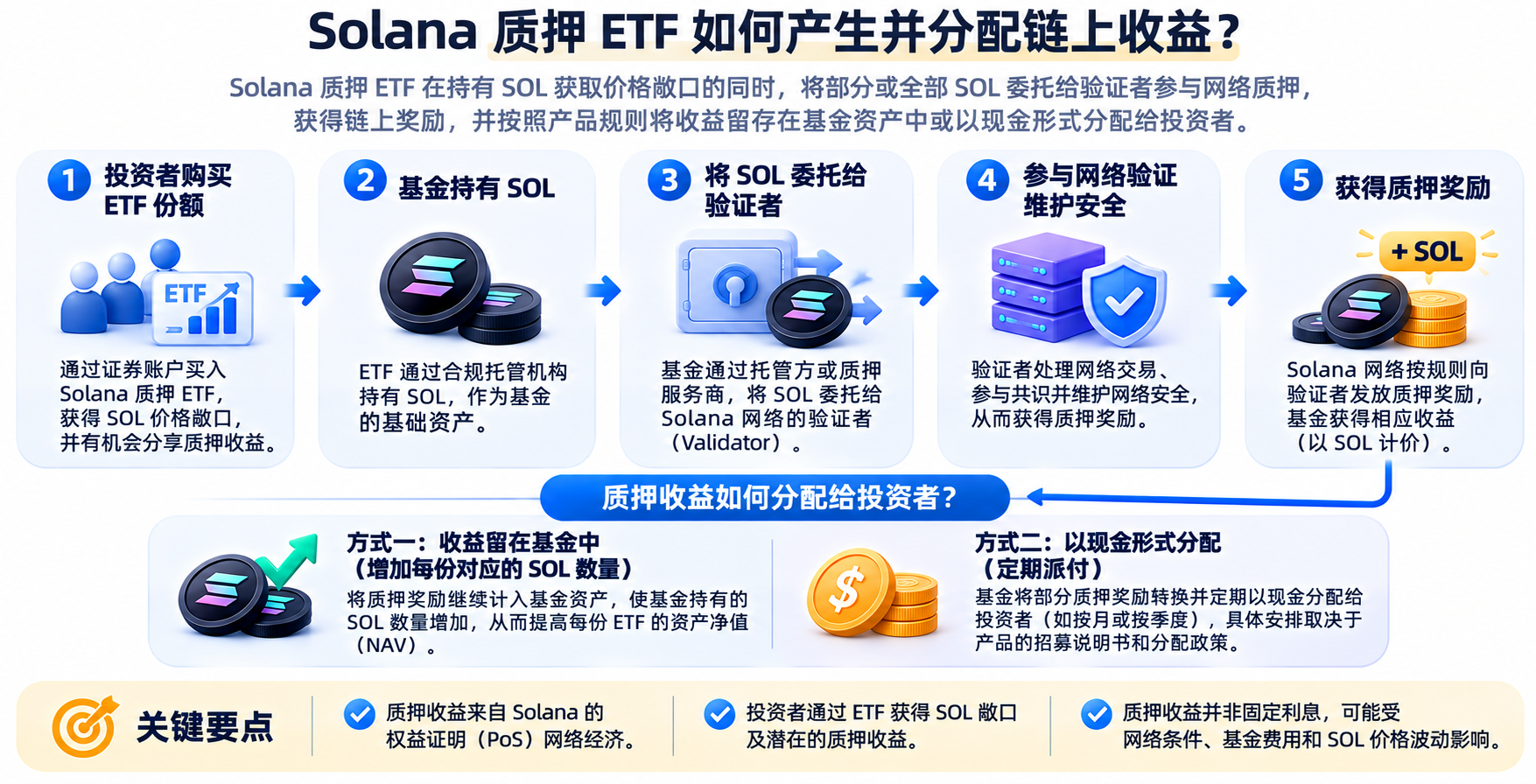
After a Solana ETF receives on-chain staking rewards, it does not necessarily mean that investors will receive an equivalent amount of cash. Different funds may use different approaches to handling returns. The most common methods are retaining rewards within fund assets or distributing cash at specified intervals.
For example, under a reward retention model, assume a fund initially holds 1 million SOL. If it receives 50,000 SOL in net staking rewards, without considering other changes, the fund's SOL holdings may increase to 1.05 million SOL. If the number of fund shares remains unchanged and there are no other fee or liability effects, the amount of SOL represented by each share will increase accordingly.
For investors, this type of return is generally reflected in the fund's net asset value rather than as a fixed interest payment received in a bank account. If the market price of SOL remains unchanged, the additional token amount may increase the value of fund assets. If the price of SOL falls, the fund's net asset value may still decline.
The cash distribution model works differently. A fund may convert or distribute part of its staking rewards to investors at specified intervals, allowing holders to receive cash returns directly. However, distributions may affect the fund's ex-dividend price. Therefore, cash distributions should not simply be interpreted as additional returns beyond the fund's total return.
It is also necessary to distinguish among three commonly confused metrics: the network's gross staking yield, the fund's net staking yield, and the investor's final realized total return. Network rewards must be reduced by validator commissions and related fees. Funds may also charge management fees, while investors' final returns are additionally affected by SOL prices, fund premiums or discounts, and trading costs.
Therefore, when evaluating a Staking ETF, investors should not compare only advertised annualized staking yields. They should also assess the fund's overall performance after actual fees and price changes.
Why Are Solana ETF Staking Returns Not Equivalent to Bond Interest?
The main difference between Solana staking returns and bond interest lies in their economic sources and risk structures. Bonds generally represent an investor's claim against an issuer, with interest and principal repayment arrangements determined by contract and affected by the issuer's credit profile. Solana staking is an economic mechanism for participating in PoS network operations, with rewards primarily determined by protocol rules, token issuance, and validator activity.
Staking rewards are generally denominated in SOL rather than a fixed U.S. dollar amount. For example, an investor may indirectly receive an annual 5% increase in the amount of SOL held through a fund, but this does not mean the U.S. dollar value of the asset will necessarily increase by 5%. If the U.S. dollar price of SOL falls by 30% during the same period, staking rewards cannot fully offset the price loss.
Assume an investor holds SOL exposure worth $10,000. Over one year, the corresponding amount of SOL increases by 5% due to staking rewards, but the price of SOL falls by 30%. Ignoring fund fees, taxes, and other factors, the asset value at the end of the period would be approximately $7,350, representing an overall loss of about 26.5%.
This example shows that staking returns can improve holding returns at the token quantity level, but they cannot guarantee the safety of principal denominated in fiat currency.
In addition, staking rewards may be affected by changes in network parameters. If Solana adjusts its inflation schedule, changes occur in the staking participation rate, or validator operating costs increase, actual reward levels may change accordingly. Therefore, defining a Staking ETF simply as a fixed-income product may underestimate its market risks.
How Could Large-Scale ETF Staking Affect SOL Liquidity and Supply-Demand Dynamics?
When institutional investors hold SOL through ETFs and funds stake a large amount of tokens, the staking structure of the Solana network may change. Unlike short-term trading capital, some ETF capital has long-term allocation characteristics and may therefore place more SOL in an ongoing delegated state.
This does not mean that all staked SOL permanently exits the market. Native Solana staking generally involves undelegation and status transition processes, and the related funds may not always be freely transferable immediately. Funds need to arrange liquidity based on subscription and redemption needs and market conditions to prevent excessively high staking ratios from affecting daily operations.
If a large number of ETFs face redemptions at the same time, funds may need to use unstaked SOL, arrange unstaking, or meet funding needs through other methods permitted by fund rules. Since unstaking involves network epochs and operational arrangements, a fund's actual liquidity management capability becomes an important risk factor.
ETF inflows also do not necessarily translate directly into higher SOL prices. Fund subscriptions may create demand for underlying assets, but actual prices are also affected by market selling pressure, the behavior of other holders, derivatives trading, and overall risk appetite. Similarly, continued ETF staking cannot guarantee that SOL's circulating supply will decline, because new network issuance, unstaking, and transfers by other holders can also affect market supply.
Over the long term, institutional staking may improve the stability of SOL holdings. However, whether it can sustainably improve market supply and demand conditions must be assessed together with ETF net inflows, the network-wide staking ratio, token issuance, and actual trading activity.
Will Institutional Staking Change the Competitive Landscape for Solana Validators?
The security of the Solana network is closely related to validator distribution. Validators maintain the network by operating nodes, participating in consensus, and processing transactions. The amount of delegated stake they receive affects their consensus weight and related economic returns.
As the amount of SOL held by ETFs increases, fund managers and staking service providers may become important allocators of delegated capital. If large amounts of institutional assets are concentrated with a small number of validators, the staking weight of these nodes may increase further, affecting the competitive landscape among network validators.
For ETF issuers, selecting validators generally requires consideration of operational stability, commissions, technical capabilities, security records, and compliance requirements. Large institutions may prefer validators with stronger operating capabilities and mature service processes to reduce fund operational risk. However, if this selection becomes concentrated among a small number of service providers over the long term, validator distribution may become more concentrated.
On the other hand, institutional capital does not necessarily lead to network centralization. Funds can diversify delegations across multiple validators, reducing the risk of a single-node failure and supporting broader validator participation. The ultimate effect depends on the delegation policies actually adopted by funds, rather than ETF scale itself.
Therefore, assessing the effect of Solana ETFs on network security requires attention to where staked capital is allocated, validator concentration, relationships among service providers, and whether funds publicly disclose relevant risk control measures.
What Additional Risks Do Staking ETFs Face?
Compared with funds that only hold SOL, Staking ETFs need to manage more technical and operational risks.
-
Validator operating risk. If validators experience prolonged downtime, configuration errors, or other operational issues, staking rewards may be affected. Solana's specific penalty and reward rules may also change with network upgrades, so funds need to continuously assess validator performance.
-
Staking liquidity risk. Funds need to maintain a balance between pursuing network rewards and meeting subscription and redemption needs. If an excessively high proportion of assets is staked and the market experiences concentrated redemptions, funds may face additional liquidity management pressure.
-
Custody and technical risk. Funds generally manage SOL through professional custodians, while related service providers execute staking operations. This means that although investors do not need to manage private keys themselves, they still bear potential risks associated with custodians, operating processes, and service providers.
-
Fund trading price risk. ETFs trade on securities exchanges, and their market prices may differ from their net asset values. During periods of severe market volatility or insufficient liquidity, the prices at which investors actually buy and sell may deviate from the reference value of the SOL held by the fund.
-
Regulatory and tax risk. Different funds may use different legal structures, and the recognition, distribution, and tax treatment of staking rewards may also differ. Product policies may be adjusted based on regulatory requirements and operating conditions. Investors should review the latest prospectus rather than relying only on historical yields to assess future performance.
Will Solana ETF Staking Change SOL's Long-Term Valuation Framework?
The development of Staking ETFs may lead the market to place greater emphasis on SOL's network economic characteristics. Traditional crypto asset valuation often focuses on supply, market demand, trading activity, and capital flows, while PoS assets also involve staking rewards, token issuance, and validator economics.
For investors holding SOL over the long term, staking rewards can affect changes in the amount of tokens held over time. However, these returns are not a cost-free source of returns independent of the network economy. Since rewards partly come from new issuance, investors need to consider both network inflation and network-wide staking participation to assess the actual economic effect.
Solana's long-term value is also closely related to actual network demand. If the network can continue to attract stablecoin payments, DeFi, trading applications, and other real user activity, it may increase market demand for SOL as the network's native asset. However, growth in network usage does not necessarily have a fixed proportional relationship with SOL prices. Fee mechanisms, token velocity, and market valuation expectations must also be considered.
The emergence of ETFs provides another channel for capital. Investors with traditional securities accounts can gain SOL exposure indirectly through funds without directly participating in on-chain operations. This may expand the potential investor base, but it also makes SOL more susceptible to institutional asset allocation, macroeconomic interest rates, and risk appetite in securities markets.
Therefore, Solana Staking ETFs primarily change how investors participate in the network economy, rather than directly changing the underlying source of SOL's value. Long-term valuation still requires analysis of network adoption, token economics, staking structures, and market demand for capital.
Are Crypto ETFs Moving From Price Tracking to On-Chain Yield Assets?
The development of Solana Staking ETFs demonstrates an important difference between crypto asset funds and traditional ETFs. For assets such as Bitcoin that do not have native staking mechanisms, funds mainly provide price exposure by holding the underlying asset. For PoS networks such as Solana, funds can participate in network economic activity while holding tokens.
This makes crypto ETF product design more diverse. Different funds can compete through staking ratios, reward retention, cash distributions, and fee structures. When selecting funds, investors also need to shift from primarily comparing management fees and tracking error to assessing staking yields, custody arrangements, validator risks, and liquidity management capabilities.
However, not every mechanism capable of generating on-chain returns is suitable for direct inclusion in an ETF. Different blockchain protocols may involve smart contracts, lending, liquidity provision, or other more complex financial activities, and their risks differ significantly from native PoS staking. Whether funds can participate in these activities must also comply with specific product documents and regulatory requirements.
The development of Solana ETFs shows that traditional finance is exploring how to incorporate blockchain-native economic mechanisms into securities investment products. However, this integration does not mean that on-chain returns can automatically become stable and predictable investment returns. For investors, understanding where returns come from, who bears the risks, and how returns enter a fund's net asset value is more important than simply comparing nominal annualized yields.
Summary
The emergence of Solana Staking ETFs has advanced crypto ETFs from tools that only track digital asset prices to investment products that can participate in blockchain network economics. Products such as BSOL and SSK use different fund structures and staking arrangements to allow investors to gain SOL price exposure while indirectly participating in Solana's network reward mechanisms.
This change provides traditional finance investors with new ways to participate, while also making fund management fees, staking ratios, reward distribution, and validator selection important factors affecting returns. However, staking rewards are primarily denominated in SOL and are affected by network issuance rules and operating conditions. They should not be simply understood as fixed interest, and they cannot eliminate losses caused by SOL market price volatility.
Over the long term, the significance of Solana ETF Staking lies not only in adding a potential source of returns for funds, but also in institutional capital beginning to participate more directly in the security and economic structure of PoS networks. Going forward, the market will need to monitor not only the scale of ETF inflows, but also the sustainability of staking rewards, validator concentration, fund liquidity, and real application demand on the Solana network.
FAQ
What Is a Solana Staking ETF?
A Solana Staking ETF is an exchange-traded product that holds SOL and obtains network rewards through staking mechanisms. Investors purchase fund shares through securities accounts to gain indirect SOL price exposure and receive staking returns retained or distributed by the fund.
Is the Staking Yield of a Solana ETF Fixed?
No. Staking returns are affected by network issuance rules, the network-wide staking ratio, validator performance, and fund fees. Historical yields do not indicate that the same returns can be sustained in the future.
Does BSOL Directly Pay Staking Rewards to Investors?
BSOL primarily retains staking rewards within fund assets, allowing the amount of SOL represented by each fund share to potentially increase rather than directly paying cash on a fixed schedule.
What Is the Difference Between a Solana ETF and Directly Holding and Staking SOL?
ETF investors hold fund shares through securities accounts. They do not directly control the SOL held by the fund or choose on-chain validators themselves. Users who directly hold SOL can manage their assets based on their own wallets and staking methods, but they must bear private key and on-chain operational risks.
Can Solana ETF Staking Returns Offset a Decline in SOL?
They can improve returns to a limited extent. If the decline in SOL's price exceeds the returns generated by staking rewards, fund investors may still incur losses.
Will Large-Scale Solana ETF Staking Make the Network More Centralized?
This is possible, but not inevitable. If institutional capital is concentrated with a small number of validators, it may increase staking concentration. If funds use diversified delegation strategies, they may also support more validators participating in the network.