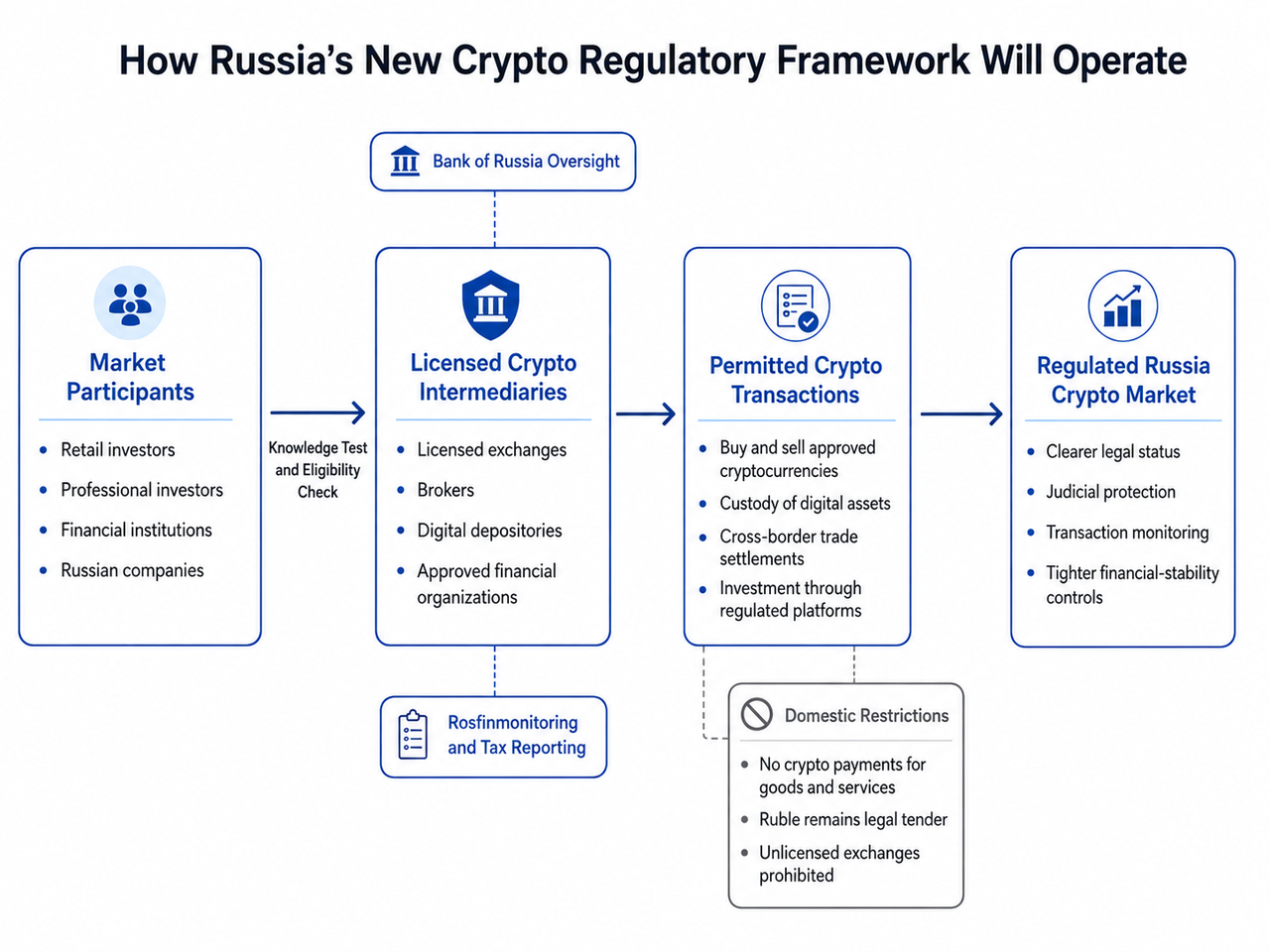
Russia’s cryptocurrency legal framework is moving from fragmented rules to a regulated market supervised by the Bank of Russia. After President Vladimir Putin signed the new law on August 4, 2026, most provisions are scheduled to take effect on September 1, 2026. Investors, financial institutions and crypto businesses must now understand who may trade, which intermediaries require licences and where crypto payments remain prohibited.
Russia’s new crypto rules legalize cryptocurrency transactions through licensed exchanges and other approved organizations, giving crypto transactions, digital financial assets, and trading cryptocurrencies a clearer legal status across the Russian Federation. The framework explains how Russia’s crypto market will operate under tighter regulation, including access for professional investors and financial institutions investing, reporting to Russian tax authorities, safeguards that guarantee judicial protection, restrictions affecting other countries, and measures intended to protect financial stability.
The framework does not make cryptocurrency legal tender or permit unrestricted domestic payments. Instead, it creates controlled access to crypto trading, formal custody and exchange infrastructure, investor testing, transaction monitoring and a transition period for existing market participants.
Key Takeaways
The new law creates regulated cryptocurrency exchanges, brokers, management companies and digital depositories under Bank of Russia supervision.
Retail investors may buy approved highly liquid cryptocurrencies after passing a knowledge test, with a limit of RUB 300,000 per year through each intermediary.
Qualified investors must also pass testing but may buy and sell cryptocurrencies without an annual purchase limit.
Crypto payments for domestic goods and services remain prohibited, while qualifying foreign-trade settlements are permitted.
Most rules begin on September 1, 2026, although existing operators have until July 1, 2027, to obtain licences and meet the new requirements.
What Changes When Putin Signs Russia Crypto Law?
The main change is that cryptocurrency activity becomes part of a formally supervised financial-market structure. Earlier rules addressed individual areas such as ownership, taxation, mining and experimental cross-border settlements. The new comprehensive cryptocurrency law connects trading, brokerage, custody and exchange services within one regulated system.
The distinction between earlier rules and the enacted framework matters. The existing Russia cryptocurrency legal framework established that digital currency could be owned and treated as property while restricting its use for domestic payments. The new law determines which organizations can arrange cryptocurrency transactions and how investors gain access.
Cryptocurrencies retain property status, which supports ownership rights, enforcement and judicial protection. According to reporting on the enacted legislation, courts may protect cryptocurrency rights even when the holdings were not previously declared, although tax, disclosure or other compliance obligations may still apply.
How Crypto Exchanges and Licensed Intermediaries Will Operate
Only licensed intermediaries will be permitted to organize crypto trading within Russia’s regulated market. The infrastructure may include cryptocurrency exchanges, brokers, management companies, clearing organizations, credit institutions and digital depositories.
Crypto exchanges will buy and sell digital currencies, while digital depositories will record rights associated with those assets. Brokers and management companies may conduct transactions for clients, including through organized trading platforms. Investors may also exchange cryptocurrencies for securities or qualifying digital rights issued under Russian law.
Organizations operating cryptocurrency exchange services must enter a special register maintained under the Bank of Russia’s regulatory oversight. Reported requirements include minimum capital of RUB 15 million and membership in a financial self-regulatory organization. Exchange activity conducted regularly outside organized trading may fall within the regulated category when monthly transactions exceed RUB 3.5 million.
The practical requirements for exchanges, brokers and custodians differ by function, making the Russia crypto exchange rules important for understanding registration, capital, reporting and client-asset responsibilities.
Bank of Russia Crypto Rules and Market Supervision
The Bank of Russia will oversee the regulated cryptocurrency market, approve operating requirements and supervise licensed participants. This places crypto exchanges and digital asset platforms closer to the existing financial-market model rather than allowing unrestricted cryptocurrency exchange services.
Regulatory compliance will include client identification, recordkeeping, transaction monitoring and anti-money laundering controls. Rosfinmonitoring, Russia’s federal financial monitoring service, remains relevant to suspicious-transaction detection and financial-crime enforcement, while the central bank supervises licensed financial institutions and market infrastructure.
Banks and branches of foreign credit institutions must reject transfers when they suspect that an unauthorized entity is providing cryptocurrency exchange services. This rule limits the ability of unlicensed platforms to access domestic payment rails and strengthens the position of registered intermediaries.
The enacted framework should not be confused with the earlier policy stages recorded in the Russia crypto regulation timeline, which separates central-bank proposals, parliamentary approval, presidential signature and effective dates.
How Retail and Qualified Investors Can Buy Crypto
Retail investors, described in the law as non-qualified investors, may buy the most liquid cryptocurrencies selected for the regulated market. They must first pass a mandatory knowledge test and may purchase no more than RUB 300,000 per year through each intermediary.
The limit applies to purchases rather than the market value of existing cryptocurrency holdings. It is also expressed per intermediary in the Bank of Russia’s explanation, meaning operational guidance will be important for determining how institutions aggregate, monitor and report investor activity.
Qualified investors must also pass a knowledge test, but they may purchase and sell any permitted cryptocurrencies without an annual amount limit. Previous cryptocurrency trading experience may contribute to eligibility for professional or qualified investor status.
Only highly liquid cryptocurrencies will be available to ordinary retail investors. The Bank of Russia must therefore establish eligibility criteria, potentially considering liquidity, market depth, trading history and susceptibility to manipulation. This prevents the retail channel from automatically providing access to every digital asset traded internationally.
For example, a trader evaluating Bitcoin volatility may compare price structure and real-time trading volume on a live BTC/USDT chart, but access from Russia will still depend on applicable law, platform availability and the investor’s permitted channel.
Crypto Payments, Domestic Purchases and Cross-Border Trade
Russia continues to prohibit cryptocurrency payments for domestic goods and services. The ruble remains the country’s legal tender, and the new law does not legalize routine crypto payments between Russian residents or businesses.
The legal position described in is cryptocurrency legal in Russia therefore remains important: cryptocurrency is legal to own as an investment asset, but being crypto legal does not make it lawful money for domestic commerce.
Exceptions apply to specified activities, including foreign-trade contracts, network fees, mining rewards and certain settlements involving securities, digital rights or other cryptocurrencies. Exporters and importers may use cryptocurrency in cross-border payments, either through intermediaries or directly with foreign partners using supported wallets and digital currencies.
This expands the 2024 experimental approach to international trade, which was introduced partly as Russian companies faced restricted access to traditional banking channels and western sanctions. It does not eliminate sanctions, counterparty, wallet-screening or foreign-jurisdiction risks.
Implementation Timeline: September 2026 to July 2027
Date
Implementation change
August 4, 2026
President Vladimir Putin signs the comprehensive cryptocurrency law
September 1, 2026
Most provisions governing investors, intermediaries and market operations take effect
Through July 1, 2027
Existing market participants may continue operating while obtaining licences and adapting their systems
After July 1, 2027
Operators must meet the new licensing and regulatory requirements to remain in the regulated market
The transition period does not remove compliance obligations already imposed by tax, anti-money laundering or financial-monitoring laws. It gives existing participants time to obtain licences, reorganize operations, establish transaction-data systems and implement custody controls.
Unlicensed platforms face the greatest structural risk. Financial institutions may block transfers connected with unauthorized cryptocurrency services, while operators that fail to join the regulated system may lose lawful access to Russian customers and banking infrastructure.
Russia crypto law market impact depends partly on how quickly licensed liquidity develops, which cryptocurrencies receive retail approval and whether existing users move from offshore venues to domestic intermediaries.
Risks and Implementation Uncertainties
The law establishes the architecture of Russia’s regulated crypto market, but secondary rules will determine many operational details. The Bank of Russia must clarify eligible cryptocurrencies, testing procedures, licensing standards, custody safeguards, reporting formats and the treatment of foreign stablecoins.
Retail purchase limits may reduce exposure to speculative digital assets, but they do not remove volatility, custody failure, cyber risk or market manipulation. Judicial protection also does not guarantee recovery when private keys are lost, assets are transferred abroad or an overseas counterparty cannot be identified.
Cross-border payments carry additional sanctions, foreign-exchange, anti-money laundering and counterparty risks. The differences become clearer when Russia’s controlled model is assessed against the authorization framework described in Russia crypto regulation versus EU MiCA.
Conclusion
Russia’s comprehensive crypto law creates legal channels for cryptocurrency investment, trading, custody and cross-border settlement without recognizing crypto as domestic money. Its strongest contribution is a regulated system in which licensed intermediaries, investor testing and central-bank supervision replace much of the previous regulatory uncertainty.
For investors and financial institutions, September 1, 2026, marks the start of implementation rather than the end of rulemaking. Market access will depend on investor classification, approved assets and compliant intermediaries, while domestic cryptocurrency payments remain prohibited. The framework should therefore be assessed alongside tax, sanctions, custody and financial-monitoring requirements rather than used as a standalone confirmation that every cryptocurrency activity is permitted.
FAQs
When does Russia’s new crypto law take effect?
Most provisions take effect on September 1, 2026. Existing operators have a transitional period through July 1, 2027, to obtain licences and align their operations with the regulated system.
Can retail investors buy crypto in Russia?
Yes. Retail investors may buy the most liquid approved cryptocurrencies through regulated intermediaries after passing a knowledge test. Purchases are limited to RUB 300,000 per year through each intermediary.
Can cryptocurrency be used for domestic payments?
No. Cryptocurrency payments for domestic goods and services remain prohibited, and the ruble remains Russia’s legal tender. Limited exceptions apply to activities such as foreign-trade settlements, network fees and mining rewards.
Who regulates cryptocurrency exchanges in Russia?
The Bank of Russia oversees cryptocurrency exchanges, brokers, digital depositories and other regulated intermediaries. Rosfinmonitoring and other authorities remain involved in anti-money laundering, suspicious-transaction and tax compliance.
Are qualified investors subject to purchase limits?
Qualified investors must pass the required knowledge test but do not face the RUB 300,000 annual purchase limit. They may buy and sell a broader range of cryptocurrencies, subject to the regulated market’s operating rules.
Is crypto mining legal in Russia?
Crypto mining has been recognized as a regulated commercial activity under legislation adopted in 2024. Mining businesses remain subject to registration, reporting, taxation and regional energy restrictions rather than receiving unrestricted operating rights.
Disclaimer
This content is for educational and informational purposes and does not constitute legal, tax or investment advice. Cryptocurrency regulations, licensing standards and implementing rules may change. Investors and businesses should verify current requirements with qualified professionals and official Russian authorities.
Author: Jared
Disclaimer
* The information is not intended to be and does not constitute financial advice or any other recommendation of any sort offered or endorsed by Gate.
* This article may not be reproduced, transmitted or copied without referencing Gate. Contravention is an infringement of Copyright Act and may be subject to legal action.
Yala is a modular Bitcoin DeFi infrastructure that connects BTC liquidity with multi-chain ecosystems through its YU stablecoin and MetaMint protocol. It enables Bitcoin holders to earn native DeFi yields across EVM and non-EVM networks securely and seamlessly.
Sui is a PoS L1 blockchain with a novel architecture whose object-centric model enables parallelization of transactions through verifier level scaling. In this research paper the unique features of the Sui blockchain will be introduced, the economic prospects of SUI tokens will be presented, and it will be explained how investors can learn about which dApps are driving the use of the chain through the Sui application campaign.
PAXG (Pax Gold) is a tokenized asset backed by physical gold, issued by the fintech company Paxos and traded on the Ethereum blockchain as an ERC-20 token. The core concept is to tokenize physical gold on-chain, with each PAXG token representing ownership of a certain amount of gold. This structure enables investors to hold and trade gold in the form of a digital asset.
Hyperliquid's vision is to develop an on-chain open financial system. At the core of this ecosystem is Hyperliquid L1, where every interaction, whether an order, cancellation, or settlement, is executed on-chain. Hyperliquid excels in product and marketing and has no external investors. With the launch of its second season points program, more and more people are becoming enthusiastic about on-chain trading. Hyperliquid has expanded from a trading product to building its own ecosystem.
PAXG (Pax Gold) is a tokenized asset backed by physical gold reserves, launched by fintech firm Paxos and issued as an ERC-20 token on the Ethereum blockchain. The core concept is to digitally represent real-world gold assets, allowing investors to hold and trade gold via the blockchain network. Because each PAXG token corresponds to a specific quantity of physical gold, its price is theoretically expected to closely track the global gold market.