Sophisticated traders, investors, institutional market participants, and legal or compliance professionals can understand how Russia’s proposed exchange framework could affect organized digital-asset trading. By focusing on asset admission, trading procedures, disclosure obligations, reporting to the Central Bank of Russia, and trading-suspension conditions, it supports clearer assessments of market access, operational requirements, and regulatory exposure without extending into the wider body of Russian cryptocurrency regulation.
TL;DR
-
Russia proposes placing eligible digital currencies and digital rights inside its existing organized-trading framework.
-
Trading organizers would establish market procedures and calculate standardized prices for covered assets.
-
Exchanges would disclose trading information and report market activity to the Central Bank of Russia.
-
Trading could be suspended when a digital depository blocks operations or when specified events affect a digital right.
-
Licensing, custody, investor limits, taxation, payments, and private-wallet withdrawals fall outside the reviewed draft.
Regulatory status: This article explains a Central Bank of Russia consultation draft rather than a final legally effective directive. The final wording may differ after consultation, adoption, and official publication.
How Does Russia Propose to Regulate Crypto Exchanges?
Russia proposes regulating crypto trading by extending its existing organized-market framework to digital currencies and digital rights.
The Central Bank of Russia draft would amend Regulation No. 437-P of October 17, 2014, which governs organized trading. Rather than creating a completely separate legal model for cryptocurrency exchanges, the proposal would allow established market rules to apply to qualifying digital assets.
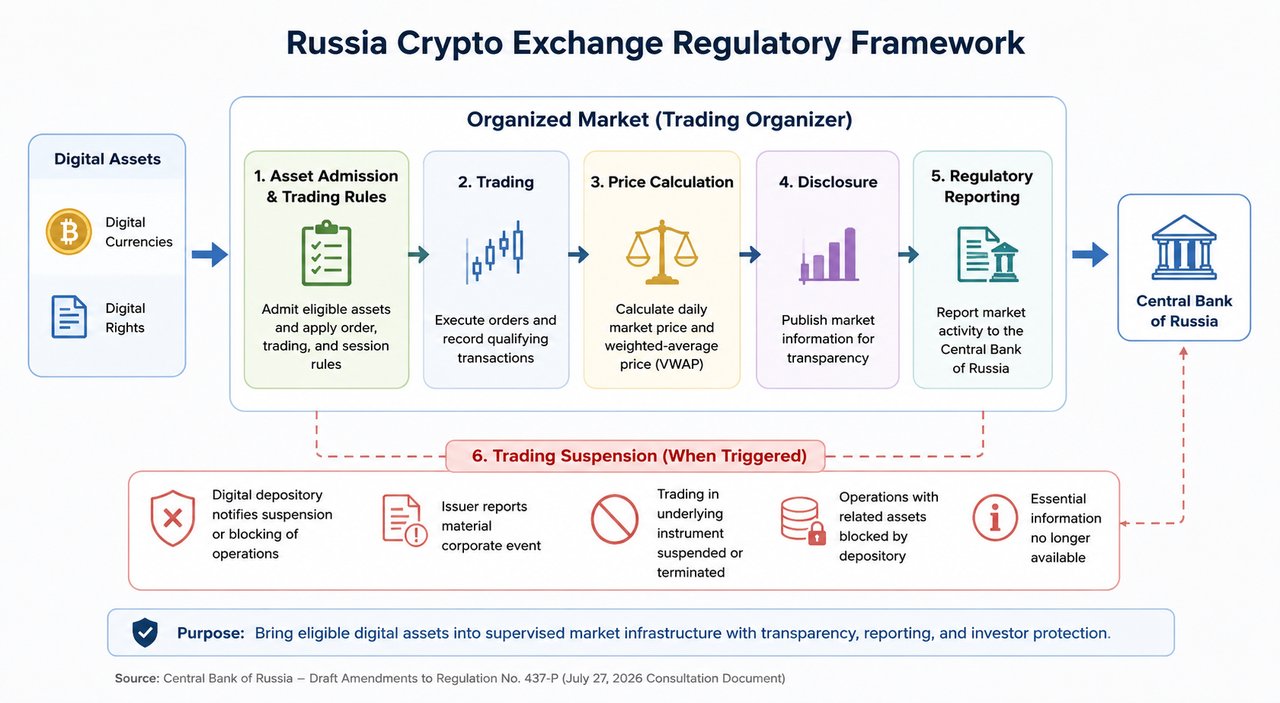
This means a regulated trading organizer would need documented procedures covering asset admission, orders, trading sessions, price calculations, market disclosures, regulatory reporting, and suspensions.
The proposal forms one part of the broader Russia cryptocurrency legal framework, which also covers issues such as ownership, mining, payments, taxation, investor eligibility, custody, and state supervision, including the fact that cryptocurrency is not recognized as legal tender in Russia even though a 2024 law allows crypto payments for international trade. It also sits apart from rules for crypto mining, which is regulated separately as part of the wider legal status analysis outside this exchange draft. Russia’s framework for digital financial assets is likewise distinct from exchange admission of digital currencies and is governed by separate rules.
Which Digital Assets Could Enter Organized Trading?
The proposed framework covers digital currencies and digital rights, but it does not automatically approve every cryptocurrency or blockchain-based instrument.
Each trading organizer would determine the applicable trading regime through its approved rules. The consultation draft creates the regulatory mechanism for admitting eligible assets, but it does not name Bitcoin, Ether, stablecoins, or other cryptocurrencies as automatically tradable.
| Asset category |
Role in the proposed framework |
Relevant market information |
| Digital currency |
May be admitted as an organized-trading instrument |
Market price, weighted-average price, order and transaction data |
| Digital right |
May trade as a legally recognized digital entitlement |
Trading data plus issuer and issuance information where applicable |
| Digital financial asset |
A regulated form of digital right issued through an authorized system |
Issuer, issuance decision, instrument, and system-operator details |
The distinction matters because digital financial assets are a regulated subset within the broader category of financial assets, and not every financial asset is automatically admitted to organized crypto trading. Whether cryptocurrency is legal in Russia in the Russian Federation depends on the activity involved, including ownership, exchange, mining, domestic payments, or cross-border settlement.
Core Rules for Crypto Exchanges and Trading Organizers
The draft concentrates on six operational areas: organized-market procedures, market pricing, volume-weighted pricing, disclosure, regulatory reporting, and trading suspensions.
Trading Must Follow Documented Market Rules
Each trading organizer would govern digital-currency and digital-rights trading through its approved organized-trading rules.
Those rules would determine how assets are admitted, how orders enter the market, which transactions qualify for official calculations, what information must be published, and when trading must stop, while in the broader regulated market model cryptocurrency exchanges would need to register with the Bank of Russia before facilitating cryptocurrency trading, and only platforms listed by the Bank of Russia could operate there as licensed intermediaries. During the transition period, existing market participants would likely need time to obtain authorization and adapt internal procedures under the new law, and regulated crypto services would be limited to licensed operators rather than unlicensed platforms.
This approach places covered crypto activity within a formal market structure rather than leaving each transaction to an informal bilateral arrangement.
Organizers Must Calculate a Market Price
Trading organizers would calculate a market price for digital currencies and digital rights for each applicable trading day.
The draft connects the calculation to qualifying transactions completed during the main trading session. These may include transactions based on anonymous orders under standard conditions and other order methods permitted by the organizer’s rules.
A standardized market price could support disclosure, reporting, valuation, and market monitoring. It would not guarantee that the price matches quotations on foreign exchanges, decentralized exchanges, peer-to-peer markets, or over-the-counter venues.
Organizers Must Calculate a Weighted-Average Price
The framework also requires a weighted-average price that reflects both transaction prices and traded quantities.
The calculation follows this structure:
Weighted-average price = total value of qualifying transactions ÷ total quantity traded
For example, consider the following illustrative transactions:
| Trade |
Price per unit |
Approximate USD value* |
Quantity |
Total transaction value |
| Trade 1 |
₽1,000 |
US$12.50 |
2 units |
₽2,000, or about US$25.00 |
| Trade 2 |
₽1,050 |
US$13.13 |
5 units |
₽5,250, or about US$65.63 |
| Trade 3 |
₽980 |
US$12.25 |
3 units |
₽2,940, or about US$36.75 |
| Total |
|
|
10 units |
₽10,190, or about US$127.38 |
Weighted-average price: ₽10,190 ÷ 10 = ₽1,019 per unit, or approximately US$12.74.
*The USD figures use an illustrative conversion rate of ₽80 per US$1 solely to help international readers understand the example. They are not official regulatory values or current foreign-exchange quotations.
Because larger transactions contribute more to the calculation, the result represents executed market activity more accurately than a simple average of the three quoted prices.
Trading organizers would disclose standardized information about digital-currency and digital-rights markets.
Depending on the instrument, the disclosure could include:
| Disclosure item |
Why it matters |
| Market price |
Provides a daily reference for organized trading |
| Weighted-average price |
Reflects transaction price and volume together |
| Number of contracts |
Shows transaction frequency |
| Contract volume |
Indicates the quantity or value traded |
| Best purchase and sale orders |
Shows current bid-and-offer conditions |
| Highest and lowest prices |
Displays the trading range |
| Issuer information |
Identifies the responsible party for issuer-backed digital rights |
Not every field applies to every digital asset. A decentralized digital currency may have no legally identifiable issuer, while a digital right may represent a claim created by a specific organization.
Organizers Must Report to the Central Bank of Russia
Trading organizers would provide information about covered digital-asset markets to the Central Bank of Russia.
This reporting channel would give the regulator greater visibility into organized crypto trading, including cryptocurrency transactions conducted through approved market infrastructure. Exchanges also face reporting requirements for crypto transactions over 600,000 rubles. Businesses must likewise report transactions above 600,000 rubles to tax authorities, and the federal financial monitoring service may also be relevant to oversight for anti-money-laundering monitoring.
The consultation document does not present every reporting field or submission schedule in consumer-facing detail. Those requirements may appear in technical standards, existing reporting rules, or the final adopted directive.
Trading Must Stop in Specified Situations
A trading organizer would suspend an affected digital currency or digital right when certain operational or market events occur.
The clearest trigger is a notification from a digital depository that operations involving an asset have been suspended or blocked.
Digital-rights trading could also be suspended when:
-
trading in the underlying instrument is suspended or terminated;
-
an issuer reports a material corporate event;
-
a digital depository reports that related asset operations are blocked;
-
information necessary for orderly trading is no longer available.
Licensed exchanges would also need anti-money laundering controls and KYC checks as part of mandatory compliance safeguards under Russian rules.
These controls are intended to prevent continued execution when custody records, underlying assets, settlement functions, or material issuer information no longer support an orderly market. This regulatory oversight is part of tighter regulation intended to reduce disorderly or opaque crypto market activity, and the suspension rules also matter because legal uncertainty around blocked operations or unavailable information can create immediate compliance and market-integrity risks.
How Would the Framework Affect Crypto Trading?
The framework would move covered crypto trading toward a model based on defined sessions, qualifying orders, official calculations, public market data, and regulatory supervision, shaping how institutions and traders can trade crypto within supervised organized markets, not just how venue operators run them.
Trading organizers could need systems for:
-
admitting qualifying digital assets;
-
processing permitted orders and transactions;
-
calculating market and weighted-average prices;
-
publishing market information;
-
reporting activity to the Central Bank;
-
suspending and restoring instruments.
That structure could also make traditional financial institutions more central because the model depends on approved market infrastructure. In practice, financial institutions investing in covered digital assets would likely rely on the same regulated venue, reporting, and pricing standards.
For traders, official market prices would be based on transactions that meet the organizer’s requirements. They would not necessarily include every blockchain transfer, offshore trade, decentralized-exchange swap, or peer-to-peer transaction.
The framework represents another stage in the development of Russia’s crypto regulation, which has gradually expanded from defining digital assets to building supervised trading, custody, mining, tax, and cross-border mechanisms.
When Could Crypto Trading Be Suspended?
Trading could be suspended when a digital depository, issuer, or underlying market reports an event that affects reliable execution.
A simplified process would be:
-
A digital depository or issuer identifies a qualifying event.
-
The relevant notice reaches the trading organizer.
-
The organizer suspends the affected asset or digital right.
-
Market participants receive the required information.
-
Trading resumes only when the applicable conditions are satisfied.
The draft does not establish one universal suspension period. It also does not fully explain how every organizer must handle open orders, pending settlements, deposits, or withdrawals during a suspension.
Those details may depend on the organizer’s rules, depository arrangements, and separate regulatory requirements.
What Does the Framework Not Cover?
The reviewed document does not establish every rule required for a complete cryptocurrency exchange regime.
Related new crypto rules are phased, and most take effect on September 1, 2026. It does not directly set:
-
a final list of eligible cryptocurrencies;
-
exchange-registration or licensing procedures;
-
investor tests or retail purchase limits, including the separate rules under which non-qualified investors may face a 300,000-ruble annual purchase cap;
-
minimum capital thresholds;
-
comprehensive custody requirements;
-
customer-asset segregation standards;
-
private-wallet withdrawal procedures;
-
crypto tax treatment;
-
domestic cryptocurrency payment rules;
-
staking, airdrop, or blockchain-fork treatment.
Here, retail investors, qualified investors, and other access categories fall under a separate investor-access regime outside this draft.
These areas require separate legislation, Central Bank regulations, or official guidance. A transition period runs until July 1, 2027, before licensed exchanges can operate in Russia under the new framework. Combining them with this trading draft would overstate what the document actually contains.
Russia’s rule-by-rule approach also differs from the European Union’s more consolidated Markets in Crypto-Assets regime. Comparing Russia’s crypto regulation with EU MiCA shows how Russia relies on multiple laws, experiments, and Central Bank instruments, while MiCA applies a common regional authorization and conduct framework.
Long-Term Implications for Russia’s Crypto Market
The framework could make organized crypto trading more transparent and easier to supervise, but its long-term impact will also depend on how these rules connect crypto markets to Russia’s broader financial systems.
| Stakeholder |
Possible long-term effect |
| Trading organizers |
Greater technology, disclosure, reporting, and compliance obligations |
| Digital depositories |
A formal role in communicating blocked or suspended operations |
| Institutional participants |
More standardized market data and trading procedures |
| Retail users |
Potential transparency benefits, subject to separate access rules |
| Central Bank of Russia |
Greater visibility into activity on organized digital-asset markets |
A regulated venue can still experience volatile prices, limited liquidity, technology failures, custody interruptions, or settlement problems. Regulatory admission should not be interpreted as a guarantee of asset quality, solvency, liquidity, or investment performance.
The final effect on Bitcoin, stablecoins, exchanges, and institutional participation will depend on licensing, eligible-asset standards, banking access, custody arrangements, and investor rules. These variables also shape the potential market impact of Russia’s crypto law. The consequences may extend beyond Russia because exchange access, settlement channels, and sanctions-related workarounds can influence global markets and inform policy debates in other countries.
Conclusion
Russia’s proposed crypto exchange rules establish a market-infrastructure model for organized trading in digital currencies and digital rights. Trading organizers would apply documented procedures, calculate standardized prices, disclose market information, report activity to the Central Bank of Russia, and suspend affected instruments when specified operational or issuer events occur.
The framework does not independently create a complete cryptocurrency exchange regime; separately from these exchange-market rules, the broader legal framework now legalizes cryptocurrency transactions for certain international-trade uses, while domestic cryptocurrency payments remain restricted. Asset eligibility, licensing, custody, investor access, taxation, payments, and private-wallet transfers remain subject to separate legislation or regulation.
Its lasting significance lies in the regulatory direction it reveals: Russia intends to bring eligible crypto activity into supervised market infrastructure while responding in part to foreign trade needs and western sanctions, especially for cross border payments, international settlements, and cross border trade under sanctions pressure.
FAQs
Are Russia’s crypto exchange rules already final?
No. The reviewed Central Bank of Russia document is a consultation draft rather than a final directive. A final version may differ after consultation, adoption, and official publication, and many related new rules are expected to take effect on September 1, 2026.
Does the framework approve Bitcoin or other cryptocurrencies?
No. The draft does not name specific approved cryptocurrencies. It creates a mechanism through which qualifying digital currencies and digital rights may enter organized trading, and separate standards may ultimately limit eligibility to the most liquid cryptocurrencies or other approved liquid cryptocurrencies even though this draft does not identify them.
How would a crypto exchange calculate a weighted-average price?
The organizer would divide the combined value of qualifying transactions by the total quantity traded. Larger trades would have a greater influence on the final price.
When could an exchange suspend crypto trading?
Trading could be suspended when a digital depository blocks asset operations or when specified events affect an underlying instrument, issuer, or digital right.
Does the draft regulate crypto custody?
Not comprehensively. Digital depositories appear in the suspension process, but the document does not establish a complete custody, asset-segregation, or capital framework.
What is the main purpose of Russia’s proposed exchange rules?
The main purpose is to integrate eligible digital currencies and digital rights into Russia’s organized financial-market system through standardized trading, pricing, disclosure, reporting, and suspension procedures. The organized-market model could also shape which credit institutions and other licensed intermediaries eventually provide crypto services under the legal framework, including how fiat currencies may later interface with digital assets in regulated market infrastructure. Its broader legal status also now includes a 2024 law allowing crypto payments for international trade, even though domestic use remains more limited. This matters to russian residents seeking legal in Russia access through supervised venues rather than unlicensed offshore platforms.







