In late November 2026, Nvidia reached a proposed settlement in a shareholder class action lawsuit dating back to 2018 concerning cryptocurrency mining demand and the disclosure of gaming GPU revenue. The event has renewed market attention on Nvidia’s historical growth cycles and the true sources of GPU demand.
Nearly a decade ago, cryptocurrency mining drove rapid growth in GPU demand. However, as digital asset prices fell and mining profitability declined, the graphics card market subsequently experienced excess inventory and a demand adjustment. Today, Nvidia is once again at the center of the global expansion of computing infrastructure, but the source of demand has shifted from cryptocurrency mining to artificial intelligence.
Both cycles featured rapid growth in GPU demand, tight hardware supply, and significant capital investment. However, the economic mechanisms behind them differ substantially. Understanding these differences can help assess the sustainability of current AI computing demand and the potential industry-cycle risks Nvidia may face in the future.
Key Takeaways
-
The two periods of GPU demand growth had different economic foundations: The cryptocurrency mining cycle was driven primarily by digital asset prices and mining profitability, while the AI computing cycle depends more on corporate capital expenditures, model development, and demand for commercial applications.
-
The customer mix has changed significantly: Cryptocurrency mining demand came mainly from individual miners and mining farms, while AI computing demand is now concentrated more among cloud computing giants, AI model companies, and data center operators.
-
AI infrastructure has a longer investment cycle: Compared with mining equipment purchases, AI computing deployments involve servers, networking, power, and data center construction, making the demand transmission mechanism more complex.
-
Growth in hardware sales does not necessarily mean that end-user demand is growing at the same pace: Advance purchases, computing-capacity reserves, and infrastructure expansion may cause GPU sales to temporarily outpace actual application demand.
-
The AI computing cycle still faces the risk of supply-demand imbalances: If revenue from intelligent services fails to match infrastructure investment, declining computing utilization and reduced capital expenditures could still affect Nvidia’s business growth.
Why Did Cryptocurrency Mining Once Drive Rapid Growth in Nvidia GPU Demand?
GPUs were originally used primarily for graphics rendering and gaming graphics processing, but their parallel computing capabilities also made them suitable for mining certain proof-of-work blockchains. Compared with traditional CPUs, GPUs can perform large numbers of similar calculations simultaneously. As a result, they were widely used on Ethereum and other cryptocurrency networks that supported GPU mining.
In 2017, as the prices of Ethereum and other crypto assets rose rapidly, the potential profitability of GPU mining increased significantly. Large numbers of miners began purchasing consumer-grade graphics cards and expanding their computing capacity by assembling mining rigs. It is important to note that Bitcoin mining had already shifted primarily to specialized ASIC equipment at that time. The main drivers of consumer-grade GPU demand were Ethereum and other crypto assets that remained suitable for GPU mining.
For miners, purchasing GPUs was essentially an equipment investment based on future mining revenue. As long as expected mining revenue could cover electricity, equipment purchases, and other operating costs, miners could continue expanding their computing capacity.
Rising token prices, improved expectations for mining profitability, and increased equipment purchases created an interconnected demand-expansion process. However, gamers and cryptocurrency miners could purchase graphics cards through the same sales channels, making it difficult to fully distinguish their actual end uses in sales data and creating challenges in assessing the sustainability of gaming-business growth.
Why Did the 2018 Cryptocurrency Mining Downturn Lead to a GPU Inventory Crisis?
Cryptocurrency mining demand is highly price-sensitive. When digital asset prices rise, miners are willing to invest more capital in equipment. When token prices fall, the payback period for mining operations can lengthen rapidly.
Suppose a GPU mining rig generates $20 in mining revenue per day. After deducting $5 in direct operating expenses, the remaining daily profit is $15. If the equipment costs $3,000, the simple static payback period would be approximately 200 days. However, if daily revenue falls to $8 while direct expenses remain unchanged, daily profit would decline to $3, extending the static payback period to 1,000 days.
When large numbers of miners face similar conditions, demand for new GPUs can decline rapidly. At the same time, some miners may sell graphics cards they have already purchased on the secondary market to recover capital. This places simultaneous pressure on the graphics card market from falling demand for new equipment and increasing supplies of used equipment.
After the cryptocurrency market entered an adjustment phase in 2018, mining equipment purchases gradually weakened, and some sales channels experienced excess inventory. The additional hardware supply created to meet high growth demand could not be fully absorbed immediately by gamers and other users.
In 2022, the U.S. Securities and Exchange Commission (SEC) reached an administrative settlement with Nvidia concerning disclosures related to cryptocurrency mining demand during certain quarters of fiscal 2018. Nvidia agreed to pay a $5.5 million penalty without admitting or denying the regulator’s findings.
This historical event highlights an important issue in the semiconductor industry: Even when hardware sales genuinely occur, companies and investors may overestimate the sustainability of revenue growth if they cannot accurately identify the source of demand.
How Do the Sources of Demand Differ Between the AI Computing Cycle and the Cryptocurrency Mining Cycle?
Both cryptocurrency mining and artificial intelligence require substantial computing resources, but they create economic value in different ways.
Cryptocurrency mining revenue comes primarily from block subsidies and transaction fees. For miners, the commercial value of computing resources is directly related to crypto asset prices, mining difficulty, electricity costs, and network reward mechanisms.
AI computing is used primarily for model training, inference services, and other high-performance computing tasks. The commercial activities supported by GPUs span software development, enterprise automation, financial research, scientific computing, content generation, and AI agent applications.
An AI company may purchase GPUs to train the next generation of foundation models or to meet existing customer demand for model inferences. Cloud computing platforms can generate revenue through computing-capacity rentals, model APIs, enterprise software, and infrastructure services.
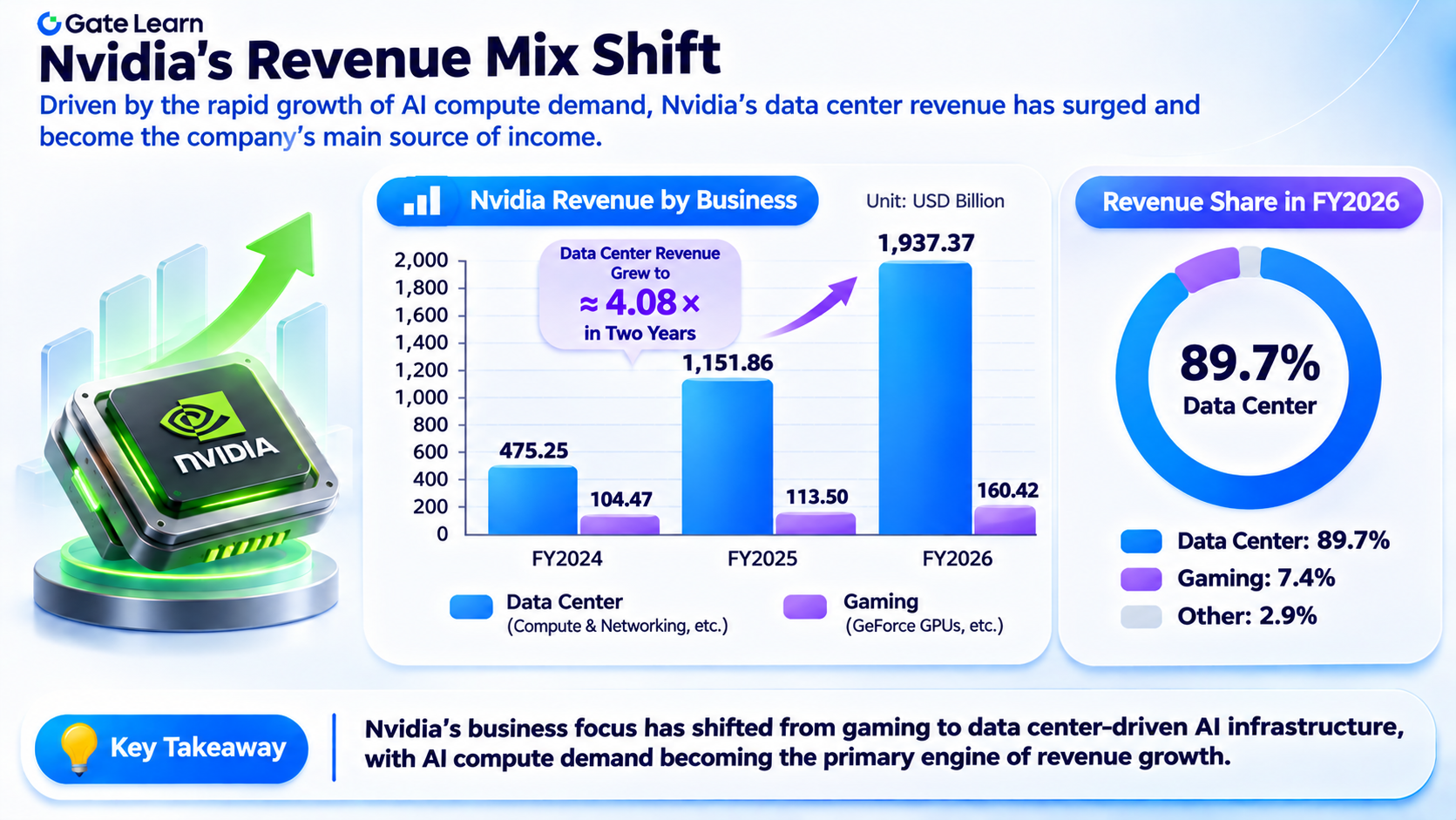
Nvidia’s financial structure already reflects this shift in demand. In fiscal 2024, its Data Center revenue was approximately $47.525 billion. This increased to $115.186 billion in fiscal 2025 and reached $193.737 billion in fiscal 2026, approximately 4.08 times the fiscal 2024 level within two years.
In the fiscal year ended January 25, 2026, Data Center revenue accounted for approximately 89.7% of Nvidia’s total revenue, while gaming revenue was approximately $16.042 billion.
Compared with the cryptocurrency mining boom, when demand was reflected primarily through the consumer-grade graphics card market, current growth is concentrated in data center computing and networking. However, the broader range of AI applications does not mean that every computing-capacity purchase corresponds to realized end-user demand. Some purchases are still based on expectations of future market growth.
Why Are the Customer Structures of the Two GPU Demand Cycles So Different?
During the cryptocurrency mining boom, potential GPU buyers included individual miners, small and midsize mining farms, and professional mining companies. These customers typically decided whether to expand equipment investment based on mining profitability and could adjust their purchase volumes relatively flexibly.
The primary customers in the AI computing market are more concentrated among large enterprises, including technology companies such as Microsoft, Amazon, Google, and Meta, as well as frontier AI model companies, specialized computing cloud service providers, and data center operators. Their equipment investments typically involve multiyear capital expenditure budgets, long-term computing-capacity partnerships, and data center construction plans.
The financial strength and long-term investment plans of large enterprises can improve the stability of some computing-capacity orders. However, customer concentration also means that changes in the capital expenditures of a small number of major technology companies could have a significant impact on the entire AI infrastructure industry.
In fiscal 2026, two of Nvidia’s direct customers each accounted for 22% and 14% of the company’s total revenue, respectively, for a combined share of 36%. The related revenue came primarily from the Computing & Networking business. This demonstrates the importance of large customers in Nvidia’s current revenue structure.
In addition, the direct purchaser of a GPU is not necessarily its end user. A server manufacturer may purchase GPUs and assemble servers, after which a cloud computing company may purchase those servers to build computing clusters. An AI model company may ultimately rent the computing capacity to provide commercial services.
Therefore, analyzing AI GPU demand requires distinguishing among hardware purchasers, computing-capacity operators, and end users who ultimately pay for the service. Whether end-user demand can continue generating economic returns will directly affect the stability of purchasing activity across the industry chain.
Why Does the AI Computing Cycle Involve More Complex Infrastructure Investment?
Deploying cryptocurrency mining equipment primarily involves mining rigs, power supplies, cooling systems, and site operations. Although large mining farms also require significant infrastructure investment, GPU mining rigs can generally be expanded in a relatively modular manner.
AI data centers require more complex system coordination. When training large foundation models, large numbers of GPUs must be connected into computing clusters through high-speed interconnect technologies. In addition to computing chips, companies also need to configure high-bandwidth memory (HBM), servers, high-speed networking equipment, storage systems, power facilities, and liquid-cooling systems.
This means that bringing an AI data center into operation depends on more than the delivery of GPUs. It is also affected by factors such as power-grid access, construction, communications networks, and software-system deployment.
Nvidia’s business has consequently expanded beyond the standalone sale of GPUs to include computing platforms, networking, and software ecosystems.
In fiscal 2026, Nvidia’s Data Center Compute revenue was approximately $162.361 billion, while Networking revenue was approximately $31.376 billion. Networking revenue grew approximately 142% from the previous fiscal year and has become an important component of the Data Center business.
A more complex infrastructure system can make it more difficult for customers to migrate to other computing platforms and expand the range of industry value in which Nvidia can participate. However, it also gives the AI computing cycle a longer capital investment and payback period.
If data center construction falls behind schedule, equipment utilization is lower than expected, or market demand changes, related risks may gradually spread across the industry chain.
Why Does Growth in GPU Sales Not Necessarily Represent Synchronous Growth in Actual AI Demand?
The semiconductor industry generally needs to schedule production based on future demand, while large technology companies also need to purchase computing resources before shortages occur. As a result, there may be a significant time lag between GPU sales revenue and the actual use of computing capacity by end users.
For example, a cloud computing company may expect AI inference demand to grow rapidly over the next two years and therefore purchase a large number of GPUs in advance while building a new data center. For Nvidia, the equipment sales may already qualify for revenue recognition. For the cloud computing company, however, the equipment still needs to be installed, deployed, and delivered to customers before the company can generate revenue through computing-capacity rentals or other commercial services.
If future AI usage reaches expectations, the equipment may achieve high utilization and gradually generate sufficient operating cash flow. Conversely, if enterprise customers expand more slowly than expected, the equipment purchased in advance may remain idle.
During periods of supply shortages, customers may also place orders early, increase safety stock, and secure future production capacity. These purchasing decisions may serve legitimate supply-chain management purposes, but they cannot be considered entirely equivalent to current end-user demand.
This is somewhat similar to the earlier cryptocurrency mining cycle. Both cycles may see equipment purchases grow faster than actual usage demand. However, the supply-demand imbalance in the AI computing market is more complex, and the risks may emerge gradually over a longer period.
Can AI Inference Demand Become a More Stable Growth Driver for the GPU Market?
Unlike cryptocurrency mining, AI computing demand can be further divided into two primary stages: training and inference.
Model training is used to develop and improve AI models and requires large amounts of computing resources during specific periods. Inference occurs when users actually interact with models, including activities such as generating text, analyzing files, writing code, and executing AI agent tasks.
As AI becomes increasingly integrated into daily enterprise operations, inference services may create more persistent computing demand. If more companies integrate AI into software development, customer service, and internal business systems, computing consumption could expand from periodic model-development activity into an ongoing operating expense.
However, determining whether inference demand can support long-term GPU market growth also requires consideration of changes in computing efficiency. As model quantization, low-precision computing, model routing, and specialized inference chips continue to develop, the computing resources required to complete the same task may gradually decline.
If computing demand per task decreases but the number of AI applications and the frequency of usage grow faster, overall computing demand may continue to expand. Conversely, if efficiency improvements outpace the growth of new demand, demand for some computing resources could be affected.
Therefore, future growth in the AI computing market will depend not only on improvements in model capabilities but also on how much new application demand can be created by improvements in computing efficiency.
Could an AI Commercialization Shortfall Trigger Another GPU Inventory Crisis?
Although the AI computing cycle differs significantly from the cryptocurrency mining cycle, the semiconductor industry itself remains cyclical in terms of supply and demand.
When the market expects future demand to grow rapidly, chip companies, server manufacturers, and data center operators may expand capacity simultaneously. Because construction and delivery cycles differ across the various segments, new supply may enter the market in concentrated waves at some point in the future. If AI application demand fails to keep pace with infrastructure expansion at that time, the industry chain could face excess supply.
This risk may not initially appear as excess GPU inventory. It could also gradually emerge through other operating indicators.
For example, declining GPU rental prices at cloud computing companies, insufficient data center utilization, reductions in long-term computing-capacity purchases by AI model companies, or delays in some infrastructure projects could all indicate changes in the supply-demand relationship for computing capacity.
For companies that use debt financing to build data centers, declining computing revenue could also affect their debt-servicing ability and subsequent capital expenditures. In addition, AI chips are updated rapidly. If a new generation of equipment can deliver higher computing efficiency at a lower cost, the rental prices and asset values of older-generation equipment could also be affected.
Compared with the consumer-grade graphics card inventory problem in 2018, a potential adjustment in AI computing capacity could involve server assets, data center utilization, long-term purchase contracts, and infrastructure financing to a greater extent.
However, a supply-demand adjustment does not mean that AI technology itself has lost its value. Long-term industry development and excessive short-term capital investment can coexist.
How Can Investors Assess Whether Nvidia’s Current GPU Demand Is Sustainable?
Rather than focusing solely on Nvidia’s revenue growth rate or the size of major technology companies’ capital expenditures, it is more important to observe whether computing demand can create a complete economic-return mechanism. The following areas can serve as reference points for long-term monitoring.
-
End-user AI revenue. Whether model APIs, enterprise software, AI agent services, and other AI applications can continue to attract paying demand will affect the long-term returns on infrastructure investment.
-
GPU utilization and rental prices. If hardware supply continues to grow while actual utilization and rental prices decline significantly, this may indicate that some computing resources are beginning to face a supply-demand imbalance.
-
Order delivery and customer capital expenditures. It is necessary to distinguish between long-term purchase plans, actual equipment deliveries, and recognized revenue while also monitoring changes in the investment budgets of major technology companies.
-
Customer profitability and cash flow. If AI companies rely on external financing over an extended period to pay for computing capacity, their ability to cover operating costs through revenue growth will affect their subsequent purchasing capacity.
-
Hardware substitution and computing efficiency. Specialized AI chips, model optimization, and changes in software ecosystems could alter the demand structure for different types of GPUs and further affect Nvidia’s competitive position.
In Gate’s Nvidia Stock-related trading and TradFi product offerings, users can consider corporate financial reports, industry-chain orders, changes in capital expenditures, and market price performance to further understand the impact of the AI computing cycle on stock valuations. The asset exposure, trading mechanisms, and risks of different trading products still need to be assessed separately.
For Nvidia, the sustainability of future growth will depend not only on whether GPUs remain in short supply but also on whether the GPUs purchased by customers can create sufficient economic value to generate the next round of genuine equipment demand.
Summary
From cryptocurrency mining to artificial intelligence, Nvidia has experienced two periods of industry expansion driven by emerging computing demand. The cryptocurrency mining cycle depended primarily on digital asset prices and miner profitability, while the AI computing cycle is built on a more diverse foundation that includes model development, enterprise digitalization, and the commercialization of intelligent services.
AI computing has a more complex infrastructure system, a broader range of potential applications, and longer-term enterprise investment plans. However, it cannot entirely escape the semiconductor industry’s supply-demand cycle. Equipment purchases that outpace end-user demand, excessive capital expenditure expansion, and changes in asset values caused by technological iteration could all affect future industry growth.
The GPU inventory adjustment in 2018 offers an important historical reference: Assessing the long-term value of a hardware company requires more than examining how many products it sells. It also requires understanding the scenarios in which those products are ultimately used and whether the related demand can generate sustainable economic returns.
FAQ
Why Did Cryptocurrency Mining Once Drive Growth in Nvidia Graphics Card Sales?
The parallel computing capabilities of GPUs made them suitable for some proof-of-work blockchains. As the prices of Ethereum and other crypto assets rose, miners purchased large numbers of consumer-grade graphics cards to expand their mining capacity.
Does Bitcoin Mining Still Mainly Use GPUs?
No. Bitcoin mining currently relies primarily on specialized ASIC mining machines. The main drivers of GPU mining demand in the past were Ethereum and other crypto assets that were suitable for GPU mining.
What Is the Main Difference Between Cryptocurrency Mining Demand and AI Computing Demand?
Cryptocurrency mining demand is driven mainly by token prices and mining profitability, while AI computing demand depends more on model development, corporate capital expenditures, and end-user commercial applications.
Could the AI Computing Market Also Experience Excess GPU Supply?
It could. If infrastructure construction grows faster than end-user AI demand, some computing resources could experience declining utilization, falling rental prices, and reduced purchasing demand.
Will Improved AI Inference Efficiency Reduce GPU Demand?
Not necessarily. Greater efficiency can reduce computing consumption per task, but it can also lower usage costs and expand the scale of AI applications. The ultimate impact will depend on the relative growth rates of these two factors.
How Can the Sustainability of AI Computing Demand Be Assessed?
Investors can conduct a comprehensive analysis based on end-user AI revenue, GPU utilization, computing-capacity rental prices, technology companies’ capital expenditures, and the cash flow performance of related companies.