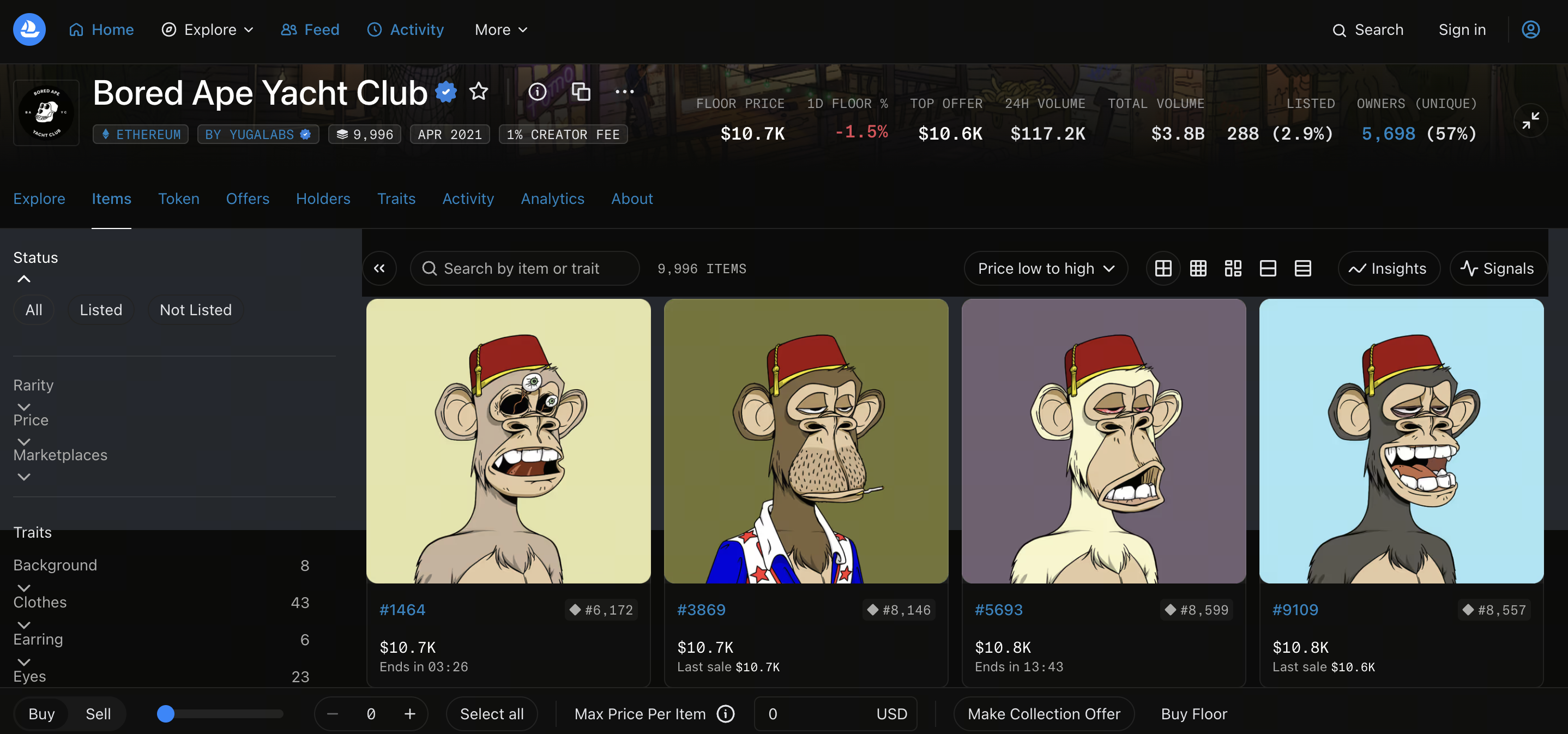
Digital profile picture collections such as CryptoPunks and Bored Ape Yacht Club (BAYC) achieved extremely high valuations through limited issuance, community identity, and celebrity influence. Some individual NFTs sold for millions of dollars. For a time, digital profile pictures evolved from internet collectibles into symbols of wealth, identity, and crypto culture.
However, the NFT market boom did not last. As crypto market liquidity contracted, speculative demand declined, and projects fell short of their commercialization expectations, once-popular blue-chip NFTs gradually entered a prolonged correction. In November 2026, the floor prices of some blue-chip NFTs rebounded briefly, but most well-known collections remained far below their historical highs. The market began to confront a question once again: As celebrity influence, wealth expectations, and community interest gradually fade, what should determine the value of NFTs?
The rise and decline of the NFT market represent more than a price cycle for crypto assets. They also reflect the complex relationship between digital scarcity, cultural consumption, and financial speculation. This article reviews the NFT market's evolution from rapid growth to stagnation, analyzes why the valuation system for blue-chip NFTs failed, examines how liquidity accelerated price declines, and explores whether digital collectibles can establish a more sustainable basis for value after the speculative boom.
Key Takeaways
-
NFTs rose rapidly in 2021–2022, driven by the combined effects of wealth creation in the crypto market, demand for digital identity, celebrity participation, and expanding liquidity.
-
The high valuations of blue-chip NFTs came not only from technical scarcity, but also from community consensus, cultural influence, and expectations of future demand.
-
NFTs are non-fungible assets with discontinuous trading and limited market depth. Floor prices cannot directly represent the realizable value of an entire collection.
-
NFT trading volume reached approximately $57.2 billion in 2022, then declined to approximately $13.7 billion in 2024, showing a significant contraction in market activity.
-
The floor prices of some blue-chip NFTs have recently rebounded, but short-term price increases do not mean that the number of buyers, trading depth, and long-term demand have recovered.
-
The future of NFTs may depend more on digital culture, IP commercialization, collecting demand, and tangible rights than on scarcity and speculative narratives alone.
Why Did NFTs Become a Global Crypto Market Phenomenon in 2021?
The rapid rise of NFTs was not the result of a single technological innovation. It was driven by the combined effects of a crypto asset bull market, the spread of digital culture, and speculative capital. From 2020 to 2021, global financial markets experienced an environment of abundant liquidity, while crypto asset prices rose sharply and some investors accumulated substantial on-chain wealth. At the same time, DeFi, on-chain trading, and digital wallets became increasingly popular, providing the technological and financial foundation for issuing, purchasing, and reselling NFTs.
NFTs created a new asset narrative for the crypto market. Unlike fungible tokens such as Bitcoin and Ethereum, each NFT can have a unique identifier, metadata, and transaction history. For digital artists, this structure provides a way to publicly record the provenance of a work and transfers of ownership. For collectors, NFTs combine digital collecting, identity display, and on-chain asset trading, giving digital images that could otherwise be copied infinitely a distinguishable on-chain identity.
More importantly, NFTs soon moved beyond simple digital art transactions. Profile picture collections such as CryptoPunks and BAYC linked NFT ownership to community identity. Some holders displayed their profile pictures on social media to express their identification with crypto culture. Celebrity purchases, brand partnerships, and social media exposure further expanded market attention, taking NFTs from niche collectibles into mainstream discussion.
Market data reflected the speed of this growth. In 2021, trading volume on major NFT marketplaces rose rapidly, with platforms such as OpenSea becoming important gateways for digital collectible transactions. In 2022, annual NFT trading volume reached approximately $57.2 billion, a historical high. However, this growth included a combination of genuine collecting demand, speculative trading, and market incentives. It cannot simply be interpreted as evidence that every transaction represented a long-term intention to hold.
The most important change during this period was that NFTs evolved from a technology for recording digital assets into a speculative collectibles market capable of carrying wealth expectations and social identity.
How Did CryptoPunks and BAYC Establish an Identity Premium for Blue-Chip NFTs?
Blue-chip NFTs generally refer to collections with high market recognition, a long trading history, strong community influence, and relatively high market valuations. CryptoPunks and BAYC are representative examples. However, the term blue-chip does not imply the profitability or stability of blue-chip companies in the stock market, nor does it provide any assurance that asset prices will be protected.
CryptoPunks launched in 2017 and consists of 10,000 pixel-style characters. Because it entered the Ethereum NFT ecosystem early and has a fixed supply and recognizable visual characteristics, it gradually acquired historical status as a digital cultural collectible. For some collectors, the value of CryptoPunks lies not only in the images themselves, but also in their status as early symbols of on-chain culture.
BAYC launched in 2021 and likewise consists of 10,000 limited-edition profile pictures, but it placed greater emphasis on community organization, brand promotion, and holder benefits. At one point, owning a BAYC was viewed as a symbol of entry into a particular crypto social circle. As celebrity purchases and brand exposure increased, NFT market prices began to include a significant identity premium. Some buyers were purchasing not merely digital images, but expectations of community status, future benefits, and potential resale gains.
This pricing mechanism bears some similarities to traditional collectibles markets. Artworks, limited-edition sneakers, and luxury goods can all command premiums because of scarcity, cultural status, and social recognition. NFTs differ in that their prices can be displayed in real time through on-chain transactions and marketplace listings, making collectibles easier to financialize. As market prices continued to rise, the wealth effect among holders attracted more new buyers, creating a positive feedback loop of rising prices, increased attention, and further purchases.
The problem is that an identity premium requires sustained social attention and cultural recognition. When market interest declines and fewer buyers are willing to pay high prices for an identity symbol, limited supply alone cannot guarantee that the original valuation will be maintained.
Why Did the Technical Scarcity of NFTs Fail to Translate Into Stable Long-Term Value?
One of the most common value narratives for NFTs is digital scarcity. Blockchain technology can record an NFT's unique identifier, issuance volume, and transfer history, causing the supply of tokens in a particular collection to be governed by smart contract rules. For example, a collection with a total supply of 10,000 NFTs can maintain a relatively clear token count as long as its issuance rules remain unchanged.
However, technical scarcity and economic scarcity are not the same concept. Technical scarcity indicates that a token identifier has verifiable uniqueness. It does not mean that the corresponding image, cultural symbol, or utility is irreplaceable. Digital images themselves can generally still be copied and distributed, while new NFT collections can continue to emerge. Even if a project's supply is fixed, the total number of digital collectibles available across the market may continue to increase.
More importantly, the price of a scarce asset requires demand. Even if an item is the only one in the world, it cannot achieve a high valuation through scarcity alone if no one is willing to buy it. During the NFT bull market, some projects used limited issuance, whitelists, and community marketing to create expectations of scarcity, leading buyers to believe that more people would be willing to purchase the assets at higher prices in the future. However, when the number of new buyers declines, this pricing logic based on resale expectations can quickly fail.
NFTs also do not necessarily generate sustainable cash flow. Stocks can establish a valuation basis through corporate profits and dividends, while bonds can generate returns through interest and principal repayment. Most profile picture NFTs, however, do not directly represent corporate ownership, rights to income distribution, or an enforceable claim to cash flow. Their value is closer to that of collectibles and cultural assets, relying primarily on market preferences, historical status, and the expectations of buyers and sellers regarding future demand.
The core issue revealed by the NFT market correction is therefore not that blockchain cannot create scarcity. Rather, scarcity cannot automatically create economic value. Scarcity can become part of a long-term valuation only when collecting demand, cultural recognition, or tangible rights can persist.
Why Is NFT Market Liquidity More Fragile Than That of Ordinary Cryptocurrencies?
An important feature of the NFT market is non-fungibility. Even NFTs from the same collection may have different values because of their rarity traits, visual characteristics, transaction histories, and holder profiles. This makes it difficult for NFTs to form continuous market prices through a unified order book in the same way as fungible assets such as BTC and ETH.
In most NFT marketplaces, the floor price generally refers to the lowest publicly listed price currently available for a collection. It is not the average sale price of all NFTs, nor does it mean that holders can immediately sell all their assets at that price. For example, suppose a collection contains 10,000 NFTs and has a current floor price of 10 ETH. If only a small number of buyers are truly willing to purchase near that price, large-scale selling could cause transaction prices to fall rapidly.
This liquidity structure is easy to overlook when the market is rising. During a bull market, a steady stream of new buyers can absorb sell orders, while a rising floor price reinforces the perception that the value of the entire collection is increasing. When capital withdraws, however, buy quotes may quickly disappear, forcing sellers to continuously lower their listing prices to complete transactions. Because NFTs lack sufficient continuous trading depth, a small number of low-priced sales can significantly change the market's valuation of an entire collection.
NFTs also face a divergence between floor prices and actual trading volume. If a collection's floor price rises by 20% but only a few transactions occur during the same period and the number of unique buyers does not increase significantly, the rise may have resulted merely from the cancellation of low-priced listings or purchases by a small number of buyers. It does not necessarily indicate that overall market demand has recovered.
When analyzing NFT prices, it is therefore necessary to examine floor prices, actual sale prices, trading volume, bid-ask spreads, listing volume, and unique trading addresses together. For collections with limited liquidity, the floor price is more suitable as an indicator of market sentiment than as a complete basis for asset valuation.
How Did NFT Market Consensus Collapse, From Celebrity Hype to Shrinking Trading Volume?
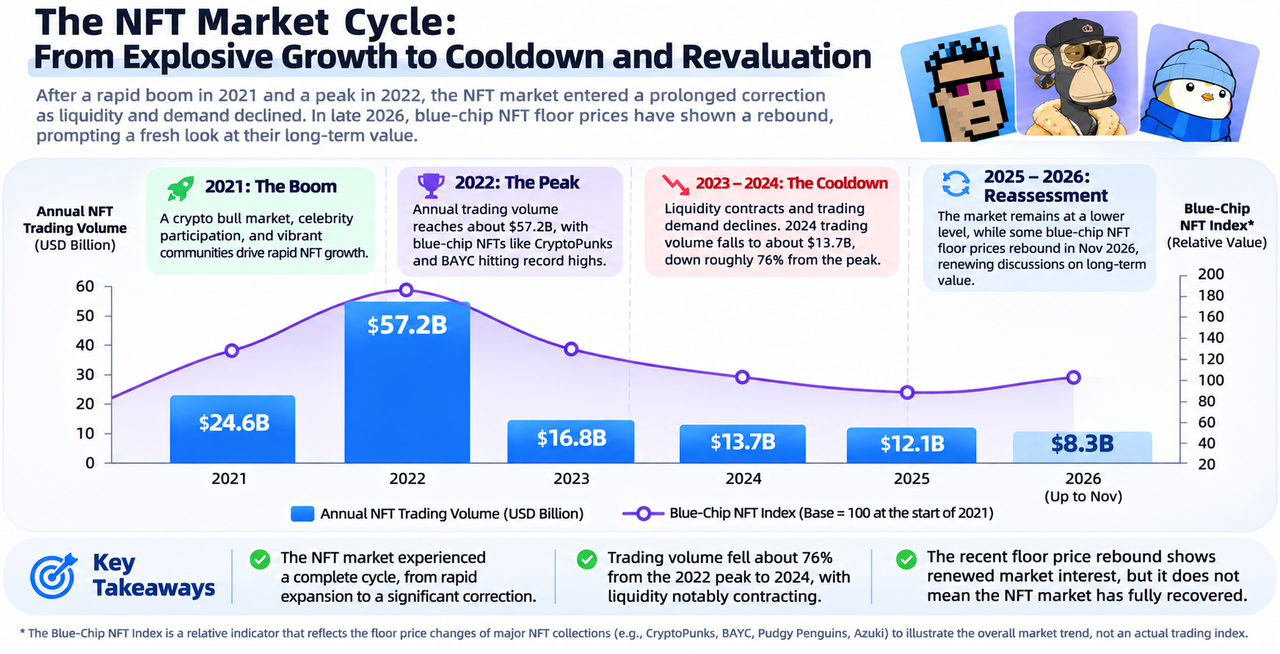
The decline of the NFT market was initially linked to changes in the macro liquidity environment. In 2022, global financial markets entered a period of tighter monetary policy, crypto asset prices underwent a significant correction, and investor risk appetite declined. For NFTs that depended heavily on market sentiment and new capital, contracting liquidity meant fewer buyers were willing to take on the risks of high-priced collectibles. The market began shifting from pursuing scarce assets to reassessing their actual value.
At the same time, the commercialization challenges facing NFT projects gradually became apparent. During the bull market, many projects developed long-term plans around the metaverse, games, community benefits, and brand partnerships. These businesses, however, often required continued investment and operational resources. Some projects failed to launch products as expected, while others released applications that did not attract enough users, causing holders to reassess the long-term demand for their NFTs.
Market trading data reflected this change. Annual NFT trading volume was approximately $57.2 billion in 2022, declined to approximately $16.8 billion in 2023, and fell further to approximately $13.7 billion in 2024. Compared with 2022, trading volume in 2024 decreased by approximately 76%. This indicates that the NFT market experienced more than a short-term price correction. Overall trading activity and capital participation contracted significantly.
Trading incentive mechanisms also affected how some historical trading volumes should be interpreted. Some NFT marketplaces previously attracted traders through token rewards, meaning that trading activity may have been driven not only by collecting demand but also by expectations of incentive returns. As incentives declined, some trading demand may have disappeared as well. Historical high trading volumes therefore do not necessarily correspond entirely to stable end-user collecting demand.
The collapse of market consensus did not occur suddenly on a single day. It gradually developed as asset prices declined, confidence in projects' ability to deliver was questioned, and the number of new buyers fell. When holders discovered that high-priced NFTs were difficult to sell quickly, market confidence that had originally depended on the wealth effect came under further pressure.
Why Did Some NFT Projects Gradually Disappear While Others Maintained Their Brand Influence?
The overall correction in the NFT market does not mean that every project followed exactly the same path. Well-known collections such as CryptoPunks, BAYC, and Pudgy Penguins differ significantly in their historical status, brand operations, and business models. Understanding these differences can help assess whether the long-term value of NFTs can become independent of simple trading prices.
CryptoPunks' core advantages come primarily from its historical status and cultural scarcity. As an early on-chain profile picture collection, it has a high level of recognition in NFT history. This value logic is somewhat similar to that of traditional art collecting, emphasizing provenance, cultural influence, and collector consensus rather than the continuous launch of large numbers of new products.
BAYC has attempted to build a broader brand and entertainment ecosystem around NFTs, including community events, games, and virtual worlds. This model can expand a project's commercial potential, but it also raises market expectations for operational results. If user growth and commercial revenue from related products fail to meet expectations, the market price of the NFTs may be affected.
Pudgy Penguins demonstrates another development path. The project has gradually expanded the penguin characters into physical toys, retail channels, and brand licensing, seeking to turn the NFT characters into IP for ordinary consumers. Compared with a model that relies primarily on on-chain trading, this strategy may reach users who do not hold crypto wallets, making brand influence less dependent on the NFT secondary market.
However, successful brand commercialization does not mean that NFT holders can directly share in all economic benefits. Whether toy sales, licensing revenue, and brand valuation can flow through to NFT prices depends on the rights actually held by holders, the project's revenue-sharing mechanism, and market demand. Even if an NFT brand makes progress in the real-world commercial sector, it does not automatically follow that its digital collectibles deserve a higher valuation.
Therefore, the key differences among NFT projects in the future may no longer be limited to community size and floor price. Instead, they may depend on whether their cultural influence, product capabilities, and holder rights are sustainable over the long term.
Do the Recent Rebounds in Blue-Chip NFT Floor Prices Mean the Market Is Recovering?
In November 2026, some blue-chip NFTs experienced short-term rebounds in their floor prices, drawing renewed attention to this long-depressed asset category. However, short-term gains need to be viewed over a longer time horizon. Data from a blue-chip NFT composite price tracker on November 18 showed that the relevant index rose approximately 0.85% in a single day, but it was still down approximately 12.60%, 25.71%, and 46.08% over the past 7 days, 30 days, and one year, respectively. This shows a clear difference between a localized rebound and the long-term trend.
Different NFT collections also performed differently. CryptoPunks, BAYC, Pudgy Penguins, and Azuki may have experienced gains or losses of varying magnitudes during the same period, reflecting differences in market preferences for historical status, brand operations, and liquidity. The rise of a few individual collections is therefore not enough to conclude that the entire NFT market has entered a new bull market.
Determining whether the NFT market has truly recovered requires observing whether trading volume continues to grow. If a rising floor price is accompanied by more unique buyers, a higher number of transactions, and improved bid-side depth, the price change may have a stronger demand foundation. Conversely, if the increase is driven mainly by a small number of high-priced sales or the cancellation of low-priced listings, market liquidity may remain fragile.
Performance denominated in ETH should also be compared with performance denominated in dollars. NFT floor prices are usually expressed in ETH, but investors may ultimately focus more on the value of the asset in dollars. For example, if a collection's floor price rises from 2 ETH to 2.2 ETH, a 10% increase, but the U.S. dollar price of ETH falls by 15% during the same period, the NFT's dollar-denominated floor price would actually decline by approximately 6.5%. Therefore, an increase in the ETH-denominated price does not necessarily mean that holders have generated dollar returns.
It is also necessary to monitor whether market activity is spreading from a small number of blue-chip collections to broader NFT categories. If only a few historically prominent projects rebound while overall trading volume, the number of unique buyers, and demand for new projects remain weak, the change is more likely to represent a structural market movement than a broad recovery.
Must NFTs Move Beyond Digital Profile Pictures and Speculative Narratives?
After a prolonged market correction, one important change has been increased attention to the boundary between technological applications and asset speculation. NFTs can be used to record digital collectibles, in-game items, memberships, and other uniquely identified assets. However, whether these applications have commercial value must be determined by actual usage demand, not by whether the tokens themselves can be traded.
Digital collectibles may still have long-term cultural value. The prices of traditional artworks, limited-edition trading cards, and historical memorabilia may also depend primarily on collector preferences, cultural influence, and scarcity rather than direct cash flow. NFTs therefore do not necessarily need to become financial-return-oriented assets to demonstrate their value. For collections with a unique historical status and a sustained collector base, cultural value itself may provide important price support.
NFTs can also be combined with real services and rights. For example, a membership NFT can serve as an access credential for certain events or services, a gaming NFT can represent a specific digital item, and a brand NFT can connect with consumer engagement and community benefits. However, these applications must provide a genuine experience and solve problems that traditional databases or standard membership systems cannot adequately address. Otherwise, using NFT technology itself will not create additional value.
For businesses, NFT commercialization also requires consideration of user experience, technical costs, and regulatory responsibilities. If ordinary consumers must first learn how to operate a wallet, pay network fees, and manage private keys before using a digital benefit, product adoption may become more difficult. The future development of NFT applications may therefore place greater emphasis on lowering the user barrier, making blockchain a back-end tool for recording assets and verifying rights rather than a complex technology that every user must directly navigate.
From this perspective, the next phase of the NFT market does not necessarily require a return to the profile picture speculation frenzy of 2021. A more sustainable direction may be for NFTs to serve concrete use cases in digital culture, gaming, branding, and asset management, maintaining their value through genuine demand rather than short-term speculation.
How Should the Long-Term Value of Blue-Chip NFTs Be Reassessed?
After major price corrections, blue-chip NFT valuations should shift away from historical highs and short-term market sentiment toward more specific sources of value. For digital art and historical collectibles, key factors include the project's cultural status, the creator's influence, the stability of its collector base, and its long-term trading history. For NFTs built around brand operations, it is also necessary to analyze whether the project has sustained user participation, commercial products, and clearly defined holder rights.
Market liquidity is another important indicator. Even if an NFT collection is highly recognizable, its market price may still lack stability if actual transaction volume is low, bid-ask spreads are wide, or listing depth is insufficient. Investors should avoid treating the floor price multiplied by the total supply as the market value that the entire collection can realize, because large-scale selling will usually change the price itself.
NFT valuation must also consider a project's ability to operate continuously. Some projects rely on initial issuance revenue and secondary-market royalties to fund development, but declining trading volume may reduce these revenue sources. If a project lacks independent commercial revenue or stable reserves, future product development and community operations may come under pressure. By contrast, projects that can establish diversified revenue sources, maintain brand influence, and clearly define holder rights may have a stronger foundation for long-term development.
NFT valuations nevertheless remain highly subjective. Unlike businesses with predictable cash flows, the cultural value and market preferences associated with digital collectibles are difficult to quantify precisely. Therefore, even if a project is highly recognizable, its price does not necessarily have a clearly defined valuation floor. Investors should treat NFTs as assets with significant liquidity risk and uncertain demand, rather than assuming that an NFT will eventually return to its historical high simply because it was once considered blue-chip.
Conclusion
The NFT market's journey from the global crypto frenzy of 2021 to prolonged stagnation reflects the complex relationship among digital scarcity, market liquidity, and investor expectations. Blue-chip collections such as CryptoPunks and BAYC once established extremely high market valuations through limited issuance, community identity, and cultural exposure. However, as speculative capital withdrew, expectations for project commercialization changed, and trading demand declined, a pricing model based solely on scarcity and the wealth effect gradually became difficult to sustain.
The decline of the NFT market does not mean that blockchain-based technology for recording digital assets has lost its significance. Rather, it shows that technological uniqueness cannot automatically become long-term economic value. The factors that can truly support the price of digital collectibles remain sustained collecting demand, cultural influence, verifiable rights, and sufficient market liquidity.
The short-term rebound in some blue-chip NFTs in November 2026 provides an opportunity to reassess this asset category. However, determining whether NFTs have entered a new growth phase requires more than observing rising floor prices. It also requires monitoring actual sales, the number of buyers, market depth, and whether commercial applications continue to improve. The future revaluation of NFTs may depend not on whether digital profile pictures can once again produce record-breaking sales, but on whether digital assets can find a more stable foundation of demand after the speculative boom.
FAQ
Why Did NFTs Suddenly Become Popular in 2021?
The rapid development of NFTs was driven by the crypto asset bull market, abundant liquidity, demand for digital collectibles, celebrity participation, and community identity culture. The development of marketplaces and wallet infrastructure also lowered the barrier to participating in the NFT market.
Why Did BAYC and CryptoPunks Prices Fall So Sharply?
NFT price corrections were affected by declining market liquidity, reduced speculative demand, volatility in crypto asset prices, and changes in long-term expectations for projects. Because NFT trading depth is generally limited, a decline in buyers can cause floor prices to fall rapidly.
Does a Rebound in Blue-Chip NFT Floor Prices Mean the Bull Market Is Back?
Not necessarily. The floor price is only the current lowest listing price and cannot directly represent the actual sale level of an entire collection. Determining whether the market has recovered also requires examining trading volume, the number of unique buyers, bid-side depth, and performance denominated in dollars.
Why Can't NFT Scarcity Guarantee Price Increases?
Scarcity can limit the supply of a specific asset, but it cannot guarantee market demand. Even if an NFT collection has a fixed supply, its price may continue to decline if there are not enough willing buyers.
Why Has Pudgy Penguins Followed a Different Development Path From Other Blue-Chip NFTs?
Pudgy Penguins has expanded its NFT characters into physical toys, retail, and branded IP, seeking to establish off-chain consumer demand. However, whether the results of brand commercialization can translate into returns for NFT holders still depends on the specific rights involved and market pricing.
Do NFTs Still Have Investment and Application Value?
NFTs may continue to serve roles in digital collectibles, cultural IP, gaming assets, and membership benefits, but the basis of value varies significantly across projects. Investors should focus on genuine demand, market liquidity, holder rights, and a project's operational capabilities rather than relying solely on historical prices or a blue-chip label.