The comparison suits intermediate readers who already know the reserve-coin skeleton and want mechanism-level selection—not yield narratives. After NetNet Primary Offerings, sNET, and NAV/RFV definitions, five dimensions follow: governance, bond floors, staking emissions, treasury vs RWA Sleeve, and chain/asset context. Verify mechanics on NetNet Docs.
Key Takeaways
- NetNet and OlympusDAO share the OHM-style reserve–bond–stake triangle; “OHM-style” names the contract skeleton, not copied prices or yields.
- NetNet stresses no policy committee, deploy-time immutable formulas, and Primary Offerings that never price below NAV; Buybacks (inverse bonds) settle near NAV − 1.5%.
- OlympusDAO, as the paradigm source, historically offered policy/governance and parameter-change paths, with broader reserve mixes and bond controllers.
- NetNet’s RWA Sleeve / Real World Bonds / RW-Play sit outside RFV/NAV; the Treasury still holds only USDG plus POL.
NetNet vs OlympusDAO at a Glance
The table contrasts verifiable mechanism differences—not returns or price calls.
| Feature |
NetNet |
OlympusDAO |
| Skeleton |
OHM v1-style Token / sNET / Treasury / bond stack |
Classic reserve currency: bonding + staking + treasury paradigm source |
| Policy & governance |
No policy committee claimed; core formulas immutable; ops permissionless |
Historical policy/governance and parameter-adjustment paths |
| Bond pricing |
Primary Offerings: max(TWAP×(1−discount), NAV); never below NAV |
Bonding injects assets into the treasury at a discount; controllers vary by version/policy cycle |
| Inverse / Buyback |
Seller-initiated near NAV − 1.5%; received NET burned |
Inverse-bond / buyback-style tools appeared in some cycles; not a 1:1 NetNet map |
| Staking & emissions |
8-hour sNET rebase; emissions = 0 when premium ≤ 1; scales to R_MAX with premium |
Staking + rebase emissions; rates/rewards historically adjustable via policy/governance |
| Backing & floor |
USDG reserves; ≥ 1 USDG RFV per NET; NAV = RFV / totalSupply |
Shared backing / RFV narrative; wider reserve mixes and valuation rules across versions |
| Product boundary |
RWA Sleeve / RW-Play outside NAV |
No NetNet-style “Sleeve excluded from NAV” split |
| Chain & assets |
Robinhood Chain + USDG; NET/USDG TWAP |
Classic OHM stack mainly on Ethereum-class chains; reserves not limited to one stablecoin |
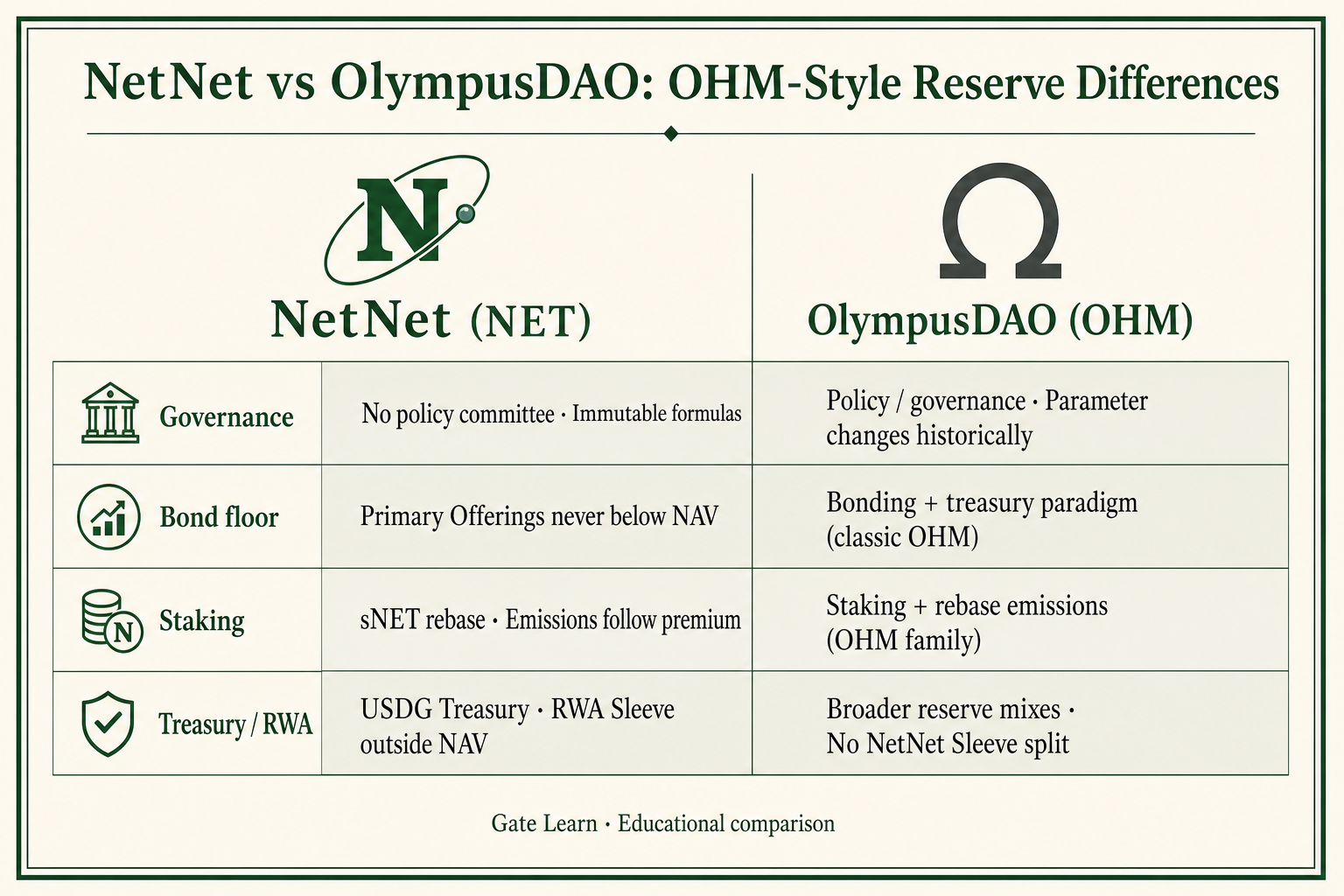
Figure 1. Multi-dimension comparison of NetNet vs OlympusDAO on governance, bond floors, staking emissions, and treasury / RWA boundaries.
The takeaway: NetNet hard-codes immutable formulas, a USDG floor, and Sleeve accounting separation; OlympusDAO contributed the paradigm and kept a wider policy and reserve surface. Secondary trading context belongs with a decentralized exchange lens—TWAP versus spot.
What Is NetNet?
NetNet Capital Management issues the reserve-backed token NET on Robinhood Chain. Core contracts follow OlympusDAO v1’s Token, rebasing sNET, Treasury, and bond stack; reserves are fixed as USDG, and RFV/NAV constrain minting and pricing. Primary Offerings, Buybacks, and emissions run on immutable formulas; Real World Bonds and RW-Play enter a separate RWA Sleeve and do not lift NAV. Full formulas and risk boundaries match the NetNet Pillar explainer for NET.
What Is OlympusDAO?
OlympusDAO (OHM) is a foundational source of the DeFi “reserve currency” narrative: bonding injects assets into the treasury, staking distributes emissions, and treasury backing underpins the onchain monetary experiment. OlympusDAO’s OHM token is reserve-backed in the classic sense: assets held by the protocol support the backing story while the community debates policies over time. Across versions and policy cycles, reserve mixes, bond controllers, and governance parameter surfaces were broader, and the product line is not the same as NetNet’s RWA Sleeve / RW-Play split. Treat Olympus / OlympusDAO as the paradigm baseline—not a parameter-for-parameter twin of NetNet.
NetNet’s differentiation centers on “no policy committee”: emissions, buybacks, premium sales, bond pricing, and fees are locked at deploy time; oracle checkpoints, rebase, Buyback, Morpho rebalance, and similar ops are permissionless—and revert when the formula says no. Paths run through smart contracts rather than a discretionary policy meeting. Build-time immutability is the point: once live, the protocol does not provide a knob for committees to rewrite the curve mid-cycle.
OlympusDAO, as the paradigm source, historically had policy teams, governance processes, and parameter-adjustment paths—emissions rates, bond discounts, and reserve admissions could change by cycle. Olympus policies and OlympusDAO governance surfaces let the community and stewards use time-based updates to reshape how the protocol earns fees, admits assets, and sizes bonding capacity. The useful contrast is not “which is better,” but how visible the rule-change surface is: locked formulas + permissionless triggers on one side; classic governance and policy levers on the other.
Bond Pricing and Floors: Primary Offerings vs OHM Bonding
NetNet Primary Offerings (bond sales) price as price = max(TWAP×(1−discount), NAV) and never clear below NAV, so each subscription is weakly accretive to NAV. Buybacks act as inverse bonds: seller-initiated, settling near NAV − 1.5%, with received NET burned and per-epoch capacity caps. The NET/USDG exchange pool’s TWAP—not spot—feeds that formula, so traders cannot use a one-block pool spike to force a below-NAV mint.
Classic OHM bonding lets users subscribe with assets (or LP), receive discounted OHM, and push assets into the treasury—raising or reshaping backing. Olympus and OlympusDAO bond desks historically let the protocol use LP and reserve assets held in the treasury to build protocol-owned liquidity over time. Discounts, tenors, controllers, and accepted assets shifted with policy cycles; there is no identical hard rule phrased as “never below NAV.” When comparing bonds, ask: Can issuance clear below backing? Is an inverse path standing and seller-initiated?—the easiest point of confusion between NetNet and the OHM family.
Staking and Emissions: sNET Rebase vs OHM Staking
NetNet’s staking path is the Shareholder Dividend: stake NET for sNET and rebase on 8-hour epochs. The rate tracks premium P = marketPrice / NAV: P ≤ 1 yields 0%; P ≥ 1.75 (K) hits full R_MAX of 0.45% per epoch. APY columns in the docs are theoretical arithmetic (constant premium, reserve cap never binds)—not a yield promise. APY compounds in NET units and says nothing about NET’s USDG price.
OHM staking likewise rewards holders via rebase / emissions, but curves and reward parameters were historically adjustable via policy or governance and tied to version-specific runaway / throttle designs. On Ethereum-class networks, OlympusDAO stakers could earn rebase rewards while the protocol used treasury assets held onchain to back OHM; NetNet instead anchors that earn path to an immutable premium function on Robinhood Chain. Shared skeleton: stake for emissions. Fork point: whether emissions are locked to an immutable premium function, and whether they hit zero with no premium.
Treasury and RWA Sleeve: Where Does NAV Backing Stop?
NetNet’s Treasury counts only USDG and protocol-owned liquidity (POL); NAV = RFV / totalSupply, with totalSupply × 1 USDG ≤ RFV at all times. Positions bought via Real World Bonds—such as tokenized stocks—sit in the RWA Sleeve and are not counted in RFV/NAV; RW-Play game-desk fees follow Sleeve accounting. Desk fees may remit USDG to the Treasury in a backing-neutral way, but Sleeve holdings themselves do not lift NAV.
OlympusDAO’s treasury is likewise the backing core, yet reserve types, valuation conventions, and product lines are broader, without NetNet’s named “RWA Sleeve forced off-NAV” split. Keep two ledgers separate: the onchain NAV/RFV figure versus RWA or ecosystem narratives—mixing them invents a false “play desk lifts the floor” story.
Chain and Asset Context: Robinhood Chain + USDG vs Classic OHM
NetNet deploys on Robinhood Chain (chain id 4663, an Arbitrum Orbit L2), with reserves and accounting anchored to USDG; market feeds use the Uniswap v2-style NET/USDG pair’s TWAP, not spot. The interaction surface is Shareholder Services.
The classic OHM stack evolved mainly in Ethereum-class DeFi environments, with more diverse reserves and liquidity venues and expanding tools/governance UIs across versions. OlympusDAO builders used ETH-adjacent infrastructure to provide reserve-currency experiments; NetNet builders use Robinhood Chain’s L2 network to provide a USDG-backed floor instead. Chain and reserve concentration make NetNet’s risk and convenience hinge on “L2 execution + single-stablecoin quality”; the OHM paradigm spreads across multi-asset treasuries and cross-version governance experience. The two do not share interchangeable liquidity, exchange venues, or custody assumptions.
Which Should You Choose?
Lean toward studying NetNet when
- You need to verify claims such as “bonds never below NAV” and “no policy committee can retune formulas.”
- You research Robinhood Chain + USDG reserves and the NAV vs RWA Sleeve accounting split.
- You already treat the OHM skeleton as given and only compare landed parameters and product boundaries.
Lean toward starting from OlympusDAO / OHM when
- You first need a paradigm map of reserve currency + bonding + staking before later variants.
- You care how policy/governance historically adjusted emissions, bonds, and reserve admissions.
- You compare multi-asset treasuries and cross-version product iteration—not a single-stablecoin floor.
These are mechanism-reading and research scenarios only—not investment, participation, or yield advice. Verify contracts, networks, and documentation before any interaction.
Summary
NetNet and OlympusDAO share the OHM-style reserve–bond–stake skeleton, but NetNet concentrates differentiation in immutable formulas, Primary Offerings that never clear below NAV, seller-initiated Buybacks near NAV − 1.5%, a 1 USDG RFV floor on USDG, and an off-NAV RWA Sleeve. OlympusDAO supplies the paradigm source plus a wider policy, reserve, and version surface. Choose by rule-change surface, bond floor, and accounting boundary—not by reading “OHM-style” as copied yields or prices.
FAQ
Is NetNet like OlympusDAO / OHM?
Yes on the skeleton: both sit in the reserve-backed + bonding + staking triangle, and NetNet even follows OHM v1’s Token, sNET, Treasury, and bond stack. No on the landing: NetNet fixes USDG, stresses immutable formulas and no policy committee, and keeps the RWA Sleeve outside NAV.
What is the NetNet vs OHM difference?
The usual forks are three: policy surface (immutable formulas vs historically adjustable governance/policy paths), bond floor (Primary Offerings never below NAV vs classic discounted bonding), and accounting boundary (NetNet’s RWA Sleeve excluded from RFV/NAV). “OHM-style” names the paradigm—not matching parameters.
How do NetNet bonds compare to OHM bonds?
NetNet Primary Offerings use max(TWAP×(1−discount), NAV), with NAV as the price floor; Buybacks are standing, seller-initiated inverse bonds near NAV − 1.5%. OHM bonding injects assets into the treasury and issues discounted OHM, with discounts and controllers shifting by policy cycle—do not equate line-by-line with NetNet.
Does NetNet have a policy team?
NetNet claims no policy committee: emissions, buybacks, bond pricing, and fees follow immutable formulas, with permissionless ops. OlympusDAO historically had policy/governance parameter paths. Claims should still be verified against onchain contracts and documentation.
What is NetNet NAV vs OHM backing?
The concepts are cognate: treasury assets support a “backing per token” narrative. NetNet defines NAV as RFV / totalSupply, with RFV limited to USDG and POL (under stated valuation) and a 1 USDG RFV floor; OHM backing / RFV used broader reserve mixes and rules across versions. Neither guarantees secondary market price always equals backing.