In the broad narrative of Web3, each technological iteration continues to expand the boundaries of human collaboration. From early distributed ledgers and decentralized finance (DeFi) to the convergence of modular public blockchains and AI agents, blockchain is reshaping the underlying logic of many areas of society. Among them, decentralized science (DeSci), a closely watched emerging sector in recent years, is reshaping global research collaboration, fundraising, and research outcome sharing through tokenomics. In recent observations across major crypto asset trading platforms and market trackers, such as CoinMarketCap's top gainers and liquidity trends, ResearchCoin (RSC) has demonstrated notable market momentum and industry discussion.
As a representative link between academic research and the crypto economy, ResearchCoin is more than a simple governance token. It is also core infrastructure for advancing Open Science. To comprehensively present its technical value, economic model, and ecosystem evolution amid industry transformation, this article provides an in-depth analysis of its cryptocurrency technical architecture, token utility, multichain coordination, and ecosystem bridging.
Key Takeaways
-
Explore how ResearchCoin uses an open-source collaboration platform to address funding and information barriers in traditional academic publishing
-
Systematically examine the core utility of the RSC token in research incentives, peer review quality control, and decentralized platform governance
-
Analyze the project's ongoing evolution across multichain ecosystems and tokenomics to improve the circulation efficiency of research assets
-
Explain how multichain network deployments provide researchers and crypto users worldwide with low-cost, efficient interactions
-
Examine the collaborative advantages of mainstream spot trading ecosystems, such as Gate, as value bridges
ResearchCoin's Multichain Coordination Architecture and Underlying Technical Implementation
In decentralized science architecture, tokens are not merely incentive tools. They also serve as the economic lifeblood that supports the healthy operation of the broader academic community. ResearchCoin (RSC) has carefully designed its tokenomics to address the persistent misalignment of incentives and inefficient dissemination in traditional research systems.
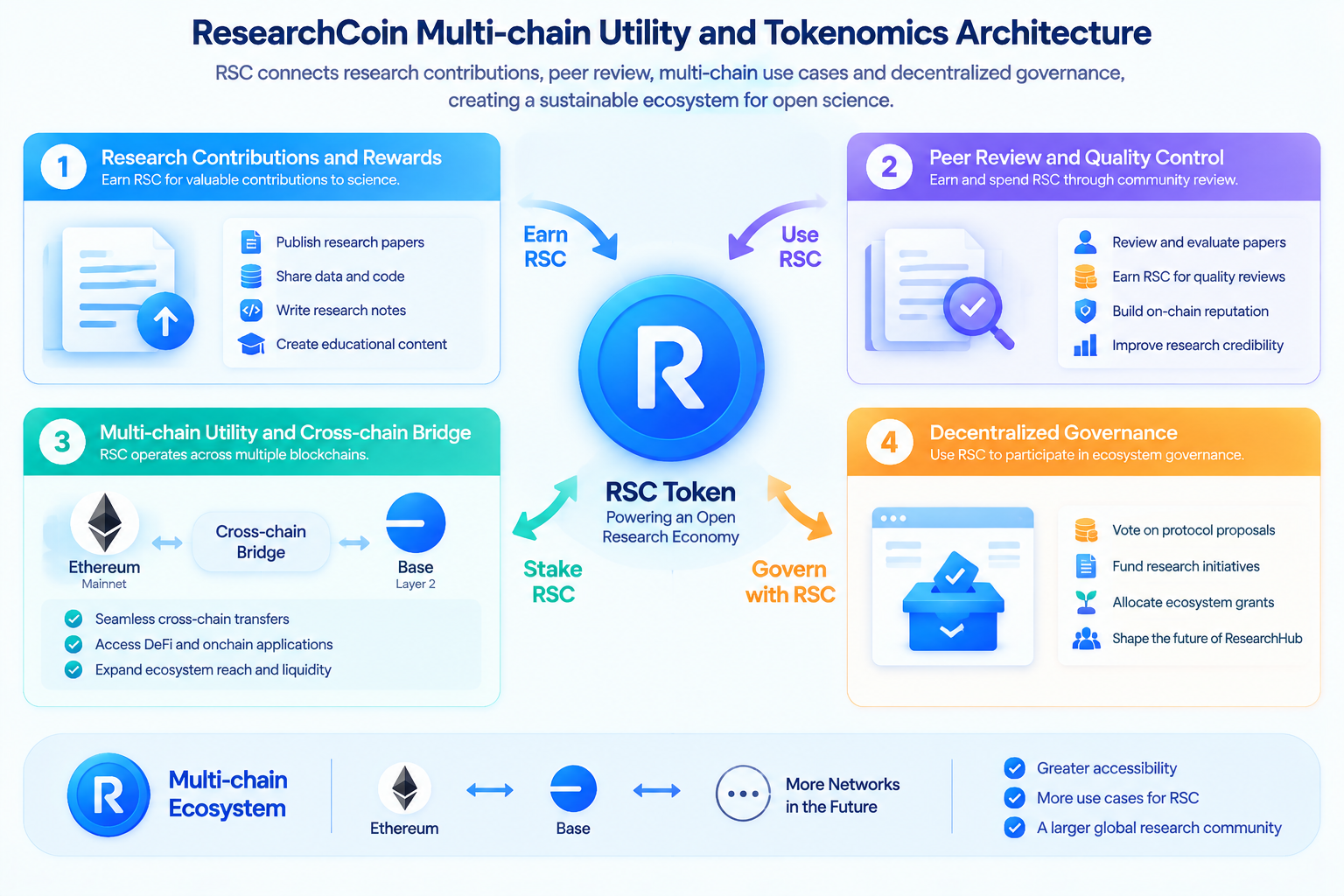
First, in terms of its foundational utility, RSC serves as a measure of research contributions. When researchers share valuable literature summaries on ResearchHub, write high-quality peer review reports, or publicly discuss a scientific hypothesis and receive community recognition, the system provides immediate RSC rewards. This mechanism ensures that effort and expertise can receive fair economic compensation, addressing the longstanding issue of contributing work without compensation to commercial journals.
Second, in terms of multichain interoperability and asset connectivity, ResearchCoin has expanded smoothly to major high-performance networks, including Ethereum and Layer 2 ecosystems such as Base, to meet the needs of the expanding Web3 ecosystem. Multichain deployment not only significantly reduces users' onchain interaction costs but also improves token liquidity depth between decentralized exchanges (DEXs) and major centralized platforms, making it more convenient for researchers and crypto investors worldwide to participate in DeSci.
Deep Integration of the Open Science Movement and Web3 Synergies
The reason decentralized science (DeSci) has emerged in the current crypto market is fundamentally because it aligns with the historical trend of the global Open Science movement. For a long time, the scientific community's peer review process has faced serious issues, including delays in anonymous reviews, bias, and a lack of meaningful material compensation. Many promising research ideas have been overlooked because they did not align with the conservative preferences of traditional academic journals.
By building a fully transparent decentralized peer review marketplace based on token voting and public reputation, ResearchCoin changes this situation. On ResearchHub, anyone can question published papers or preprints, provide supplementary experimental data, or offer suggestions for improvement. Other community members can Upvote high-quality comments, allowing contributors to receive corresponding RSC token rewards. This crowdsourced academic review model not only shortens review cycles from months to days, but also uses market-based token incentives to identify insights with genuine scientific value.
From the perspective of Web3's long-term development, this mechanism introduces a collaborative model similar to open-source software development into the broader process of human knowledge production. Capital and technology are no longer directed solely toward speculative virtual narratives, but can support projects that advance real progress in medicine, energy, AI, and fundamental science. This foundation gives the DeSci sector considerable long-term potential and social impact.
The Future of Decentralized Funding and Intellectual Property (IP) Assetization
Beyond tokenized incentives for academic review and daily collaboration, DeSci's most transformative impact on the traditional research system at a macro level lies in fundamentally reshaping research funding mechanisms and IP assetization pathways. In traditional research systems, scientists applying for national grants or commercial R&D sponsorships often face lengthy, bureaucratic, and highly subjective review processes. Countless innovative but relatively niche early-stage research projects are forced to end because they cannot secure initial funding.
By introducing Quadratic Funding, decentralized autonomous organization (DAO) dedicated funds, and transparent crowdfunding based on smart contracts, DeSci reshapes the traditional concentration of research funding allocation. Under this model, crypto community members, biopharmaceutical enthusiasts, and investors interested in specific scientific fields around the world can directly contribute funds to research proposals they support. Each research project's funding details, experimental milestones, and phased outcomes are fully recorded onchain and subject to real-time oversight across the network, reducing opportunities for fund misappropriation and research-related corruption.
More importantly, DeSci is transforming traditional academic achievements and intellectual property into digital assets that can circulate, be traded, and be commercialized onchain (DeSci IP NFTs). When cutting-edge biomedical research or open-source hardware designs achieve breakthroughs on platforms such as ResearchHub, the associated intellectual property can be tokenized and distributed among early contributors and funding supporters. This means that the commercial economic returns generated by scientific research are no longer controlled by a small number of intermediary institutions, but can be directly returned to the scientists and community members who contribute to building the ecosystem. This new economic model, which closely connects human knowledge production with onchain capital flows, not only introduces a long-term narrative with real social value to the crypto market but also supports faster technological innovation across society.
DeSci Ecosystem Connectivity and Gate's Value as a Bridge
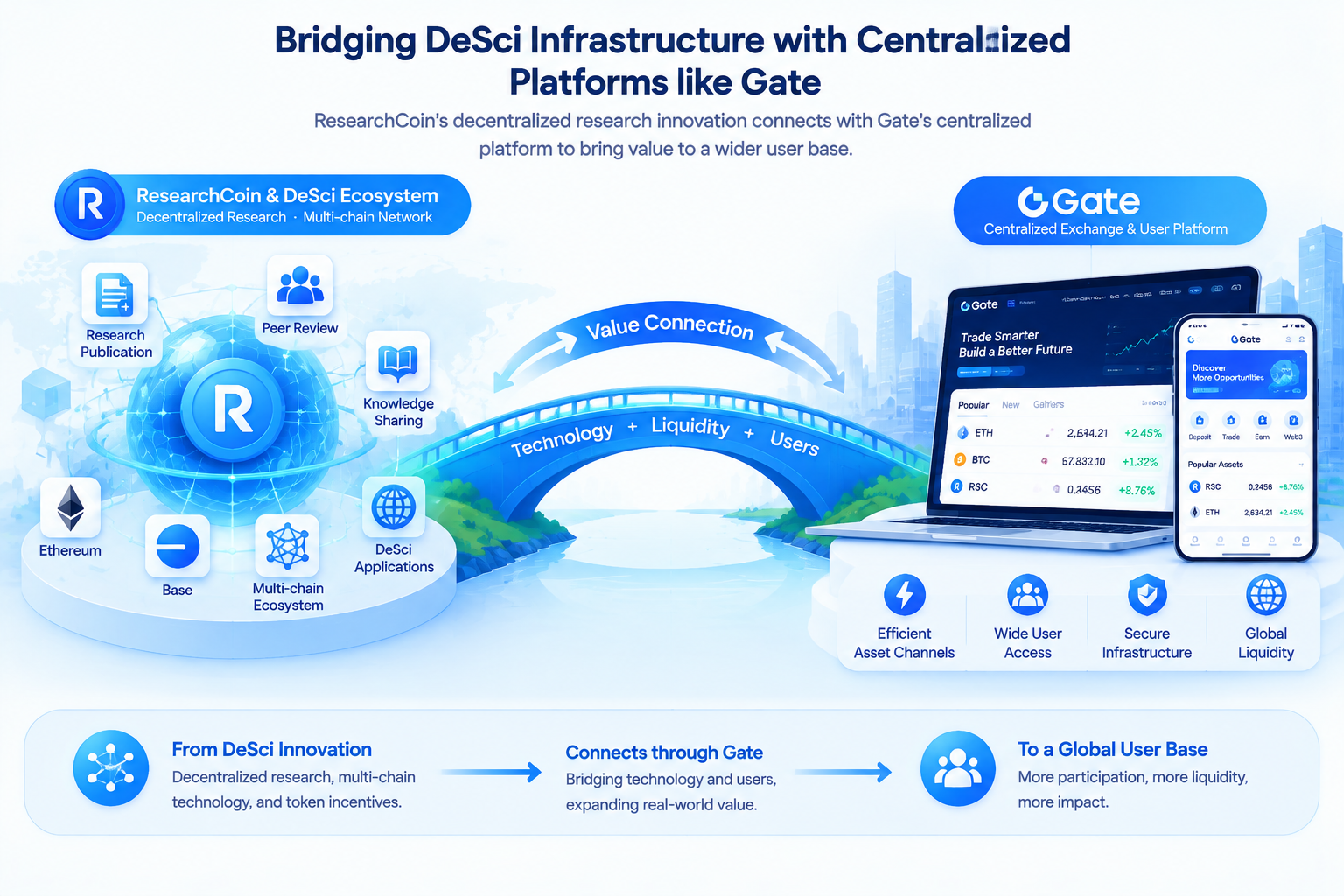
As the DeSci sector moves toward mainstream adoption at scale, crypto asset trading platforms play an indispensable role as hubs. While emerging decentralized science projects offer new technologies and concepts, conveniently and securely acquiring and managing these frontier assets remains a practical barrier for ordinary crypto users. For example, when users follow and allocate to core DeSci assets such as RSC on Gate, they gain convenient access to the future of research innovation.
Through Gate's convenient spot trading and asset management services, users can participate in the value creation of the decentralized science ecosystem with a low entry threshold. Whether diversifying into benchmark assets in the DeSci sector or tracking the long-term development of academic tokens, the combination of centralized trading convenience and decentralized research innovation provides ordinary users with an efficient path for navigating market cycles and participating in advances in frontier technology.
In future macro-level development, as more institutional capital and rational investors enter the DeSci sector through mainstream compliant channels, platforms such as Gate that provide deep liquidity and secure asset custody will continue to serve as important bridges, supporting the decentralized science ecosystem's development toward higher quality and greater sustainability.
FAQ
The RSC token is used to directly reward scientists who publish high-quality research content, conduct peer reviews, offer academic insights, and participate in community discussions on the platform, turning academic contributions into transferable crypto assets.
What are the advantages of ResearchCoin's deployment across multichain ecosystems, such as Base and Ethereum?
Multichain deployment can effectively reduce users' onchain transaction fees (gas fees), significantly improve token circulation efficiency and liquidity depth across different networks, and enhance the overall user experience.
How can ordinary Web3 users participate in ResearchCoin's ecosystem development?
Users can trade and allocate to RSC tokens through mainstream platforms such as Gate, while also accessing ResearchHub to explore the latest research outcomes in decentralized science.