Infinity Ground AI App Store is a platform within the Infinity Ground ecosystem for showcasing, distributing, and potentially monetizing AI-generated applications. It is designed to help creators turn Web3 applications built with an Agentic IDE into digital products that other users can discover, use, and reuse. Unlike traditional app stores, which primarily accept software submitted by professional developers, it places greater emphasis on connecting natural-language development, template sharing, and AI-assisted creation.
As Vibe Coding and AI Agent development tools continue to mature, the technical barrier to creating simple applications is declining. However, application development is only the beginning of the product lifecycle. Even if an AI-generated mini-game, interactive website, or on-chain tool runs properly, it still needs to address user discovery, feature updates, service costs, and monetization. For non-professional developers, these aspects may be more difficult than generating the code itself.
Infinity Ground aims to create a complete path from idea input and application generation to product publishing and ecosystem participation by combining its Agentic IDE with the AI App Store. This article focuses on the AI App Store's product positioning, template reuse mechanism, creator revenue models, and practical operational challenges. It also explores how AI application generation platforms can establish a sustainable creator economy.
Key Takeaways
-
Infinity Ground AI App Store is a distribution and creator ecosystem for AI-generated applications. It attempts to connect the application development capabilities of the Agentic IDE with product showcasing, user discovery, and monetization.
-
The value of an AI App Store is not limited to publishing applications. Template reuse, remixing, and creator collaboration can turn applications from one-time generated creations into digital products that can be iterated on continuously.
-
The number of generated applications does not equal ecosystem activity. To determine whether an AI app store is successful, it is necessary to focus on real users, application retention, repeat usage, and willingness to pay—not just the number of products created.
-
Creators can monetize their work through multiple models. Paid applications, feature subscriptions, pay-per-use services, template licensing, and revenue sharing have different business models, but not all of these mechanisms have been fully launched on Infinity Ground.
-
The AIN token cannot be equated directly with creator revenue. Even if the app store attracts more users, it is still necessary to determine whether there is a clear relationship between platform revenue and the token's actual utility.
-
Security, quality, and distribution efficiency determine long-term competitiveness. AI-generated applications still require functional testing, permission reviews, and ongoing maintenance. The app store must also address low-quality content, user acquisition, and developer incentives.
What Is Infinity Ground AI App Store, and What Role Does It Play in the Ecosystem?
Infinity Ground AI App Store is a distribution and discovery mechanism built by the project around AI-generated applications. Its core goal is to enable users not only to create applications, but also to showcase their work, explore products from other creators, and use existing templates for further development.
In the traditional software development model, code creation and application distribution are usually handled by different tools. Developers use an IDE to create products and then publish them through website hosting services, app stores, or other channels. For creators without a technical background, this means that in addition to learning development tools, they must also understand deployment, promotion, and maintenance processes.
Infinity Ground attempts to shorten this process. Users can create applications in the Agentic IDE through natural-language instructions and then publish their work in a showcasing and distribution environment for other users. Other creators can browse existing products and, where supported, reuse templates through the Remix function to create their own application versions.
This model gives the AI App Store three roles at the same time: an application showcase, a creator portfolio, and a collection of reusable development resources.
Based on the current publicly visible product interface, Infinity Ground IDE already provides a showcase area for user-generated products, along with categories such as Featured Apps, Creator League, Arcade, AI Characters, and Game. Some applications also have Remix entry points. This indicates that product discovery and template reuse already have observable product implementations.
However, a product showcase is not the same as a complete commercial app store. Whether standardized payment, automatic revenue sharing, and a complete creator settlement system have been fully opened to users still needs to be determined according to the actual product rules.
Therefore, when evaluating Infinity Ground AI App Store, it is important to distinguish between the currently visible capabilities for showcasing and reusing applications and the more comprehensive commercial ecosystem goals proposed in the project's white paper.
How Does the AI App Store Connect the Agentic IDE With Application Distribution?
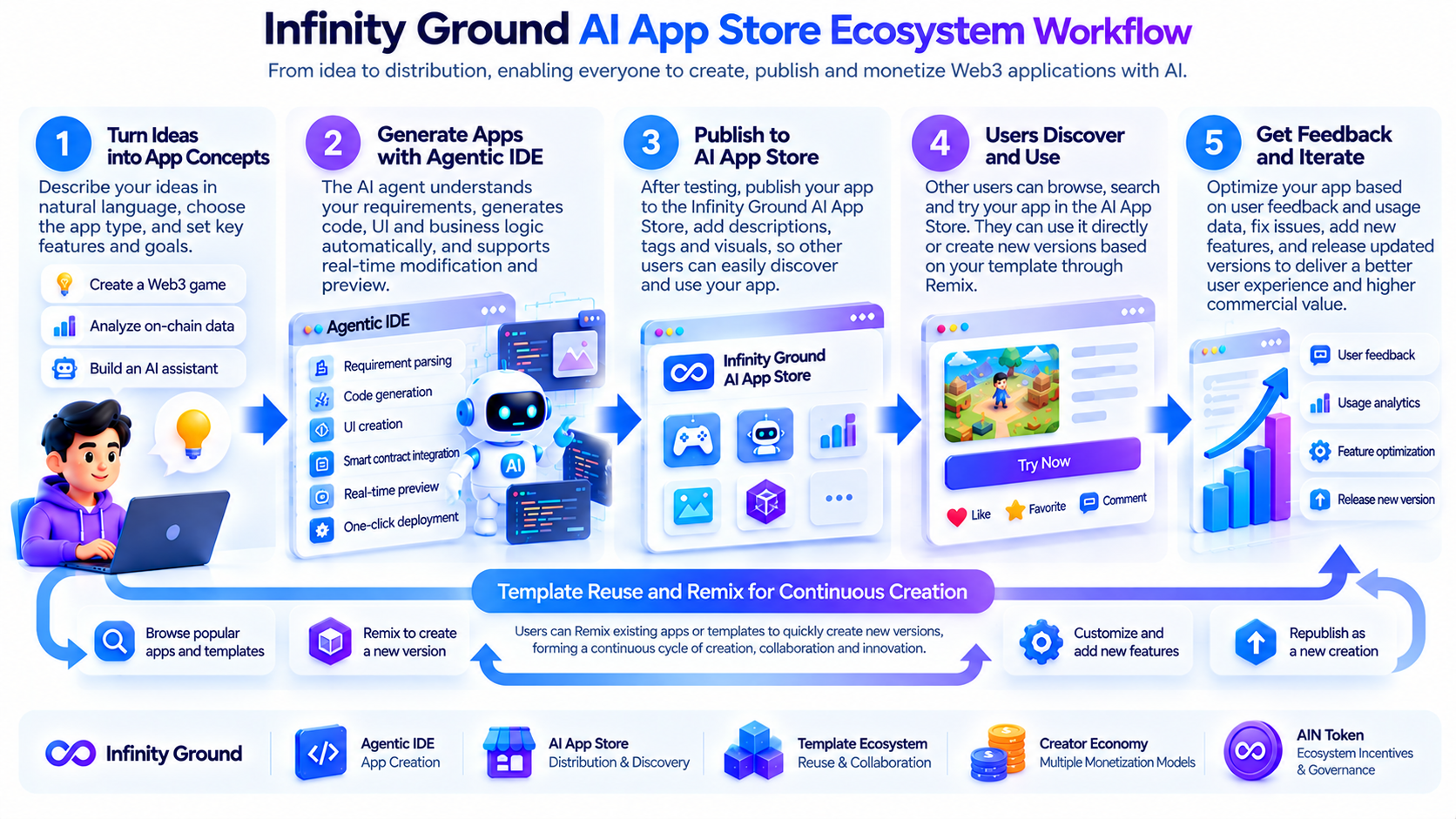
Infinity Ground's product logic can be understood as connecting application creation and application distribution into a continuous process.
The first stage is idea generation. Users describe the application they want to develop in natural language, such as a mini-game that supports wallet login, a crypto asset data display page, or an AI interactive story. The Agentic IDE helps generate the code and interactive interface based on the requirements, after which users can modify the application through feedback.
The second stage is application validation. The generated result must undergo functional testing to ensure that the pages, business logic, and necessary external interfaces work properly. If the application involves wallet connections or smart contracts, users must also check signature requests, transaction permissions, and on-chain interaction logic.
The third stage is publishing and showcasing. Validated products can enter the corresponding publishing process for other users to browse and try. Application categories, product descriptions, and showcase entry points can help users quickly understand a product's purpose.
The fourth stage is user feedback and continuous iteration. Creators adjust features, fix errors, or develop new application versions through template reuse based on user feedback.
The key point is that the AI App Store is not an ordinary content page independent of the Agentic IDE. It is a downstream component of the development tool. The easier it becomes to generate applications, the more the platform needs effective product screening and distribution mechanisms. Otherwise, a large number of low-quality or duplicate applications could make it more difficult for users to discover valuable products.
At the same time, distribution mechanisms can also influence development behavior in return. If certain types of mini-games or tools consistently attract user attention, other creators may develop similar products based on existing templates, driving the continued reuse and improvement of related components.
This means that the long-term value of the AI App Store depends not only on whether it can showcase products, but also on whether it can create a continuous cycle of application usage, user feedback, and creator iteration.
How Do Remix and Template Reuse Reduce the Cost of Developing AI Applications?
Remix is an important feature direction in Infinity Ground's application creation process. It allows creators to modify an existing application or template as a starting point instead of beginning with a blank project each time.
For example, a user who wants to create a crypto asset price prediction mini-game can select an existing interactive game template and then use natural-language instructions to adjust the page, scoring rules, and data presentation. Compared with developing everything from scratch, this approach reduces the need to repeatedly build basic interfaces and interaction logic.
Template reuse is particularly important for non-technical creators. Although AI can generate code, users still need to clearly describe the structure of an application. A template with basic functionality already in place allows users to observe the product structure directly and gradually complete a personalized design by modifying their requirements.
For professional developers, templates can also serve as reusable component resources. Developers can build basic modules around common Web3 functions, such as wallet connections, asset displays, points management, and user interaction components, for use by other creators.
However, Remix does not mean that any application can be copied without restrictions. Creators need to consider the scope of the original product's license, permissions for using third-party materials, and the usage terms for code dependencies and external APIs.
If a template includes smart contracts or fund interaction features, its deployment configuration and permission logic must also be reviewed again. Even if the original version has been tested, there is no guarantee that the modified version remains secure.
From a business perspective, template reuse could create a new division of labor among creators: some users develop foundational templates, while others focus on application design and content innovation. Whether this division of labor can produce a revenue distribution system depends on whether the platform establishes clear rules for licensing, attribution, and settlement.
How Can the AI App Store Help Creators Monetize Their Applications?
The commercial logic of an AI App Store is to turn creators' development work into digital products that can provide ongoing services. Unlike selling code as a one-time transaction, an app store can establish different payment models around user usage, feature access, and template reuse.
Potential monetization models for AI-generated applications mainly include the following:
| Monetization Method |
Operating Mechanism |
Applicable Scenarios |
| Paid Applications |
Users pay to obtain access to an application |
Independent tools, professional applications |
| Subscription Services |
Fees are charged periodically for features or services |
AI assistants, data analysis tools |
| Pay-Per-Use |
Fees are charged based on the number of API calls or feature executions |
AI inference, automation tools |
| Template Licensing |
Other creators are permitted to reuse templates for a fee |
Game templates, Web3 components |
| Revenue Sharing |
Revenue generated by an application is distributed according to an agreed ratio |
Collaboration among platforms, developers, and contributors |
Among these models, pay-per-use has a strong connection to the cost structure of AI applications. Because some AI applications require continuous model calls, each use may incur inference costs. Pay-per-use can therefore establish a more direct relationship between user payments and resource consumption.
For Web3 applications, on-chain payments can also support automated settlement for small amounts. For example, after a user calls an AI feature, they can pay based on the number of times it was used. However, this model still needs to address network fees, payment confirmation, refunds, and dispute resolution.
Revenue sharing involves more complex relationships among participants. An application may be jointly developed by the original template author, a secondary creator, and other component contributors. If the platform wants to distribute revenue based on contributions, it must clearly define product ownership, licensing conditions, and settlement rules.
Infinity Ground's white paper lists an application marketplace and transparent revenue sharing as ecosystem development goals. However, this does not establish that all monetization methods have been officially opened. In particular, creator revenue percentages, withdrawal conditions, and platform service fees should be determined according to the product rules officially disclosed by the platform.
Whether a creator economy can be established ultimately depends on whether people are willing to continue paying for applications—not on whether the platform has a token or reward mechanism.
How Does the AI App Store Differ From Traditional App Stores?
Traditional app stores typically focus on application distribution. Developers complete product development externally and then submit their applications to a platform for review and publication. The app store handles search, recommendations, payments, and user acquisition.
Infinity Ground AI App Store attempts to connect AI development tools with application distribution, enabling users to start by generating an application through natural-language instructions and then gradually complete modification, publishing, and template reuse.
The main differences between the two models are as follows:
| Comparison Dimension |
Traditional App Stores |
Infinity Ground AI App Store |
| Development Method |
Primarily relies on external development tools |
Integrated with the Agentic IDE |
| Creator Barrier to Entry |
Typically requires programming skills or a development team |
Emphasizes natural-language and AI-assisted development |
| Content Supply |
Complete applications submitted by developers |
AI-generated products and creator applications |
| Secondary Creation |
Depends on source code and licensing |
Emphasizes template reuse and Remix |
| Application Distribution |
Search, rankings, recommendations, and categories |
Product showcasing, categories, and creator discovery |
| Monetization |
Purchases, subscriptions, in-app payments, and other methods |
Planned application monetization and revenue sharing |
| Main Challenges |
Review, competition, and developer revenue sharing |
Application quality, duplicate content, and monetization validation |
These differences do not mean that AI App Stores will necessarily replace traditional app stores.
Traditional platforms generally have mature user bases, payment systems, and review mechanisms. AI app stores still need to solve issues such as attracting real users, establishing credible content screening mechanisms, and enabling creators to earn sustainable income.
At the same time, AI generation tools may significantly increase the supply of applications. If application development time is reduced, a platform may see a large number of similar products emerge in the short term. In this situation, user experience will depend less on the number of applications and more on recommendation quality, product reliability, and practical value.
Therefore, the competitive advantage of an AI App Store must be built on improvements in both development efficiency and distribution efficiency. It cannot rely solely on growth in the number of AI-generated applications.
How Does the AIN Token Participate in the Infinity Ground Creator Ecosystem?
AIN is a utility token in the Infinity Ground ecosystem. Its designed uses include platform services, membership benefits, governance, and ecosystem incentives. As the AI App Store develops, the token may be used to connect demand for platform services with creator participation. However, the specific economic relationship must be evaluated separately from the token's design objectives and actual implementation.
Payments for platform services could create use cases for the token. If certain application creation, publishing, or advanced features require payment, AIN could serve as a payment method or proof of entitlement in supported scenarios. However, whether AIN is required and whether the platform also accepts other payment methods depend on the actual rules.
Creator incentives could be used to encourage application development and ecosystem participation. For example, the platform could provide rewards based on product contributions, community activities, or specific tasks. However, the distribution of rewards does not mean that the application itself generates revenue. Platform subsidies must be distinguished from genuine commercial income.
Membership and governance mechanisms could grant holders different participation rights. Whether these features can generate long-term demand depends on whether the benefits have practical utility and whether the governance mechanisms can be implemented effectively.
Investors should pay particular attention to the fact that growth in the app store, growth in platform revenue, and growth in demand for the AIN token are not necessarily equivalent.
If platform revenue is primarily settled in fiat currency or stablecoins, and there is no clear mechanism for purchasing, consuming, or otherwise transmitting value through the token, increased application usage may not directly affect market demand for AIN.
Conversely, if token usage relies primarily on subsidies or short-term campaigns, demand may decline as incentives are reduced.
Therefore, when evaluating the relationship between AIN and the AI App Store, the key factors to examine are the payment functions actually supported, the scale of token usage, revenue distribution rules, and the long-term cost of incentives—not simply the relationship between the number of creators and the token's value.
What Changes Took Place in the Infinity Ground Application Ecosystem in 2026?
Infinity Ground's early ecosystem plans included the Agentic IDE, AI App Store, and ING Network. The project hoped to use dedicated blockchain infrastructure to connect application creation, on-chain execution, and ecosystem incentives.
As the project developed, however, its resource allocation shifted. In late 2025, the team associated with Infinity Ground proposed gradually withdrawing from the operation of the Initia-based Arcade network and concentrating resources on IDE tools, reusable templates, and support for third-party creators. The related network wind-down plan listed January 5, 2026, as the closure date.
This change reflects the difference between two business models: one in which the platform operates applications and games on an ongoing basis, and another in which the platform provides tools that enable more independent developers to create and operate products.
The former model requires the platform to bear the costs of user acquisition, content operations, and infrastructure maintenance. The latter attempts to position the platform as development infrastructure, with external creators taking on more of the product innovation and operational work.
For Infinity Ground, this shift makes the Agentic IDE, template resources, and application distribution capabilities more important. If the platform no longer relies primarily on self-operated games to attract users, it needs to demonstrate that external creators can continue developing valuable applications.
Current public IDE pages already showcase user-generated applications, category browsing, and Remix functionality. The project website also provides entry points for mini-games and products from partner creators. These product implementations indicate that Infinity Ground is building an ecosystem around application creation and showcasing.
However, the existing public pages are not sufficient to fully demonstrate that the AI App Store has developed into a mature paid distribution market. Metrics such as creator revenue, real paying users, and platform transaction volume still require further disclosure and verification.
What Ecosystem and Monetization Challenges Does the AI App Store Face?
The primary challenge for an AI App Store is application quality. AI can help users quickly generate large numbers of products, but not every product has a clear use case. If the platform lacks effective review and recommendation mechanisms, users may need to spend more time filtering for applications that provide genuine value.
The second challenge is security. AI-generated applications may contain faulty code, unchecked external dependencies, or unreasonable wallet authorization requests. For Web3 applications involving real assets, the platform needs to establish an appropriate balance between open creation and security review.
The third challenge is user retention. Users may try an application because of the novelty of AI-generated products, but they may not be willing to use it over the long term. The platform needs to focus on whether applications solve real problems rather than simply tracking the number of applications generated or first-time visits.
The fourth challenge is creator revenue. Even if an app store has a large number of products, creators may struggle to cover the costs of model calls, hosting, maintenance, and promotion if there is insufficient sustained demand for paid services.
The fifth challenge is product ownership and licensing. Template reuse can promote creation, but it can also lead to disputes over code licensing, content copyrights, and revenue attribution. The platform needs to establish clear usage rules to prevent disputes between secondary creators and original contributors.
The final challenge is the sustainability of token incentives. Rewards can attract creators and accelerate early ecosystem growth, but if incentives consistently exceed actual business revenue, the platform may develop a growth model that depends on subsidies.
Therefore, when assessing whether Infinity Ground AI App Store has long-term competitiveness, the key factors to observe are application activity, real user retention, creator revenue, platform service quality, and security mechanisms—not merely the total number of published products.
Conclusion
Infinity Ground AI App Store is an important ecosystem direction for connecting AI application development with product distribution. By integrating with the Agentic IDE, it attempts to enable users to start with a natural-language description of their requirements and complete application generation, template reuse, product publishing, and continuous iteration, thereby lowering the overall barrier from idea to digital product.
Compared with traditional app stores, its distinctive feature is the connection between AI-assisted development and application distribution. It also attempts to establish a new content supply model through Remix, creator collaboration, and potential revenue sharing.
However, greater application creation efficiency does not equal commercial success. Infinity Ground still needs to demonstrate that the platform can attract real users, create sustained demand for paid services, and establish reliable mechanisms for application quality and security management. The economic relationship between the AIN token and the application ecosystem also needs to be validated through actual usage data and clear product rules.
In the long term, the value of an AI App Store will not lie in how many applications it can generate, but in whether it can enable more creators to continuously develop, publish, and operate products that users genuinely use.