Infinity Ground Agentic IDE is an AI-driven application development environment in the Infinity Ground ecosystem. It is designed to help users create Web3 applications through natural language interactions and AI Agent collaboration. Unlike traditional code editors, it aims to turn application development into an interactive process centered on requirement descriptions, automated generation, and ongoing revisions, allowing creators to focus more on product design and feature validation.
As generative AI gradually enters software engineering, Vibe Coding is changing how applications are developed. In the past, developers needed to understand programming languages, frameworks, and deployment tools to turn ideas into products. Today, AI can handle parts of code writing, interface generation, and debugging. However, for Web3 applications involving wallet connections, smart contracts, and on-chain assets, improved development efficiency does not mean lower security requirements.
This article analyzes the core features of Infinity Ground Agentic IDE, AI Agent collaboration mechanisms, natural language development workflows, and Web3 integration methods. It also discusses how it differs from traditional No-Code tools, as well as the limitations of AI-generated applications in security, maintenance costs, and real-world use.
Key Takeaways
-
Infinity Ground Agentic IDE is an AI-driven application development environment. It aims to turn natural language requirements into runnable applications, reducing Web3 creators' reliance on traditional programming skills.
-
Vibe Coding changes how users interact with software development. Users can participate in application development by describing requirements, reviewing generated results, and providing ongoing feedback, rather than writing all code from scratch.
-
AI Agent collaboration is a core technical direction for Agentic IDE. Through task planning, code generation, tool calls, and feedback iterations, AI systems can assist with multiple development stages.
-
Web3 application development involves more than code generation. Wallet connections, smart contracts, on-chain transactions, and permission management have specific requirements that need independent validation during development.
-
Agentic IDE differs from traditional No-Code platforms. The former emphasizes AI understanding of natural language requirements and code generation, while the latter typically relies on predefined components and visual configuration.
-
AI-generated applications still require security reviews. Smart contract vulnerabilities, incorrect authorizations, third-party dependencies, and deployment configuration issues do not disappear automatically because AI is used for development.
What Is Vibe Coding, and Why Is It Changing Web3 Application Development?
Vibe Coding is a software development approach in which users describe requirements in natural language and use AI to generate and modify code. Unlike traditional development, where developers write code line by line, Vibe Coding places greater emphasis on users expressing goals, AI performing parts of the development work, and both sides completing product iterations through continuous feedback.
For example, a user who wants to create a Web3 mini-game that supports wallet login can first describe the game rules, page style, points system, and interaction methods. AI can then assist in generating the basic application. The user can subsequently adjust page layouts, add features, or fix runtime errors through new text instructions. This approach lowers the difficulty of initial prototype development and makes it easier for nonprofessional developers to participate in product creation.
However, Vibe Coding does not mean that technical knowledge is no longer needed. AI can generate code that appears complete, but users still need to determine whether the functionality meets expectations, whether data is handled correctly, and whether the program has security issues. For applications involving on-chain assets, incorrect smart contract logic may also create difficult-to-reverse financial risks.
Therefore, Vibe Coding is better understood as a change in development methods rather than the disappearance of software engineering requirements. It can reduce some repetitive programming work, but application design, testing, deployment, and security maintenance remain important parts of product development.
What Is Infinity Ground Agentic IDE, and What Are Its Core Features?
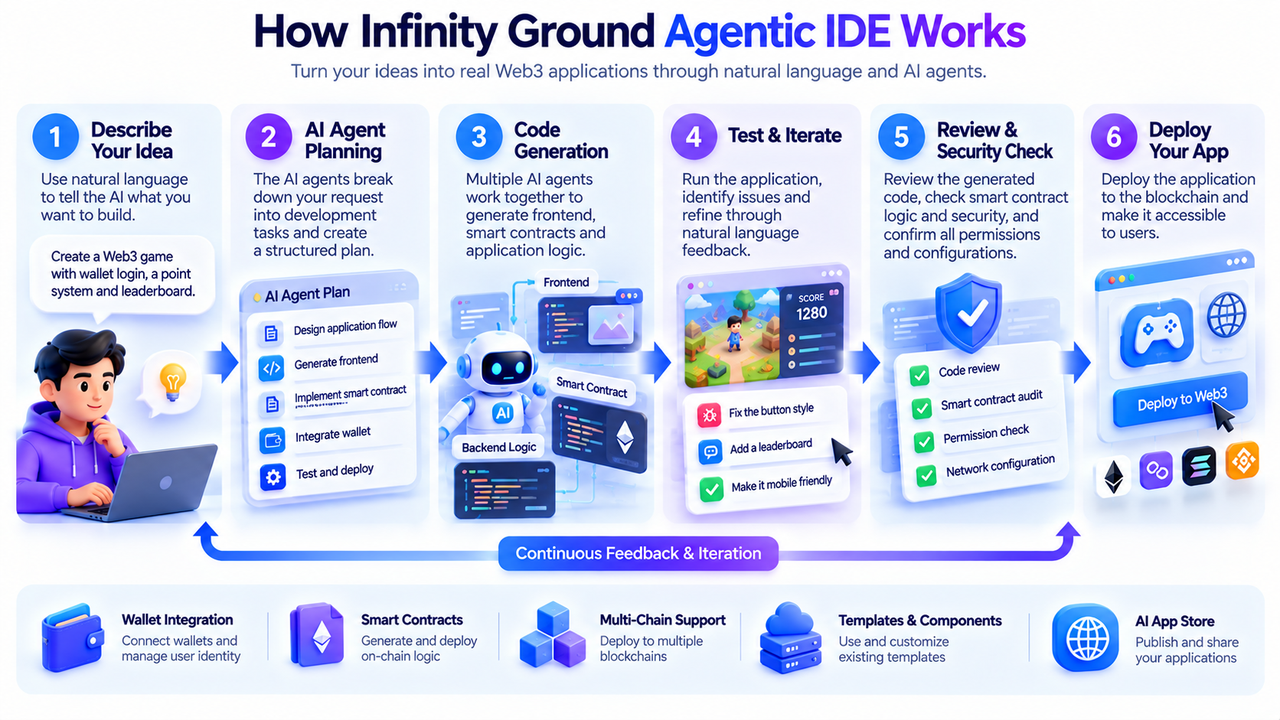
Infinity Ground Agentic IDE is an application development environment built around AI Agents. Its goal is to integrate natural language input, code generation, feature modification, and application deployment into a relatively unified workflow. Users can start with an application idea without first completing a full technical architecture design.
Unlike conversational AI that only answers programming questions, Agentic IDE places greater emphasis on task execution. The system needs to understand the functionality a user wants to implement, break requirements into specific development steps, and complete parts of the work through code generation and tool calls. Users can then review runtime results and provide revision requests to progressively improve the application.
From a product design perspective, Agentic IDE primarily focuses on the following capabilities:
| Core Feature |
Primary Function |
| Natural Language Requirement Input |
Describe application goals, features, and interaction methods through text |
| AI Agent Task Planning |
Break complex requirements into multiple development tasks |
| Code Generation and Modification |
Assist with building pages, business logic, and related components |
| Feedback and Debugging |
Adjust generated results based on error messages and user feedback |
| Web3 Feature Integration |
Support application scenarios involving wallet connections, smart contracts, and other on-chain features |
| Application Deployment and Release |
Help users turn generated applications into accessible products |
These capabilities reflect Infinity Ground's product direction of lowering barriers to application development. However, the specific supported frameworks, blockchain networks, deployment methods, and degree of automation still depend on the current product version.
For simple interactive applications and standardized features, AI-assisted development may significantly improve prototype generation efficiency. For applications involving complex business logic, extensive external dependencies, or high-value fund operations, professional developers are still needed for review and maintenance.
How Do AI Agents Turn Natural Language Requirements Into Web3 Applications?
Generating an application from natural language does not mean directly converting a single sentence into a final product. It is a multistage process that includes requirement understanding, task planning, code generation, testing, and deployment. The role of Agentic IDE is to connect these stages as much as possible and reduce the cost of switching between different development tools.
Users need to clearly define the application's goals. For example, when creating an on-chain points game that supports wallet connections, requirements may include user login, point calculations, leaderboards, page interactions, and whether some data needs to be recorded on the blockchain. The clearer the description, the easier it is for AI to identify the application's core features and constraints. AI Agents can break overall requirements into different tasks, including frontend page design, business logic implementation, wallet interaction components, and smart contract functionality. The system can attempt to generate tasks that can be handled independently in parallel. Features with dependencies, however, need to be completed in a reasonable sequence.
During the code generation stage, AI can assist with creating page components, configuration files, and parts of the business logic. After the initial build is completed, users need to review the runtime results and continue requesting changes for any parts that do not meet expectations.
This process can be summarized in six stages:
-
Requirement Description: Users explain the application's goals and features in natural language.
-
Task Planning: AI Agents break requirements into executable development steps.
-
Code Generation: Generate frontend code, business logic, and necessary Web3 components.
-
Testing and Feedback: Check application performance and identify functional issues.
-
Human Review: Verify critical logic, smart contracts, and permission settings.
-
Deployment and Release: Deploy validated applications to the appropriate environment.
It is important to note that AI-generated applications do not mean every stage can be completed fully automatically. In particular, users should retain clear human confirmation steps for smart contract deployments, real asset interactions, and external service authorizations.
The value of Agentic IDE lies in helping users move more quickly from ideas to prototypes, rather than bypassing necessary engineering validation.
How Do Multiple AI Agents Collaborate to Complete Application Development?
The core idea behind AI Agent collaboration is to divide complex goals into multiple relatively independent tasks and then execute them through models, tools, and feedback mechanisms. For application development, this approach can reduce the contextual complexity that needs to be handled in a single generation and allow different tasks to be processed according to their specific requirements.
For example, a Web3 application may include page design, user interactions, wallet connections, and smart contract logic at the same time. Different tasks require attention to different technical issues: page design focuses on layout and interaction experience, while smart contract development focuses more on state management, access control, and transaction execution.
A multi-Agent architecture can attempt to configure corresponding workflows for different tasks and then integrate the generated results into a complete application. Some tasks can be performed in parallel to improve development efficiency. However, components involving shared data structures and mutual dependencies still require coordination of interfaces and execution order.
Infinity Ground's technical design emphasizes task routing, parallel processing, and feedback iterations. The goal of these mechanisms is to enable AI systems not only to generate code, but also to continuously execute, review, and modify work around development tasks.
However, multi-Agent collaboration may also introduce new issues. If different Agents interpret requirements inconsistently, they may generate conflicting code. Excessively granular task division may also increase model call costs, code integration difficulty, and debugging time.
Therefore, when evaluating multi-Agent development capabilities, it is not enough to consider only the number of Agents involved. It is also important to assess whether the final application runs properly, whether the code is consistent, and how much additional revision work users need to perform.
How Does Infinity Ground Handle Frontends, Smart Contracts, and Wallet Interactions?
Web3 applications typically consist of multiple technical layers, including user interfaces, business logic, wallet connections, smart contracts, and blockchain networks. Even if users only want to create a simple on-chain application, the development process still needs to handle data interactions and permission relationships among these components.
The frontend displays the application interface and receives user actions, such as connecting a wallet, viewing balances, or submitting transaction requests. Business logic determines how the application responds to user behavior, including point calculations, task completion conditions, and page state updates.
Wallet connections are an important entry point for Web3 applications. Applications need to request user connections through wallet interfaces and initiate signature or transaction confirmations when necessary. However, a wallet connection itself should not be considered permission to operate a user's assets. Specific permissions depend on the messages, transactions, and authorizations that the user subsequently signs.
Smart contracts are responsible for executing business logic that requires on-chain verification. For example, an application may use smart contracts to record NFT ownership, process on-chain points, or execute specific transaction conditions. Compared with ordinary backend programs, deployed smart contracts may be difficult to modify directly, making logic validation during development especially important.
Infinity Ground Agentic IDE aims to use AI-assisted generation and integration of these components to reduce the repeated configuration work developers perform across different tools. However, users still need to confirm whether the application correctly handles wallet connections, network switching, failed transactions, and permission restrictions.
In particular, users should avoid directly deploying AI-generated code to production environments that manage real funds. Even if an application runs properly, this does not mean its fund operation logic has passed sufficient security validation.
What Types of Applications Can Users Create Through Agentic IDE?
Infinity Ground is positioned for creators who want to quickly build digital applications, with particular attention to scenarios such as mini-games, interactive content, and Web3 applications. The natural language development model allows users to validate ideas first and then decide whether to invest more resources in professional development.
For mini-games, users can describe characters, levels, point mechanisms, and interaction rules, while AI assists with generating the basic interface and game logic. If Web3 functionality is needed, users can further design wallet login or digital asset-related mechanisms.
For community applications, creators can attempt to build event pages, membership display tools, or interactive task systems. These applications usually have relatively clear page structures and business processes, making them suitable for rapid prototyping through templates and AI generation.
For on-chain tools, users may want to create wallet information displays, NFT search tools, or interaction pages for specific smart contracts. These scenarios involve blockchain data reads and transaction requests, requiring reviews of the target network, contract interfaces, and user authorization methods.
| Application Type |
Typical Requirements |
Development Focus |
| Web3 Mini-Game |
Interaction rules, points, wallet connection |
Game logic and asset security |
| Community Application |
Membership pages, events, and interactive tasks |
User identity and data management |
| NFT Application |
Asset display, minting, and search |
Contract permissions and transaction fees |
| On-Chain Tool |
Data reads and transaction interactions |
Contract addresses and network configuration |
| AI Interactive Application |
Content generation, user input, and feedback |
Model output quality and usage costs |
These are typical scenarios that the Agentic IDE technical direction can cover. They do not mean that the current version fully supports every feature or all blockchain networks.
For users who want to develop applications with AI, a more reasonable approach is to start with low-risk prototypes with clearly defined features, validate whether the application meets requirements, and then gradually add wallet interactions and on-chain functionality.
Why Do AI-Generated Web3 Applications Still Require Human Review?
AI-generated code can improve development efficiency, but it cannot guarantee that generated results are completely correct. In ordinary applications, code errors may cause pages to fail to load, data to display incorrectly, or features to fail. In Web3 applications, some errors may directly affect user assets and on-chain permissions.
-
Smart Contract Logic Risks. AI may generate code that meets syntax requirements but fails to properly handle access control, state changes, or fund transfer conditions. For example, an asset management function without necessary permission checks may allow unauthorized operations.
-
External Dependency Risks. AI-generated applications may use third-party software packages, contract interfaces, or external services. If dependency versions contain vulnerabilities, or if an application incorrectly handles externally returned data, security risks may increase.
-
Wallet Signature and Authorization Risks. Applications may require users to sign messages, approve token allowances, or execute on-chain transactions. If the interface does not clearly display the content of an operation, users may complete signatures without understanding the actual permissions involved.
-
Deployment Configuration Risks. Test and production environments may use different networks, contract addresses, and access credentials. Incorrect deployment configuration may cause an application to connect to the wrong contract or expose information that should be protected.
Therefore, AI-generated Web3 applications should establish a layered validation mechanism. Ordinary pages and non-sensitive business logic can be reviewed through functional testing. Parts involving smart contracts, asset transfers, and high-permission operations require more rigorous code review, security testing, and necessary professional audits.
For high-value asset applications, measures such as multisignature management, least-privilege access, and emergency pauses should also be considered. However, these security designs must also be implemented correctly. The use of a particular mechanism does not mean an application is risk-free. AI can shorten code generation time, but it cannot replace independent judgment regarding on-chain asset security.
Infinity Ground Agentic IDE, ChatGPT, and Cursor can all participate in AI-assisted software development, but their product positioning and usage methods differ.
ChatGPT is a general AI assistant that can help users understand requirements, generate code, analyze errors, and explain technical concepts. Its application scope is not limited to software development, and specific code execution and deployment capabilities depend on the features and development environment used.
Cursor is an AI programming tool built around code editing and software engineering workflows. It places greater emphasis on developers writing, modifying, searching, and debugging within existing codebases.
Infinity Ground Agentic IDE is positioned more as an AI application generation environment for creators. It emphasizes application creation through natural language and AI Agent collaboration, while attempting to connect Web3 functionality with an application distribution ecosystem.
| Comparison Dimension |
ChatGPT |
Cursor |
Infinity Ground Agentic IDE |
| Core Positioning |
General AI assistant |
AI programming development environment |
AI-driven application generation platform |
| Primary Users |
Broad individual and professional users |
Developers and engineering teams |
Creators, Vibe Coders, and Web3 users |
| Primary Interaction Method |
Natural language conversations |
Code editing and AI collaboration |
Natural language and AI Agent task execution |
| Web3 Development |
Can assist with related tasks |
Can assist with related project development |
Treats Web3 as a core product direction |
| Application Distribution |
Depends on the external environment and specific features |
Usually combined with external deployment channels |
Plans to integrate with an AI App Store |
It is important to note that the features of these products continue to evolve. Differences in positioning alone cannot determine whether a platform has an absolute advantage in code quality, development speed, or security.
For professional developers, code editors and mature engineering tools can usually offer more flexible control. For nontechnical creators who want to quickly validate ideas, environments focused on natural language application generation may be easier to use.
Infinity Ground's competitiveness ultimately needs to be validated through actual application generation quality, development costs, Web3 integration capabilities, and user retention.
Can Vibe Coding Truly Lower the Barrier to Web3 Development?
Vibe Coding does have the potential to lower the initial barrier to Web3 application development. For creators unfamiliar with programming languages, natural language input can reduce the upfront cost of learning complex development frameworks, allowing users to create prototypes and validate ideas more quickly.
This change may expand the group of Web3 application creators. In the past, only teams with relevant technical capabilities or development resources could complete certain products. AI-assisted development allows designers, community operators, and content creators to attempt to build applications independently as well.
However, the development barrier is not a single metric. After the cost of writing code decreases, requirement design, quality control, user acquisition, and long-term maintenance still require resources. In Web3 scenarios in particular, wallet security, smart contract audits, and on-chain transaction costs do not disappear automatically because natural language development is used. AI development tools may also introduce new maintenance challenges. If users do not understand the structure of generated code, they may still need to rely on professional developers when applications need to handle complex errors or upgrade features.
Therefore, evaluating the practical value of Vibe Coding requires considering prototype generation speed, manual revision costs, application stability, security, and long-term maintainability together. For Infinity Ground, the long-term development of Agentic IDE depends not only on how many applications it can generate, but also on whether these applications can operate reliably, attract real users, and create ongoing usage demand through the AI App Store or other channels.
As AI Agent development tools continue to mature, Web3 application creation may gradually shift from a model led by professional developers to one in which developers and nontechnical creators participate together. However, security validation and engineering quality remain important foundations for determining whether this model can scale.
Summary
Infinity Ground Agentic IDE is an application creation environment centered on AI Agent collaboration and natural language development. It aims to lower the technical barrier to Web3 application development. Through Vibe Coding, users can start with requirement descriptions and let AI assist with task planning, code generation, feature modification, and deployment workflows.
Compared with traditional No-Code platforms and general AI programming tools, Infinity Ground places greater emphasis on the connection between application generation, Web3 functionality, and the creator ecosystem. Its development direction is not only to improve code writing efficiency, but also to help users turn ideas into publishable and usable applications.
However, AI-generated code cannot automatically resolve issues such as smart contract security, wallet permissions, and application maintenance. For Web3 products involving real assets, human review, security testing, and permission management remain essential.
In the long term, the value of Infinity Ground Agentic IDE needs to be validated through actual application quality, development efficiency, user activity, and ecosystem usage demand. Vibe Coding can change the entry point to software development, but whether it can create a sustainable Web3 application ecosystem still depends on product capabilities and security safeguards beyond generation tools.
FAQ
What Is Infinity Ground Agentic IDE?
Infinity Ground Agentic IDE is an AI-driven application development environment designed to help users generate, modify, and deploy Web3 applications through natural language and AI Agent collaboration.
What Does Vibe Coding Mean?
Vibe Coding is a software development approach in which users describe requirements in natural language and let AI assist with generating and modifying code. Users primarily participate in development by defining goals and providing feedback on results.
Do I Need Programming Experience to Use Agentic IDE?
Its product positioning is to lower traditional programming barriers. Users can create parts of an application through natural language, but complex features and smart contracts involving funds still require relevant technical understanding and review.
How Do AI Agents Help Develop Web3 Applications?
AI Agents can assist with understanding requirements, breaking down tasks, generating code, checking runtime errors, and modifying features, thereby reducing some repetitive development work.
Can Agentic IDE Generate Smart Contracts?
Its product direction includes Web3 applications and smart contract-related development, but the specific scope of support depends on the current version. AI-generated contracts still require security checks and should not be used to manage real assets without validation.
Traditional No-Code tools typically rely on predefined components and visual configuration, while Agentic IDE emphasizes code generation and application development through natural language and AI Agent collaboration.
Are AI-Generated Web3 Applications Safe?
AI-generated applications may contain logic errors, smart contract vulnerabilities, or permission configuration issues. Functional testing, security reviews, and necessary professional audits should be conducted for applications involving on-chain funds and sensitive operations.
What Is the Relationship Between Infinity Ground Agentic IDE and the AIN Token?
Agentic IDE is Infinity Ground's core product, while AIN is a utility token in the project ecosystem. AIN is designed for uses including platform services, membership benefits, and ecosystem incentives, but specific payment and usage functions should be assessed based on current product rules.