ao Computer (AO) is a decentralized, hyper-parallel computing environment built on Arweave. Independent processes exchange ANS-104 messages, settle interaction logs on permanent storage, and scale concurrent workloads without the single-threaded throughput limits that still constrain most major smart-contract chains today.
As blockchain and Web3 technologies rapidly evolve, decentralized computing is gradually becoming a core force driving industry transformation. However, existing decentralized computing systems are often constrained by performance bottlenecks, limited scalability, and a lack of flexibility for developers, making it difficult to meet the growing demands of complex application scenarios. Against this backdrop, AO (Ao Computer) introduces new possibilities to the decentralized computing space with its unique technical architecture and innovative concepts.
If you already understand Arweave permanent storage, AO is the compute layer that turns that immutable “hard drive” into a full processing environment—closer to an operating system than to a classic L1 execution thread. Mainnet-era AO (AO-Core and HyperBEAM tooling) shipped in February 2025 under founder Sam Williams’s Arweave ecosystem; as of late September 2026, AO trades on Gate with a maximum supply of 21 million tokens and a circulating supply near 3.5 million (Gate market data).
Key Takeaways
ao Computer runs independent processes in parallel and coordinates them with standardized messages permanently logged on Arweave.
Three unit types—Messenger (MU), Scheduler (SU), and Compute (CU)—route, order, and execute work so throughput is not capped by a single global thread.
The AO token follows a Bitcoin-inspired fair launch (21 million cap, smooth four-year halving curve) used for staking, compute payments, and ecosystem incentives.
Modular AO-Core / HyperBEAM design targets DApps, AI agents, and DePIN-style workloads, while still carrying smart-contract, liquidity, and regulatory risk.
What Is ao Computer and Its Unified Computing Environment?
ao Computer (often shortened to AO) is a trust-minimized computing system that sits on Arweave’s distributed storage network. Users, apps, and AI agents send messages; processes handle those messages independently and concurrently—what engineers typically call multi-threaded or hyper-parallel execution.
Unlike networks that force every transaction through one global ordering bottleneck, AO treats each process as its own execution path. Messages interconnect those paths through an open message passing layer, the way hyperlinks connect websites, forming a Single System Image (SSI) and a unified computing environment: one logical computer assembled from many decentralized parts.
Arweave launched as permanent storage in 2018. Before AO, most usage stayed passive—cheap, durable writes with limited native compute. AO adds an active computing environment so the same permanence layer can host dynamic DApps, agents, and services, with the core objective of enabling trustless computation at scale. In product language: Arweave is the hard drive; ao Computer is the operating system. The pairing is sometimes compared to full-stack decentralized platforms such as Internet Computer Protocol (ICP), though AO’s storage-settlement model is Arweave-native.
How ao Computer Uses Arweave
Arweave stores data immutably across incentivized nodes. Its Blockweave links each block to the previous block and to a random recall block, supporting Proof of Access (PoA) / SPoRA-style incentives that reward proven access to historical data—not only the latest tip.
AO reuses that permanence as the settlement and audit layer for computation. Message logs and interaction history land on the Arweave network so any participant can recompute state from the log (a Storage-based Consensus Paradigm, or SCP, idea popularized in the Arweave ecosystem). The network does not need every node to re-execute every process in lockstep; instead, logs are ordered for further processing while verifiability comes from reproducible logs plus cryptographic checks.
AO’s runtime uses a modular architecture built from three cooperating unit types as its key components. A client (app, service, or agent) sends a message to a Messenger Unit (MU). The MU forwards it to a Scheduler Unit (SU), which orders the work, stores the message on Arweave, and prepares ordered messages for computing units. A Compute Unit (CU) executes the process logic and returns an output message through the MU to the client.
Unit
Role
Layer metaphor
Messenger Unit (MU)
Accept, route, and deliver messages
Message-routing layer
Scheduler Unit (SU)
Order messages and persist logs on Arweave
Message-ordering / storage layer
Compute Unit (CU)
Run process logic and produce results
Execution layer
Together, these units enable trustless coordination across independent servers without centralized control.
Processes
Processes are the network’s work modules. Each process accepts an input message and returns a finalized result, with its own state isolated from peers. Independence is what enables hyper-parallel scale: multiple processes can run in parallel, and in principle an arbitrary number can progress at once without sharing one global execution lock, which improves scalability.
They can also execute tasks autonomously, including scheduled tasks.
Messages
Messages are AO’s primary data units. They carry user requests, process-to-process data, and replies. AO supports Arweave’s ANS-104 data-item format so messages stay interoperable with existing Arweave tooling and SmartWeave-era patterns. Reproducible message logs on Arweave let independent processes interact through a shared message-passing layer, so participants can verify activity without trusting a single operator.
Parallel Processing and Modular Architecture
Parallel process execution is the headline difference versus Ethereum-style single-threaded transaction models, where one global queue serializes work. Compared with traditional compute environments and many existing smart-contract platforms, AO is built for concurrent workloads with fewer protocol-enforced limits on size and form. AO’s modular stack also lets apps compose functions as separate processes—for example, a game login process and an in-game purchase process that can be swapped or upgraded independently.
AO-Core extends that modularity by expressing process steps over familiar HTTP messaging with verifiable state transitions. HyperBEAM, AO-Core’s node-oriented operating environment, lets operators choose which device to run—scheduling, messaging, compute, and related capabilities—across a distributed network of services that presents a unified experience instead of one fixed monolith. That broader design space can also support virtual machines or similar modular services.
AO aims for trust-minimized intelligence: models and agents can run computations whose inputs, messages, and outputs settle to Arweave logs that third parties can audit. That design targets privacy-sensitive or high-stakes inference cases—such as market-data forecasts—where operators want cryptographic and log-based assurance with less reliance on centralized providers and lower exposure to data breaches.
Trust minimization still depends on correct process code, honest-enough unit markets, and Arweave availability. It reduces certain centralized failure modes; it does not erase smart contract bugs, oracle mistakes, or key-management errors.
How to Get Started With ao Computer
For developers
Developers typically start with aos, the command-line operating environment for AO processes, then use aoconnect (JavaScript/TypeScript) to create integrations and interact with AO from Node.js or the browser. Game-oriented stacks in the ecosystem have included Reality Protocol (spatial worlds on AO) and loomSDK (WebGL/Unity paths that reach Arweave via aoconnect). Always verify current install docs on the project’s official sites before shipping production code.
For users
Non-developers can explore AO-native DApps as the ecosystem grows. Public coverage has highlighted ecosystem projects including DeFi names such as Astro (liquidity) and Permaswap (DEX), where bridge assets may support AO-native finance activity, plus AI-linked experiences such as AO-Effect. Treat any third-party app as independently risk-assessed: check contracts, audits, and withdrawal paths before depositing funds.
AO Tokenomics and AO Tokens
AO tokens are the native cryptocurrency of ao Computer. Design goals intentionally echo Bitcoin’s scarcity narrative while fitting Arweave-linked bootstrapping:
Parameter
Design
Max supply
21 million AO
Launch style
100% fair launch (no classic team pre-mine allocation in the published model)
Mint cadence
New AO every ~5 minutes; about 1.425% of remaining unminted supply per month
Halving style
Smooth curve that roughly halves issuance over four-year spans (not a single cliff cut)
Long-run split
Roughly ~36% of supply path to AR holders; ~64% to users bridging qualified yield assets
Early phase
Feb 27–Jun 17, 2024: 100% of mint to AR holders; from Jun 18, 2024: ~1/3 AR / ~2/3 bridged assets
Transferability
Circulating unlocks aligned with mainnet around February 2025 after ~15% of supply had been minted
Common utility categories described by the project include staking by nodes that provide compute, payment options for on-platform computation and services, and rewards or funding for ecosystem builders. Exact fee and staking parameters can change with network upgrades—confirm live docs before relying on a specific rate.
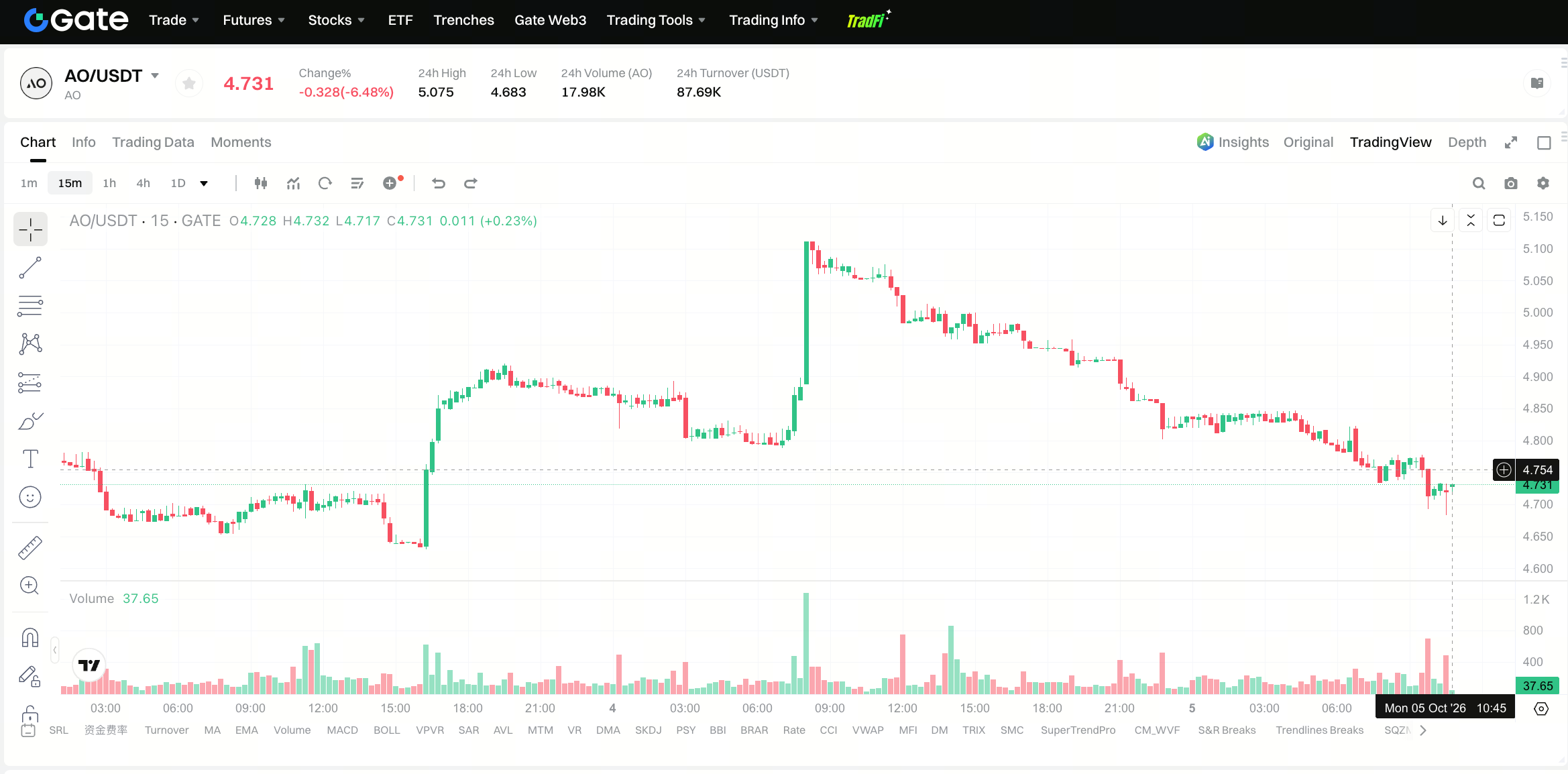
As of late September 2026, Gate lists AO with a total supply near 3.9 million, a maximum supply of 21 million, and circulating supply near 3.5 million (Gate AO market page).
Where to Buy AO
AO is available on Gate as a spot market (search AO). Use only official Gate trading interfaces, confirm the contract or market ticker carefully, and size positions for high volatility typical of mid-cap infrastructure tokens.
Key Risks
Technical complexity. MU/SU/CU markets, HTTP-native AO-Core devices, and TEE or attestation paths add moving parts. The architecture can be efficient at scale, but bugs in messaging order, CU markets, or client SDKs can still affect correctness or availability under load.
Competition and demand. High-throughput L1/L2s and other decentralized compute or DePIN networks compete for the same developer attention. Weak DApp retention would limit fee demand for AO.
Market and regulatory risk. AO and AR prices can move sharply with crypto beta. Jurisdictions differ on token classification, staking rewards, and compute-network compliance (for example MiCA-style regimes in the EU). None of the mechanisms above are financial advice.
Summary
ao Computer extends Arweave from permanent storage into a hyper-parallel, message-driven compute environment. Processes run independently; MU, SU, and CU units route, order, and execute work; logs settle on Arweave for auditability. AO-Core and HyperBEAM push modularity further, while the AO token ties staking, payments, and fair-launch distribution to that compute layer. For readers comparing storage-only Arweave history with today’s AO stack, the practical question is whether hyper-parallel processes and permanent logs deliver enough app demand to sustain the network—not short-term price targets.
FAQ
What is ao Computer in one sentence?
ao Computer (AO) is a hyper-parallel computer and unified computing environment that runs independent processes on top of Arweave’s permanent storage and message logs.
How is AO different from Ethereum execution?
Ethereum-style chains typically serialize transactions through a shared global thread; AO lets many processes execute concurrently and communicate across an open message passing layer, with message history stored on Arweave.
What are MU, SU, and CU?
Messenger Units route messages, Scheduler Units order and persist them on Arweave for further processing by Compute Units, and Compute Units execute process logic and return results—together forming AO’s processing pipeline.
What is the AO token used for?
AO is designed for node staking, payments for compute/services on the network, and ecosystem incentives under a 21 million fair-launch supply model linked to AR holders and bridged assets.
Is ao Computer only for AI agents?
No. AI agents are a highlighted use case, but the same architecture targets DeFi, gaming, autonomous services, and other DApps that need scalable, verifiable off-the-single-thread compute with permanent logs.
Author: Alawn
Translator: Viper
Reviewer(s): Pow、KOWEI、Elisa、Jayne
Translation Reviewer(s): Ashley、Joyce
Disclaimer
* The information is not intended to be and does not constitute financial advice or any other recommendation of any sort offered or endorsed by Gate.
* This article may not be reproduced, transmitted or copied without referencing Gate. Contravention is an infringement of Copyright Act and may be subject to legal action.
Solana faces both opportunities and challenges in its development. Recently, severe network congestion has led to a high transaction failure rate and increased fees. Consequently, some have suggested using Layer 2 and appchain technologies to address this issue. This article explores the feasibility of this strategy.
This article introduces the technical principles, framework, and applications of Zero-Knowledge (ZK) technology, covering aspects from privacy, identity (ID), decentralized exchanges (DEX), to oracles.
Sui is a PoS L1 blockchain with a novel architecture whose object-centric model enables parallelization of transactions through verifier level scaling. In this research paper the unique features of the Sui blockchain will be introduced, the economic prospects of SUI tokens will be presented, and it will be explained how investors can learn about which dApps are driving the use of the chain through the Sui application campaign.
Dewhales Research released a research report to delve into the mechanism and potential of AltLayer and explore how it can serve as a Rollup-as-a-Service solution in the rapidly developing blockchain environment. The article also introduces AltLayer’s Tokenomics, team and integration cases.
TronScan is the primary blockchain explorer for the TRON network. It allows users to check TRX and TRC-20 transactions, inspect wallet balances, analyze smart contracts, monitor tokens, and view network activity without logging in. By connecting a compatible wallet such as TronLink, users can also transfer assets, stake TRX, vote for Super Representatives, and interact with TRON ecosystem applications.