The process of integrating blockchain technology into the financial system is not simply about converting assets such as stocks, bonds, or real estate into tokens. For financial institutions, how funds themselves move on-chain is also a key question in determining whether asset tokenization can form a complete market. Even if a bond has been tokenized, the overall transaction process may still be constrained by traditional settlement mechanisms if both parties must use different systems to process fund transfers, confirm receipt, and reconcile accounts.
Tokenized deposits have gained attention in this context. They aim to connect deposits within the commercial banking system to blockchain networks, allowing funds to participate in payments and settlement in a manner closer to native on-chain assets while remaining subject to banking rules. Services provided by J.P. Morgan's Kinexys offer a practical example of this approach.
However, tokenized deposits do not mean that blockchain replaces bank credit, nor do they mean that all on-chain funds have the same legal characteristics. Understanding this area requires examining the underlying deposit relationship, token issuance and redemption mechanisms, network access rules, and the relationship between on-chain transactions and bank accounting.
Key Takeaways
-
Tokenized deposits are still based on commercial bank deposits. Blockchain changes how funds are digitally represented and transferred, rather than automatically changing the underlying credit relationship.
-
JPM Coin is a bank deposit token provided by Kinexys. J.P. Morgan positions it as a bank-issued instrument distinct from cryptocurrencies and stablecoins.
-
A Blockchain Deposit Account (BDA) connects bank accounts with on-chain fund operations and can support deposit management, payment instructions, and JPM Coin minting.
-
The value of tokenized funds extends beyond transfer speed. It also lies in enabling closer integration among payment, settlement, collateral management, and account reconciliation processes.
-
Operating on-chain does not mean there are no risks. Bank credit, compliance access, network availability, technical security, and interinstitutional settlement must still be assessed.
From Bank Deposits to On-Chain Assets: What Does Tokenization Actually Change?
Traditional bank deposits are essentially claims held by depositors against commercial banks, with banks recording the corresponding deposit liabilities on their balance sheets. When users initiate transfers through bank accounts, funds must move through internal bank accounting systems or be settled across institutions through clearing networks, correspondent banking systems, and other payment infrastructure. This process has established regulatory and operational frameworks, but it may also involve information sharing, reconciliation, and processing time across multiple systems.
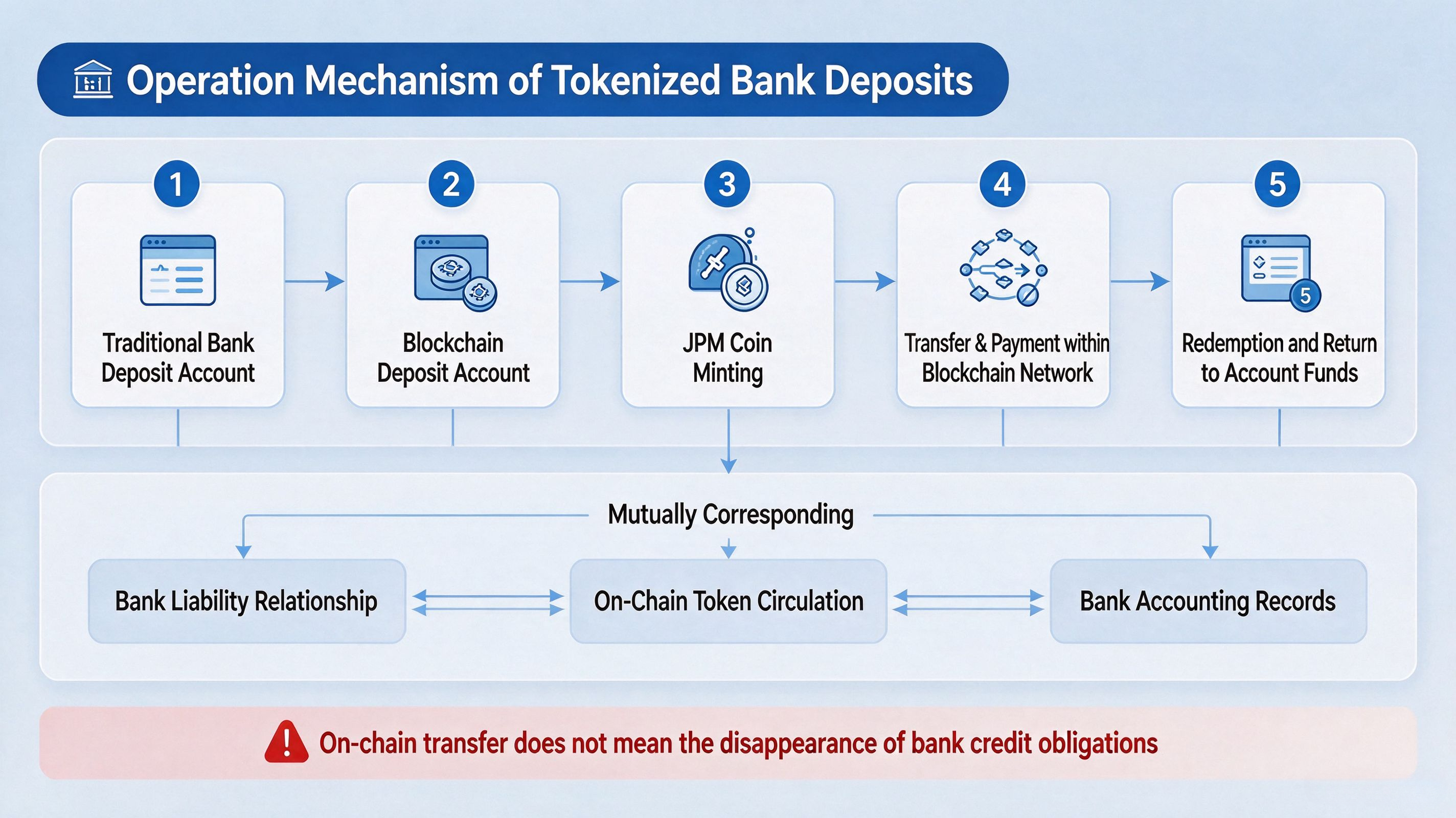
The core concept of tokenized deposits is to use distributed ledger technology to connect deposit relationships or deposit value to blockchain networks in digital form. This is not as simple as taking a screenshot of a bank account balance and creating a token. It requires institutional and technical links among token issuance, holding, transfer, redemption, and bank accounting records. Tokenized funds can have practical financial use only when the circulation of on-chain tokens remains consistent with the funding obligations in the banking system.
It is also important to distinguish between two concepts that are often used interchangeably: tokenized deposits and deposit tokens. Both relate to the use of blockchain for commercial bank deposits, but their specific designs may differ. The former may use an account-based structure to record or trigger changes in deposit accounts on a blockchain, while interbank fund settlement may still be completed through traditional systems. The latter places greater emphasis on representing bank deposit value in token form, enabling the tokens themselves to be transferred in on-chain environments that comply with the issuer's rules. Institutions do not always use these terms consistently, so analysis of a specific product should be based on the legal structure and operating mechanisms disclosed by its issuer.
Kinexys' product suite reflects the connection between bank accounts and on-chain tokens. Its Blockchain Deposit Account provides blockchain-enabled deposit account capabilities, while JPM Coin is a deposit token issued by J.P. Morgan. The former can serve as an account foundation for fund management and on-chain operations, while the latter can be used to transfer funds across eligible blockchain networks. Together, they form an operational path from bank deposits to on-chain payments.
How Does Kinexys Connect Bank Accounts and Blockchain Networks?
Kinexys is J.P. Morgan's blockchain financial infrastructure ecosystem for corporate and institutional clients, covering digital payments, digital assets, and related platform services. Its design focus is not on issuing a single token independently, but on connecting fund movement, asset management, and settlement processes so institutions can use blockchain technology within existing banking frameworks.
At the account level, the Blockchain Deposit Account (BDA) provides clients with a blockchain-enabled deposit account. J.P. Morgan states that BDA can support cross-border liquidity management, programmable payments, and near real-time settlement, and can connect with companies' existing systems through APIs, SWIFT, or user interfaces. Its public materials list supported currencies including the U.S. dollar, Hong Kong dollar, Singapore dollar, Chinese yuan, Japanese yen, Australian dollar, euro, and British pound. For corporate treasury management, this may allow fund visibility, account management, and payment processes to rely less on manual operations and traditional business hours.
At the token level, JPM Coin is a U.S. dollar-denominated bank deposit token. J.P. Morgan states that eligible institutional clients can convert account funds into JPM Coin through a BDA and use it for transfers, payments, collateral delivery, and trade settlement in approved blockchain environments. The token can also be redeemed for U.S. dollar account funds under applicable arrangements. Therefore, JPM Coin is not an anonymous digital currency that operates independently of the banking system. Its issuance and use still depend on bank customer relationships, compliance reviews, and account systems.
Regarding network deployment, J.P. Morgan announced in 2025 that JPM Coin would be available to institutional clients on the Base network. In October 2026, it announced that JPM Coin would expand to the Ethereum mainnet. Deployment across different networks means that institutions can explore fund transfers and asset settlement in more on-chain environments. However, it does not mean that any wallet address or individual user can hold and use the token without restrictions. Actual participation eligibility, counterparty scope, and business functions must still comply with Kinexys access and service rules.
Programmable Payments: Blockchain Offers More Than Transfer Speed
Traditional payment processes typically require payment conditions to be confirmed before a fund transfer is initiated, followed by receipt confirmation and account reconciliation across different systems. When a transaction involves cross-border funds, multiple counterparties, or complex contractual terms, companies may also need additional manual reviews and system coordination. Programmable payments on blockchain aim to convert certain business conditions into executable rules, allowing funds to move according to predefined conditions.
For example, companies can set payment instructions based on delivery confirmation, timing, account balances, or other business conditions. When the agreed conditions are met, the system can trigger the corresponding transfer of funds. For supply chain payments, intragroup fund allocation, and financial transaction settlement, this mechanism may reduce repeated confirmations and manual processing. However, the rules themselves still require accurate business data as inputs, and automated on-chain execution cannot replace contract review, compliance checks, or dispute resolution.
Kinexys includes programmable payments and continuous liquidity management among its service capabilities. BDA allows companies to manage funds within a banking framework and arrange fund flows through configurable instructions. JPM Coin can be used for on-chain payment and settlement scenarios. Combined, the two enable institutions to explore more integrated processes for fund management, payment execution, and transaction settlement, rather than treating blockchain solely as another standalone transfer channel.
It is important to note that "near real-time" or "around-the-clock" does not mean that all fund inflow and outflow processes are free of timing limitations. On-chain transfers, conversion of funds between bank accounts and on-chain networks, and final settlement across institutions may be subject to different processing arrangements. When evaluating efficiency, companies should separately assess the timing of on-chain transaction confirmation, bank accounting processing, and final interinstitutional fund delivery rather than judging the efficiency of the entire payment chain based solely on token transfer speed.
What Is the Difference Between Tokenized Deposits and Stablecoins?
Both tokenized deposits and stablecoins can appear on blockchain as digital instruments linked to fiat currency value, and both may be used for payments, trade settlement, and on-chain asset markets. However, their underlying credit relationships are different. Tokenized deposits typically represent deposit claims within the issuing bank's system, meaning holders have a corresponding deposit relationship with the issuing bank. Stablecoins, by contrast, are generally maintained at a value peg by specialized issuers based on their reserve assets, redemption arrangements, and applicable regulatory frameworks.
In a tokenized deposit structure, bank credit and the balance sheet are important starting points for understanding risk. Using JPM Coin as an example, J.P. Morgan describes it as a bank-issued deposit token and explicitly states that it is not a cryptocurrency or stablecoin. Its fund conversion and redemption are completed through the BDA framework, and its use is limited to approved institutional clients. Stablecoins, on the other hand, may be backed by cash, short-term government bonds, or other reserve assets. Users need to consider the issuer, reserve asset quality, custody arrangements, redemption mechanisms, and regulatory requirements.
The two may also differ in how they are used across networks. Stablecoins are generally available to broader on-chain ecosystems, with the degree of openness depending on the issuer and network. Bank deposit tokens may be restricted by bank customer identity, counterparty reviews, and use cases. More stringent access arrangements can help financial institutions manage counterparty and compliance risks, but they may also limit token circulation in open markets.
Therefore, the fact that a token operates on a public blockchain alone does not determine whether it is an open stablecoin or whether it provides the same redemption and holding rights. When analyzing an on-chain monetary instrument, it is necessary to review at least the issuer, legal claim relationship, reserve or liability structure, transfer restrictions, redemption path, and applicable regulatory framework. Research by the Bank for International Settlements on the tokenized financial system also identifies coordination among commercial bank money, central bank money, and tokenized assets as an important issue for future financial infrastructure.
Application Boundaries and Key Risks of Tokenized Deposits
The potential value of tokenized deposits is first reflected in institutional fund management and payment processes. Companies can use more continuous fund visibility and automated instructions to manage funds across time zones. Financial institutions can also explore using deposit tokens for on-chain collateral delivery, securities settlement, or other digital asset transactions. These applications may reduce waiting periods and manual reconciliation in traditional processes, but their actual effectiveness depends on the number of participating institutions, the degree of network interoperability, and final fund settlement arrangements.
Second, the use of tokenized deposits remains subject to the rules of the issuing bank and network. Banks need to manage customer access, anti-money laundering controls, sanctions screening, transaction monitoring, and liquidity arrangements. A token being transferable on-chain does not mean that every recipient can automatically convert it into bank account funds. If interoperability mechanisms are lacking between different banks or networks, on-chain funds may still be restricted to specific institutions or business networks.
Technical risks also cannot be overlooked. Smart contract vulnerabilities, key management errors, network congestion, cross-chain bridge failures, and third-party service disruptions may all affect token transfers or asset settlement. Even when a token is issued by a bank, this does not mean that every technical component supporting its operation is risk-free. Institutions need to define incident handling, transaction reversal or remediation mechanisms, permission management, and business continuity arrangements.
In addition, faster on-chain transaction speeds do not necessarily eliminate liquidity risk. If there is a time gap between on-chain transfers and final interbank settlement, participating institutions may still bear counterparty credit exposure or liquidity usage. For tokenized deposits to become broader financial infrastructure, issues such as cross-institution recognition, legal certainty, settlement asset availability, and regulatory coordination must still be addressed.
The Connection Between Gate and Tokenized Financial Infrastructure
Kinexys represents a direction for bringing bank deposits and payment infrastructure on-chain, while Gate's tokenized stock securities gStocks represent another path for bringing traditional securities into digital asset trading environments. They are not the same type of product, but they can be understood within the same evolution of financial infrastructure: one explores how on-chain funds can be issued, transferred, and settled, while the other explores how traditional stocks can enter digital asset platforms through tokenization.
According to Gate's public introduction to gStocks, the product uses a reserve mechanism corresponding 1:1 with the underlying native stocks and provides trading through the platform's order book. Users hold tokenized securities units, which does not automatically grant them exactly the same rights as registered shares held through traditional brokers. Actual rights, dividend handling, conversion mechanisms, and scope of application are subject to the specific product rules.
From an infrastructure perspective, tokenized securities markets require not only asset issuance, custody, and trading mechanisms, but also reliable fund settlement tools. As stocks, bonds, and money market funds gradually enter on-chain environments, counterparties also need funding instruments that can complete payment, delivery, and asset transfers. Bank deposit tokens may become one institutional-grade settlement option. However, whether they can connect with specific asset platforms depends on network compatibility, institutional partnerships, compliance access, and settlement arrangements. It cannot be inferred that interoperability has already been achieved simply because both use blockchain technology.
Therefore, the relationship between Kinexys and Gate is better understood at the industry structure level rather than by viewing JPM Coin and gStocks as interchangeable tokens. The former focuses on bringing bank money on-chain, while the latter focuses on tokenizing traditional securities assets. Together, these two approaches show that the development of RWA and institutional-grade blockchain finance requires infrastructure development across the asset, funding, and settlement layers.
Conclusion
Tokenized deposits are not simply bank accounts moved onto a blockchain. Instead, they add new forms of digital representation and transfer for deposits within existing bank credit and regulatory frameworks. Through BDA and JPM Coin, Kinexys demonstrates how bank accounts, deposit tokens, and blockchain payments can be connected, while also reflecting institutional finance's exploration of programmable funds and continuous settlement capabilities.
However, transfer efficiency on blockchain is only one part of financial infrastructure. Bank liability relationships, redemption paths, interinstitutional settlement, compliance management, and technical security still determine whether tokenized deposits can operate reliably in real business scenarios. As more tokenized securities and real-world assets enter on-chain markets, interoperability between funding instruments and asset instruments will become an important measure of the maturity of this system.
FAQ
Are tokenized deposits stablecoins?
Not necessarily. Tokenized deposits typically represent claims on commercial bank deposits, while stablecoins generally maintain their value peg through reserve assets and redemption arrangements established by their issuers. Their issuers, legal relationships, reserve or liability structures, and regulatory frameworks may differ.
What Is JPM Coin?
JPM Coin is a bank deposit token provided by J.P. Morgan through Kinexys. Its official materials state that eligible institutional clients can use it for on-chain fund transfers, payments, collateral delivery, and trade settlement, and can convert it back into U.S. dollar account funds through the BDA framework.
What Is the Difference Between a Blockchain Deposit Account (BDA) and JPM Coin?
A BDA is a blockchain-enabled bank deposit account that supports fund management and account connectivity. JPM Coin is a bank-issued deposit token that can be transferred across eligible blockchain networks. Clients can convert account funds into JPM Coin through a BDA.
Can Tokenized Deposits Be Transferred Around the Clock?
Certain on-chain operations may support around-the-clock availability, but on-chain transfers, bank account fund conversions, and final settlement across institutions may follow different schedules. Specific availability is subject to bank and product rules.
Can Tokenized Deposits Be Used for RWA Settlement?
They can serve as one potential on-chain settlement funding tool, but asset platforms, fund issuers, and relevant institutions need to establish connections across network, compliance, and settlement mechanisms. Not all tokenized assets can be settled directly using a specific bank deposit token.