Gate Rank surfaces relative market attention: which listed pairs are moving, which names print volume, and which boards highlight newcomers or sector heat. The page is useful for scanning, not for skipping due diligence. Thin pairs can spike to the top of a short-window gainer board and reverse quickly.
Key Takeaways
- Start from a clear board (gainers, volume, market cap style lists) instead of scrolling every tab.
- Match the time window to your horizon—5-minute spikes differ from 24-hour leaders.
- Open the pair page to confirm liquidity, spread, and whether you can exit.
- Treat Rank as a shortlist generator; research still happens after the click.
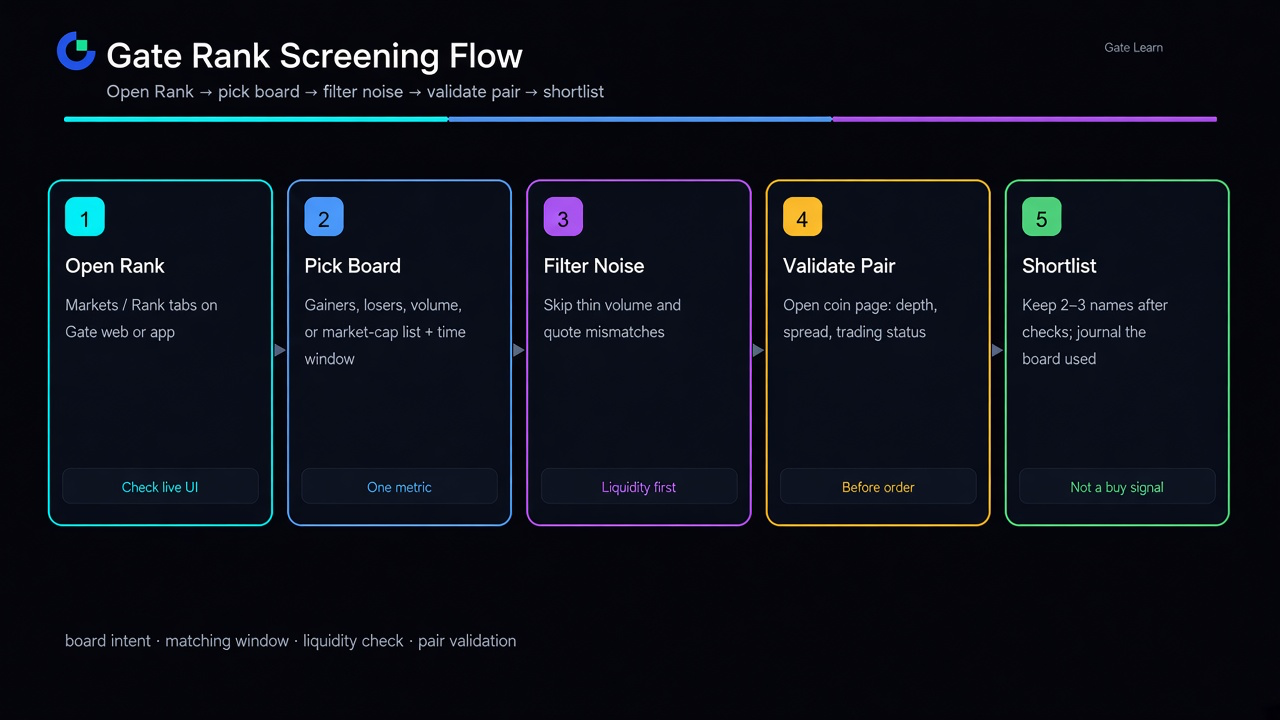
Figure 1. Gate Rank five-step screening: open Rank, pick a board and window, filter noise, validate the pair, then keep a repeatable shortlist.
What Gate Rank Is For in the Crypto Market
Rank boards compress sortable crypto market activity into lists so you can answer “what is moving on Gate right now?” faster than browsing every spot pair, and they help you compare what is moving beyond Bitcoin. Typical jobs include spotting momentum candidates, checking prices on the board, seeing whether a narrative sector is broad or one-coin, and finding high-volume names for tighter execution. It is important to separate broad market moves from one-off coin action, because one move can dominate sentiment while the broader number of active names may point elsewhere.
Rank is not a fundamentals terminal and not an onchain scanner, so deeper research should be considered after the initial shortlist is built. For early onchain discovery workflows, use dedicated tools; for listed-pair heat, Rank is the right first pass. Moving from the board to coin-level filters is close to screening for promising cryptocurrencies on Gate.
Step 1: Open Rank and Orient the Tabs
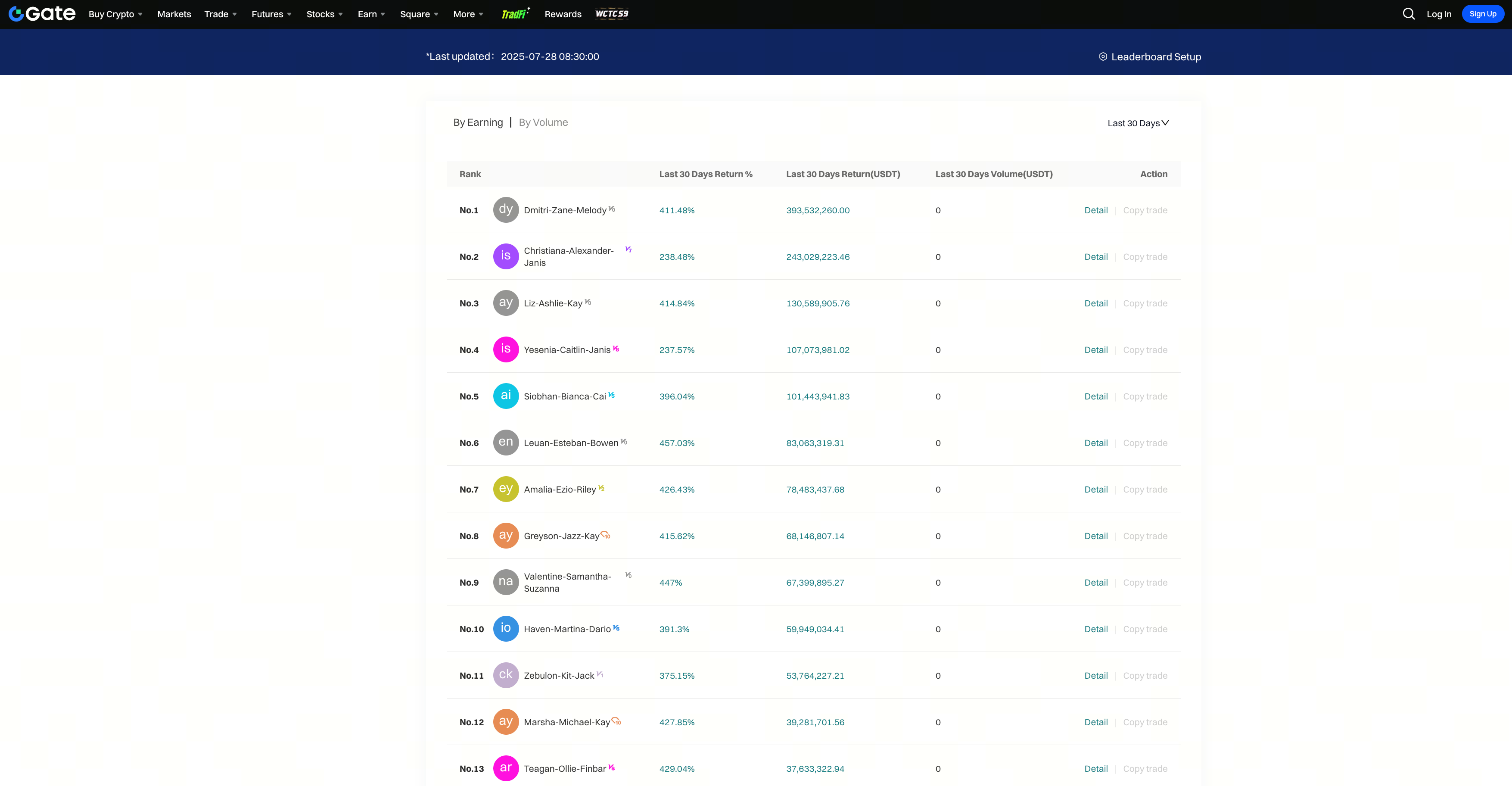
On the Gate website or app, open Rank (or the ranking section under Markets, depending on layout). Identify the available boards and rankings—common patterns include top gainers, top losers, volume leaders, and new or trending lists. Note the default quote currency (often USDT) so you compare like with like. The layout may be updated over time, so compare any instructions with the live interface by date before following them.
If you are reviewing a walkthrough published in August or December, confirm the current tab labels before relying on it.
If a big-data or heatmap module sits nearby, use it as secondary context, along with any nearby charts, not as a replacement for Rank’s ordered table. The big data dashboard adds complementary analytics that may live under different navigation labels after UI updates. Before relying on nearby figures, check the data source shown on the adjacent module.
Step 2: Choose a Ranking Metric (e.g., market cap) and Time Window
| Board intent |
Prefer when |
Watch-outs |
| Gainers / losers |
Momentum scan |
Illiquid spikes, wash attention |
| Volume |
Execution quality focus |
Volume ≠ sustainable trend |
| Market-style size lists / market capitalization |
Relative scale |
Listing coverage differs by venue |
| New / trending |
Fresh attention |
Higher failure rate of narratives |
| Pick one metric per session. Mixing “top gainer” and “top volume” without a rule produces inconsistent shortlists. Market-cap style lists are typically calculated by multiplying a coin’s current price by the number of units in circulation, or using equivalent methodology shown by the platform—close to market capitalization, but different from share-based stock market cap. Comparisons with companies such as Microsoft, Amazon, or Walmart belong to a different ranking framework than crypto assets. That gives a rough relative value view, but coverage can differ across venues; read boards with volume beside percentage change. Align the window to your plan: intraday traders care about short windows; swing scanners lean on longer boards when offered, and the selected window should match the horizon you are watching. |
|
|
Step 3: Filter Noise Before You Click Through
Skip names where 24-hour volume cannot support your ticket size, because thin liquidity can lead to misleading moves when volume is too low for your size. Prefer pairs with continuous order-book updates over one-tick pumps. A risky combination of low volume and sharp percentage moves can distort the board, and it may still look active even when overall liquidity held up poorly under real order size. If the board shows percentage change without volume, open the pair before acting.
Watch for quote mismatches (BTC-quoted vs USDT-quoted) when comparing percentages. Stablecoin pairs are usually easier for beginners to interpret. These moves are often pulled by brief attention rather than durable demand, and order flow can change quickly depending on who has the upper hand in thin markets. Weak breadth or low participation can be pointing to a temporary burst rather than a durable trend.
Step 4: Open a Coin and Validate Tradability
From Rank, open the coin or pair page and check whether the asset is a coin or a token, with Render as one example of a listed token that still needs the same tradability checks as any other name on the board. Check last price continuity, order-book depth near mid, recent trades, and whether the pair is suspended or in special state. Confirm the network and deposit status if you plan to move funds. This step matters even more if market momentum looks strong but exit conditions are uncertain.
Only after that validation should you open the spot or derivatives ticket. The pair page can also show whether recent gains are supported by steady activity rather than a brief spike, though trading experience still matters when judging whether the move is actually tradable. Rank got you to the door; the pair page decides whether entry is sane.
Step 5: Build a Repeatable Shortlist Habit
Save a personal routine: for example, “volume leaders + gainers filter, top 10 open, keep 2–3 after liquidity check.” Use it to create a process you can repeat across sessions. Write the rule down so each session is comparable. Consistent rules help keep fear and impulse from expanding the shortlist. Avoid expanding the shortlist during FOMO candles. Names rising on the board still need the same liquidity check every time.
For meme-heavy boards, pair Rank screening with venue-risk thinking for memecoin trading platforms so listing heat is not confused with safe execution venues.
When a board looks crowded with identical percentage moves, carefully check whether they share the same quote asset and sector tag. A cluster of names moving together can represent one narrative rather than independent opportunities. Select two or three survivors after liquidity checks instead of copying the entire top ten.
Keep a short journal of which Rank boards you used and which pairs survived your filters. Over weeks, that journal becomes a guide for which time windows produce higher-quality shortlists for your style. Market cap style lists and volume leaders often display different leaders; compare them side by side before you size any trade.
Summary
Using Gate Rank well means choosing the right board, matching time windows to intent, filtering illiquid spikes, validating each pair’s tradability, and keeping Rank in the role of a shortlist tool for watching relative market activity, not just reacting to one move. Momentum on a ranking table is information about attention—not a substitute for risk controls. There are many reasons a coin appears near the top of Rank, and the table alone does not explain them. What looks strong today may not hold by tomorrow unless liquidity and participation stay intact.
FAQ
Is Gate Rank a buy signal?
No. It ranks relative market activity. This is a brief disclaimer: appearing on Rank is not a recommendation to buy or sell any asset. Nothing on the board should be treated as a solicitation involving a security. Decisions still need liquidity, risk, and thesis checks.
Why do tiny coins with low market capitalization dominate gainers?
Low liquidity can produce large percentage moves on small notionals because thin participation from investors and traders can make small coins jump fast. Those low-liquidity moves can reverse quickly if early buyers try to exit at once. Always check volume and depth.
Can I use Rank for futures symbols?
Use the board that matches the market type you trade. Do not assume a spot gainer list maps 1:1 to perpetual contracts. In some case, futures activity can diverge sharply from the spot list. Forced liquidations can also move derivatives symbols faster than the spot ranking suggests.
How often should I refresh Rank?
As often as your strategy horizon requires, based on what could change by tomorrow rather than just this minute, but avoid overtrading every refresh. Constant refreshing rarely improves decision quality unless the underlying board data has materially changed. Batch reviews beat impulsive clicks.
What if the Rank URL or tab name differs in my app?
UI labels change. The exact country or region of the app store version can affect labels. Read the surrounding market labels carefully before clicking unofficial links. Look for Markets ranking, gainers/losers, or Rank entry points, then confirm you are on Gate’s official domain, especially if you are comparing screenshots or guides from India, Japan, or China and need to verify the current Gate interface directly. Easy access matters, but safety and the correct Gate domain matter more.