AI data center construction has made cooling equipment an infrastructure segment attracting attention from the capital markets. Rising power density in high-performance servers is prompting data center operators to reassess the design of air-cooling, liquid-cooling, and heat-dissipation systems. For equipment suppliers, this may create new orders and expand their addressable markets.
AAON's BASX brand provides customized cooling and air-handling solutions for data centers, so the market may include it in research on AI infrastructure stocks. However, growth in industry demand does not automatically mean that a company will achieve comparable revenue growth, much less that its stock price will rise. Manufacturing companies must go through order acquisition, design, procurement, production, delivery, and collection before they can convert market opportunities into financial results.
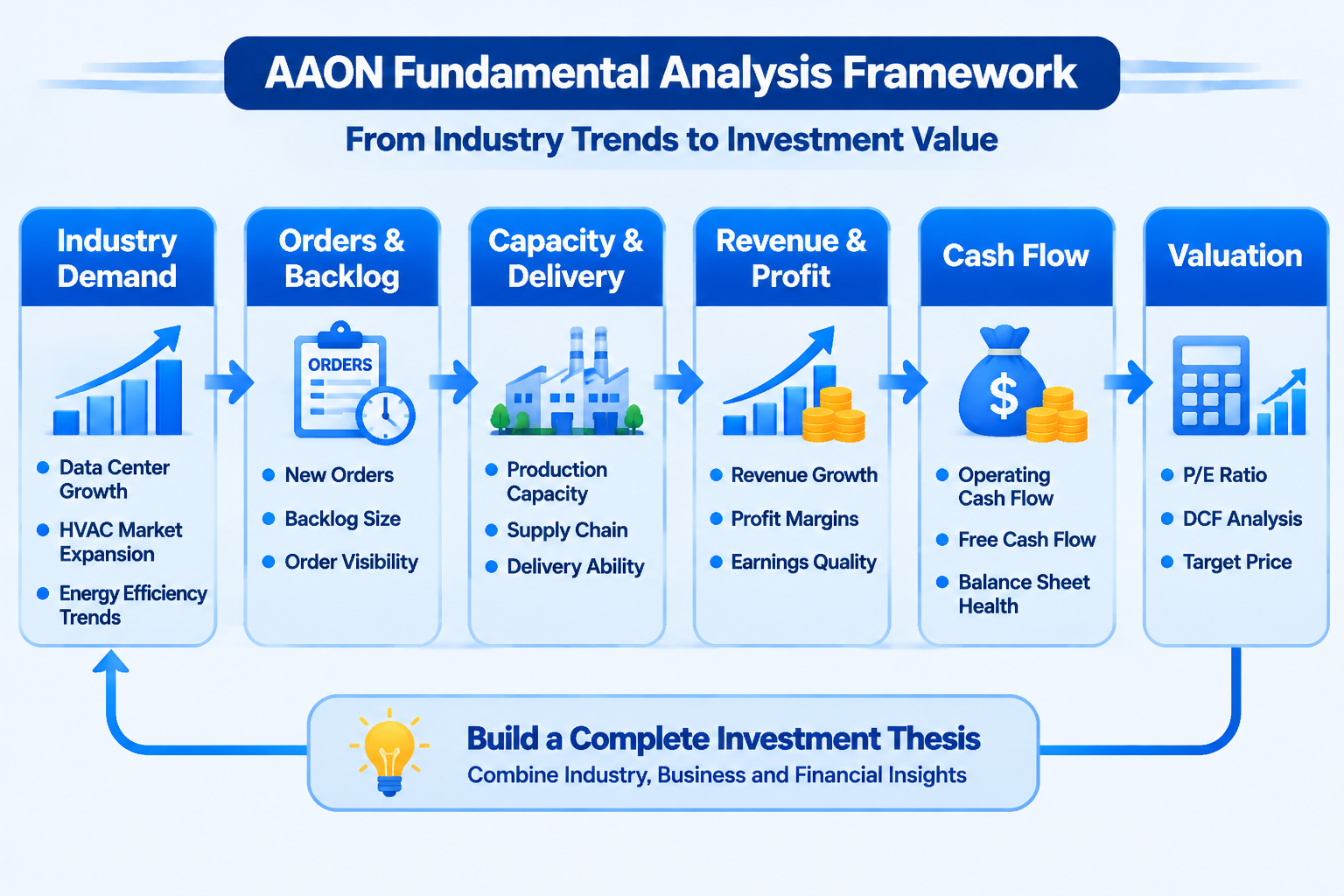
Therefore, researching AAON stock requires an analytical framework that covers the industry, the company, valuation, and trading risks. Investors should understand the long-term demand for AI data center cooling while also evaluating the company's operating quality and avoiding decisions based solely on the popularity of the theme.
Key Takeaways
-
AAON's investment thesis needs to consider both its traditional HVAC business and its data center thermal management business
-
Data center order growth must pass through production, delivery, and revenue recognition before it is reflected in financial results
-
Backlog can provide business visibility, but delivery timelines, cancellation risk, and profit quality must also be evaluated
-
Capacity expansion may support long-term growth, but it may also increase fixed costs and pressure profit margins in the short term
-
Valuation analysis should not rely solely on expectations surrounding the AI theme. It should also consider revenue growth, profit margins, cash flow, and returns on capital
-
Before trading AAON-related products, verify the specific product structure, trading rules, and regional availability displayed on the Gate page
Understanding AAON's Business Structure and Revenue Sources
When researching a company, the first step is to understand what it sells, who it sells to, and how each business contributes to revenue and profit. AAON's business includes HVAC, air-handling, and thermal management equipment for commercial, industrial, and data center applications. The BASX brand is an important part of its data center cooling business, but the company does not rely solely on the AI data center market.
This business structure means that AAON's performance may be affected by multiple end markets at the same time. Demand for traditional commercial and industrial HVAC systems, investment in data center projects, customer capital expenditure cycles, and the sales mix across different products may all affect the company's revenue growth and profitability.
For analysis, the business can be divided into several layers: traditional HVAC products, customized air-handling equipment, data center air-side cooling equipment, and liquid-cooling-related products. Different products may have different technical requirements, order cycles, manufacturing complexity, and profit levels. If data center products account for a larger share of revenue, the company's overall growth and profit structure may also change.
Investors should prioritize the company's annual reports and quarterly earnings announcements, including segment revenue, brand sales, product descriptions, and management discussion. Do not determine the size of the business solely from the "AI concept" label used in market articles. Instead, confirm how much revenue the data center business actually contributes and whether its growth is sustainable.
How Can You Determine Whether Order Growth Is Sustainable?
Orders and backlog are important indicators when researching manufacturing companies. For an equipment supplier such as AAON, order growth may reflect customer project demand, product competitiveness, and future delivery opportunities. Backlog represents business that has been won but has not yet been fully recognized as revenue, and it can provide some visibility into future production scheduling.
However, backlog is not the same as realized revenue or guaranteed profit. Orders may be affected by customer project schedules, equipment specification changes, delivery timelines, contract terms, and supply chain conditions. If a manufacturer cannot deliver on time, the pace of order conversion may fall short of expectations.
Therefore, when analyzing AAON, orders, backlog, and revenue growth should be evaluated together. If orders continue to increase and revenue also grows as planned, the company may have a certain level of delivery capability. If order growth is significantly faster than revenue growth, further research is needed to determine whether capacity, delivery timelines, or the supply chain have become bottlenecks.
You should also examine the product mix and customer concentration within the order book. High-growth orders concentrated among a small number of large projects or customers may provide greater business visibility, but they may also increase volatility resulting from changes in customer capital expenditures. Order quality deserves more attention than the total order amount alone.
Capacity Expansion and Profit Margins: The Cost Issues Behind Growth
Data center cooling equipment may require customized design, relatively complex production processes, and specialized engineering capabilities. When market demand grows rapidly, manufacturers typically need to expand their facilities, equipment, and workforce to improve delivery capacity. AAON's capacity expansion may be viewed as an operating investment to support future growth, but it must also be evaluated in the context of costs and utilization.
When a new plant or production line begins operations, fixed costs may not yet be absorbed by sufficient production volume. Employee hiring and training, equipment commissioning, supply chain integration, and the ramp-up in production efficiency may all affect gross margin in the short term. As a result, even if revenue grows rapidly, profit growth may temporarily lag behind.
Investors can focus on changes in gross margin, operating margin, capital expenditures, depreciation, inventory, and accounts receivable. If the company continues expanding capacity but order conversion and capacity utilization do not increase at the same pace, new investments may weigh on returns. Conversely, if capacity gradually ramps up and delivery efficiency improves, fixed costs may be absorbed by a larger volume of products, potentially improving profit margins.
The key is not to simply classify capital expenditures as positive or negative. Instead, evaluate whether the investment can create effective capacity within a reasonable timeframe and generate returns above the cost of capital.
What Should You Watch in Cash Flow and Working Capital?
The income statement shows a company's revenue and profitability over a given period, but cash flow provides further insight into whether its operating results have been converted into cash. For rapidly expanding manufacturers, changes in inventory, accounts receivable, and accounts payable may have a significant impact on cash flow.
If a company purchases raw materials in advance to meet customer delivery requirements or increases its work-in-progress and finished-goods inventory, its working capital needs may rise. If customers have longer payment cycles, accounts receivable may also increase. In this situation, operating cash flow may come under pressure even as revenue and accounting profit grow.
When analyzing AAON, compare operating cash flow with net income and monitor inventory turnover, accounts receivable turnover, and capital expenditure trends. If the company requires substantial cash investment over an extended period to maintain growth, its financing capabilities and balance sheet capacity should be evaluated.
Cash flow is also related to capacity expansion. Investments in facilities, equipment, and automation systems may consume cash in the short term, but long-term returns may improve if the new capacity can consistently generate revenue and profit. Investors should focus on the scale of capital expenditures, the timing of production launch, utilization, and ongoing maintenance needs rather than looking only at cash flow for a single quarter.
How Should You Evaluate AAON's Valuation?
When the market links AAON to AI infrastructure, the stock's valuation may be influenced by both the company's fundamentals and expectations surrounding the industry theme. Investors need to assess how much future growth is already reflected in the current stock price rather than simply determining whether the company's industry has room to grow.
Common valuation metrics include the price-to-earnings ratio, price-to-sales ratio, enterprise value-to-EBITDA ratio, and free cash flow yield. Different metrics are appropriate in different situations. If the company's profit is affected by capacity expansion and one-time costs, the price-to-earnings ratio for a single year may not fully reflect its operating performance. If profit has not yet stabilized, the price-to-sales ratio should also be interpreted together with future profit margins.
When comparing peers, do not focus solely on valuation multiples. Also consider business structure, the proportion of revenue from data centers, customer concentration, growth rate, profit margins, capital intensity, and the balance sheet. Customized product capabilities and customer relationships may create competitive advantages, but these advantages must be validated through actual operating performance.
Valuation analysis should also include different scenarios. An optimistic scenario may assume that data center demand continues to grow, capacity ramps up smoothly, and profit margins improve. A base-case scenario may assume that demand grows but delivery and cost improvements are more gradual. A cautious scenario may consider project delays, slower orders, rising costs, or multiple contraction. Scenario analysis can help identify how sensitive the stock price is to different operating assumptions.
What Risks Need to Be Managed When Trading AAON Stock?
The first is industry expectations risk. The AI infrastructure theme may drive market sentiment in the short term, but there may be a time lag between the popularity of the theme and the company's actual performance. If the market has already priced in high growth expectations, the stock price may become volatile if subsequent results fall short of expectations, even if the company continues to grow.
The second is operating risk. Data center projects have long construction cycles and may be affected by power access, approvals, financing, and changes in customer capital expenditures. Supply chain conditions, production efficiency, and delivery capabilities will also affect whether the company can fulfill its orders. Investors should monitor company announcements and financial reports rather than adjusting their views solely based on industry news.
The third is valuation and market risk. Changes in interest rates, overall equity market risk appetite, industry rotation, and capital flows may all affect the valuations of growth stocks. Even if the company's operating condition does not deteriorate significantly, a decline in the market valuation multiple may still cause the stock price to fall.
Finally, there is trading execution risk. Investors should determine their position size based on their individual risk tolerance and avoid excessive concentration in a single theme. For highly volatile stocks, investors may set research assumptions, monitoring indicators, and exit conditions in advance, while distinguishing between long-term fundamental views and short-term trading plans.
Gate Stock Services and AAON-Related Trading Access
Gate provides access to stock-related services, and users can learn more through the AAON stock page. Before trading, however, you must first confirm the specific product type and applicable rules provided on the page. Traditional stock trading, stock tokens, and other derivatives may differ in terms of asset rights, ownership structure, settlement mechanisms, and risks.
If the product is a stock token, do not equate it with direct ownership in a traditional securities account without verification. You should also not assume that holders have exactly the same voting rights, dividend rights, or other rights as ordinary shareholders. Carefully review the product description, trading rules, and risk disclosures.
Research on AAON should not be simplified merely because a trading access point is available. Users still need to independently evaluate the company's business, financial performance, valuation, and market risks. The Gate page can serve as an entry point for learning about the relevant services and trading rules, but it cannot replace fundamental research on the underlying company.
FAQ
Why Is AAON Stock Considered an AI Infrastructure-Related Asset?
AAON's BASX brand provides data center cooling and thermal management equipment. The construction of AI data centers is increasing demand for related infrastructure, so the market may include AAON in research on the AI infrastructure industry chain.
What Are the Most Important Metrics When Researching AAON Stock?
It is recommended to consider data center business performance, orders and backlog, revenue growth, gross margin, cash flow, capital expenditures, and valuation together. No single metric can fully reflect the company's operating quality.
Does a Larger Backlog Mean the Stock Is More Worth Buying?
Not necessarily. Backlog provides some visibility into future business, but the orders must still go through production and delivery before revenue can be recognized. Order quality, delivery capabilities, profit levels, and cancellation risk are also important.
Why Might Profit Margins Decline When Revenue Grows?
Capacity expansion may increase labor, depreciation, training, and fixed costs in the early stages. If new production volume is not yet sufficient to fully absorb these costs, gross margin or operating margin may come under temporary pressure.
Is AAON a Pure AI Concept Stock?
No. AAON has traditional HVAC and industrial applications businesses, and data center cooling is only one part of its business. Investors should research the company's overall business structure rather than assess its value solely based on the AI label.
What Should You Confirm Before Trading AAON-Related Products on Gate?
You should confirm the specific asset structure, trading and settlement rules, any regional restrictions, and the rights actually available to holders. Stocks, stock tokens, and derivatives should not be treated as interchangeable.
Reference Links