Over the past few years, advances in artificial intelligence have driven global data center construction. Major cloud service providers and AI companies have continued increasing investment in computing power, while the scale, power density, and operational complexity of server clusters have also risen. Market discussions often focus on GPUs, chip manufacturers, and cloud computing platforms, but the infrastructure that supports the long-term, stable operation of these computing devices is equally important.
A data center cannot begin operations simply by deploying servers. Power supply, power distribution systems, backup power, cooling equipment, air management, and data hall environmental controls all affect a facility's operating efficiency and reliability. When high-density computing equipment generates substantial heat, cooling capacity can become a key constraint on data center expansion and operations.
AAON is a company that has drawn attention in this part of the industry. Through brands such as AAON and BASX, it provides HVAC, air handling, and thermal management equipment. BASX's customized cooling solutions for data centers have linked the company to the AI infrastructure investment cycle. Understanding AAON requires examining what it actually sells, why customers need this equipment, and how the company converts orders into revenue and profit.
Key Takeaways
-
AAON's core business centers on HVAC, air handling, and thermal management solutions. It is not a company that directly provides AI chips or cloud computing services.
-
BASX is an important AAON business brand serving high-performance data centers and other specialized environments.
-
Rising power density and cooling requirements for AI servers have further increased the importance of air cooling, liquid cooling, coolant distribution, and heat rejection systems.
-
AAON's business opportunities depend not only on the scale of data center construction, but also on order conversion, capacity expansion, product delivery, and profitability.
-
Growing demand for data center cooling does not necessarily mean that the company's performance or stock price will continue to rise. Investors should still monitor valuation, profit margins, cash flow, and industry cycles.
-
When learning about related stock trading services through Gate, users should first confirm the specific product type, trading scope, and applicable rules. Stock trading and stock tokens should not be considered the same type of asset.
What Type of Company Is AAON?
AAON is a manufacturer of HVAC and thermal management equipment, with operations across commercial, industrial, and other settings with demanding indoor environmental control requirements. Compared with companies that only provide standardized air conditioning equipment, some of AAON's business places greater emphasis on customized designs based on customers' building structures, operating environments, and technical requirements.
From a business perspective, AAON products do not directly participate in server computing or train artificial intelligence models. Instead, the company provides the environmental control systems needed to operate computing equipment, including air handling, cooling, thermal management, and related equipment. For data centers, the value of these systems lies in helping facilities control temperatures, maintain operating conditions for equipment, and remain stable under high-load conditions.
AAON's BASX brand is particularly noteworthy. BASX provides customized air handling and thermal management solutions for specialized settings such as data centers, cleanrooms, healthcare facilities, and industrial environments. Its data center applications include air handling equipment, data hall cooling systems, and equipment that supports liquid cooling architectures. This shows that AAON is not positioned solely as an "AI stock," but rather as a combination of traditional HVAC manufacturing capabilities and emerging data center thermal management demand.
Why Do AI Data Centers Need More Complex Cooling Systems?
AI computing tasks typically require large numbers of high-performance processors to operate together. Compared with typical office or internet applications, training and inference workloads can create higher and more concentrated computing loads, potentially increasing the power density of server racks significantly. The heat generated during operation must be removed promptly. Otherwise, rising temperatures can affect performance and reliability or even trigger equipment protection mechanisms.
Traditional air cooling systems remove heat generated by equipment through air circulation. Within a certain power density range, air cooling is mature, relatively easy to maintain, and supported by extensive deployment experience. However, as computing density continues to increase, relying only on traditional data hall air conditioning and airflow may not meet the cooling requirements of equipment with concentrated high heat loads.
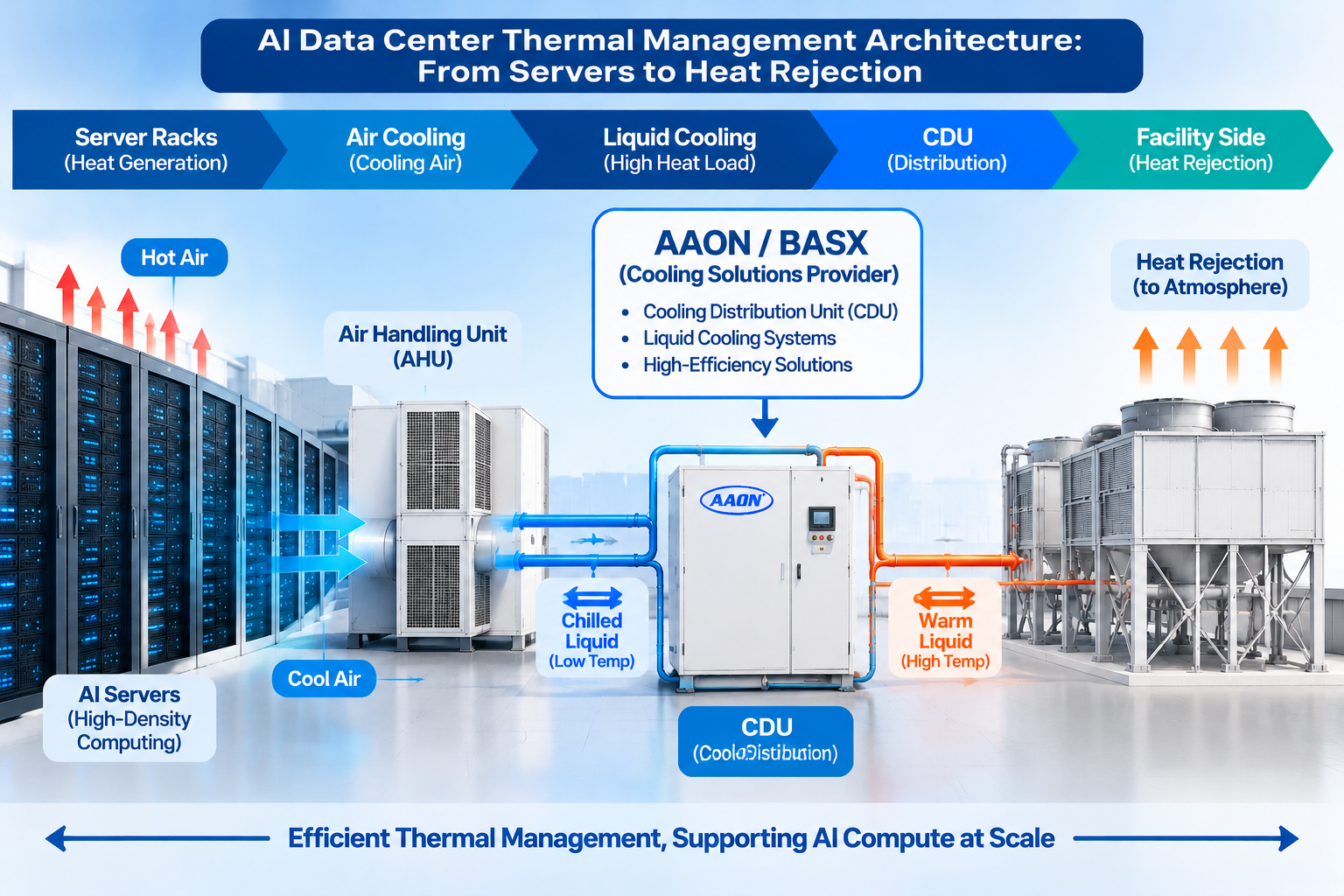
Liquid cooling technology transfers heat more directly through a liquid medium. In direct liquid cooling, for example, coolant can remove heat generated by processors through components such as cold plates, after which the coolant circulation system transfers the heat to the facility side. Coolant distribution units (CDUs) play an important role in connecting the facility water system with the technology cooling loop and need to manage parameters such as flow, temperature, and pressure.
It is important to note that air cooling and liquid cooling are not simply substitutes for one another. In practice, data centers may adopt hybrid architectures and configure different cooling solutions based on server types, rack power density, data hall design, and operating costs. Therefore, suppliers with capabilities across multiple air-side and liquid-side thermal management products may be better positioned to participate in different types of data center projects.
How Does BASX Participate in the Data Center Cooling Supply Chain?
BASX focuses on providing customized equipment based on the actual needs of data centers rather than selling a single model of general-purpose air conditioner. Different data centers vary in data hall area, server configurations, rack power density, cooling architecture, and deployment schedules. As a result, equipment dimensions, performance, interfaces, and control methods may also vary.
For air-side cooling, BASX products cover air handling equipment, data hall air handling units, fan walls, and other thermal management solutions. These products help data centers manage airflow, control temperatures, and remove heat generated by server operations from critical areas.
In liquid cooling-related applications, coolant distribution units are an important component. They connect facility-side cooling systems with server-side technology cooling loops and manage coolant circulation. AAON disclosed in relevant annual reports that it expanded BASX's liquid cooling product portfolio, including products such as CDUs for high-density computing environments.
From a supply chain perspective, BASX is positioned more closely to a data center infrastructure equipment supplier. It does not directly determine AI chip performance or the amount of computing revenue ultimately generated by cloud service providers, but its equipment may affect a data center's cooling capacity, deployment progress, and long-term operating performance.
AAON's Business Model and Growth Drivers
To understand AAON's growth drivers, it is first necessary to distinguish between industry demand and the company's actual operating performance. Growth in AI data center construction creates potential demand for cooling equipment, but whether this can ultimately be converted into AAON revenue still depends on customer orders, project delivery, capacity utilization, and product competitiveness.
The first driver is data center construction and upgrades. As demand for computing power increases, cloud service providers and data center operators may expand facility capacity or renovate existing data halls. New projects typically involve planning for complete cooling systems, while upgrade projects may require replacing or adding certain equipment.
The second factor is the product mix. Standard HVAC products and customized data center equipment may differ in technical requirements, project timelines, and profit structures. If the company can provide more complex, higher-value equipment while effectively controlling design, manufacturing, and delivery costs, changes in the product mix may affect overall profitability.
The third factor is capacity and delivery capabilities. Data center customers typically need equipment deployed according to project schedules. Even if suppliers have orders, they must have sufficient manufacturing capacity, supply chain management capabilities, and quality control capabilities. Factory expansions can increase capacity, but ramp-up periods may also create pressure from depreciation, labor, training, and fixed costs.
Therefore, when evaluating AAON, investors should not only look at growth in orders or order backlog, but also track revenue recognition, gross margins, operating expenses, cash flow, and capital expenditures. Rising orders can provide a certain degree of business visibility, but this does not mean that all orders will be converted into profit within the expected timeframe.
What Competitive and Operational Risks Does AAON Face?
The data center cooling market has high technical and engineering requirements, but it is not limited to only a small number of participating companies. Competitors may include traditional HVAC manufacturers, specialized data center cooling equipment suppliers, and companies that provide liquid cooling systems and thermal management solutions. Competitive factors include equipment efficiency, reliability, customization capabilities, delivery timelines, maintenance support, and total cost of ownership.
Capacity expansion is also a risk that requires attention. Manufacturers need to invest in facilities, equipment, and personnel in advance to meet future order demand. If customer projects are delayed, orders are canceled, or market demand grows more slowly than expected, additional capacity may not be fully utilized, affecting profit margins and return on assets.
In addition, data center construction cycles and customer capital expenditure plans may change. Large projects are affected by factors such as power connections, land, approvals, financing, and equipment supply. Project delays may affect cooling equipment deliveries. Raw material costs, labor costs, supply chain bottlenecks, and manufacturing execution issues may also affect the company's operating performance.
Finally, market valuations may reflect expectations for AI infrastructure growth in advance. If investors assign the company a high AI-themed valuation, the stock price may still fluctuate even if revenue grows, provided that growth rates, profit margins, or order performance fall below market expectations.
How Should Investors Understand the Relationship Between AAON and AI Infrastructure Investment?
AAON's connection to AI infrastructure is primarily established through demand for data center cooling equipment. AI computing power expansion drives data center construction, data centers require stable power and thermal management systems, and AAON/BASX participates in this part of the infrastructure through related equipment.
This is an indirect supply chain relationship. Buying AAON stock does not mean directly investing in GPUs, AI models, or cloud computing platforms, nor does it mean that investors can proportionately share the operating revenue of an AI company. Stock performance is still determined by AAON's own operating conditions, market expectations, valuation level, and the macroeconomic environment.
Therefore, AI data center demand can be viewed as an important industry variable when analyzing AAON, but it should not be the only basis for evaluation. Investors also need to examine the company's foundation in traditional HVAC markets, the revenue contribution of its data center business, order quality, capacity utilization, and long-term profitability.
Gate and AAON: From Company Research to Stock Trading
Users who want to learn more about AAON can first research its business and financial performance through its investor relations page, annual reports, and regulatory disclosures, and then assess risk based on stock market trading rules.
Gate provides access to stock-related services, and users can visit the Gate Stocks page to learn relevant information about AAON. It is important to note that stock trading, stock tokens, and other derivatives are different product types, involving different asset rights, trading mechanisms, settlement methods, and risks. Available trading products, regional restrictions, and specific rules are subject to the information displayed on Gate at the time and the relevant product descriptions.
When researching AAON, it is recommended to distinguish among three questions: whether the company has genuine and sustainable business demand; whether new orders can be converted into revenue and profit; and whether the current market price has already fully reflected future growth expectations. Analyzing these three questions separately is more helpful for building a complete research framework than assessing stock direction based solely on AI trends.
FAQ
What does AAON do?
AAON is an HVAC and thermal management equipment manufacturer. Its products are used in commercial, industrial, and data center settings. Its BASX brand provides customized cooling and air handling solutions for data centers.
Is AAON an AI company?
No. AAON does not primarily develop AI chips or artificial intelligence models. It participates in the AI infrastructure supply chain through data center cooling and thermal management equipment.
What is the relationship between BASX and AAON?
BASX is an important AAON brand that provides customized air handling and thermal management equipment for data centers, cleanrooms, and other specialized environments.
Why do AI data centers need liquid cooling?
The heat generated by high-density computing equipment may exceed the range supported by traditional air cooling architectures. Liquid cooling can remove heat more directly through liquid circulation, but the actual solution needs to be selected based on server design, data hall conditions, and operational requirements.
Does AAON's growth depend entirely on AI data centers?
No. Data center business is a growth area worth monitoring, but AAON also has other HVAC and industrial application businesses. Its operating performance is also affected by traditional market demand, product mix, costs, and capacity utilization.
What should users note when trading AAON-related products through Gate?
First, confirm the specific product type displayed on the page, as well as its trading and settlement rules. Stocks, stock tokens, and derivatives are not equivalent, and users should not infer that holders have the same shareholder rights based only on the underlying asset name.