The core of real-world asset tokenization (RWA Tokenization) is not simply converting traditional financial assets into digital certificates on a blockchain. It requires a complete structure that connects the underlying assets, legal rights, investors, and on-chain systems. This process is particularly complex for private credit. Assets such as business loans, trade financing, and accounts receivable typically depend on loan agreements, debt registration, collateral arrangements, and professional management. Their value is closely tied to the borrowers' ability to repay. To bring these assets into on-chain markets, it is first necessary to determine how the assets will be identified and held, what rights investors will receive, and how claims will be enforced in the event of default.
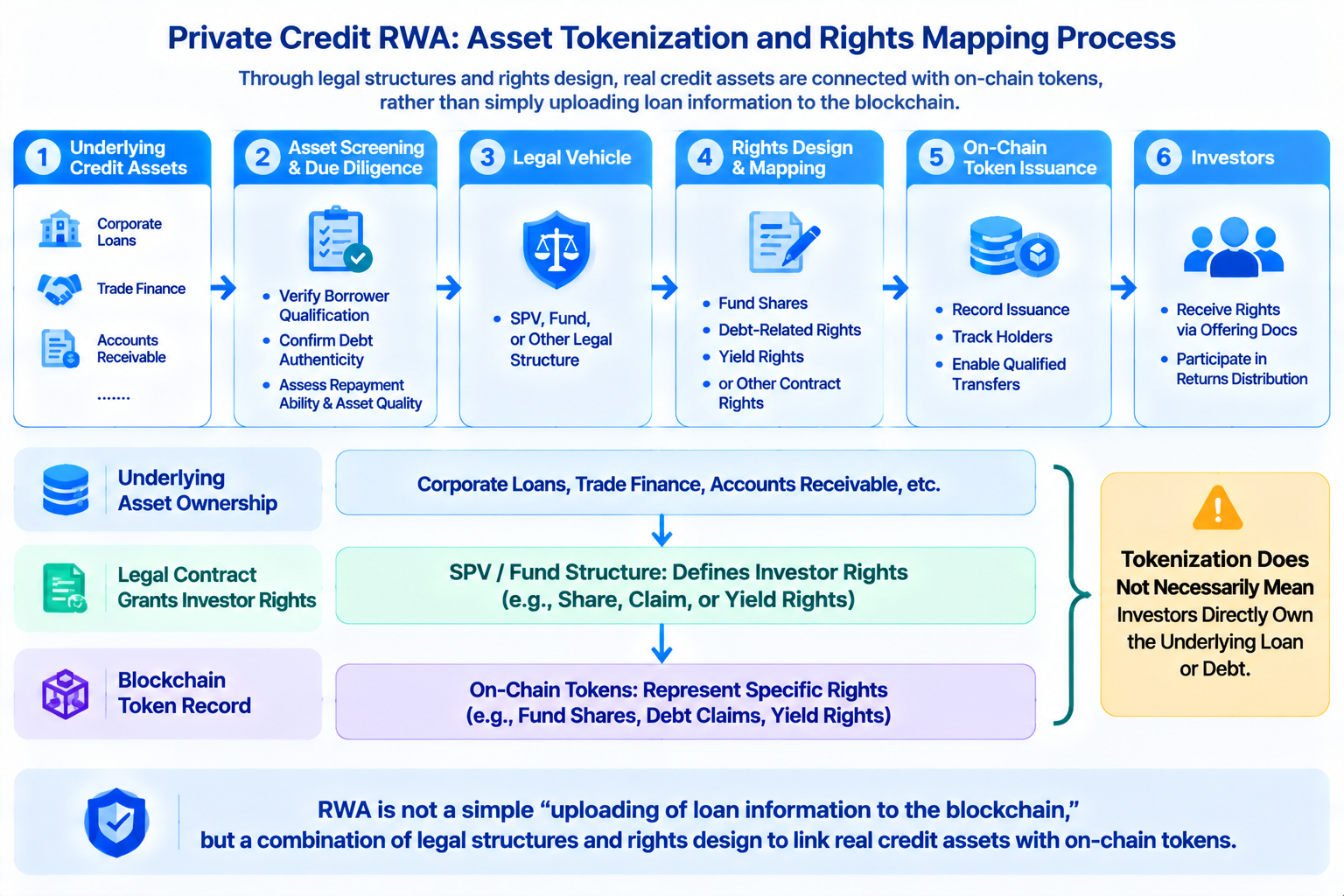
Private Credit RWA (on-chain private credit) is therefore not merely a technical token issuance process. It is also a process of structuring financial assets and digitizing rights. Project teams need to screen eligible loan assets, clarify asset ownership through a fund, special purpose vehicle (SPV), or other legal arrangement, and then map the interests or contractual rights available to investors to on-chain tokens. Blockchain can provide records of holdings, transfer rules, and certain fund operation capabilities. However, the legal relationship between the tokens and the underlying claims still needs to be established through contracts and applicable law.
Understanding this process helps investors distinguish tokenized assets from ordinary crypto assets and assess whether an RWA product's transparency and liquidity have a sound basis. This article starts with the screening of underlying credit assets and explains the legal structures, rights mapping, token issuance, and circulation arrangements for private credit. It also discusses issues that tokenization cannot automatically resolve, including asset ownership, information disclosure, and exit restrictions.
Key Takeaways
-
Asset tokenization begins with screening the underlying assets, not issuing tokens. Project teams need to verify the authenticity of the loans, borrower creditworthiness, contractual terms, repayment history, and related collateral arrangements before determining whether the assets are suitable for inclusion in a tokenization structure.
-
The legal vehicle determines how the assets are connected to investor rights. An SPV, fund, or other legal arrangement may be used to hold assets, assume claims, or organize investor interests. However, the specific legal effect depends on the law of the jurisdiction where it is established and the transaction documents.
-
The rights represented by the tokens must be clearly defined. Investors may hold fund interests, pool interests, credit-related interests, or contractual rights to returns. They do not necessarily become direct creditors of the underlying loans.
-
On-chain records do not equal complete asset transparency. Blockchain can record token issuance, holdings, and transfers. However, reliable off-chain disclosures are still needed for information such as borrowers' financial conditions, loan authenticity, collateral value, and repayment performance.
-
Token circulation does not mean that the underlying credit assets have immediate liquidity. Loan maturities, redemption arrangements, investor eligibility, transfer restrictions, and market depth all affect token holders' actual ability to exit.
Why Does Private Credit Need RWA Tokenization?
Private credit assets typically have relatively clear contractual relationships and cash flow arrangements. However, traditional investment methods may involve multiple institutions and different systems for investor registration, asset interest management, and fund settlement. For larger loan portfolios, asset managers need to continuously maintain loan records, investor interests, repayment statuses, fee deductions, and distribution information. If investors participate in cross-border funding arrangements, the process may also involve custody, payment, and compliance procedures across different jurisdictions. These processes form the operational foundation of traditional private credit products while also creating complexity in information coordination and operational management.
RWA tokenization attempts to provide a unified digital record for some of these processes through blockchain. After the legal structure is designed, a project can issue tokens representing interests in specific assets or investment shares and use smart contracts to record changes in holdings, enforce transfer restrictions that comply with applicable rules, or process certain distributions according to predefined conditions. For investors, digital interests may provide a more direct way to check their holdings. For asset managers, on-chain records may also help organize investor registers and certain fund operations.
Another important motivation is to strengthen the connection between real-world credit assets and digital asset infrastructure. Stablecoins can be used by investors to participate in fundraising and certain settlement processes, while blockchain provides an environment for recording asset interests and executing transactions. Where permitted under applicable law and product rules, tokenized structures may also support more flexible interest designs and investor participation arrangements. However, this connection does not mean that private credit has become a completely open, permissionless on-chain asset. Because underlying loans involve borrower creditworthiness, contract enforcement, and investor eligibility, many products still require identity verification, eligibility management, and transfer restrictions.
From an asset perspective, private credit is not necessarily the easiest RWA category to tokenize. Loan agreements may involve multiple borrowers, guarantors, collateral assets, and service providers. Loan portfolios may also undergo continuous repayments, extensions, delinquencies, and asset replacements. Project teams must not only convert initial asset information into digital records but also establish ongoing management and data update mechanisms throughout the life of the loans. Therefore, the value of tokenization should not be measured solely by issuance speed or the number of on-chain transactions. Instead, investors should assess whether it improves asset records, rights management, and fund operations while maintaining clear underlying legal relationships.
How Do Private Credit Assets Enter an RWA Structure?
Introducing private credit into an RWA structure first requires determining which loan assets are suitable for inclusion in the product. Project teams typically screen assets based on their authenticity, borrower creditworthiness, contractual completeness, cash flow stability, and legal enforceability. The focus of due diligence also varies by credit asset type. Business loans require analysis of the borrower's financial condition, operating cash flow, and debt structure. Trade financing requires verification of the transaction background, movement of goods, payment obligations, and the authenticity of accounts receivable. Consumer credit may require an assessment of the borrower pool, loan origination standards, historical default rates, and data quality.
Asset screening affects not only whether loans can enter a pool but also whether subsequent risk disclosures will be meaningful. If a project discloses only the total loan amount and expected return rate without explaining the borrower distribution, asset maturities, industry concentration, and delinquency status, investors may find it difficult to assess the pool's actual risk. For portfolios consisting of multiple loans, the project must also clarify the eligibility criteria, replacement conditions, concentration limits, and ongoing monitoring mechanisms for the portfolio. An asset pool is not a static set of figures. It is a credit portfolio that may continuously change as principal is repaid, new loans are added, and defaults are resolved.
After screening the assets, the project team must determine how the underlying assets will be held and managed. Some structures use an SPV or other legal entity to assume the loan assets. Others may use a fund, trust, or contractual arrangement to organize investor interests. Requirements for claim transfers, asset segregation, fund management, and securities issuance vary across jurisdictions. Therefore, no single structure should be treated as a universal template for all Private Credit RWA projects. The key is to clarify who owns the loan assets, who is responsible for managing them, who owes contractual obligations to investors, and what rights investors can assert if a default or issuer bankruptcy occurs.
Due diligence before assets enter an RWA structure is particularly important for investors. On-chain tokens can show the number of tokens issued and the distribution of holdings, but they cannot independently prove that the underlying loans actually exist or automatically verify that collateral is valid. Projects need mechanisms that link off-chain asset information to on-chain records. They should also use appropriate audits, custody arrangements, service provider reports, or other verification processes to reduce the risk of incomplete asset information and inconsistent records.
How Does the Legal Structure Connect the Underlying Loans to the Tokens?
The legal structure is one of the most important foundations of Private Credit RWA. The technical tokenization process can map asset interests to a blockchain, but the rights investors actually receive must be defined through legal documents and contractual relationships. In other words, the fact that a token can be identified and transferred on-chain does not mean that it inherently carries a claim, ownership interest, or right to returns. Only when the issuance arrangement clearly defines the legal relationship between the token and the underlying assets, and that relationship is recognized and enforceable under applicable law, can on-chain records form a reliable connection with investors' actual interests.
SPVs and Asset Segregation Arrangements
An SPV is one type of legal vehicle that may be used in Private Credit RWA. It is typically established for a specific financing or asset arrangement and used to hold loans, assume claims, or organize related contractual relationships. In some structures, the loan originator transfers eligible assets to an SPV. The SPV then holds the underlying loans and provides investors with an opportunity to participate through fund interests, notes, or other legal instruments. This can help clarify the relationship between specific assets and other business activities and establish a relatively independent legal framework for asset management and risk allocation.
However, an SPV is not an automatically effective risk-segregation tool. Its effectiveness depends on whether the asset transfer is genuine and valid, whether the relevant accounts are independent, whether corporate governance meets applicable requirements, and how the law of the jurisdiction of establishment addresses bankruptcy remoteness and creditor claims. If the loans remain held by the original originator or the asset transfer arrangement contains defects, issuing tokens on-chain does not mean that the underlying assets have been completely separated from the originator's other liabilities.
In addition, an SPV may be only one part of the transaction structure and does not necessarily owe repayment obligations directly to every token holder. Investors may obtain economic interests through a fund, trust, note, or other intermediary arrangement. Understanding the role of an SPV therefore requires reviewing the complete organizational structure and contractual relationships rather than assuming that investors hold direct claims merely because an SPV is mentioned in the product documentation.
Funds, Trusts, and Contractual Interest Arrangements
In addition to SPVs, funds, trusts, or contractual arrangements may be used to organize private credit assets and investor interests. A fund structure typically represents investors' economic interests in an asset portfolio through fund interests, with the fund manager managing the underlying assets according to an investment policy. In a trust structure, a trustee may hold or manage assets under the trust documents and perform obligations toward beneficiaries as agreed. Other products may use notes, loan participation agreements, or contracts granting rights to returns to allow investors to participate in the cash flows generated by underlying loans.
The differences between these structures involve more than their names. They may also affect asset ownership, management authority, distribution of returns, investor protections, and default procedures. For example, fund interests generally mean that investors participate in the economic performance of the fund's asset portfolio but do not necessarily directly own each loan in the portfolio. A contract granting rights to returns may allow investors to receive specific cash flows as agreed but may not give them the right to pursue claims directly against borrowers. Investors must confirm the specific relationships among themselves and the issuer, manager, trustee, or asset holder.
The core purpose of the legal structure is therefore to connect the underlying assets, management responsibilities, and investor rights. Tokenization merely expresses some of these rights in digital form. It does not automatically change the legal nature of the original contractual relationships. If the product documents do not clearly explain what the tokens represent, against whom investors can assert rights, how returns are calculated, and how defaults are handled, on-chain holding records will be unlikely to constitute sufficient investor protection on their own.
How Are Private Credit Interests Mapped to Tokens?
After the underlying assets and legal structure have been determined, the project team needs to design the interests represented by the tokens. This process is often called rights mapping. Its focus is not simply to divide a loan amount into a number of tokens. Instead, it determines which rights investors can exercise under which legal documents after holding the tokens, and how those rights correspond to the cash flows and risk allocation of the underlying assets.
One common approach is to design the tokens as digital representations of fund interests or pool interests. Investors hold a certain number of tokens corresponding to their percentage interest in the pool or fund. After the pool receives loan principal and interest, the manager calculates the distributable amount under the fund documents or product rules and makes distributions based on investor holdings or registration records. In this structure, the tokens are primarily used to record investors' interests and related rights, while legal ownership of the underlying loans may remain with a fund, SPV, or other entity.
Another approach is to establish investor interests through notes or credit-related arrangements. A token may correspond to a debt instrument, loan participation interest, or contractual right to receive specified cash flows. Investors must then consider whether the issuer has a clear repayment obligation, the source of repayment, whether guarantees or collateral exist, and which enforcement procedures apply if the issuer defaults. Even if a token is linked to returns from a specific loan portfolio, investors do not necessarily have the right to assert claims directly against every underlying borrower.
Some structures also map different risk levels to different tokens or classes of interests. For example, a pool may include senior and subordinated interests. Senior investors receive principal and return distributions in the agreed order, while subordinated investors bear more of the residual risk. These arrangements can reorganize risk and returns at the contractual level, but they cannot eliminate the possibility of losses in the underlying loans. Investors need to understand the payment priority, loss-absorption mechanism, trigger conditions, and management authority for each level. They should not assume that a product is absolutely safe merely because it is described as "senior."
Rights mapping must also account for token holding and transfer rules. If a product is available only to specific investors who have completed identity verification, the token contract or related registration system may need to include whitelists, eligibility checks, and transfer restrictions. Some products may also require tokens to be transferred only on designated platforms or between eligible participants. These restrictions may reduce the openness of the tokens but form part of legal compliance and investor eligibility management.
Determining whether tokenization has truly been completed therefore requires more than checking whether tokens have been deployed on a blockchain. Investors should assess whether the token records correspond to the interest arrangements in the legal documents. They need to confirm the token issuer, nature of the rights, source of returns, transfer restrictions, redemption conditions, and default enforcement process. They should also understand whether there is an effective mechanism connecting on-chain holding records with legal registration.
How Are Token Issuance and On-Chain Management Implemented?
Token issuance typically takes place after the underlying assets have been screened, the legal structure has been designed, and the rights have been mapped. Based on the product size, investor eligibility, and legal documents, the project team needs to determine the issuance amount, token units, subscription rules, and transfer conditions and deploy the relevant rules to a blockchain through a smart contract. For products that restrict the investor pool, the issuance process may include identity verification, investor eligibility reviews, and wallet address registration. These arrangements allow the product to record eligible holding relationships in a digital environment.
During token issuance, the project team must also manage the relationship between asset interests and the number of tokens. For example, a pool may issue a corresponding number of interest tokens based on subscription amounts, or update investor holdings according to the net asset value and valuation method specified in the product documents. The calculation method must remain consistent with the legal documents and asset management system. Without a reliable reconciliation mechanism between the number of on-chain tokens and the off-chain investor register, asset size, or actual subscription funds, holding records may not match the underlying interests.
Smart contracts can perform certain automated management tasks. Depending on the product design, they may be used to issue and burn tokens, enforce transfer restrictions, register interests, and process certain distributions. When investors meet the product conditions, the smart contract can update their holdings according to predefined rules. When loan repayment data has been confirmed through an authorized channel, the system may also calculate and distribute the corresponding funds according to the applicable rules. However, smart contracts can execute only the rules that have been encoded. Their results still depend on code quality, permission settings, and the accuracy of external data.
Private credit products that rely on off-chain data also typically require an information transmission mechanism. For example, after a loan servicer confirms that a loan has been repaid, the relevant data may be transmitted to the on-chain system through a management system, oracle, or other authorized interface. The on-chain system can then update the asset status or trigger a distribution process based on the confirmation. This does not mean that the blockchain can independently verify whether a borrower has actually made a payment. Instead, it creates a connection between data provided by off-chain institutions and on-chain execution rules. The data source, verification responsibilities, and exception-handling mechanism are therefore important.
Token issuance also requires ongoing management. Underlying loans may be prepaid, extended, become delinquent, be restructured, or be replaced. The product needs to update the relevant information according to the contracts and ensure that token interests, the pool's net asset value, and distribution rules remain valid. For products with token upgrade mechanisms, administrator permissions, or emergency pause mechanisms, investors should also understand who controls these permissions, the conditions under which they may be used, and whether these actions are subject to audit and governance controls.
Can Tokenization Truly Improve Private Credit Liquidity?
Liquidity is one of the frequently discussed benefits of RWA tokenization, but it is also one of the concepts most easily oversimplified. Traditional private credit typically has a defined term. Investors may need to wait for borrowers to repay principal as scheduled or exit through a transfer method permitted under the contract. Tokenization can record investment interests in digital form and support transfers where permitted by the applicable rules. However, it does not change the maturity of the underlying loans or automatically increase the number of market participants willing to buy these assets.
First, tokenization may improve the transferability of asset interests. Transferring traditional private credit interests may involve document reviews, investor registration, and confirmation from multiple parties. In an appropriate on-chain structure, some holding updates and transfer processes can be completed through smart contracts. However, this efficiency still needs to comply with the product documents and regulatory requirements. If tokens can be transferred only between investors who have completed identity verification or require manager approval, their circulation remains restricted.
Second, tokenization may provide a technical foundation for secondary-market trading. In theory, eligible investors can buy and sell the relevant tokens on permitted trading venues, allowing holders to avoid relying entirely on redemption at maturity. However, whether a secondary market can provide genuine liquidity also depends on asset disclosures, investor demand, quotation mechanisms, market depth, and trading rules. Private credit assets often involve significant information asymmetry. Buyers need to understand borrower quality, loan portfolio performance, and legal rights before they can reasonably assess token prices. Even if tokens are transferable, there may not be enough buyers willing to acquire them without ongoing disclosures and independent valuations.
Third, the cash flows and exit arrangements of the underlying loans still determine when investors can recover their funds. If a pool primarily consists of long-term business loans and the product lacks sufficient cash reserves or a clear early-exit mechanism, investors may need to wait for loan repayments. If a large number of investors request redemptions at the same time, the manager may also need to impose redemption limits, queuing mechanisms, or redemption suspensions under the contract to avoid being forced to sell assets at unfavorable prices. Such liquidity management is especially important for credit assets without a public trading market.
It is therefore necessary to distinguish among three concepts: the technical transferability of a token, the transferability permitted by the product contract, and the actual liquidity provided by the market. The first is supported by tokens and blockchain technology. The second is determined by legal documents and product rules. The third depends on genuine buying and selling demand and market depth. Tokenization can improve investors' exit options to some extent only when all three are aligned. If a token is technically transferable but lacks lawful transfer conditions and actual buyers, investors may still face a long lockup period.
Key Risks of Private Credit RWA Tokenization
Private credit RWA risks do not disappear when assets enter a blockchain. A tokenized structure typically involves the underlying credit assets, legal vehicle, asset manager, service providers, and smart contracts. Investors therefore face a combination of risks across multiple levels. In addition to the credit risk arising from borrowers' inability to repay, they need to consider the rights relationship between the tokens and the underlying assets, the authenticity of off-chain data, asset custody and fund settlement arrangements, and the reliability of token transfer and exit mechanisms.
Asset authenticity and ownership risk is the most fundamental issue. The project team needs to prove that the underlying loans actually exist, that the loan agreements are valid, that ownership of the claims is clear, and that the relevant assets have not been pledged or sold more than once. If the loan assets have been transferred to an SPV or other legal vehicle, investors must also confirm whether the transfer procedures have been completed, whether the debtors must be notified, and whether related security interests can be validly transferred with the claims. If the legal ownership of the underlying assets is disputed, on-chain tokens may not correspond to the interests investors expect.
Legal structure and investor rights risk concerns whether investors can obtain protection when problems arise. A token may represent fund interests, contractual rights to returns, or another indirect interest. Different structures involve different parties and procedures for enforcement. If the issuer becomes insolvent, the asset manager can no longer perform its obligations, or an underlying borrower defaults, investors need to know against whom they can assert rights and whether the relevant assets are subject to claims from other creditors. Establishing a legal vehicle does not automatically guarantee bankruptcy remoteness. Its actual effect must be assessed based on the contracts and applicable law.
Information disclosure and valuation risk arises from differences between off-chain asset information and on-chain records. Blockchain can show token amounts, transfer records, and some fund flows, but it cannot inherently verify borrowers' financial condition, collateral value, or loan quality. If a project discloses only aggregate pool data without providing the portfolio composition, delinquency status, and risk concentration, investors may find it difficult to assess the actual asset quality. For loan assets without public market prices, valuation may also depend on the manager's models and external assessments. Investors should consider the valuation frequency, assumptions, and potential conflicts of interest.
Liquidity and maturity mismatch risk also requires particular attention. If the recovery period of the underlying loans is longer than investors' expected exit period, or if the product's redemption arrangements do not match the assets' actual ability to be liquidated, funding pressure may arise. Insufficient secondary-market trading volume, investor eligibility restrictions, and market price discounts may prevent token holders from exiting at the expected price. Tokenization cannot eliminate the difference between loan maturities and investors' funding needs.
Finally, technical and operational risks may affect the normal management of tokens and funds. Smart contract vulnerabilities, abuse of administrator permissions, incorrect oracle data, cross-chain bridge failures, and operational errors by custody institutions may cause irregularities in funds or records. Even if a contract has been audited, this does not guarantee that all external dependencies and off-chain processes will always operate normally. Project teams need to establish permission controls, data verification, exception handling, and emergency response mechanisms. Investors should understand who performs key operations and how technical failures will be handled.
These risks show that the reliability of RWA tokenization cannot be measured solely through on-chain transaction data. Asset authenticity, legal rights, information disclosure, fund management, and technical security must together form a complete foundation of trust. For private credit, the underlying borrowers' ability to repay remains the key factor determining investment performance. Blockchain primarily changes how assets are recorded and funds are managed; it does not replace traditional credit management.
How Can Investors Assess the Quality of Private Credit RWA Tokenization?
When researching Private Credit RWA, investors can begin with the underlying assets. They should confirm what types of loans the product holds, what types of borrowers are involved, whether the portfolio is diversified, and whether the loan maturities and repayment arrangements are clear. If the product involves multiple loans, investors should also consider industry, geographic, and borrower concentration, including whether any single borrower represents an excessive portion of the portfolio. Asset size alone does not indicate quality. Loan origination standards and ongoing management capabilities are equally important.
The second step is to review the legal documents and rights structure. Investors need to confirm who issued the tokens, who holds the underlying loans, whether an SPV or fund vehicle exists, and what specific interests the tokens represent. They should also understand whether they can assert rights directly against the issuer or asset holder and who is responsible for collection and legal enforcement if a default occurs. For cross-border products, investors should also consider the governing law of the contract, the dispute resolution venue, and the relevant regulatory requirements in their jurisdiction.
The third step is to assess the information disclosure and asset verification mechanisms. A reliable product should explain the basic composition of the loan portfolio, underwriting standards, repayment status, and risk management methods. It should also explain how off-chain data is transmitted to the blockchain. If the product claims that assets are held in custody or audited, investors should confirm the responsibilities of the relevant institutions and the contents of their reports. On-chain token balances and transaction records reflect only part of the digital layer and cannot replace independent verification of the underlying loans.
The fourth step is to understand the token circulation and exit mechanisms. Investors should confirm whether the tokens can be transferred, which parties are eligible to hold them, whether manager approval is required, and whether a secondary market or regular redemption arrangement exists. They should also distinguish among repayment at maturity, early redemption, and market transfer as three different exit methods. Technical transferability should not be mistaken for the ability to withdraw funds at any time.
Finally, investors should examine the security arrangements at the technical and operational levels, including whether the smart contract has been audited, who controls key permissions, whether upgrade or pause mechanisms exist, how assets under custody are managed, and how off-chain service interruptions are handled. For investors, tokenization quality is not determined by whether a product uses the latest blockchain technology. It depends on whether the digital records accurately reflect the underlying assets and investor rights and whether the related processes remain effectively managed when exceptions occur.
The Significance of RWA Asset Structures for the Digital Asset Ecosystem
The development of Private Credit RWA has made the legal structures and rights representation of real-world credit assets increasingly important topics in the digital asset market. Unlike native crypto assets, the value of private credit tokens depends not only on on-chain supply and demand but also on the authenticity of the underlying loans, ownership of the claims, how the assets are held, and how their cash flows are distributed. For the digital asset ecosystem, this means that understanding RWA products requires looking beyond token issuance and trading to the real-world assets represented by the tokens and the rights investors actually obtain through them.
This shift also provides a more specific perspective for market education and asset research related to RWA in the Gate ecosystem. When learning about different types of digitalized assets, users can start with the asset structure and distinguish whether a token represents ownership of an underlying asset, fund interests, credit-related interests, or rights to returns obtained under a contract. They should also consider who holds the assets, who manages them, how on-chain records correspond to off-chain legal documents, and through what mechanisms investors can assert rights if the underlying assets default. This information helps users understand structural differences among RWA products rather than merely comparing token prices, expected returns, or trading methods.
For Gate, as RWA becomes an important direction in the digital asset market, asset structures, rights mapping, and information disclosure will also be essential areas of knowledge for users seeking to understand these products. Regardless of how real-world assets ultimately enter the digital asset ecosystem, the technical performance of a token cannot replace an assessment of the underlying assets and legal relationships. Users need to understand the difference between on-chain token records and off-chain asset interests. They should pay particular attention to whether a token has a clear legal basis, whether transfers are restricted, and which parties are responsible for asset management and default resolution.
It should be noted that this article discusses the general asset structures and tokenization mechanisms of Private Credit RWA. It does not represent that Gate issues, underwrites, holds in custody, guarantees, or recommends any specific private credit product. The asset ownership, investor rights, transfer conditions, and risk arrangements of a specific product should be determined based on its official offering documents and applicable law.
In the long term, whether RWA can establish a sustainable foundation for applications in the digital asset market will depend not only on whether assets can be tokenized but also on whether a clear, verifiable, and legally effective relationship can be established between the underlying assets and on-chain rights. For users, understanding this structure is an important prerequisite for assessing the transparency, rights boundaries, and potential risks of Private Credit RWA. For the digital asset ecosystem, reliable asset information and clear rights mapping are also the foundation for creating a digital connection to real-world financial assets.
FAQ
What Is the First Step in Private Credit RWA Tokenization?
The first step is typically screening the underlying assets and conducting due diligence. The project team needs to verify the authenticity of the loans, borrower creditworthiness, contractual terms, repayment arrangements, and collateral, and determine whether the assets meet the product's investment standards. Only after the asset quality and legal relationships have been clarified should the team proceed to design the legal vehicle and token issuance structure.
What Role Does an SPV Play in Private Credit RWA?
An SPV is a legal entity established for a specific transaction or asset arrangement. It may be used to hold loan assets, assume claims, or organize related contractual relationships. It can help clarify asset ownership and the transaction structure, but it does not automatically guarantee bankruptcy remoteness or investor rights. Its actual effect depends on the asset transfer, corporate governance, account arrangements, and applicable law.
Do Private Credit RWA Tokens Represent Ownership of the Underlying Loans?
Not necessarily. Tokens may represent fund interests, pool interests, credit-related interests, or contractual rights to returns. Whether investors directly own claims against the underlying loans must be determined based on the offering documents, asset-holding structure, and applicable law. It cannot be determined solely from the token's name.
Can Private Credit Assets Be Freely Traded After Tokenization?
Not necessarily. A product may impose investor eligibility, identity verification, whitelist, and transfer approval requirements. Even if tokens technically support transfers, transfers must comply with the product documents and applicable law. In addition, the existence of actual buyers and sufficient market depth will affect whether investors can exit successfully.
Can Blockchain Verify the Authenticity of Underlying Loans?
Blockchain can record transaction and holding information, but it cannot inherently verify off-chain loan agreements, borrowers' financial condition, or the authenticity of collateral. Projects still need to rely on due diligence, legal documents, custody arrangements, audits, and information provided by loan servicers to establish a verification mechanism between off-chain assets and on-chain records.
What Determines the Liquidity of Private Credit RWA?
Liquidity is affected by the maturity of the underlying loans, cash flow recovery, product redemption rules, token transfer restrictions, and secondary-market depth. The ability to transfer a token does not mean that the underlying loan can be liquidated immediately or that buyers willing to acquire it will always be available in the market.
If an Underlying Loan Defaults, Can Token Holders Pursue the Borrower Directly?
Not necessarily. Whether investors can pursue the borrower directly depends on the legal interests represented by the token and the structure holding the underlying claims. If investors hold fund interests or indirect rights to returns, enforcement will generally need to be conducted through the fund, SPV, trustee, or another contractual party. The specific rights and procedures should be determined based on the product's legal documents.