As the Ethereum ecosystem continues expanding toward Layer 2, blockchain scaling competition has gradually moved beyond simply increasing TPS. It now spans transaction costs, proof efficiency, data availability, EVM compatibility, and the overall developer experience. Polygon CDK gives projects modular infrastructure for building custom Ethereum Layer 2 networks. By adopting this approach, Prom can avoid duplicating the development of core scaling infrastructure while building its own network on top of Ethereum's mature development environment.
From a digital asset infrastructure perspective, Prom's ZK scaling solution is not merely about moving transactions from the Ethereum mainnet “off-chain.” It reallocates computational workloads through coordination among the execution layer, batch processing, validity proofs, and final settlement. Understanding how ZK Rollup, Polygon CDK, ZK-SNARK, EVM compatibility, and transaction costs relate to one another provides a clearer picture of why Prom chose the ZK Layer 2 model and what technical challenges this architecture may face over time.
Key Takeaways
-
Prom is a ZK Layer 2 network built on Polygon CDK, focused on scalability, low costs, and compatibility with the Ethereum ecosystem.
-
ZK Rollup executes transactions in batches and submits validity proofs, reducing the need for the underlying network to repeatedly process large volumes of transactions.
-
Polygon CDK is a modular development framework for building custom Ethereum Layer 2 networks, with foundational capabilities such as EVM compatibility.
-
Zero-knowledge proof technologies such as ZK-SNARK allow verifiers to confirm that transaction computations are correct without re-executing every transaction in full.
-
Prom's scaling value extends beyond more efficient transactions. It also provides a lower-cost execution environment for high-frequency on-chain applications such as DeFi, GameFi, and RWA.
What Is ZK Rollup
ZK Rollup is a Layer 2 scaling solution based on zero-knowledge proofs. The basic model is to execute large volumes of transactions on Layer 2, compress them into batches, and generate a proof showing that each batch was executed correctly under predefined rules.
Under the traditional model, when many users transact directly on the Ethereum mainnet, network nodes must process each transaction and include its data and state changes in blocks. As user activity increases, block space becomes scarce, potentially driving transaction fees higher.
ZK Rollup changes the allocation of computational work. User transactions are first executed in the Layer 2 environment, which produces a new state based on those transactions. The proving system then processes the entire batch and generates a ZK Proof. The core information submitted to Ethereum or another settlement layer is no longer the full set of transactions for the underlying network to execute again. Instead, it is cryptographic evidence that the state transition was correct.
This process can be summarized as: User Transactions → Layer 2 Execution → Batch Aggregation → ZK Proof Generation → Underlying Network Verification → Final State Confirmation.
The central value of this mechanism is that it proves the result of the computation rather than requiring the underlying network to perform the entire computation again.
It is important to note that ZK Rollup does not mean all transaction data can remain entirely off-chain. Different ZK Layer 2 networks may adopt different data availability models. Current Polygon CDK documentation distinguishes among zkRollup, Validium, and Sovereign operating modes. zkRollup emphasizes fully on-chain data availability and trust assumptions aligned with Ethereum, while Validium places data availability off-chain.
Therefore, ZK Rollup changes how transactions are computed and verified—it does not simply move all data permanently off-chain.
What Is Polygon CDK
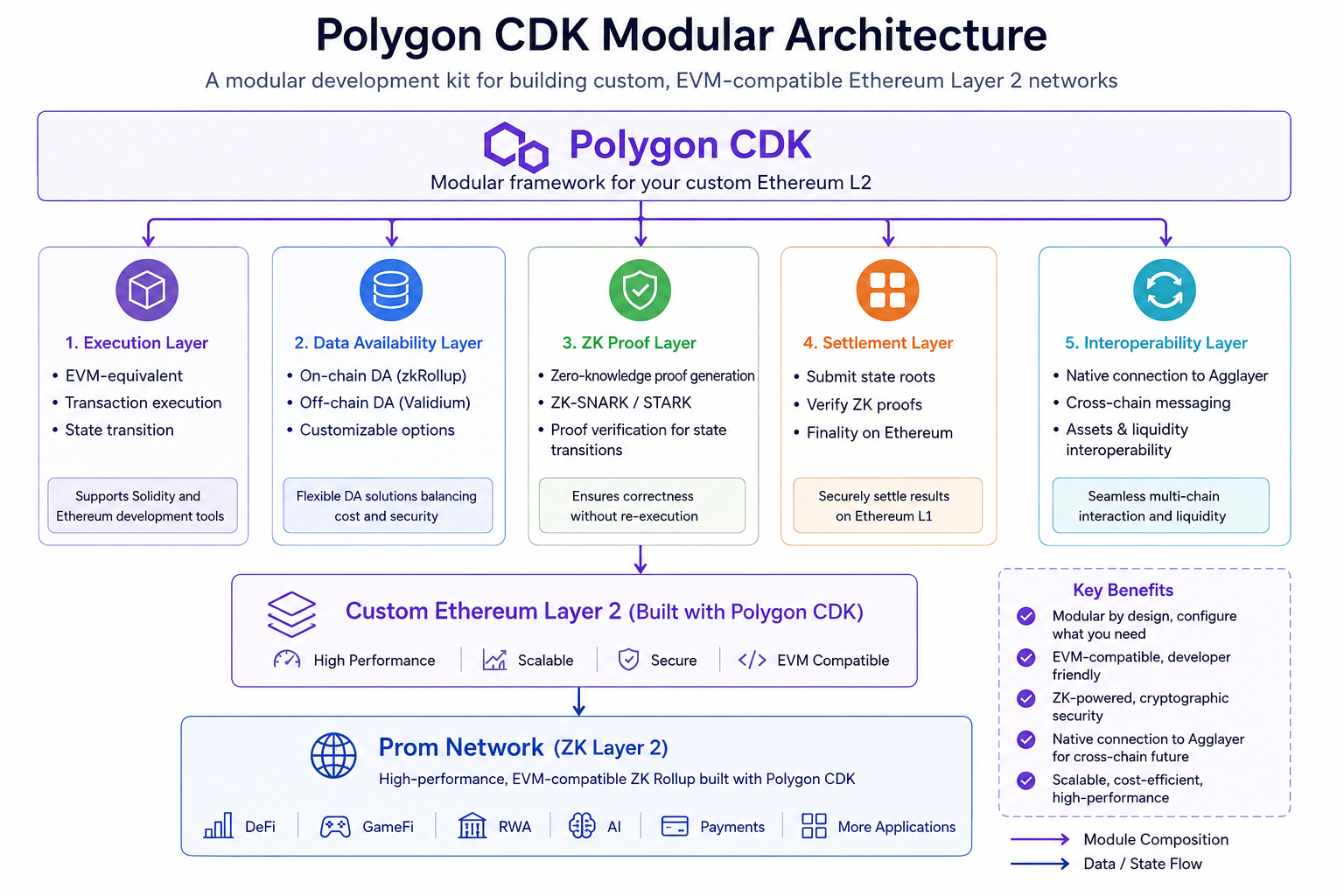
Polygon CDK, short for Polygon Chain Development Kit, is a modular blockchain development toolkit launched by Polygon to help projects build custom Ethereum Layer 2 networks.
Compared with building a blockchain from scratch, CDK offers a relatively complete set of infrastructure components. Projects can configure their execution environment, scaling model, data availability, and interoperability capabilities based on their specific requirements.
Polygon defines CDK as a toolkit for building custom Ethereum L2 networks and highlights its EVM compatibility and connection to Agglayer. CDK chains can choose among Sovereign, Validium, and zkRollup operating modes to address different requirements for security, cost, and data availability.
EVM compatibility allows developers who use Ethereum tools such as Solidity, Hardhat, and Foundry to migrate existing applications more easily to networks built with CDK.
Modularity also means that projects do not have to adopt identical chain architectures. Developers can choose configurations that prioritize cost, throughput, data availability, or security depending on the application.
This is a major reason Polygon CDK is attractive to Layer 2 projects: teams can allocate more resources to governance, ecosystem development, and user growth instead of rebuilding consensus, execution, and proving systems from the ground up.
Why Did Prom Choose Polygon CDK
Prom's decision to use Polygon CDK is closely tied to its positioning as a ZK Layer 2 network.
Prom describes itself as a high-performance, scalable network built on Polygon CDK and presents ZK Proofs as a key technical component in reducing transaction costs. With more than 2.5 million unique wallets and over 26 million on-chain transactions, the network appears to have progressed beyond basic technical validation and into practical adoption and ecosystem expansion.
For Prom, Polygon CDK offers value in three primary areas.
-
ZK infrastructure. Prom does not need to develop a complete zero-knowledge scaling stack from scratch. Instead, it can build its network on Polygon's infrastructure.
-
Ethereum compatibility. Prom can retain many of the tools and development practices familiar to Ethereum developers, which is important for attracting DeFi, GameFi, and other Web3 applications.
-
Modular scalability. Polygon CDK supports multiple operating modes and offers native connectivity with Agglayer, allowing CDK-based networks to explore cross-chain interoperability and shared liquidity.
Prom's choice of Polygon CDK does not mean that Prom is the same as Polygon. More precisely, Polygon CDK supplies the underlying development infrastructure, while Prom builds an independent network and ecosystem on top of it.
How Does ZK-SNARK Verify Off-Chain Transactions
ZK-SNARK stands for Zero-Knowledge Succinct Non-Interactive Argument of Knowledge. It is an important technology within the broader field of zero-knowledge proofs.
Its core purpose can be expressed simply: How can a verifier be convinced that a computational result is correct without re-executing the entire computation?
Suppose Prom Layer 2 processes a series of transactions: A transfers funds to B → B interacts with a DeFi protocol → C performs a swap → D mints an NFT → E transfers assets again.
If the underlying network had to re-execute every operation, it would need to process a large volume of transaction details. But if the transactions have already been executed correctly on Layer 2, the proving system can generate a ZK Proof for the entire batch.
Once the verifier receives the proof, it can check several key points, including:
-
Whether the transactions followed the network's rules;
-
Whether account balances were updated correctly;
-
Whether smart contract execution complied with the requirements;
-
Whether the final state was produced by valid transactions.
If verification succeeds, the underlying network can accept the corresponding state transition.
This is the significance of “zero-knowledge”: the verifier does not need access to all internal information involved in the computation and does not need to re-execute the entire process to determine whether the result is valid.
Prom uses zkSNARKs in its ZK scaling solution and emphasizes that ZK Proofs help reduce transaction costs. Official materials also reference recursive STARK technology as a means of supporting network scalability. A distinction should be made between an individual proving system and the broader ZK architecture: ZK-SNARK and STARK are both zero-knowledge proof technologies, but a live network may rely on multiple proving and aggregation components to verify transactions and support scaling.
Put more intuitively, a ZK Proof is like attaching a “mathematical proof certificate” to a large batch of computational results. The underlying network does not need to recheck every step; it only needs to confirm that the certificate is valid.
How Does Prom Maintain Ethereum EVM Compatibility
EVM, or Ethereum Virtual Machine, is the core execution environment of Ethereum's smart contract ecosystem.
Many Web3 applications are built around EVM, including DEXs, lending protocols, NFT marketplaces, wallets, oracles, and development frameworks. As a result, a Layer 2 network's level of EVM compatibility directly affects how difficult it is for developers to migrate applications.
EVM compatibility is one of Polygon CDK's key features. Chains built with CDK can achieve EVM equivalence, allowing existing smart contracts to be deployed without code changes while preserving compatibility with standard Ethereum tools.
For Prom, this means developers do not have to abandon their existing Ethereum technology stack.
Developers can continue using Solidity to write smart contracts, along with familiar tools for development, testing, and deployment. This compatibility lowers migration costs and makes it easier for existing Ethereum applications to enter the Prom ecosystem.
From a user perspective, EVM compatibility also makes wallets, tokens, and smart contract interactions more familiar. Users do not have to adapt to an entirely different account model or programming language ecosystem.
Prom's ZK scaling solution therefore does not create an environment isolated from Ethereum. It builds on Ethereum's development model while providing an execution layer better suited to high-frequency transactions.
How Do ZK Proofs Reduce Transaction Costs
The key to reducing transaction costs with ZK Proofs is not simply to make every transaction cheaper. It is to improve the efficiency of underlying resource usage through batch processing.
Suppose Layer 2 processes many transactions in a single batch. If each transaction submits its own verification information to the underlying network, fixed on-chain costs are paid repeatedly.
A Rollup can aggregate those transactions and use a single proof to demonstrate that the entire batch's state transition is valid.
The underlying network's verification workload therefore changes from:
Verifying a large number of independent transactions
to:
Verifying a proof that represents the results of many transactions, together with the relevant data.
This can materially reduce the cost per transaction.
Prom's official materials explicitly identify Cost-Efficiency via ZK Proofs as an important network feature and state that the network uses zkSNARKs to reduce transaction costs.
However, ZK Proofs do not make computation “free.” Proof generation consumes computational resources, and proving systems require specialized hardware, software, and infrastructure. The true cost efficiency of a ZK Layer 2 network must therefore be assessed across proof-generation costs, data availability costs, L1 settlement costs, and network operating costs.
That is why competition among modern ZK Layer 2 networks is moving beyond simple TPS comparisons toward more specific metrics, such as proof efficiency, hardware requirements, data compression, finality, and actual cost per transaction.
How Does Prom's Scaling Solution Differ From Traditional Layer 2 Networks
Layer 2 is not a single technology.
Based on their proving mechanisms, Layer 2 networks in today's market are generally divided into two categories: Optimistic Rollup and ZK Rollup.
Optimistic Rollup generally assumes that transactions are valid unless someone challenges them. If an error is identified under the applicable conditions, it can be addressed through a fraud-proof mechanism.
ZK Rollup uses validity proofs. After a transaction batch is submitted, the network provides cryptographic evidence that the state transition is correct.
The primary differences can be summarized as follows:
| Comparison Dimension |
Optimistic Rollup |
ZK Rollup |
| Core Mechanism |
Fraud proofs |
Validity proofs |
| State Verification |
Assumed valid and subject to challenge |
Verified through a submitted cryptographic proof |
| Proof Generation |
Typically does not require a ZK Proof for every batch |
Requires ZK Proofs |
| Typical Advantages |
Mature technology and relatively strong compatibility |
Potentially more efficient verification and faster finality |
| Main Challenges |
Challenge mechanisms and withdrawal waiting periods |
Proof-generation costs and technical complexity |
Prom has chosen the ZK Layer 2 path, placing emphasis on validity proofs and batch verification.
Polygon CDK itself, however, supports more than one network mode. Its operating modes include Sovereign, Validium, and zkRollup. zkRollup emphasizes a fully on-chain ZK Rollup model, while Validium uses an off-chain data availability model.
When analyzing Prom, Polygon CDK should therefore not be treated as one fixed technical configuration. CDK is better understood as a modular infrastructure framework, while a specific network's architecture depends on the project's own choices and deployment model.
Prom's differentiated value lies in combining ZK scaling with EVM compatibility, multichain infrastructure, and application ecosystems.
Future Development Directions for ZK Layer 2
The next stage of ZK Layer 2 competition may extend beyond TPS and focus primarily on three areas.
-
Proof efficiency. As on-chain transaction volumes grow, the computational resources required to generate ZK Proofs will become a critical infrastructure factor. More efficient proving systems, recursive proofs, hardware acceleration, and proof aggregation could further reduce proof costs per transaction. Prom has already connected recursive STARK technology with network scalability, suggesting that recursive proofs are part of its broader scaling narrative.
-
Multichain interoperability. Web3 will likely evolve into an ecosystem made up of numerous Rollups, Appchains, and specialized networks rather than a single main chain and a small number of Layer 2 networks. Increasing the performance of one chain alone cannot solve ecosystem-wide liquidity fragmentation. Polygon's current CDK architecture already identifies interoperability with Agglayer as a key capability. Through Agglayer, CDK chains can support cross-chain messaging, unified liquidity, and cross-chain applications.
-
Expanding from scaling infrastructure into application infrastructure. As transaction costs decline, EVM compatibility matures, and cross-chain capabilities improve, ZK Layer 2 networks can support a broader range of use cases, including DeFi, GameFi, RWA, payments, and AI Agent applications. This suggests that future competition may shift from “which network has the highest TPS” to “which network can attract the most real transactions and economic activity.”
This shift is particularly significant for Prom. Prom currently describes its network as high-performance, scalable infrastructure and has reported more than 2.5 million unique wallets and over 26 million transactions.
If on-chain activity continues to grow and generates sustained demand for DeFi, GameFi, RWA, and other applications, ZK technology can convert its underlying technical advantages into durable network-level competitiveness.
Conclusion
Prom's ZK scaling solution can be understood as a combination of “Layer 2 execution + batch processing + ZK Proof verification + Ethereum ecosystem compatibility.” Large volumes of transactions are first executed on the Prom network. Zero-knowledge proofs then demonstrate that the corresponding state transitions are correct, reducing the need for the underlying network to re-execute every transaction.
Polygon CDK provides the modular infrastructure underlying this architecture. It supports Ethereum EVM compatibility, allows projects to choose operating modes based on their requirements, and enables further exploration of cross-chain interoperability through Agglayer.
For Prom, the central benefit of choosing Polygon CDK is the ability to develop its own network on top of mature Ethereum Layer 2 infrastructure without building the entire scaling stack from the ground up. At the same time, Prom extends its ZK scaling capabilities into a wider range of Web3 applications through its own network and ecosystem development.
Technologically, the core competition among ZK Layer 2 networks is shifting from transaction throughput alone toward proof efficiency, transaction costs, EVM compatibility, data availability, and multichain interoperability. Prom's ability to establish lasting advantages across these dimensions will determine whether it can evolve from a ZK Layer 2 network into broader blockchain infrastructure.
ZK technology itself should not be equated with either absolutely low costs or absolute security. Proof generation, data availability, cross-chain components, smart contracts, and network operations all involve different forms of technical risk. For users and developers, understanding Prom's actual network architecture, ecosystem adoption, and on-chain activity is more important than focusing solely on the “ZK” label.