This structure connects an asset associated with the Hyperliquid ecosystem to Base's broader onchain environment. Understanding how CBHYPE works therefore requires looking beyond the token itself and considering the relationship between the underlying HYPE, Coinbase's custody infrastructure, the Base network, and applications that support the wrapped asset.
Why Bring HYPE to Base?
HYPE is the native token associated with the Hyperliquid ecosystem, while Base provides a separate environment with its own decentralized applications, liquidity pools, lending markets, and other onchain services. Assets that exist natively on one blockchain cannot automatically be used by smart contracts on another network.
Wrapped assets provide a way to represent an existing asset in a format that another blockchain can recognize. Coinbase's wrapped-assets infrastructure is designed around this concept, allowing eligible assets held in custody to be represented as tokens on supported networks. This can expand where an asset can be used without creating an entirely new underlying asset.
For HYPE, a Base-based representation creates another route into the broader Ethereum-compatible application environment. Instead of requiring a Base application to directly support native HYPE on Hyperliquid, the application can interact with a token representing HYPE on Base. The result is greater potential composability between HYPE liquidity and Base-based applications.
How Does CBHYPE Work?
The basic mechanism involves an underlying HYPE asset and a corresponding wrapped representation. Coinbase's wrapped-asset model uses underlying assets held in custody to support the issuance of corresponding onchain tokens. For CBHYPE, available public information describes the wrapped asset as being backed 1:1 by HYPE.
In practical terms, the underlying HYPE and CBHYPE exist in different environments. The HYPE serves as the underlying asset, while CBHYPE functions as its representation on Base. This separation allows the wrapped token to follow the technical standards and smart-contract infrastructure of its destination network.
The important point is that wrapping does not turn CBHYPE into an independent version of HYPE with completely separate underlying value. Its purpose is to represent the underlying asset in another blockchain environment. Coinbase's official wrapped-assets documentation describes this broader model as a way to bring assets onchain and make them compatible with supported decentralized applications.
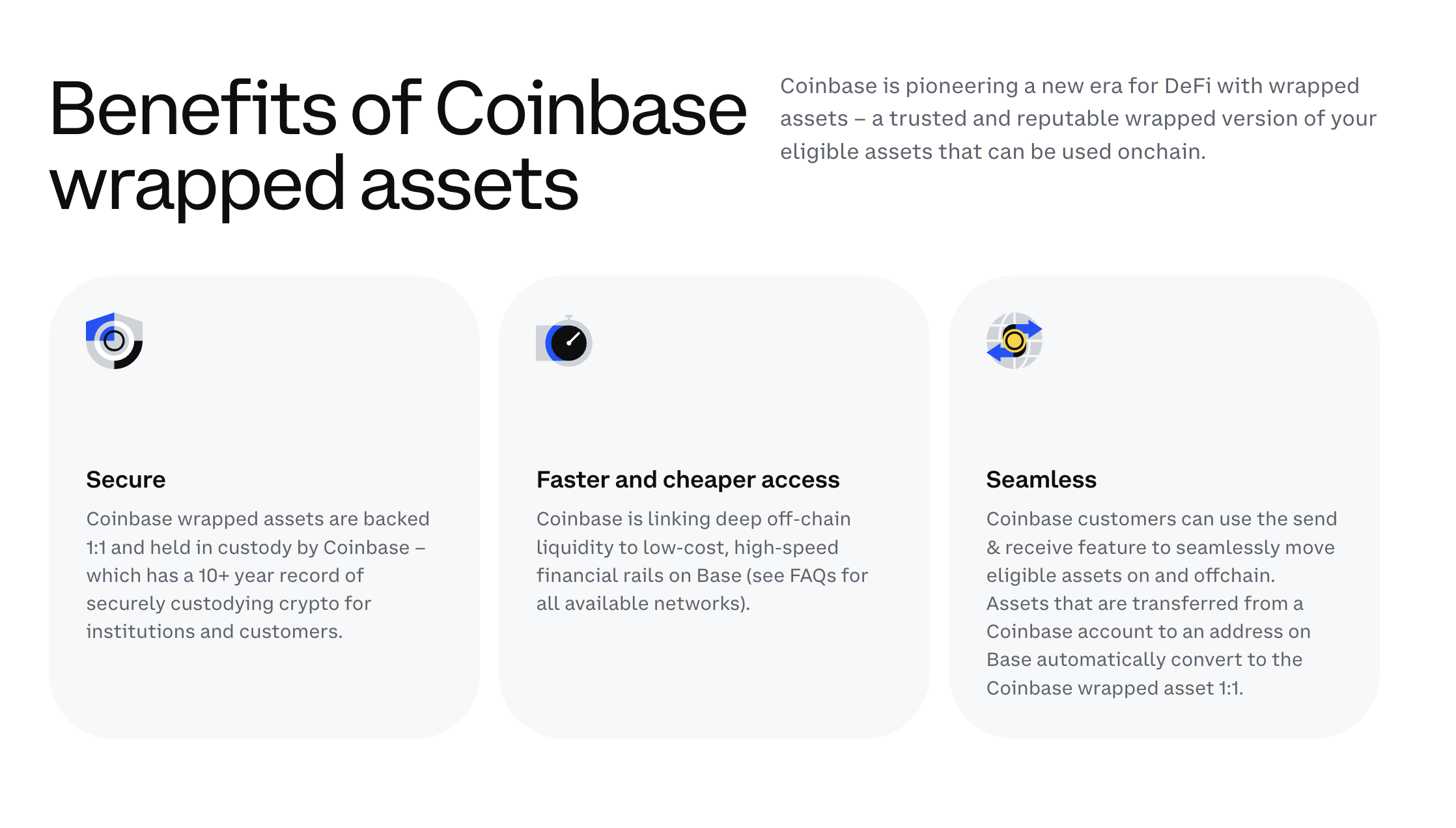
Sources:Coinbase Website
What Happens When HYPE Is Wrapped?
The wrapping process can be understood as a relationship between custody, representation, and redemption rather than simply a token conversion.
First, the underlying HYPE is held as the asset backing the wrapped representation. A corresponding amount of CBHYPE can then exist on Base to represent that underlying value. Because the two sides are linked, the wrapped token is designed to maintain a relationship with the underlying HYPE rather than operate as an unrelated cryptocurrency.
Once represented on Base, CBHYPE can be transferred between compatible wallets and smart contracts in the same way that other Base-based tokens can be used. However, the actual functionality depends on whether individual applications recognize and support the token.
This distinction matters because being issued on Base does not automatically mean CBHYPE can be used across every Base protocol. Users should check the supported asset list of each application before depositing, swapping, lending, or providing liquidity.
What Can You Do With CBHYPE on Base?
The main purpose of CBHYPE is to make HYPE available within Base's onchain environment. Where supported, a wrapped HYPE token can potentially participate in several categories of decentralized applications.
Swap and Trade
If a decentralized exchange supports CBHYPE, users may be able to swap it for other Base-based assets. This provides an onchain trading route without requiring the application to support native HYPE directly.
Provide Liquidity
A supported decentralized exchange may allow CBHYPE to be deposited into a liquidity pool. Liquidity providers can then participate in the trading infrastructure of that protocol, subject to its own rules and risks.
Lending and Borrowing
If lending protocols integrate CBHYPE, the token could potentially be supplied as collateral or deposited into a lending market. However, support should not be assumed simply because a protocol supports other Coinbase-wrapped assets.
Other DeFi Applications
Base has a wide range of smart-contract applications, and wrapped assets can potentially be integrated into different forms of onchain financial infrastructure. As CBHYPE is a relatively new asset, its actual integrations and available use cases may develop over time.
CBHYPE vs. Native HYPE
The relationship between the two assets is best understood through their roles within different blockchain environments.
Native HYPE is the original asset associated with the Hyperliquid ecosystem. CBHYPE, meanwhile, is designed to represent HYPE on Base. Therefore, choosing between the two is not simply a matter of selecting different versions of the same token. The appropriate asset depends on the blockchain and application a user intends to interact with.
For example, an application operating directly within the Hyperliquid ecosystem may require native HYPE, while a Base-based application may require CBHYPE or another compatible representation. Sending one representation to an incompatible network or application can result in failed transactions or asset loss.
CBHYPE vs. Other Wrapped HYPE Tokens
CBHYPE is not necessarily interchangeable with every token that uses the name "Wrapped HYPE." Multiple wrapped representations can exist across different blockchain networks, and they may rely on different issuers, custodians, contracts, and infrastructure.
For example, WHYPE is another wrapped representation associated with HYPE. Coinbase's asset information lists Wrapped HYPE separately from CBHYPE, illustrating why users should identify the network and contract rather than relying only on a token's name.
The distinction is particularly important when transferring assets. Two tokens can both represent HYPE while remaining technically incompatible because they exist on different networks or use different smart contracts.
What Makes Base Important for CBHYPE?
Base is an Ethereum Layer 2 network designed to support lower-cost onchain applications and a broad ecosystem of decentralized services. Because it uses Ethereum-compatible infrastructure, assets represented on Base can interact with smart contracts built for that environment.
For CBHYPE, this provides the technical setting in which the wrapped representation can operate. The value of the token is therefore not limited to simply holding a representation of HYPE. Its broader purpose is to make that representation usable within applications that operate on Base.
Coinbase's wrapped-assets ecosystem demonstrates this model through integrations with decentralized exchanges, lending protocols, and other onchain applications. However, the presence of an application in Coinbase's broader wrapped-assets ecosystem does not necessarily mean that every wrapped asset is supported there. Individual CBHYPE integrations need to be verified separately.
How to Verify CBHYPE Before Using It
Because wrapped assets can have similar names, verification is an important part of using CBHYPE.
Check the Network
Confirm that the asset is being used on Base when a Base-based CBHYPE transaction is intended. Network mismatches are one of the most important operational risks when transferring tokens.
Check the Contract Address
Public token information currently identifies the CBHYPE contract on Base as:
0xB200000000000000000000451d033a5000cb479e
Users should verify the contract against an authoritative source before interacting with it, rather than relying on a token name or search result alone.
Check Protocol Support
A Base application may support USDC, ETH, or other assets without supporting CBHYPE. Always check the protocol's current supported-token list before making a deposit.
Check Liquidity
Even when a protocol supports CBHYPE, available liquidity can vary. Lower liquidity may result in greater slippage or make larger transactions more difficult to execute.
Check Deposit and Withdrawal Networks
When moving assets between centralized platforms and self-custody wallets, confirm the supported deposit and withdrawal network on both sides. A correct token sent through an unsupported network can still result in permanent loss.
What Are the Risks of Using CBHYPE on Base?
Using CBHYPE introduces risks associated with both the underlying asset and the wrapped infrastructure.
The first is custodial and backing risk. Because the wrapped representation depends on underlying HYPE being held as backing, users rely on the relevant custody and redemption infrastructure to maintain the intended relationship between the wrapped token and the underlying asset.
There is also smart-contract risk. CBHYPE operates as a token on Base, while applications interacting with it may introduce additional smart-contract dependencies. A vulnerability in a decentralized exchange, lending protocol, bridge, or other application could affect deposited assets.
Liquidity risk is another consideration, particularly for a newly introduced wrapped asset. The market for CBHYPE may be smaller than the market for native HYPE, and individual trading pairs can have different levels of liquidity.
Finally, users face operational risk. Sending CBHYPE to the wrong network, using an incorrect contract address, or depositing it into an unsupported application can cause funds to become inaccessible.
Why Does CBHYPE Matter for the HYPE Ecosystem?
The broader significance of CBHYPE is its potential to connect HYPE with another blockchain ecosystem. Rather than requiring every Base application to integrate native HYPE directly, a standardized wrapped representation provides a token that can operate within Base's existing smart-contract environment.
This can improve composability by allowing HYPE-related liquidity to interact with other Base assets and applications. If more protocols support CBHYPE, the token could become part of a larger network of swaps, liquidity markets, lending applications, and other onchain services.
At the same time, ecosystem growth should not be assumed. CBHYPE's long-term usefulness depends on actual liquidity, protocol integrations, user adoption, and the reliability of the infrastructure supporting the wrapped asset. Its importance will therefore become clearer as Base applications begin to determine how and where the asset can be used.
Conclusion
CBHYPE provides a way to represent HYPE within the Base ecosystem rather than replacing native HYPE on Hyperliquid. Its main purpose is interoperability: the underlying HYPE remains the reference asset, while CBHYPE provides a Base-compatible representation that can interact with supported smart contracts.
For users, the most important distinction is between the underlying asset, the wrapped representation, and the network on which that representation exists. CBHYPE can potentially expand HYPE's reach into Base DeFi, but its practical utility depends on protocol support, liquidity, and the development of the surrounding ecosystem.
FAQs
Why is HYPE available on Base through CBHYPE?
CBHYPE provides a Base-compatible representation of HYPE, allowing the asset to potentially interact with applications that operate on Base.
Can CBHYPE be used in Base DeFi?
Yes, where individual Base protocols support the token. Users should verify current protocol support before depositing or trading CBHYPE.
What is the difference between CBHYPE and HYPE?
HYPE is the native asset, while CBHYPE is a wrapped representation designed to operate on Base.
Is CBHYPE the same as WHYPE?
No. They are different wrapped representations of HYPE and can exist on different networks with different contracts and infrastructure.
How can I verify the CBHYPE contract?
Check the network and contract address against authoritative Coinbase or blockchain sources before interacting with the token. The publicly listed Base contract is 0xB200000000000000000000451d033a5000cb479e.
Can CBHYPE lose its 1:1 relationship with HYPE?
A wrapped asset is designed to maintain a relationship with its underlying asset, but market liquidity, custody, technical, and other risks can affect how closely a wrapped token trades to the underlying asset. Users should not assume that a 1:1 backing structure eliminates all market or operational risks.