Blockchain is often used to improve the transparency and traceability of environmental data, but transparent records do not inherently mean that the data is accurate. For carbon credits and other environmental assets, credibility depends on complete data collection, accounting methodologies, independent verification, registry management, and accountability mechanisms. Blockchain can provide shared records and automated execution tools for these processes, but it cannot independently resolve the accuracy of real-world data. Starting with the MRV workflow, this article examines how IoT data enters on-chain systems, what on-chain records can and cannot address, and the technical and business considerations for evaluating Web3 environmental infrastructure such as ValueX Chain.
Key Takeaways
-
Blockchain can improve the traceability of data records, but it cannot automatically verify whether real-world information is accurate
-
The credibility of MRV depends on measurement methodologies, data sources, independent verification, and clearly defined responsibilities
-
IoT devices, oracles, smart contracts, and blockchains serve different roles, and no single component can ensure the reliability of the entire system
-
The environmental attributes, registry status, and legal rights associated with carbon credits must be clear; tokenization alone cannot replace verification and registration
-
When evaluating Web3 environmental projects, review the technical architecture, data quality, actual adoption, and tokenomics together
Why Carbon Credit Data Credibility Matters More Than On-Chain Records
Carbon credit-related activities need to address a series of specific questions: Did an environmental activity actually occur? How were emissions reductions or carbon removals calculated? What baseline scenario was used? Who collected the relevant data? Who issued the verification conclusion? And have the corresponding environmental attributes been registered, transferred, or retired? These questions do not disappear simply because blockchain is used. Even if data is fully recorded on a public ledger, it is still necessary to know which device produced it, how it was processed, which accounting methodology was used, and whether the submitter had the appropriate authority. Without this context, a ledger may only prove that a certain account submitted a certain record at a certain time; it cannot prove that the real-world event described by that record actually occurred.
Environmental data is also highly specialized. Different types of projects may require different monitoring frequencies, calculation models, and verification procedures. For example, transportation emissions may depend on fuel consumption, voyage distance, and cargo weight; forest carbon storage may require consideration of land area, vegetation types, sample surveys, and long-term changes; renewable energy-related data may involve generation volumes, time periods, and ownership of environmental attributes. If the boundaries and methodologies used by different projects are inconsistent, the data may not be directly comparable even if it is publicly accessible. Therefore, data credibility first depends on whether the applicable standards and accounting methodologies are clear, followed by whether the recording system supports traceability and auditing.
This is why it is necessary to distinguish among three levels: "data traceability," "verified data," and "valid environmental outcomes." Traceability means that the source, change history, and processing of records can be reviewed; verified data means that the relevant data has been reviewed under certain procedures; valid environmental outcomes further involve whether a project complies with applicable standards, whether the accounting boundaries are reasonable, and whether the claimed emissions reductions or carbon removals are supported by appropriate evidence. These concepts are related, but they cannot replace one another. When assessing blockchain environmental applications, displaying only transaction records, data hashes, or on-chain credentials without explaining the verification process and applicable standards is insufficient to demonstrate that the system has resolved environmental data credibility issues.
MRV and IoT: How Real-World Data Enters the Blockchain
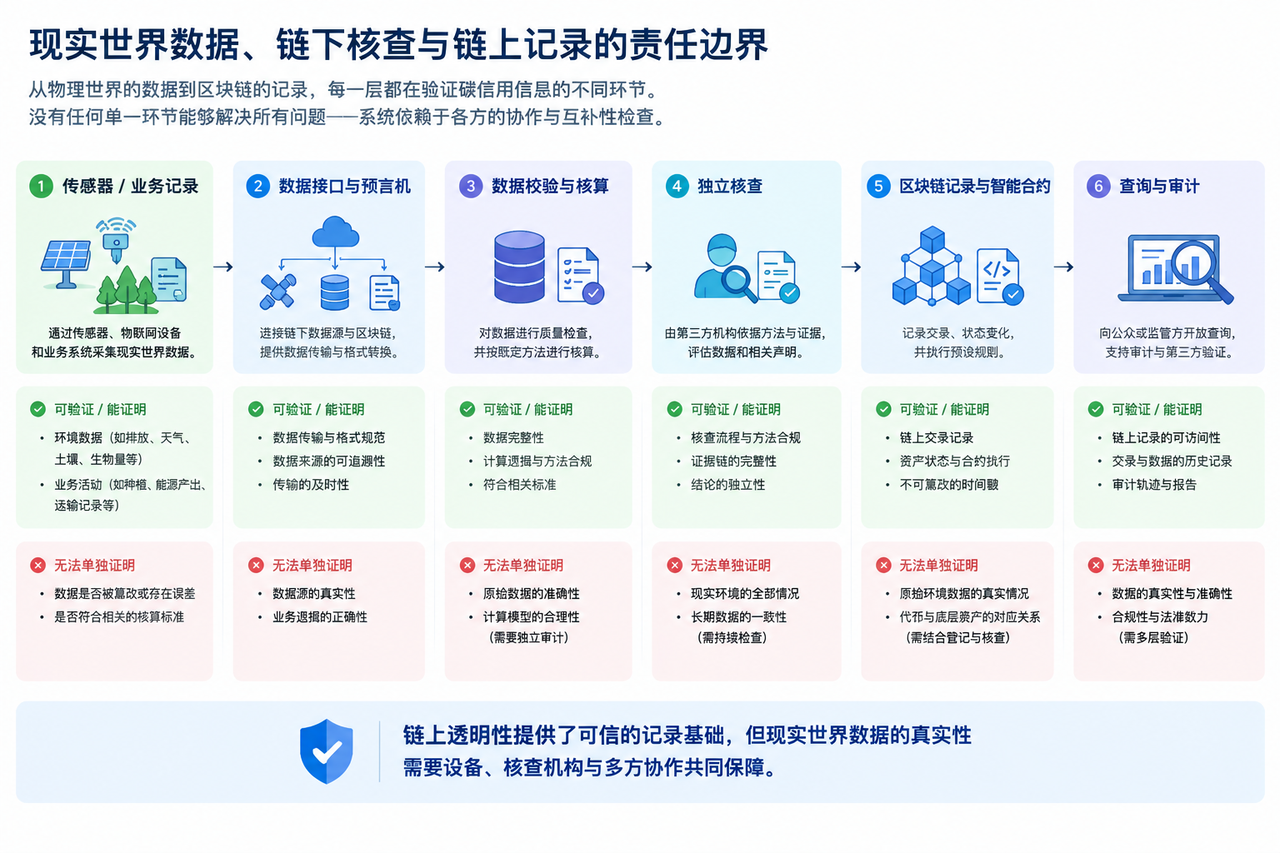
MRV, or measurement, reporting, and verification, is an important process for environmental projects to establish verifiable records. The measurement stage determines what data must be collected and how; the reporting stage organizes the data into reviewable records and explains the statistical scope and calculation logic; the verification stage reviews data sources, calculation methods, and supporting evidence according to applicable rules. MRV requirements may vary across projects and cannot be reduced to a single software function. To integrate blockchain systems into this process, it is first necessary to clarify which data comes from devices, which comes from manual records, which is generated through model calculations, and which conclusions require confirmation from third-party institutions. Only after the data flow is clearly defined can subsequent audits determine whether a record is sufficient to support a related claim.
IoT devices can provide continuous sources of environmental data. For example, devices may record fuel consumption, temperature, energy use, or other parameters related to environmental activities, then transmit the information to business systems through data interfaces. The system can perform format conversion, anomaly detection, and preliminary validation, then determine which information should be written to the blockchain based on business rules. Because on-chain storage and computation also involve costs, a practical design may not need to write every piece of raw data in full to the ledger. Some architectures may store raw files off-chain while recording data hashes, time information, access credentials, or verification results on-chain. This design can reduce some storage requirements, but it also means that auditors must still be able to access and verify off-chain data. An on-chain hash alone cannot confirm whether the original content is accurate.
The process from devices to blockchain may also involve oracles or other data interfaces. An oracle generally transfers off-chain information to smart contracts, allowing contracts to execute rules based on external data. However, an oracle does not inherently guarantee that input data is correct: it may retrieve biased data sources or be affected by interface failures, permission configurations, or the actions of data providers. Therefore, systems need to consider device authentication, data integrity validation, timestamp handling, anomalous data labeling, permission management, and failure recovery. For environmental claims, it is also necessary to distinguish between automated data checks and independent verification. Automated programs can identify formatting errors or abnormal values, but they may not be able to determine whether an environmental project meets all accounting and certification requirements.
What On-Chain Transparency Can and Cannot Address
One key advantage of blockchain is that it provides a shared, traceable recordkeeping mechanism for multiple participants. Depending on the network and contract design, a system can record data submission times, operating accounts, transaction statuses, and the transfer history of related assets. If recordkeeping rules are properly designed, participants can more easily verify whether an action occurred, whether a record was updated, and how the status of a digital credential changed within the system. This is particularly meaningful for cross-organizational collaboration, as different institutions may need to share certain records without allowing a single participant to control the entire historical record. Blockchain can also use smart contracts to execute certain deterministic rules, reducing some manual processing steps.
However, blockchain's recordkeeping capabilities have clear limitations. It can make data that has already been written more traceable, but it cannot automatically confirm whether submitted data reflects real-world conditions. If a sensor reading is inaccurate, the system may still write that inaccurate reading to the ledger; if the assumptions in a calculation model are unreasonable, an automatically executed contract may also produce results based on incorrect inputs. Even if a data hash matches an original file, this only shows that the file is consistent with the corresponding hash. It does not prove that the file's contents are accurate. A system still needs trusted data collection processes, clear calculation methodologies, and appropriate external verification mechanisms for on-chain records to become part of a credible chain of evidence.
Another limitation involves privacy and commercial confidentiality. Environmental projects may include corporate operational data, supply chain information, or personal information, and not all raw data is suitable for public storage. Permanent records on public blockchains can also create challenges for data correction and privacy management. Therefore, practical architectures need to balance auditability with data protection. For example, they may disclose only necessary evidentiary information, store sensitive data in controlled environments, and clearly define who may access, update, or verify original materials. Such designs still require security and compliance assessments. It cannot simply be assumed that more public data is more credible, nor that encrypted or summarized data necessarily meets all audit requirements.
Carbon Credit Tokenization and Double Counting: Transparent Records Do Not Mean Clear Rights
Carbon credit tokenization generally refers to using blockchain tokens or other digital credentials to represent a record, asset, or right related to carbon credits. However, when analyzing a specific project, it is essential to clarify the relationship between the token and the underlying carbon credit. A token may represent a registered carbon credit, or it may only record a type of participation right, transaction credential, or another interest related to an environmental project. Different structures have different legal effects and economic implications. Questions requiring verification include whether the underlying carbon credit actually exists, whether it has been verified and registered under the relevant standards, what specific rights the token holder has, and how the token's status is handled if the underlying asset is transferred, retired, or disputed.
Double counting is one of the issues that environmental asset systems need to address carefully. If the same emissions reduction outcome is registered multiple times across different recordkeeping systems, or if the same environmental attribute is claimed repeatedly, market participants may develop inaccurate assumptions about the actual environmental benefit. Blockchain can help track the creation, transfer, and status changes of credentials within a single system, but if multiple systems lack unified identification rules and status synchronization mechanisms, a single ledger cannot automatically prevent double counting across systems. Therefore, systems need to clearly define unique identification methods, underlying registry information, transfer rules, and retirement procedures, while connecting them with applicable registry or verification mechanisms. Technical anti-duplication logic must work alongside institutional and business processes.
Asset liquidity also cannot replace rights verification. Tokens may trade on secondary markets, but active trading does not prove the quality of the underlying asset or guarantee that token holders can obtain the corresponding rights as expected. Market prices may be influenced by liquidity, supply and demand, project narratives, and trading mechanisms, while the validity of the underlying carbon credit must still be assessed according to applicable standards, verification records, and registry status. If a project cannot clearly explain the relationship between a token and its underlying environmental asset, transparent on-chain transfers and properly functioning contracts are still insufficient to establish that the token carries clear environmental rights. Therefore, the digitization of environmental assets must consider technical records, asset identification, and rights arrangements together. A project's credibility cannot be assessed solely by whether its token can be traded.
How to Evaluate Web3 Infrastructure for the Carbon Economy
When evaluating this type of infrastructure, the first step is to determine whether its technical information is sufficiently clear. Network architecture, smart contract execution environments, transaction records, node and validation mechanisms, permission configurations, and failure-handling methods can all affect system reliability. A public block explorer can provide a way to observe transaction and block activity, but activity volume alone does not fully demonstrate network security, the scale of real users, or business value. A more complete assessment should also review technical documentation, contract code and verification information, ongoing network operations, and whether related tools and applications can be independently reproduced. For specialized chains, it is also necessary to consider cross-chain connections, ecosystem dependencies, and governance mechanisms, as these factors may affect application composability and long-term maintenance costs.
The second step is to verify data flows and real-world operations. It is necessary to understand which devices or institutions provide the data, which standards are used for collection and calculation, who performs verification, how errors are corrected, and whether relevant records can be independently audited. If a project proposes applications for carbon credit tracking or environmental impact verification, its actual deployment, users, data scale, and evidence of third-party validation should also be confirmed. Case descriptions on a project's official website can help explain its intended use cases, but without independent supporting evidence, they should not be presented directly as proof of widespread adoption or measurable environmental benefits. For environmental applications, whether business processes are actually operating and whether data can be verified are more important than simply presenting technical concepts.
The third step is to assess the economic model and token utility. Network fees, incentive mechanisms, and token supply structures may affect the willingness of developers and users to participate, but token prices are not direct indicators of technical quality or environmental benefits. Review the token's specific uses, fee payment requirements, supply and unlock arrangements, incentive distribution mechanisms, and whether network usage can generate sustained demand. It is also necessary to analyze whether the project can continue operating when there are fewer market participants, rewards decline, or market liquidity contracts. If long-term operation depends heavily on rising token prices or continuous reward distribution without genuine business demand, usage may decline after incentives weaken. The long-term value of infrastructure ultimately depends on whether technical reliability, business demand, verifiable data processes, and economic mechanisms can work together.
ValueX Chain (VLX) positions itself as infrastructure for the Web3 carbon economy, and Gate's official project introduction also mentions EVM compatibility, environmental data MRV, and related application directions. This gives readers a specific case for discussing how specialized blockchains may serve real-world environmental activities, but a project's positioning alone does not prove that its data verification process has reached any particular independent verification standard. Researchers still need to assess its capabilities and limitations item by item based on technical materials, blockchain records, evidence of actual applications, and applicable environmental verification rules. Gate's VLX price page and VLX/USDT trading page can be used to review market information about the token, but market prices and trading activity cannot replace verification of network technology and environmental applications. Separately analyzing technical capabilities, real-world data credibility, and crypto asset market performance provides a more comprehensive understanding of the opportunities and risks of Web3 environmental applications.
FAQ
Can blockchain automatically verify whether carbon credits are real?
No. Blockchain can record data submissions, asset transfers, and status changes, but it cannot independently prove that real-world environmental activities actually occurred. The credibility of carbon credits still depends on applicable accounting standards, data sources, verification procedures, and registry mechanisms.
What roles do MRV and blockchain play respectively?
MRV is a process framework for measurement, reporting, and verification, focusing on how environmental data is collected, organized, and validated. Blockchain can provide traceable records for some data and operations and execute deterministic smart contract rules. The two can be combined, but blockchain cannot replace professional verification.
Why do environmental data systems need IoT and oracles?
IoT devices can collect real-world data, while oracles and other data interfaces can transmit off-chain information to blockchain applications. They address data collection and transmission, but device authentication, data validation, and independent verification are still needed to reduce the risk of errors or manipulation.
Does carbon credit tokenization mean that token holders own carbon credits?
Not necessarily. The legal and business relationship between a token and the underlying carbon credit depends on the specific design and related documentation. The underlying asset, registry status, holder rights, transfer conditions, and retirement mechanisms must be verified. The rights represented by a token cannot be inferred solely from its name or on-chain records.
How can you determine whether a Web3 carbon economy project has practical application value?
It can be assessed across factors such as technical reliability, data sources and verification, actual deployment, genuine usage demand, and tokenomics. A project's disclosed design objectives, public on-chain activity, and independently verified environmental outcomes represent different levels of evidence and should be assessed separately.