Introduction
With the integration of artificial intelligence into practical work scenarios, a significant change is occurring in how users interact with software. Traditional software typically requires users to understand system interfaces, fill out forms, select functions, and complete tasks according to predefined steps. Generative AI lowers the barriers to information retrieval and content production, while AI Agents further attempt to translate user-defined goals into a series of specific actions, enabling software not only to provide suggestions but also to execute tasks within authorized limits.
The significance of this change is not merely to speed up certain tasks but potentially to alter the organization of workflows. In the past, employees needed to switch between multiple applications to query data, compare options, fill in information, initiate approvals, and verify results. AI Agents can link these steps together, invoking different tools as needed and determining the next course of action based on execution feedback. However, the ability to describe a task does not guarantee its reliable completion. The actual capabilities of AI Agents are still influenced by factors such as model inference, tool interfaces, data quality, permission design, and result verification.
Understanding such systems requires shifting attention from the answers generated by models to the complete execution process. A model that can write payment instructions is not the same as a system that can, after obtaining authorization, invoke payment interfaces, check transaction statuses, and return verifiable results. Only by examining models, tools, business rules, and execution environments together can we see how AI Agents might change enterprise software and more accurately assess their connections to finance, digital assets, and blockchain infrastructure.
Key Points
-
The key feature of AI Agents is organizing multi-step tasks around goals, rather than just generating a response.
-
AI Agents require models, tool interfaces, execution environments, permission management, and result verification to work together.
-
Enhanced automation capabilities may change the interaction methods and service delivery models of enterprise software.
-
The ability to automate tasks does not imply that models possess reliable judgment or unrestricted autonomy.
-
When AI Agents involve payments and digital assets, authorization, risk control, and auditability become particularly important.
-
The integration of AI and digital asset trading requires distinguishing between information assistance, instruction generation, and actual execution.
How AI Agents Differ from Traditional Software Automation
Traditional software automation is typically built on clear rules and fixed processes. For example, a business can set rules to automatically create payment requests upon receiving eligible invoices, or the system can periodically aggregate data and send alerts when inventory falls below a threshold. This type of automation is very effective for tasks with stable processes and clear conditions, but when input formats change, information is dispersed, or tasks require contextual judgment, predefined rules often need constant supplementation.
Generative AI introduces another approach. Models can understand natural language instructions, extract unstructured information, and generate plans or content based on context. Users can describe goals in relatively natural terms without needing to master all software functions in advance. However, merely generating text does not equate to executing tasks. To enable actual operations in external systems, it is necessary to connect to search engines, databases, browsers, enterprise applications, or other tools, and clearly specify which operations can be invoked.
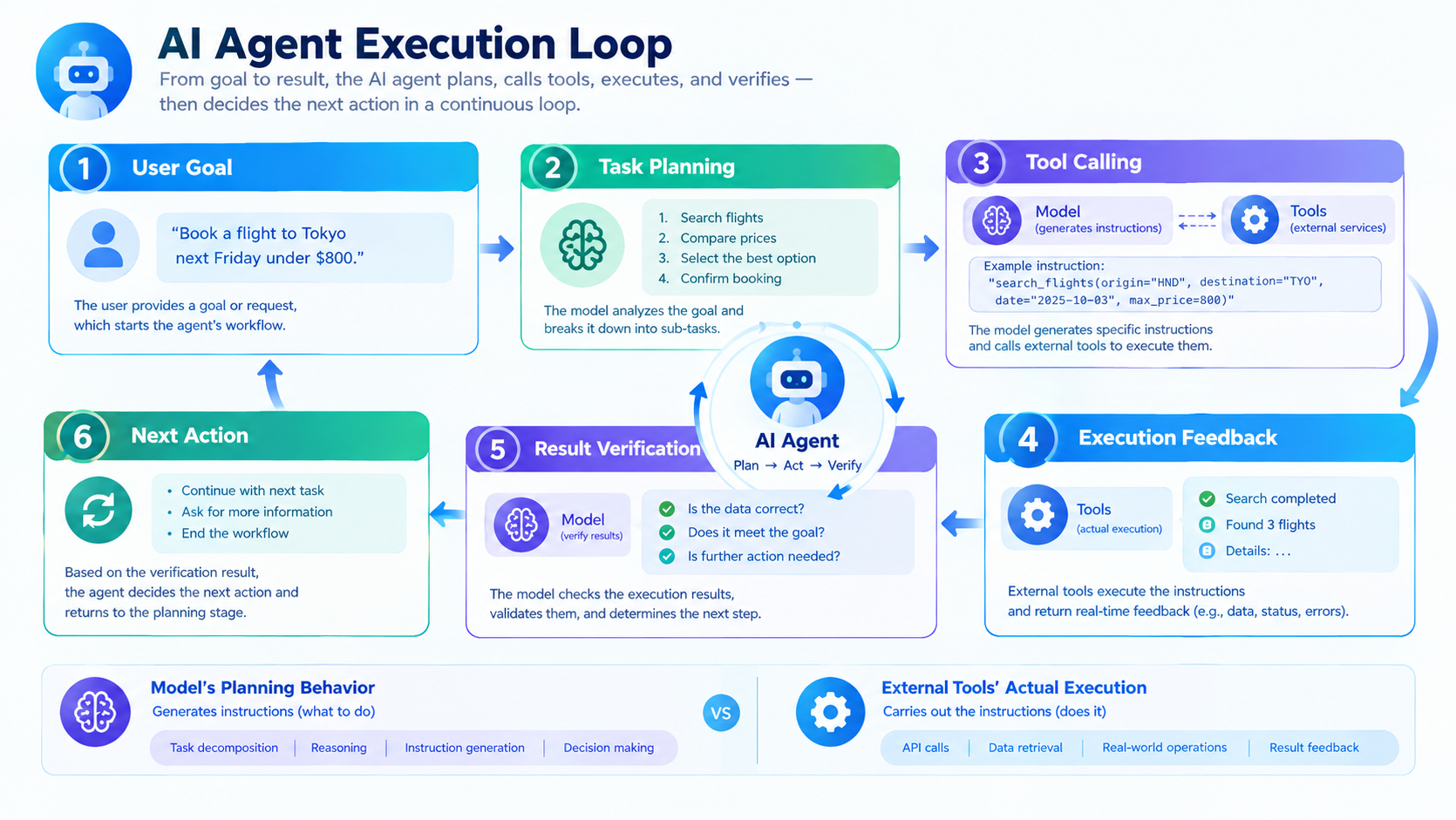
AI Agents typically further organize execution processes on top of these two types of capabilities. They can first analyze goals, break tasks into steps, then invoke tools to gather information or complete operations, and determine whether to continue execution based on feedback. They do not necessarily need to make complex decisions independently at every step: mature systems usually delegate more certain aspects to programs and business rules, while assigning parts that require understanding and synthesis to models, and setting additional confirmations for high-risk actions.
Thus, AI Agents and traditional automation are not simply a replacement for one another. A more common design is to combine the two: models handle vague instructions, organize information, and generate candidate solutions, while deterministic programs manage permission checks, data validation, and transaction execution, and business systems maintain state and record results. The reliability of the system depends on the collaboration of these components, not just on whether the model can provide seemingly reasonable answers.
The execution of an AI Agent typically begins with goal identification. A user may present a broad request, such as organizing vendor invoices for the quarter, identifying unusual expenses, and generating a payment list for approval. The system first needs to define the boundaries of the task, available data, and the final deliverable. For vague or contradictory requests, it should pose clarifying questions rather than assume that all missing information has been determined.
Next, the system breaks the goal down into smaller sub-tasks. In the example above, it may need to retrieve invoices, read vendor information, compare historical amounts, identify unusual records, generate summaries, and submit the results for review. Each step requires clear inputs, expected outputs, and handling methods for failures. Task planning may not occur just once; if a tool returns incomplete data, the AI Agent may need to re-query or hand the issue back to the user.
Tool invocation is a critical link between information processing and actual operations. An AI Agent may read databases through interfaces, invoke enterprise resource planning systems, access files, or submit approval requests. The tools themselves perform specific functions and return success, failure, or other statuses. The model can adjust subsequent plans based on this feedback, but it cannot assume that external operations have been completed solely based on its generated text.
Finally, the system needs to check whether the results meet the goals. Evidence of task completion may include records in the database, transaction numbers returned by the system, approval statuses, or verified calculation results, rather than the model claiming "it has been processed." For operations that affect funds, accounts, legal obligations, or important business records, the verification process is especially crucial. If the execution results cannot be confirmed, the system should clearly report the uncertain status rather than packaging incomplete tasks as successful results.
A model may possess strong language understanding capabilities, but if it cannot access the data needed to complete tasks, it cannot independently perform the corresponding work. Customer data, contracts, inventory, financial records, and approval systems in enterprise software are often siloed. For an AI Agent to work across systems, it needs appropriate interfaces and data access permissions. The stability of interface design, clarity of field meanings, and comprehensibility of error messages all affect whether tasks can be completed continuously.
Permission design determines what an AI Agent can do and which operations must be restricted. The risks of reading reports and deleting records are clearly different; generating payment suggestions does not equate to obtaining payment authorization. Systems can adopt tiered permissions: low-risk operations may be allowed to execute automatically, medium-risk operations may require additional checks, and high-risk operations must be confirmed by humans. Permissions should also be associated with tasks to prevent AI Agents from gaining unnecessary broad access to achieve a localized goal.
Another key issue is that external information may not be trustworthy. Web content, email bodies, uploaded files, or data returned from third-party tools may contain erroneous instructions or malicious content. If the system treats this content as authoritative commands, unauthorized operations may occur. Therefore, a reliable AI Agent needs to distinguish between user authorizations, system rules, tool-returned data, and external text, and implement independent verification mechanisms for sensitive operations.
From a system design perspective, AI Agents do not imply that all rules should be left to model judgment. When it comes to amounts, account permissions, transaction limits, compliance requirements, or irreversible operations, deterministic rules are usually better suited to bear the final constraints. Models can help understand scenarios and organize tasks, but key security conditions should be executed by mechanisms that can be tested, audited, and reproduced. Intelligence and control strength are not in conflict; rather, the more complex tasks a system is expected to handle, the clearer the permission boundaries need to be.
How AI Agents Change Enterprise Software and Workflows
Traditional enterprise software typically organizes interfaces around functional modules. Financial personnel enter financial systems, sales personnel enter customer relationship management systems, and operations personnel enter supply chain or inventory systems. Employees need to learn the interfaces and operational logic of different systems, then break a business goal into a series of manual steps. This structure facilitates clear control and accountability, but cross-system work often requires repeated input, data duplication, and constant interface switching.
AI Agents may transform some interactions into goal-driven approaches. Users describe the work they wish to accomplish, and the system then invokes relevant tools based on authorized limits. This does not mean traditional interfaces will disappear; rather, the entry points for software use may become more diverse. Simple queries can be completed through natural language, while complex tasks may still require users to enter specialized interfaces to check data, handle exceptions, and confirm results. For high-risk businesses, the system may also deliberately retain clear approval steps rather than pursuing a fully automated process.
This change may also affect the sources of value for enterprise software. In the past, the competitiveness of software products was often related to functional coverage, data storage, interface experience, and the depth of organizational processes. With the proliferation of AI Agents, users may focus more on whether the system can provide reliable data access, clear tool interfaces, stable execution capabilities, and verifiable results. 企业软件的价值 may extend from merely providing functions to organizing different tools to collaboratively complete work.
However, the simplification of software interaction entry points does not imply that underlying systems will lose their importance. AI Agents still require trustworthy data, business rules, identity verification, and record systems. They can change how users communicate with software but cannot automatically resolve issues such as data silos, unclear responsibilities, poor historical data quality, or overly complex approval processes. If the underlying business logic itself is flawed, automation may actually exacerbate the problems more quickly.
Why Task Automation Does Not Equate to Complete Autonomous Decision-Making
"Autonomy" in the context of AI Agents is not a single metric. A system can autonomously break down tasks but still require human approval for final operations; it can also automatically complete low-risk steps but stop execution when encountering exceptions. When discussing the capabilities of AI Agents, it is essential to distinguish between task planning autonomy, tool invocation autonomy, fund or account operation permissions, and the entities responsible for final results. These capabilities do not automatically coexist simply because a system is labeled as an Agent.
Models can also produce erroneous judgments. They may misinterpret user intent, incorrectly extract numbers, overlook exceptions, or provide seemingly reasonable conclusions based on insufficient information. Even if the probability of error in a single step is low, multi-step tasks can still accumulate errors. If a task requires continuous invocation of multiple tools, each step relying on the results of the previous one, the system must perform checks at critical nodes and provide recovery mechanisms for exceptions.
Therefore, tasks suitable for automation typically possess several characteristics: goals can be clearly defined, input data can be validated, execution results can be checked, failures can be recovered from, and losses from errors can be controlled. For operations involving fund transfers, legal commitments, account security, or significant financial decisions, systems often require stricter authorization and human oversight. Just because a technology can execute does not mean that the business should fully entrust it to machines.
From an economic perspective, the value of AI Agents cannot be measured solely by how many clicks have been reduced. It is essential to assess whether they lower overall error rates, reduce coordination costs, improve service accessibility, and generate net benefits after accounting for model invocation, tool maintenance, auditing, and security control costs. Different enterprises have varying processes, risks, and data conditions; thus, the same AI Agent solution may be effective in one scenario but not economically viable in another.
What Changes Will Payments and Settlements Face When AI Agents Start Handling Digital Assets
As digital services are increasingly initiated automatically by software, how machines obtain payment capabilities becomes a question worth exploring. An AI Agent may need to purchase cloud computing resources, invoke paid APIs, settle service fees, or complete other digital transactions after receiving explicit authorization. At this point, the system is no longer just reading information or generating suggestions; it needs to identify transaction parties, determine amounts, check permissions, and confirm transaction results.
Traditional financial systems have mature account management, identity verification, compliance checks, and dispute resolution mechanisms, but there may be differences in interfaces and operational times between different banks, payment service providers, and regions. 区块链 offers another technical path: under network rules, digital assets can be transferred through programmatic interfaces, and smart contracts can execute preset conditions. This mechanism may be suitable for transactions that require round-the-clock operation, have clear rules, and can be verified through on-chain states.
However, blockchain does not automatically resolve all payment issues. AI Agents still require reliable 钱包管理, identity and permission controls, asset price information, cost budgets, transaction simulations, and exception handling. Once on-chain transactions are confirmed, they typically cannot be easily reversed through the same processes as traditional card payments. If an AI Agent misinterprets, invokes malicious tools, or signs transactions based on erroneous information, the technical capability for automatic execution may amplify risks.
Therefore, the integration of AI Agents with digital assets should be understood as starting from constrained payment or operational tasks, rather than directly equating to machines possessing complete financial autonomy. A more reasonable architecture is to have AI Agents propose or organize transactions, with independent authorization mechanisms checking goals, amounts, and permissions, followed by execution through wallets, transaction interfaces, or smart contracts, and verification of results through transaction records. Automation can reduce manual coordination, but fund security still requires clear responsibility boundaries.
Observing the Development of AI Agents from Gate's Digital Asset Trading Scenarios
Gate's digital asset trading and payment scenarios can help readers understand the practical issues to consider when integrating AI Agents with financial systems. For example, Gate for AI Agent can assist in organizing market information, summarizing asset data, generating analytical ideas, or helping users understand trading processes; however, these functions belong to different capability levels compared to automatically submitting orders, controlling account funds, or executing on-chain transfers. Whether analytical tools can access real-time data, whether trading operations require user confirmation, and how account permissions are restricted will all affect the actual utility of the system.
In trading scenarios, it is especially important to distinguish between information generation and execution results. Models can summarize market changes but may misread data or use outdated information; models can also generate trading parameters, but this does not mean the parameters align with the user's risk preferences or account conditions. A reliable system should handle real-time market data, order statuses, fees, and risk limits through verifiable data and programs, rather than solely relying on the model's natural language judgments.
If AI Agents in the future integrate with digital asset trading interfaces or on-chain wallets, permission layering will become even more critical. Read-only access, trading suggestions, order submissions, fund transfers, and smart contract authorizations should have different levels of control. Users should clearly understand what permissions the system has obtained, what operations it can perform, how to revoke authorizations, and what recourse is available in the event of errors. The protection of sensitive keys and account credentials cannot be replaced by the convenience of "AI automation."
Therefore, when observing Gate and AI 相关应用, the focus should not be on whether a product has an AI label, but rather on which specific problem it addresses: information understanding, workflow orchestration, transaction execution, or result verification. Only by separately evaluating the scope of functions, authorization mechanisms, and execution evidence can we avoid misinterpreting auxiliary tools as fully autonomous trading systems and gain a clearer understanding of how AI and the digital asset market may gradually integrate.
From the Execution Capabilities of AI Agents to the Commercial Value of the AI Industry Chain
The significance of AI Agents lies not only in enabling software to understand instructions, invoke tools, and complete tasks but also in their potential to change the delivery methods of enterprise software, the interaction patterns between users and software, and the demand for computing resources within enterprises. As agents can take on more continuous work, the criteria for evaluating AI technology will gradually shift from model capabilities to task completion rates, operating costs, work efficiency, and actual business benefits. The enhancement of technical capabilities is merely the starting point for industrial change; the ability to form sustainable business models ultimately determines how these technologies will be integrated into enterprise operations.
This change will also propagate upstream along the AI industry chain. To support more complex reasoning, tool invocation, and continuous operation, enterprises may increase investments in chips, cloud computing, data centers, and related software infrastructure; at the same time, model service providers and application developers will need to explore new pricing methods and revenue sources. However, the growth in computing power demand does not necessarily mean that all related enterprises will achieve the same level of profit. Capital expenditures, service pricing, customer willingness to pay, operating costs, and competitive landscapes will all influence the extent to which technological demand translates into revenue and profit.
AI 产业链
Therefore, understanding the technical mechanisms of AI Agents also requires further observation of their impact on enterprise profit models and capital market pricing. For technology companies, the key issues are not only whether they can develop more powerful models or agents but also whether new investments can increase revenue, improve profit margins, create stable cash flows, and how long it will take for these changes to materialize. There is a connection between technological progress, commercialization advancements, and stock valuations, but the three do not always change in sync.
What Basic Conditions Determine the Long-Term Development of AI Agents
The long-term value of AI Agents primarily depends on the quality of task completion. A system can execute a large number of steps continuously, but if it frequently requires human error correction or if the consequences of errors are difficult to control, its economic value may be quite limited. As applications expand from personal assistants to enterprise processes, the focus of evaluation will shift from whether responses are fluent to task success rates, execution times, unit costs, exception handling capabilities, and result auditability.
Secondly, the tools and data infrastructure will affect the business scope that AI Agents can reach. Standardized interfaces, stable data structures, and clear identity permissions facilitate collaboration between different applications. Conversely, data silos, frequent changes in interfaces, and a lack of unified business rules will increase the difficulty of planning and executing for AI Agents. Therefore, the proliferation of AI Agents is not only a matter of model capabilities but also involves enterprise software architecture, data governance, and process standardization.
Finally, trust and responsibility arrangements will determine the extent of actual permissions that AI Agents can assume. Enterprises need to clarify which operations can be executed automatically, which require approval, and which must be handled by professionals. For financial transactions, considerations must also include account security, compliance requirements, transaction disputes, and operational records. As system capabilities increase, security design should not merely be an afterthought but should be an integral part of the execution architecture.
From a longer-term perspective, AI Agents may evolve software from being passive tools that respond to commands to systems capable of continuously organizing work under defined goals. However, this change will not occur at the same speed across all industries and tasks. The truly important criterion is not how autonomous a system appears but whether it can stably complete tasks of value to users under clear authorizations, controllable costs, and verifiable results.
FAQ
How do AI Agents differ from ordinary chatbots?
Ordinary chatbots primarily generate responses based on input; AI Agents can further plan multi-step tasks, invoke external tools, adjust actions based on execution feedback, and verify task results. The distinction lies in whether the system has a controlled execution process, not whether a chat box appears on the interface.
Can AI Agents completely replace enterprise employees?
It cannot be generalized. Tasks that are highly repetitive, have clear rules, and yield verifiable results are easier to automate; work involving complex judgments, responsibility, exception handling, and interest coordination may still require human involvement. The feasibility of automation depends on the task itself, not on whether an AI model is used.
Can AI Agents directly manage cryptocurrency assets?
Technically, systems can be designed to invoke wallets or trading interfaces, but this does not mean they should be granted unlimited permissions. Fund operations require clear authorization, transaction limits, key protection, risk checks, and result verification. Generating transaction instructions and obtaining actual control over funds are two different issues.