This comparison is for intermediate readers who already grasp basic order logic and are choosing a range strategy inside Gate Trading Bot. It covers definitions, leverage and capital efficiency, direction, risk/fees, and choose-if rules.
Key Takeaways
- Spot Grid places layered buy-low/sell-high orders on spot pairs and is typically long-only; Futures Grid runs on perpetual futures, supports long/short/neutral grids, and can raise capital efficiency with leverage.
- Capital-efficiency differences come from margin and leverage: Spot Grid locks spot principal; Futures Grid can control larger notional with less margin, while adding liquidation and funding.
- Risk stacks diverge: spot risk centers on range breakouts, inventory drawdowns, and fee drag; futures risk adds margin, estimated liquidation price, and funding rates.
- Choose by goal and constraint: prefer Spot Grid for spot exposure with zero leverage; prefer Futures Grid for direction flexibility or higher capital efficiency—and manage liquidation separately.
The table below compares Spot Grid and Futures Grid across leverage, direction, capital efficiency, and risk. It does not imply returns.
| Feature |
Spot Grid |
Futures Grid |
| Market |
Spot pairs |
Perpetual futures |
| Leverage |
No leverage; spot capital locked |
Configurable leverage; higher capital efficiency |
| Direction |
Typically long-only (buy low / sell high) |
Long / short / neutral grid |
| Capital efficiency |
Lower; principal fully staged across grids |
Higher; margin supports larger notional |
| Core risks |
Range breakout, one-way inventory drag, fees |
Margin, estimated liquidation, funding, directional PnL |
| Typical parameters |
Bounds, grid count, investment; optional Trailing Grid |
Side, leverage, range, grid count; optional stop-loss |
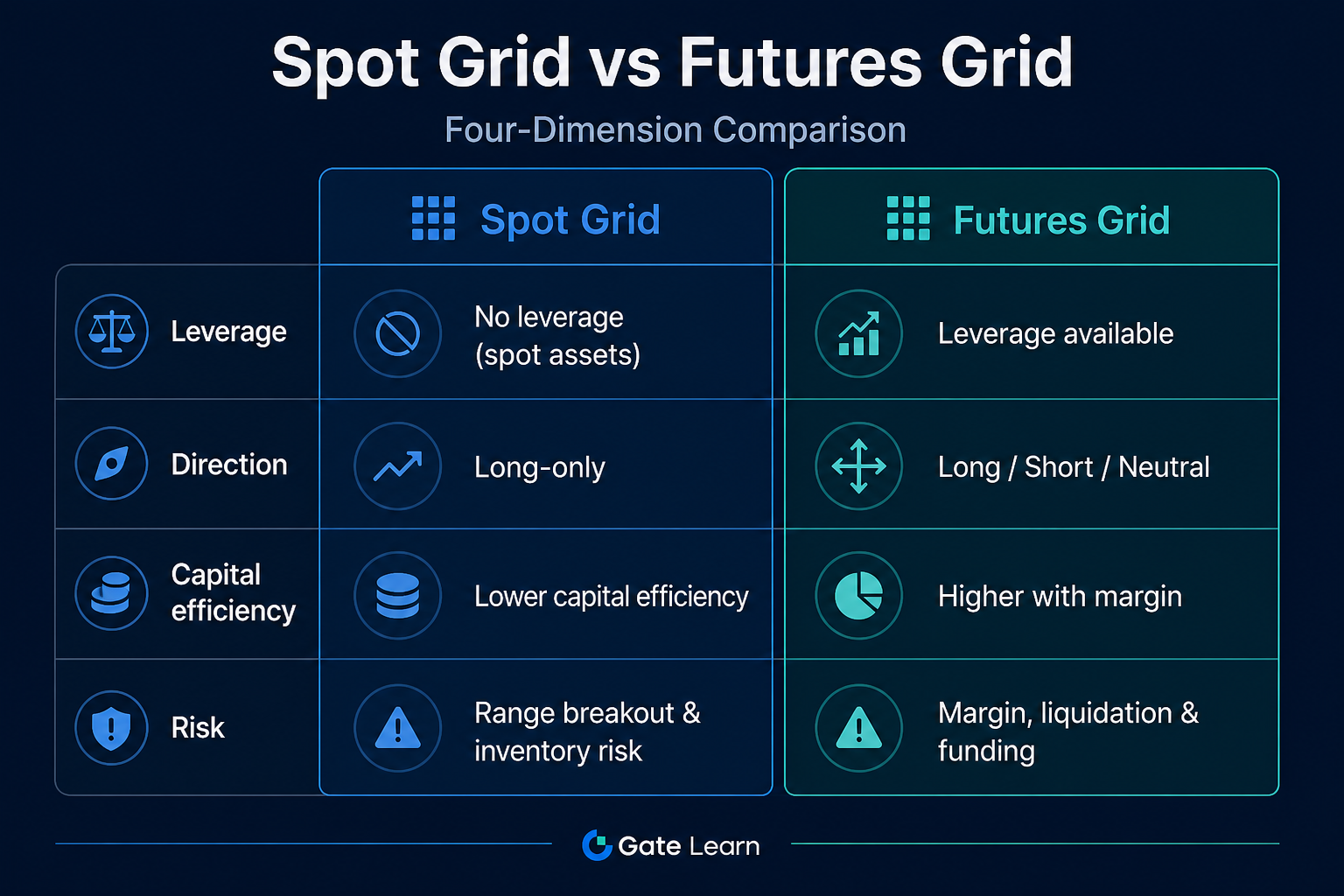
Figure 1. Spot Grid vs Futures Grid across leverage, direction, capital efficiency, and risk.
Reading the table: Spot Grid stages spot buys and sells inside a band; Futures Grid moves the same skeleton onto futures, trading direction and efficiency for a margin stack.
What Is Spot Grid?
Spot Grid is an automated spot strategy for choppy markets: after setting bounds and grid count, the bot buys as price falls and sells as price rises to harvest swings. Per the Spot Grid Trading Guide, Spot Grid typically supports long positions only, can sit underwater in prolonged downtrends, and may stop executing usefully when price leaves the preset range.
Creation paths include smart recommendations, copy flows, and custom setup; pages often split Ultra AI Spot Grid versus manual configuration. Trailing Grid can shift both bounds after a breakout using moving-average or breakout rules while keeping grid count fixed. Spot Grid does not introduce futures margin; risk sits in range design, fees, and spot inventory exposure.
What Is Futures Grid?
Futures Grid uses futures as the instrument, still posting by range and grid count, but it can amplify equity with leverage and choose long, short, or neutral modes. Help Center notes that Futures Grid aims to improve Spot Grid’s lower capital efficiency and long-only constraint: oscillating uptrends map to long grids, downtrends to short grids, and unclear direction to neutral grids.
Neutral grids place shorts above and longs below the start price to reduce the cost of a wrong directional call in chop; one-way breakouts can still build unrealized losses. Higher leverage makes estimated liquidation and volatility shocks more sensitive. Do not confuse Futures Grid with Futures DCA (Futures Martingale): the latter adds size on adverse moves to average cost and is not a range-grid order book.
How Do Capital Efficiency and Leverage Differ?
Spot Grid capital efficiency is capped by staging spot principal: investment is split across levels, unfilled slices still lock spot funds, and notional usually cannot exceed capital committed. Futures Grid uses leverage so the same notional needs less margin, raising capital efficiency; futures fee structures may leave more room for per-grid gross edge than spot—yet funding and potential liquidation costs still apply.
Leverage is a two-way amplifier: sensible settings may scale in-range notional; excessive leverage or a too-narrow band can push the account toward margin limits on a modest adverse move. Confirm whether margin and liquidation are acceptable before chasing capital efficiency.
Direction: Long-Only vs Long / Short / Neutral?
Spot Grid direction is effectively long-biased: buy on dips, sell on rallies, with no native short grid inside a spot wallet. Futures Grid offers three modes: long grids for oscillating up moves; short grids for oscillating down moves; neutral grids when direction is unclear but two-way volatility is expected.
Direction choice is a judgment input, not a return guarantee. Wrong calls matter: long grids keep buying into sharp drops; short grids keep shorting into sharp rallies; neutral grids can still open mid-trend in one-way markets. Trailing Grid only shifts the band; it does not auto-correct a wrong side.
How Do Risk and Fee Structures Differ? (Margin, Liquidation, Funding)
Spot Grid risk centers on breakouts, inventory drawdowns, and round-trip fees: buys stall below the lower bound, sells stall above the upper bound; one-way declines deepen spot inventory losses; denser grids raise fee drag on per-grid net edge. Take-profit/stop-loss, coin-accumulation mode, and sell-all-on-termination change exit shape, not market risk itself.
Futures Grid adds a margin stack: watch estimated liquidation price, auto stop-loss ratio, and trigger price; leverage scales notional while shrinking room for error. Perpetual futures may also charge funding rates, so holding time affects net results. Evaluate open/close fees with funding and potential liquidation losses; high leverage can lead to liquidation when price moves sharply.
Which Should You Choose: Spot Grid or Futures Grid?
Choose Spot Grid if: the goal is range buy-low/sell-high with spot capital; leverage, margin, and liquidation are unwanted; the bias is long-only; range breakouts and inventory drag are more acceptable than liquidation risk. If parameters feel hard, Ultra AI or backtested presets can help—still verify that bounds cover expected volatility.
Choose Futures Grid if: short or neutral direction is required; higher capital efficiency via leverage is the point; margin, estimated liquidation, and funding are understood; wrong-side unrealized losses can be managed. When direction is unclear, neutral grids are a common option, still needing exit rules for one-way breakouts.
If the goal is staged add-ons that average cost on adverse moves, evaluate Futures DCA instead of forcing a grid range to act like a martingale. Keep spot locks and futures margin distinct so one strategy does not starve the other.
Summary
Spot Grid and Futures Grid share a staged range skeleton and diverge on market, leverage, direction, and the fee/risk stack. Spot Grid maps to zero-leverage spot exposure; Futures Grid trades leverage plus long/short/neutral modes for capital efficiency and directional flexibility, while adding liquidation and funding constraints. Match risk boundaries and direction needs first, then set range, grid count, and investment size; parameter helpers do not replace strategy-type choice.
FAQ
What is the difference between Spot Grid and Futures Grid?
The core gaps are market, leverage, and direction: Spot Grid runs on spot, is typically long-only, and uses no leverage; Futures Grid runs on perpetual futures, can use leverage, and supports long, short, and neutral grids. On risk, spot focuses on breakouts and inventory drag; futures adds margin, liquidation, and funding.
How does Spot Grid work?
After setting bounds and grid count, the bot buys in layers as price falls and sells as price rises to harvest swings. Price leaving the band can stop useful execution; optional Trailing Grid shifts the range after breakouts. Field definitions live in Gate’s Spot Grid help docs.
What is Futures Grid?
Futures Grid is a perpetual-futures grid bot that combines a price range, grid count, direction mode, and leverage to trade volatility—and optionally a directional bias—in choppy markets. Long, short, and neutral modes encode different side assumptions; neutral grids keep both-side logic when direction is unclear.
Are futures grid bots riskier?
Versus Spot Grid, Futures Grid usually adds more risk dimensions: leverage magnifies unrealized losses and introduces estimated liquidation plus margin management; perpetuals may also charge funding. Whether it is “riskier” depends on leverage, side, and range—not the label alone. A zero-leverage, long-only Spot Grid is simpler, but it can still lose money.
Which grid is better for beginners?
Most beginners start with Spot Grid to learn how range, grid count, and fees shape per-grid net edge without liquidation. After margin and perpetuals are familiar—and short exposure or higher capital efficiency is required—evaluate Futures Grid with low leverage, a wider band, and clear stops. Choose by risk boundaries.