For anyone trying to estimate Simple Earn returns, the important part isn’t just the percentage shown on the product page. The calculation changes with the earning period, whether interest is reinvested, and whether the displayed APR changes while the funds are active. Understanding those mechanics helps avoid common mistakes, such as assuming a 5% estimated APR means a deposit immediately earns 5% or that the same rate will necessarily apply for an entire year. The sections below break down the Flexible and Fixed formulas, interest timing, compounding behavior and the factors that can cause actual earnings to differ from a simple annual estimate.
Key Takeaways
-
APR annualizes the rate rather than guaranteeing a return. A 10% APR mathematically implies 100 units of simple annual earnings on 1,000 units of principal if the same rate applied for an entire year.
-
Flexible Simple Earn works on an hourly cycle. Funds generate interest when successfully matched for lending, and hourly interest is automatically reinvested.
-
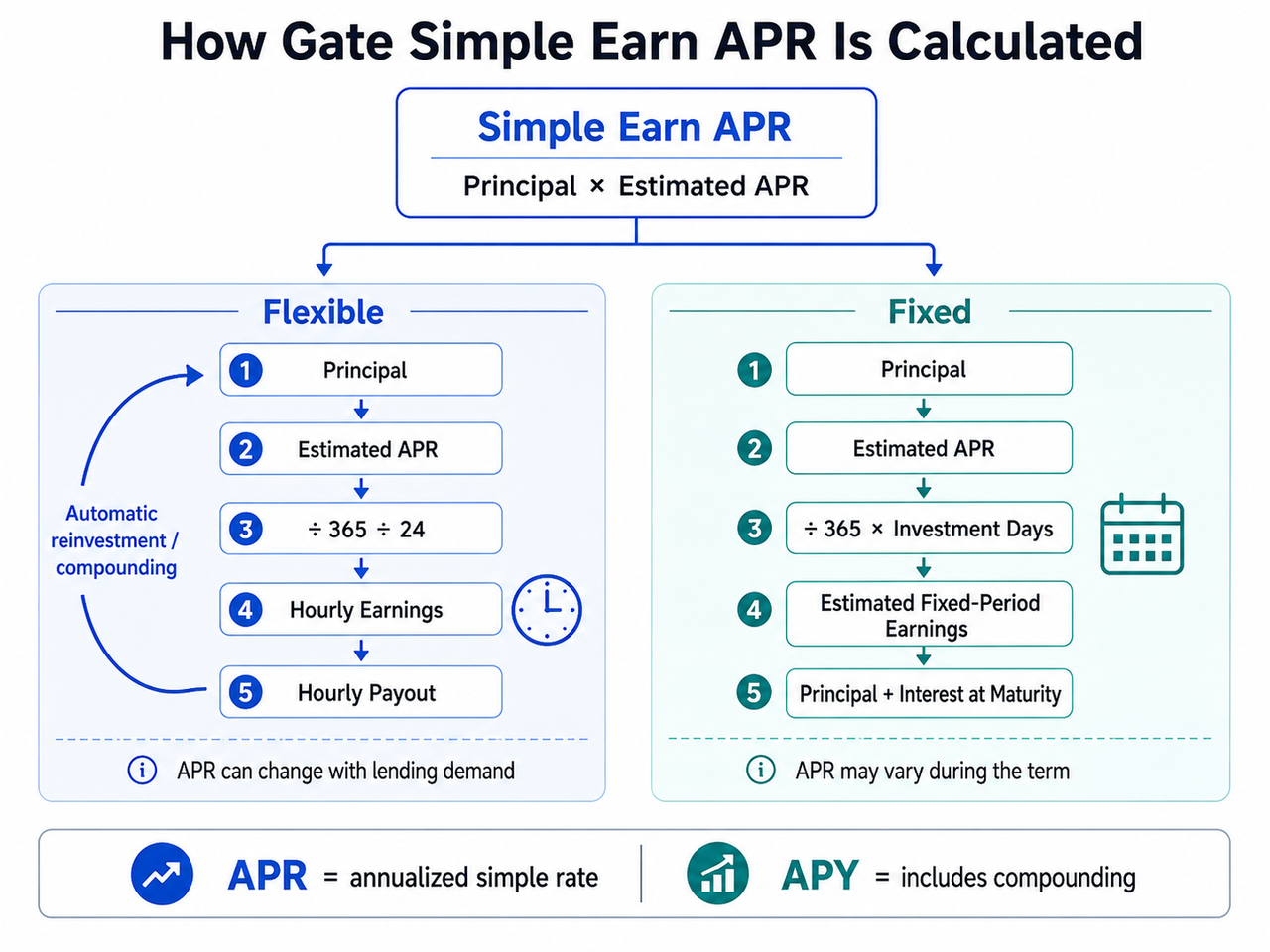
Fixed Simple Earn uses a day-based calculation. Estimated interest can be expressed as principal × APR ÷ 365 × investment days.
-
“Fixed” describes the product term, not necessarily an unchanging interest rate. Gate states that subscribed Fixed APR may vary daily, with final settlement determined at maturity.
-
Displayed APR can change. Lending demand, available liquidity, product rules and bonus rates can affect the rate visible on the product page.
Gate Simple Earn APR Explained: How Are Crypto Earnings Calculated?
The annual percentage rate, or APR, converts an interest rate into a one-year percentage without including compound interest in the quoted rate itself. In its simplest form:
Annual Earnings = Principal × APR
If an investor initially invested 1,000 USDT at a constant 10% APR for one full year:
1,000 × 10% = 100 USDT
The estimated total amount would therefore be 1,100 USDT before considering any compounding, changes in APR or other product conditions.
For periods shorter than a year, the annual rate has to be scaled to the actual investment period:
Estimated Earnings = Principal × APR × Time Fraction
Using days:
Estimated Earnings = Principal × APR ÷ 365 × Number of Days
This is why calculating APR shouldn't be confused with simply multiplying a deposit by the displayed percentage regardless of holding time. A 30-day investment at a 10% APR doesn't generate 10% in 30 days.
The broader concept of annualized return rates in crypto is also used across staking products, crypto loans, DeFi platforms, yield farming and other investment options. The underlying source of rewards can differ considerably even when two products display a similar APR.
How the Simple Earn Interest Rate Is Generated
Gate Simple Earn Flexible uses subscribed crypto assets as working capital for lending activity on the platform. When those funds are matched with borrowing demand, the interest generated by borrowers contributes to the annualized return distributed to subscribers.
That mechanism connects Simple Earn returns to crypto lending rather than treating the displayed percentage as an arbitrary fixed savings rate. In a lending market, demand matters. When borrowing demand, available capital or liquidity changes, the rate at which funds can be successfully matched can also change.
Crypto lending generally connects holders willing to lend digital assets with market participants willing to pay interest to borrow them. Unlike traditional banks, crypto platforms may calculate and distribute such interest over much shorter intervals, although the precise mechanics depend on the product.
On the Gate Simple Earn product page, the relevant figure is shown as Est. APR. Gate describes Flexible's current estimated APR as the lowest APR at which Simple Earn funds can successfully be matched for lending and earning returns, calculated from historical data and current borrowing demand.
So an estimated APR is best treated as a current annualized reference rate, not a promise that today's percentage will remain unchanged for the next month or year.
Calculating APR for Simple Earn Flexible
Flexible Simple Earn calculates earnings around successful hourly lending.
If assets are borrowed at hour T, Gate states that the corresponding interest is received at T+1. Redeeming before that hourly cycle completes means the interest from that incomplete hour isn't earned. Interest already distributed is automatically invested again, allowing it to participate in subsequent earning periods.
For a simplified estimate, an annual APR can be converted into an hourly rate:
Estimated Hourly Earnings = Principal × APR ÷ 365 ÷ 24
Suppose 10,000 USDT is continuously earning at an illustrative 6% APR:
10,000 × 0.06 ÷ 365 ÷ 24 ≈ 0.0685 USDT per hour
Twenty-four comparable earning periods would produce roughly:
0.0685 × 24 ≈ 1.64 USDT
The actual calculation can differ because Flexible APR is dynamic and depends on successful lending. It shouldn't be assumed that every hour will necessarily use the same interest rate.
Flexible also introduces compound interest. Once an hourly reward has been credited and reinvested, the principal available for a later earning period can become slightly larger. Over time, this means the effective yield may be higher than a simple APR calculation if the rate remains constant and earnings continue to compound.
The beginner introduction to Gate Simple Earn places this earnings mechanism in the broader context of using otherwise idle crypto assets without requiring active trading.
How Is Fixed Simple Earn APR Calculated?
Fixed Simple Earn follows a different timing model. Interest starts accruing at 00:00 UTC on the day after subscription, and principal plus interest is distributed after the product reaches maturity.
Gate gives the calculation as:
Estimated Interest = Principal × APR ÷ 365 × Investment Days
For example, consider 5,000 USDT in a 30-day Fixed product with an illustrative 8% APR:
5,000 × 0.08 ÷ 365 × 30 = 32.88 USDT
The estimated maturity amount would be:
5,000 + 32.88 = 5,032.88 USDT
The catch is the word estimated. Fixed doesn't necessarily mean the APR itself is permanently fixed when the subscription begins. Gate states that the APR of subscribed Fixed products is variable, may change daily, and is finally settled when the order matures.
This separates the mechanics from the choice of product. The Gate Simple Earn Flexible vs. Fixed comparison deals with liquidity and product selection, while the calculation itself depends on the applicable rate, principal and earning period.
APR and APY: Where Compound Interest Changes the Result
APR and APY aren't interchangeable.
APR, or annual percentage rate, normally expresses annualized simple interest without incorporating compounding into the quoted percentage. APY, or annual percentage yield, includes the effect of reinvesting earnings.
Assume 1,000 USDT earns a constant 10% APR without compounding:
Annual simple interest = 1,000 × 10% = 100 USDT
If the same nominal rate compounds repeatedly, each reward begins generating additional earnings. The effective annual percentage yield would therefore be above 10%, assuming the rate and principal remain otherwise unchanged.
This distinction appears throughout the cryptocurrency sphere. Staking platforms, lending products, Binance Earn products, DeFi liquidity strategies and exchange-based savings products may use APR, APY or another annualized-return measure. Two percentages shouldn't be compared until the investor knows whether compound interest is included and how frequently rewards are paid.
Gate Flexible is especially relevant here because hourly earnings are automatically reinvested. Its displayed metric is still estimated APR, while the realized growth of continuously reinvested assets can reflect compounding.
Why Can the Displayed APR Change?
Simple Earn returns aren't isolated from market conditions. Flexible funds depend on lending demand, so changes in the number of users borrowing an asset, available lending liquidity and the rates required for successful matching can affect the estimated APR.
Fixed APR can also change daily. In addition, certain Simple Earn products may include bonus APR. Gate's bonus rules state that bonus rewards are additional to standard annualized returns and that bonus APR itself can change. Eligibility can also be limited to a specified amount of principal.
That makes a headline APR less useful without context. A very high APR displayed by any crypto investment platform may come from a temporary incentive, limited allocation, unusual demand or a higher-risk economic model. High APR alone doesn't prove that a product is unsafe, but investors shouldn't treat the percentage as evidence of sustainability either.
The same principle applies beyond Simple Earn. Gate Soft Staking, Gate Staking and Dual Investment can all generate crypto returns, but their reward sources, settlement rules and risk profiles aren't identical to Simple Earn lending.
Why APR Doesn't Guarantee Dollar Profit
An APR describes earnings in relation to the crypto principal. It doesn't guarantee the fiat currency value of those earnings.
Suppose an investor deposits one crypto asset and earns additional units of that same asset. The account may contain more coins after the investment period, yet the value measured in dollars can still fall if the asset's market price declines enough.
This is particularly important when comparing crypto savings with traditional bank savings. Crypto savings and bank savings can both use annualized interest terminology, but crypto introduces asset-price risk and different custody, lending and liquidity structures.
Users calculating total earnings should therefore separate two questions:
-
How many additional units of the crypto asset could the APR generate?
-
What might those assets be worth in fiat terms when they are redeemed?
APR answers the first question more directly than the second.
What Happens to Earnings When Assets Are Redeemed?
For Flexible Simple Earn, principal and accumulated interest can be redeemed together. Gate states that real-time redemption is supported, although heavy redemption demand can delay arrival; interest continues accruing while such a request is being processed.
Fixed products can also permit early redemption, but the earnings consequence is very different: early redemption results in the loss of accrued interest, and the principal is generally returned within the period specified by the product rules. Gate also states that early redemption isn't supported during the final hour before maturity.
That makes the actual holding period part of any meaningful return calculation. A projected annual income figure is useful only if the assumptions behind it match what actually happens.
Conclusion
Gate Simple Earn APR is an annualized reference rate used to express potential earnings, while actual Simple Earn returns depend on principal, the active APR, successful earning periods and the product's settlement rules.
Flexible works on an hourly lending cycle and automatically reinvests distributed interest, creating compound-interest effects over time. Fixed calculates estimated earnings using principal × APR ÷ 365 × investment days, begins accruing from 00:00 UTC on the day after subscription, and settles at maturity. Its APR may still change daily.
The most useful way to interpret an estimated APR is therefore as a calculation input rather than a promised profit. Check the current rate on the product itself, identify whether returns compound, account for the actual investment period, and remember that crypto-denominated earnings don't guarantee a positive return in fiat terms.
FAQ
Is Gate Simple Earn APR fixed?
Not necessarily. Flexible APR changes with lending conditions, while Gate states that subscribed Fixed-product APR may also vary daily. Promotional or bonus APR can have separate rules and can change as well.
How do I calculate daily Simple Earn earnings?
For a simple day-based estimate, use:
Daily Earnings = Deposit Amount × APR ÷ 365
At 5% APR, 1,000 USDT would produce an estimated 0.137 USDT per day if the rate remained constant and the full principal qualified for that rate.
Does Simple Earn APR include compound interest?
APR itself normally excludes compounding. However, Flexible Simple Earn automatically reinvests hourly interest, so realized earnings can experience compound growth even though the displayed annualized figure is APR.
When does Flexible Simple Earn start paying interest?
Flexible earnings depend on successful lending. If funds are borrowed at hour T, Gate states that the associated interest is received at T+1; redeeming before that hour completes means the unfinished hour doesn't earn interest.
When does Fixed Simple Earn start accruing interest?
Fixed interest begins at 00:00 UTC on the day after subscription. The resulting interest is distributed together with the principal when the order reaches maturity.
Does a higher APR always mean better returns?
No. A higher displayed APR can increase projected crypto earnings if all other factors remain equal, but rates can be temporary, dynamic or subject to limits. Asset-price movements, liquidity, early redemption, product rules and the source of the yield also affect the final outcome.
Disclaimer
This content is for educational purposes only and does not constitute financial, investment, tax or other professional advice. Crypto assets and yield products involve risk, and annualized rates are not guarantees of future returns. Product terms, availability and APRs can change; check the current Gate Simple Earn product information before making any decision.