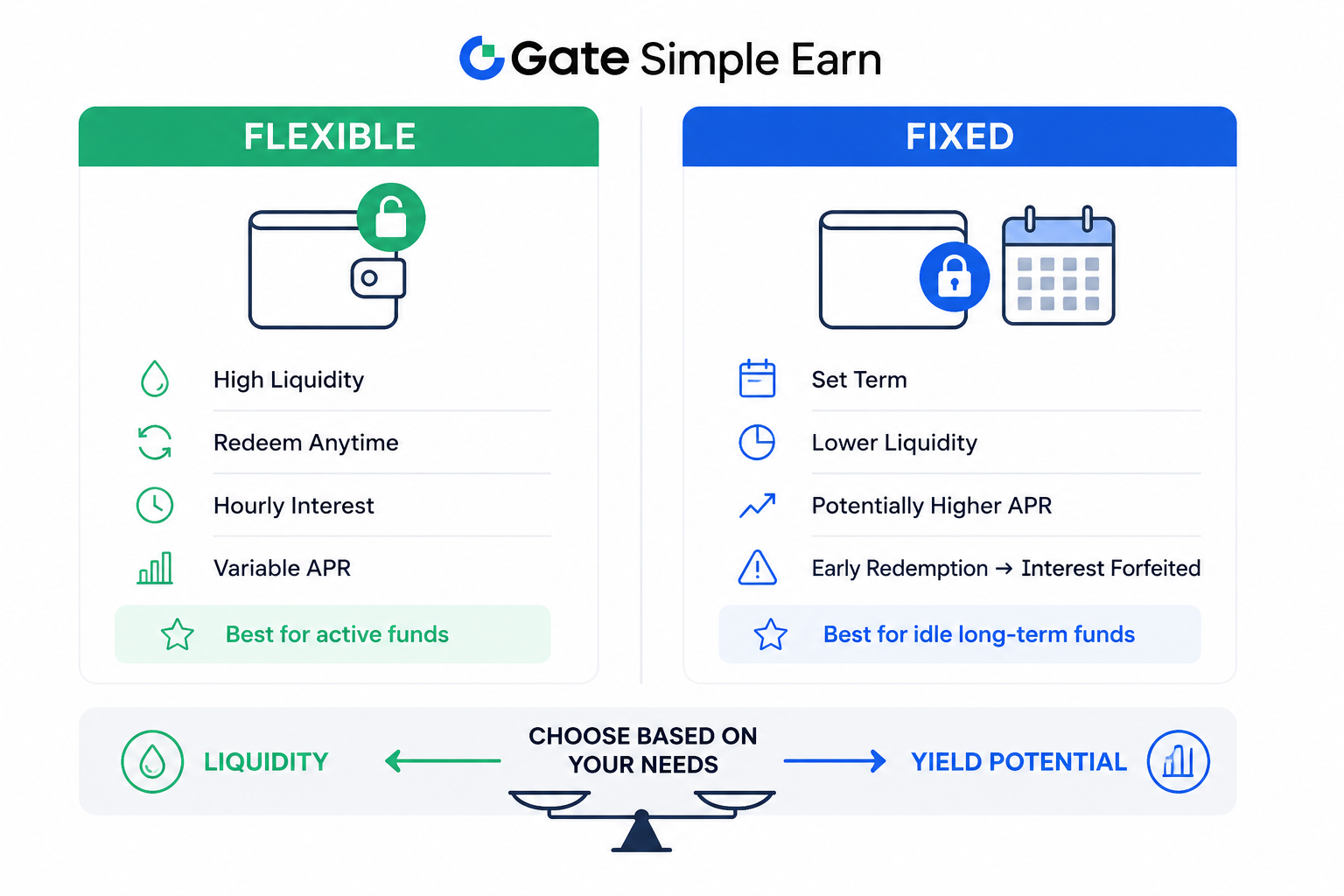
That distinction matters for anyone deciding what to do with idle funds. An active trader may value access more than an extra percentage point of estimated APR. A long-term holder who doesn't expect to trade or withdraw an asset soon may be more comfortable with a fixed period. Neither choice is automatically better, and the displayed Simple Earn APR can vary with the asset, product rules, market demand, term and promotional conditions.
The sections below compare liquidity, rewards, redemption, interest calculation, lock-up periods and risk, then show how different portions of a crypto portfolio can be matched to each option.
Key Takeaways
-
Simple Earn Flexible prioritizes liquidity. Assets can generally be redeemed in real time, although unusually heavy redemption demand may delay arrival.
-
Simple Earn Fixed prioritizes committed earning periods. Terms vary by product, and current Gate listings should be checked rather than assuming every asset uses a 1- or 3-month lock up.
-
Fixed doesn't necessarily mean a permanently fixed interest rate. Gate states that subscribed fixed-term APR may change daily, with final settlement determined at maturity.
-
Early redemption changes the economics. Gate Fixed permits early redemption in supported circumstances, but accrued interest is forfeited and principal may require 24–48 hours to return.
-
Choosing between Flexible and Fixed is mainly an allocation decision: how much liquidity do you need, and how long can the underlying assets remain unused?
What Is Gate Simple Earn?
Simple Earn is a Gate.com product for putting otherwise idle crypto assets to work rather than leaving them unused in an account. Gate currently separates products into Flexible and Fixed categories, with the available crypto assets, estimated APRs and terms displayed on the product page.
Gate describes Flexible subscriptions as working capital for its lending business. Funds can be matched with borrowers, and the resulting interest is distributed to subscribers as an annualized return. Flexible interest that is earned is automatically reinvested, creating compounding without requiring a new manual subscription each hour.
The broader concept is covered in Gate Simple Earn's beginner-friendly introduction, where Flexible and Fixed are presented as two ways of managing otherwise idle digital assets.
For current assets, terms and estimated rates, a user can check Gate Simple Earn before subscribing because product availability and APRs aren't static.
Flexible vs Fixed: Gate Simple Earn at a Glance
| Feature |
Simple Earn Flexible |
Simple Earn Fixed |
| Main objective |
Preserve access while earning interest |
Commit assets for a defined term |
| Liquidity |
High; real-time redemption is generally available |
Lower during the selected term |
| Interest timing |
Eligible interest can accrue hourly |
Starts accruing from 00:00 UTC on the day after subscription |
| Compounding |
Earned hourly interest is automatically reinvested |
Settlement occurs with principal at maturity |
| APR behavior |
Variable with borrowing demand and market conditions |
Can also vary daily after subscription |
| Early redemption |
Generally available |
Supported subject to product rules, but accrued interest is forfeited |
| Principal return |
Normally real time, subject to processing conditions |
Early redemption principal generally returns within 24–48 hours |
| Best fit |
Trading capital, liquidity reserves, uncertain holding periods |
Assets unlikely to be needed before maturity |
The important point is that Flexible vs Fixed isn't simply low rate versus high rate. It is a trade-off between access, earning mechanics and the consequences of changing your mind.
Flexible Savings, Auto Subscribe, and Passive Income
Simple Earn Flexible behaves more like flexible savings than a traditional locked product. If funds may be needed for trading, withdrawal to an external wallet, paying for another crypto service or responding to a sudden crypto market move, keeping full access can be more valuable than pursuing a potentially higher rate.
Gate calculates Flexible earnings through hourly loan matching. If an asset is borrowed at hour T, the associated interest is distributed at T+1. Redeeming before that hour finishes means the interest for that unfinished period isn't received. Earned hourly interest is then automatically invested again.
This is more precise than saying interest is simply calculated daily. Flexible rewards accrue according to Gate's hourly lending mechanism, although displayed APRs are annualized.
An Auto-Earn or auto subscribe approach can also reduce the amount of money sitting idle. Gate's Simple Earn course states that Auto-Earn can periodically subscribe eligible surplus balances from the user's spot or trading account into Flexible products.
That can suit experienced users as well as beginners, but automation doesn't remove asset risk or platform risk. A crypto savings balance still carries the price exposure of its underlying assets.
For users who want an even lighter-touch approach without moving assets into a separate lock-up product, Gate Soft Staking focuses on earning from eligible spot holdings while retaining liquidity. The Earn While Holding model addresses a similar question from the perspective of assets already sitting in a spot account.
Fixed Earn, Locked Products, and Interest Rates
Fixed Earn is aimed at funds that have a more predictable idle period. The user chooses an available term and commits the crypto for that period rather than prioritizing withdraw-anytime liquidity.
The term length isn't universally 1 to 3 months. Gate's current documentation describes fixed-term choices ranging from short terms to substantially longer periods, while actual availability varies depending on the asset and current product listing.
There is another subtle point: Fixed refers primarily to the term, not necessarily to an interest rate that can never change. Gate states that the APR for subscribed fixed products may change daily and that final interest is settled at maturity.
That makes statements such as “Flexible plans pay up to 5% APR” or “Fixed Earn always reaches 10% APR” too rigid for an evergreen comparison. Current rates can be below or above those numbers depending on the crypto asset, market borrowing demand, bonus campaigns, subscription tier and term. Gate listings have displayed materially different APRs across assets and products.
Higher returns shouldn't be evaluated without considering the lock up. If you unexpectedly need the funds, early redemption from a Fixed subscription forfeits all accrued interest. Principal is normally returned to the relevant account within 24–48 hours, and early redemption isn't supported during the final hour before maturity.
That is the real cost of giving up liquidity.
Gate Simple Earn Flexible vs Fixed: Which Should You Choose?
A practical way to decide is to start with when the money may be needed, rather than choosing whichever product currently shows the highest APR.
Suppose someone holds 10,000 USDT. They expect to keep 6,000 USDT untouched for the next month but may use the remaining 4,000 USDT if a trading opportunity appears.
Putting all 10,000 USDT into a fixed product could increase the opportunity for yield, but it also creates a liquidity constraint. Keeping everything Flexible avoids that constraint but may mean accepting a lower rate when suitable Fixed products pay more.
A mixed strategy may better match the financial situation:
-
4,000 USDT in Flexible for immediate access.
-
6,000 USDT in an appropriate Fixed term if it isn't expected to be needed before maturity.
This isn't a recommendation about those exact amounts. It illustrates why different portions of the same portfolio can serve different purposes.
Stablecoin holders comparing other ways of earning interest can also consider how lending, staking and other approaches differ in methods for earning USDT. For assets that participate directly in staking mechanisms, Gate staking represents a different mechanism from Simple Earn lending.
Binance Account, Binance Earn Products, Dual Investment, and Other Exchanges
Users familiar with a Binance account may recognize similar terminology in Binance Simple Earn, where Flexible Products and locked products also separate liquidity-focused earning from term-based earning. Binance Earn, Nexo and other exchanges can use different interest rates, settlement schedules, eligibility requirements and early-redemption rules.
Those similarities shouldn't be treated as interchangeable product rules. A Binance Earn product doesn't define how Gate Simple Earn works, and advertised rates from another platform aren't a reliable benchmark for the current Gate APR.
The same applies to geography. Product access for EEA users or users in another jurisdiction can vary with local rules and platform eligibility, so availability should be checked on the relevant account rather than assumed.
Dual Investment is even less comparable to ordinary flexible savings. It is a structured product whose settlement can depend on a target price and market outcome, creating a different risk-and-return profile. Simple Earn is therefore better compared with lending or crypto savings products than with structured products designed around potential gains from a future price scenario.
Risks Behind Passive Income and Higher Interest Rates
Earning interest doesn't remove cryptocurrency investments' underlying risks.
Asset risk: If the crypto asset falls sharply against fiat currency, earning additional units doesn't guarantee protection of the portfolio's fiat value. Principal protection in crypto terms, where applicable, shouldn't be confused with fiat-value protection.
Platform risk: Simple Earn operates through a centralized exchange rather than an external wallet under the user's direct custody. Security controls and robust security measures can reduce certain operational risks, but they can't make a centralized platform risk-free.
Rate risk: Current rates can change. Flexible APR depends partly on borrowing demand, while Gate also states that Fixed APR may vary daily. Market volatility can affect borrowing activity and earning rates.
Liquidity risk: Flexible has substantially greater liquidity, but large redemption volumes can delay processing. Fixed has stronger constraints, and early redemption sacrifices accrued interest.
Product-specific risks: Simple Earn, staking options and Dual Investment don't generate yield in the same way. Comparing only the displayed percentage can hide meaningful differences in settlement, liquidity and exposure.
Even a native utility token such as GT can have market-price risk independent of whatever yield is available. Users should conduct their own research into the asset, product rules, platform terms and their financial situation before allocating funds.
Conclusion
Gate Simple Earn Flexible is the stronger fit when access to funds comes first. It lets users withdraw anytime under normal conditions, compounds eligible hourly interest and keeps assets available for a changing trading or liquidity strategy.
Simple Earn Fixed makes more sense when the assets can remain committed for a known period and the available term and APR justify giving up some flexibility. The catch is early redemption: withdrawing before maturity can erase the interest already accrued.
For many portfolios, the decision doesn't have to be entirely Flexible or entirely Fixed. Separating idle funds into a liquid portion and a longer-term portion can align the earning strategy more closely with when those assets may actually be needed.
FAQ
Is Gate Simple Earn Flexible better than Fixed?
Neither is universally better. Flexible generally suits users who prioritize liquidity and may need their crypto for trading or withdrawals, while Fixed can suit funds that are expected to remain unused until maturity.
Does Simple Earn Fixed guarantee a fixed APR?
No. Gate states that the APR on subscribed Fixed products may change daily, with the final return determined when the product reaches maturity. Always check the current product rules rather than assuming “Fixed” means a permanently locked interest rate.
Can I withdraw Simple Earn Flexible anytime?
Gate supports real-time redemption for Flexible subscriptions. During periods with unusually high redemption requests, asset arrival can be delayed, with interest continuing to accrue while the request is processed.
What happens if I redeem Simple Earn Fixed early?
Gate states that early redemption forfeits all accrued interest. The principal normally returns to the Spot or Trading Account within 24–48 hours, and redemption isn't supported during the final hour before maturity.
Does Fixed Earn always pay more than Flexible Earn?
Not necessarily. Fixed products are often associated with higher potential rates, but the actual APR varies by asset, term, demand and promotional conditions. Compare current Flexible and Fixed listings for the same asset before deciding.
Is Simple Earn the same as staking?
No. Simple Earn Flexible primarily uses subscribed funds as working capital for Gate's lending business, whereas staking generally relates to participating in or earning rewards associated with blockchain staking mechanisms. Gate Soft Staking uses another model designed to let eligible spot holdings remain accessible while earning rewards.
Disclaimer: This content is for educational purposes only and does not constitute financial or investment advice. Crypto assets and yield products involve market, liquidity, counterparty and platform risks. APRs, supported assets, terms and product availability can change, and services may differ by jurisdiction. Conduct your own research and review the current product terms before making a decision.