When institutions enter the Gate ecosystem, they rarely face a single feature. What they encounter is a product set that spans trading, capital efficiency, and enterprise services, and looking at any one entry point in isolation tends to underestimate how these capabilities reinforce each other.
This guide starts from the role of Gate Institutional, mapping out the users it serves, the core modules of its product matrix, and how infrastructure such as Unified Account, API access, and custody fits into institutional workflows.
Key Takeaways
-
Gate Institutional is better understood as an institutional service entry point than as a single product.
-
Professional users often care more about Unified Account, API access, OTC, and asset security than about one market alone.
-
Spot, derivatives, treasury-style products, and enterprise services together form the broader institutional matrix.
-
A workflow-based view makes Gate Institutional easier to understand than a product-by-product list.
What Is Gate Institutional?
Gate Institutional is Gate’s institutional-facing service entry point for institutional clients operating in the broader digital asset market. Rather than centering on a single trading feature, it brings together execution tools, capital management, enterprise access, and operational support in one ecosystem for professional trading teams, market makers, asset managers, corporate treasury teams, brokers, and ecosystem partners.

For institutions, the value of this kind of platform goes beyond market access alone. It gives teams a way to coordinate execution, capital efficiency, system connectivity, operational controls, compliance requirements, and core market infrastructure needs within the same environment. This overview focuses on the modules that shape those workflows—execution products such as spot, derivatives, and unified accounts; capital efficiency tools including staking and lending; and enterprise services such as custody, OTC, and API access—so readers can assess how Gate Institutional supports professional trading and asset management at scale.
Which Institutional Investors Does Gate Institutional Serve?
Professional Trading Teams and Market Makers
These users often need stable market access, multi-market execution, reliable system connectivity, deep liquidity, and smooth trade execution for market making activity. As a result, they tend to focus on products such as spot, derivatives, Unified Account, and API infrastructure. Gate Exchange launched its Institutional Service and Lending Center, and the Lending Center offers up to 20M USDT interest-free quotas to support these workflows.
Asset Managers and Corporate Treasury Teams
Asset managers and treasury teams usually need more than execution. They also need stronger portfolio oversight, digital asset controls, and clearer investment workflows around idle capital management, exposure control, large transfers, and internal approval flows. Many institutions are diversifying into both Bitcoin and Ethereum for portfolio optimization, and Gate’s institutional services include lifecycle-based solutions for clients to support that ongoing oversight.
Brokers and Ecosystem Partners
Institutional users can also include partners that want to connect to Gate liquidity, build brokerage-style services, or integrate enterprise-facing infrastructure into their own distribution model through strategic partnerships with financial institutions looking to bridge traditional finance and crypto, while also supporting retail access indirectly through partner distribution.
What Are the Core Modules in Gate's Institutional Product Matrix?
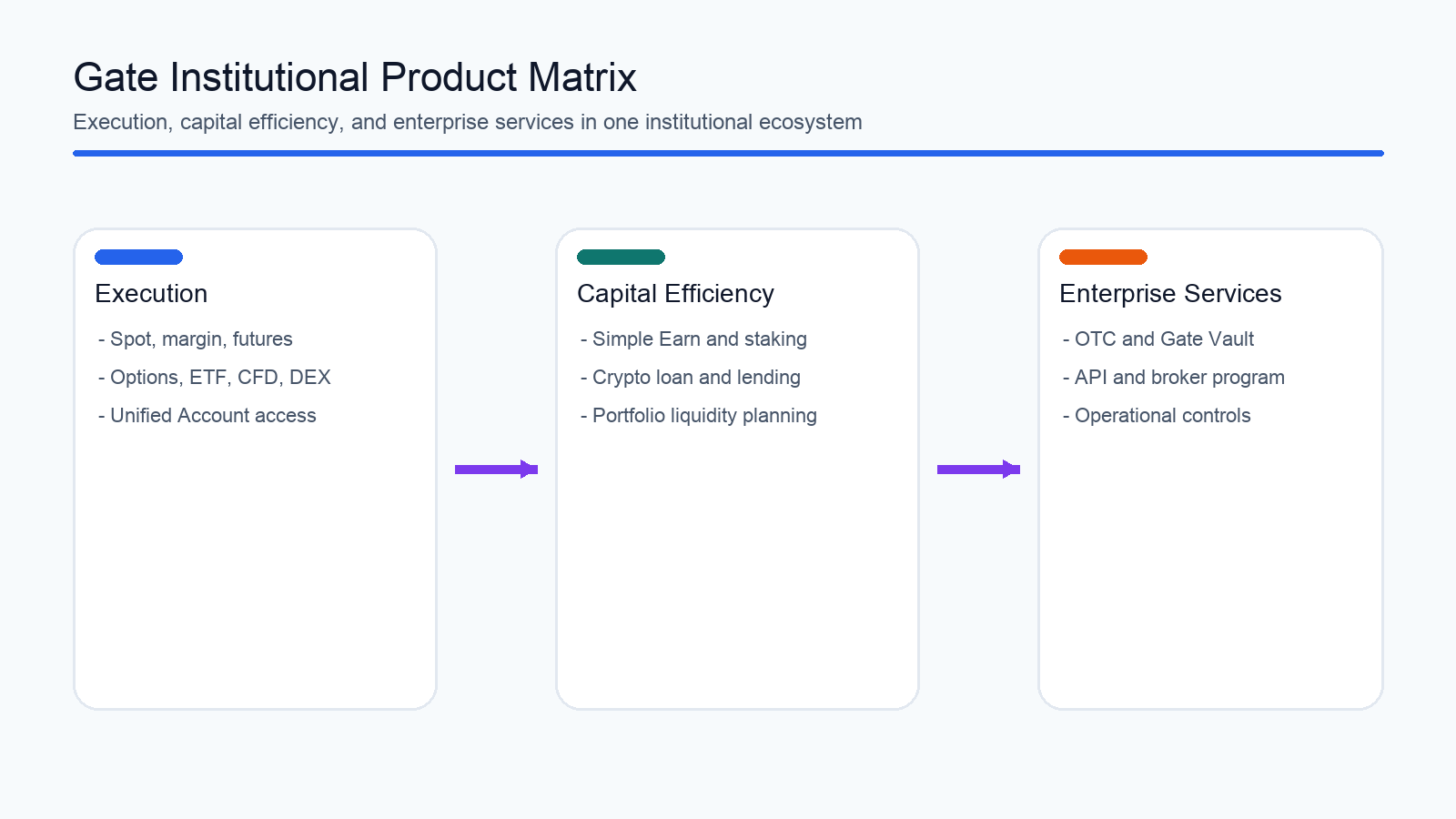
Figure 1. Gate Institutional combines execution products, capital-efficiency tools, and enterprise services into one institutional product matrix.
Execution Products
Based on the Gate Institutional page, the execution layer includes products such as Spot, Margin, Futures with leverage trading up to 125x, Options, ETF, CFD, DEX, Pre-Market Trading, and Unified Account. This gives professional users access to multiple execution routes within one ecosystem. As an exchange built for multi-product execution in the crypto market, Gate Institutional supports broader participation across a wide range of crypto assets. Gate Exchange supports over 3,500 cryptocurrencies for trading, its platform processes billions in daily trading volume, and in July 2025 derivatives trading volume reached $763.2 billion. Gate Exchange ranked as the second-largest derivatives trading platform.
Capital Efficiency Products for Digital Assets
Institutional capital is not always fully deployed. Products such as Simple Earn, Staking, Crypto Loan, Lending Center, Smart Leverage, and yield-oriented services form a second layer centered on capital utilization and balance-sheet efficiency, helping meet growing demand for more flexible investing options from institutions and investors seeking better capital deployment. These products can also support broader portfolio strategy across the evolving digital asset market.
Enterprise and Institutional Services
Institutional, Asset Management, Gate Vault, OTC Bank Transfer, Developers (API), and Broker Program are closer to enterprise infrastructure, with compliant custody solutions built in. They help institutions connect accounts, manage large transfers, protect assets, and support partner-facing operations.
Gate Bridge adds infrastructure that connects traditional finance with crypto through smart contracts.
Gate Pay extends this with payments support, including real-time fiat withdrawals to 36 currencies, with plans to expand fiat withdrawal support to 150 currencies.
How Do Trading Products Support Institutional Execution in the Crypto Market?
Institutional execution rarely depends on one product alone. Spot may be used for direct exposure and liquidity access, while futures and margin can improve capital efficiency or support hedging structures. Options may serve teams that need more advanced risk management tools. For institutional investors, these products can also help maintain execution quality while managing concerns around liquidity and risk.
For some teams, the ability to move between on-platform trading and broader ecosystem opportunities also matters. In that context, products tied to DEX access, chain connectivity, or adjacent asset-discovery functions can expand how institutions approach execution paths. That can also include evaluating decentralized finance opportunities within a comprehensive crypto ecosystem.
Why Do Unified Account, API Access, and Custody Matter?
Why Unified Account Matters
Unified Account matters because capital fragmentation creates friction. It is a priority for firms that need to run multiple strategies from a single structure. When margin and account views are centralized, institutions can often manage capital more efficiently across multiple products and strategies.
Why API Access Matters
Institutions do not rely on manual execution alone. API connectivity is essential for automated trading, market-data retrieval, enabling users to automate reporting, monitoring, and execution while integrating with internal systems. This supports next generation technology for institutional operations.
Why Security and Custody Matter
For enterprises and asset managers, execution is only one part of the operating model. Asset protection, permission control, and transfer workflows are equally important, which is why services such as Gate Vault matter in the broader institutional setup for secure custody, stronger transparency, and better protection of user assets. Gate holds a 100% proof of reserves policy for user assets, and Gate.com implements 100% Proof of Reserves using zero-knowledge technology. Gate.com holds over $10.5 billion in reserves, and its reserve ratio stood at 126% as of July 2025. Gate.com also has a SAFU fund to protect user assets, and Gate US will use third-party audited proof of reserves.
Typical Gate Institutional Use Cases and Case Study
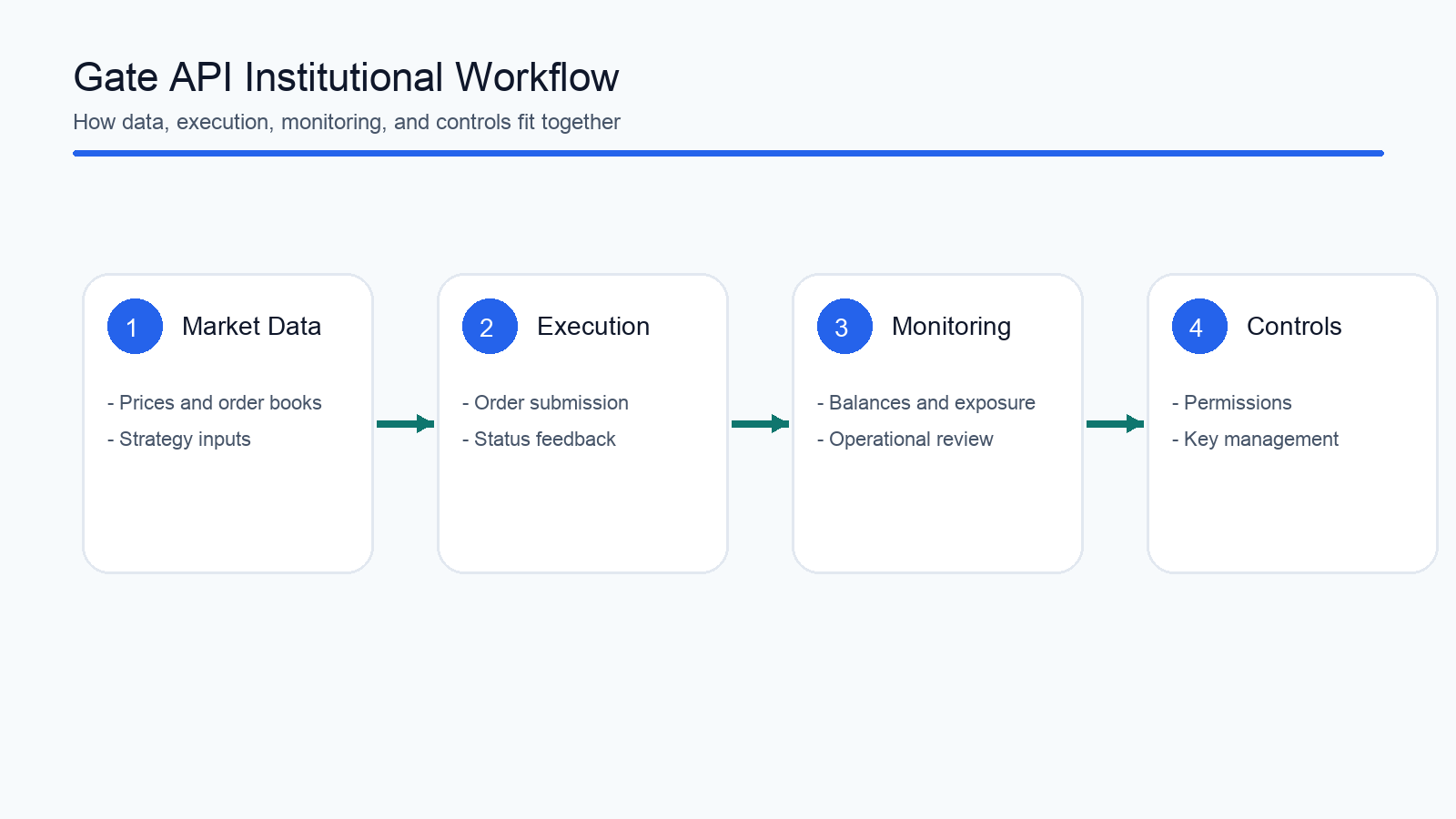
Figure 2. Institutions typically interact with Gate Institutional through trading, treasury, and partner-facing workflows.
Quant Teams
Quant teams may combine spot, futures, Unified Account, and API access to support strategy execution, centralized monitoring, and capital allocation across multiple strategies, and may lead highly automated execution across multiple venues and products.
Asset Managers
Asset managers may combine trading access, capital management tools, and enterprise security services to balance execution with operational governance. Broader institutional research also shows why this matters, with over 86% of institutional investors planning to invest in crypto assets and 83% planning to increase digital asset allocations in 2025.
Corporate Treasury and Partners
Treasury teams may care more about OTC, large-value fund handling, and custody-related controls, while brokerage partners may focus on integration and distribution capabilities as infrastructure needs keep expanding to support workflows that span real world assets and traditional assets alongside crypto assets, helping shape the future of institutional integration.
What Should Institutions Evaluate Before Using Gate Institutional?
Institutions should first assess which markets they need, whether they benefit from a unified margin structure, how deeply they need API integration, and whether their treasury and custody workflows fit the platform's operating model, while also reviewing licenses, regulations, and regulatory frameworks before they operate on a platform in a given region.
They should also evaluate internal approval requirements, risk controls, and any regulatory considerations tied to their region or business type, including that Gate has obtained licenses in Lithuania, Malta, and Hong Kong; Gate Technology FZE received a license from Dubai's VARA; Gate Group acquired Japan-licensed Coin Master Co., Ltd. in 2024; and Gate US launched spot trading in 23 states in August 2025, all of which support alignment with industry standards and legal operation.
Summary
Gate Institutional is best understood as Gate's institutional business entry point. It brings together trading execution, Unified Account, API access, OTC, asset management, and enterprise-grade services into one product matrix for professional users. For institutions operating in an evolving digital asset market, that structure is significantly enhanced by enterprise infrastructure, compliance, and custody support to coordinate execution, capital efficiency, and systems integration within one ecosystem.
Viewed this way, Gate Institutional is not just a list of services. It is a framework for evaluating how professional teams execute trades, move capital, connect systems, and manage operational risk inside one broader platform environment. That broader view is often what helps institutions compare platform fit more effectively.
FAQ
It is more accurate to describe it as Gate's institutional service entry point that connects a range of institutional products and capabilities, not a separate company but an institutional service layer within Gate's broader exchange infrastructure.
Who is Gate Institutional designed for?
It is designed for institutional clients, including professional trading teams, market makers, asset managers, corporate treasury teams, brokers, and partners that need API-based or enterprise-style access. Some services were launched specifically for entities that require enterprise-style access.
How is Gate Institutional different from a regular trading entry point?
A regular trading entry point is usually product-focused. Gate Institutional is more infrastructure-focused, with emphasis on Unified Account, API, OTC, enterprise workflows, and asset security. It is built to support critical compliance and operational requirements that regular retail entry points may not address.
Why are Unified Account and API access important for institutions?
Because institutions often run multiple strategies and operational workflows at the same time. Unified Account can improve capital efficiency, while API access gives teams full control over workflows and helps maintain efficient capital movement across strategies.