Gate Event Contracts are short-cycle products built around price direction. A trader predicts whether the underlying price will rise or fall over a period such as 5 or 15 minutes, chooses Up or Down, enters an amount, and submits the order. The price benchmark decides which price series is displayed and which price settles the contract. The choice matters: two markets can share an asset and period yet settle differently. For readers comparing event contracts with prediction markets and their mechanisms, the question is not only direction, but which benchmark defines the outcome.
Gate lists two benchmarks: INDEX (contract index price) and TWAP (time weighted average price). The INDEX market is the newer addition; the TWAP market remains available. The platform also introduced one-click trading, which shortens the order-entry path but does not change the contract's economics. The launch is listed on the Event Contracts campaign page.
Key Takeaways
-
The INDEX market uses the Gate Contract Index Price for display and settlement; the TWAP market uses a Chainlink-supplied time-weighted average price.
-
INDEX and TWAP are independent markets, each with its own order book, quotes, orders, positions, and settlement results.
-
The Gate Contract Index Price is a weighted average of selected price sources, calculated every second; BTC_USDT and ETH_USDT apply tighter 0.5% correction and 1.5% exclusion thresholds.
-
One-click trading offers preset 5, 20, and 100 USDT cards plus a custom amount; clicking a card opens a position immediately.
What Is the Gate Event Contracts INDEX Market?
Event contracts are trading products built around price-direction judgments. A trader predicts whether the underlying price will rise or fall over a short period, such as 5 or 15 minutes, chooses Up or Down, enters an amount, and submits the order. A correct prediction settles at 1 USDT per contract; an incorrect prediction expires worthless, with the maximum loss limited to the amount paid to open the position.
The INDEX market is one of two price-benchmark markets on Gate Event Contracts. It uses the Gate Contract Index Price as the basis for displaying and settling the underlying price; that index is Gate's futures index price, also used across Gate's futures contracts. The TWAP market continues to use the existing time weighted average price for settlement and remains available. The structure differs from perpetual futures contracts: there is no leverage and no forced liquidation, and each contract has a fixed short cycle.
The two markets run independently: the same asset and period can have different target, reference, and settlement prices. Users can choose the benchmark they prefer rather than being forced into a single price convention. Contract prices also reflect the market's implied probability, which can offer real-time sentiment feedback as trading changes.
| Market |
Price source |
Display and settlement basis |
| INDEX (contract index) |
Gate Contract Index Price |
Gate Contract Index Price |
| TWAP (time-weighted) |
Time-weighted average price supplied by Chainlink |
Chainlink time-weighted average price |
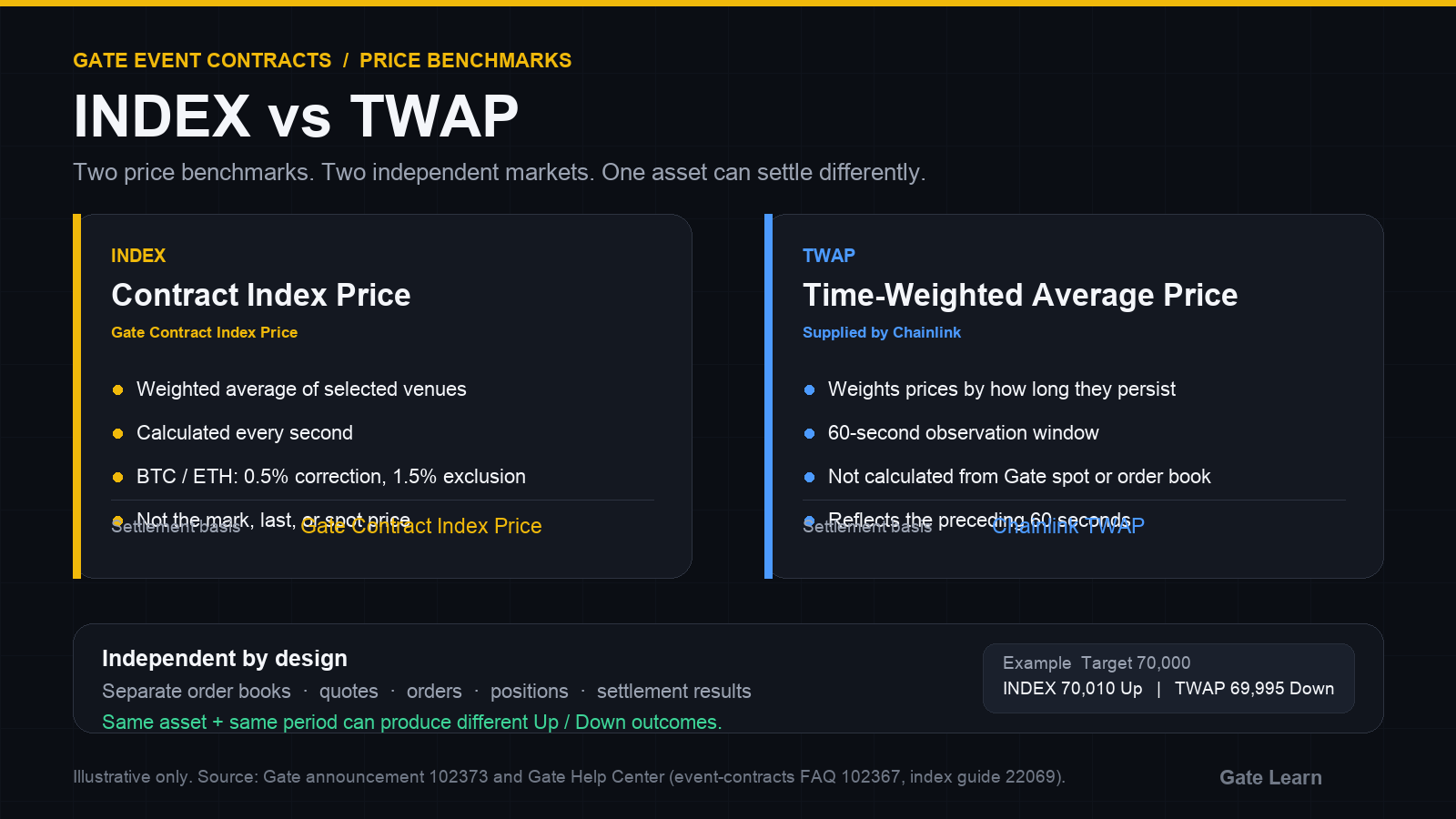
Figure 1. INDEX vs TWAP: price source and settlement.
The table separates the two markets by price source and settlement basis. The distinction is structural, not a display setting: each market has its own order book and settlement result.
INDEX currently covers BTC and ETH contracts with 5-minute and 15-minute periods. The tradable range shown on the market page is the final reference. On the market page, the title or benchmark label shows either INDEX / Contract Index or TWAP / Time-Weighted Average Price.
How Is the Gate Contract Index Price Calculated?
The Gate Contract Index Price is a weighted average of selected price sources, but unlike Volume Weighted Average Price it is not weighted by trading volume during the period. It is designed to reflect the composite market price of the underlying asset, built from quotes across several venues rather than one exchange's last trade. The index is calculated every second, and components and weights are configured per trading pair.
The component list includes, but is not limited to, Gate, Binance, OKX, Bybit, Bitget, Coinbase, KuCoin, MEXC, Gate Alpha, and PancakeSwap. The collected quotes may include spot USDT and USD prices from those venues. Gate selects components for each pair and may adjust weights from time to time; the current components and weights are shown on the index information page.
The formula is a weighted sum:
Index price = price of component A × weight of A + price of component B × weight of B + … + price of component N × weight of N, with the weighted sum reflecting each source's total value contribution according to its assigned weight.
By contrast, VWAP calculated over a period multiplies each traded price by the size traded at that price, then divides the total by the volume traded.
A worked example from Gate's index guide uses BTCUSDT with five components at 20% each.
| Component |
Price (USDT) |
Weight |
| Gate |
100,000 |
20% |
| Binance |
100,100 |
20% |
| OKX |
100,200 |
20% |
| Bitget |
100,100 |
20% |
| Bybit |
99,900 |
20% |
The resulting index price is 100,060 USDT: 100,000×20% + 100,100×20% + 100,200×20% + 100,100×20% + 99,900×20%. The example shows how small differences across venues combine into one composite value rather than a single venue's last trade.
How Does the Index Handle a Bad Quote?
Gate applies price protection before the index is used. When there are at least three components, a component whose price deviates from the median of all sources by more than 8% is removed until it returns within 8% of the median. A deviation between 2% and 8% is capped at 98% or 102% of the median, depending on whether the quote is too high or too low. If a component's price is unavailable for 20 consecutive seconds, its weight is temporarily set to zero until the quote returns.
BTC_USDT and ETH_USDT use tighter thresholds: a 0.5% correction threshold and a 1.5% exclusion threshold. Major altcoin pairs and traditional-financial-asset markets use 1% and 3%. The default protection, which applies when at least three components are available and no pair-specific threshold is set, corrects deviations between 2% and 8% and excludes a quote that moves beyond 8%.
| Market |
Correction threshold |
Exclusion threshold |
| BTC_USDT, ETH_USDT |
0.5% |
1.5% |
| SOL_USDT, DOGE_USDT, XRP_USDT, BNB_USDT, ADA_USDT, SUI_USDT, LINK_USDT, LTC_USDT |
1% |
3% |
| XAU_USDT, CL_USDT, and other traditional financial markets |
1% |
3% |
| Default protection when components ≥ 3 |
2% |
8% |
The protection mechanism reduces the influence of a single abnormal quote and the risk of market manipulation from one venue, but it does not remove market risk: the index can still move quickly, and settlement uses the value the methodology produces at the relevant time.
When checking an INDEX market, use the contract index price for the relevant asset. The latest contract price, mark price, and latest spot price use different pricing methods, and using the wrong series can affect your reading of the relevant benchmark.
INDEX vs Time Weighted Average Price (TWAP): What's the Difference?
The two benchmarks differ in where the price comes from, what the price represents, and how it is calculated. The table below follows Gate's own comparison.
| Comparison item |
INDEX (contract index) |
TWAP (time-weighted average price) |
| Price source |
Gate Contract Index Price |
Time-weighted average price supplied by Chainlink |
| What the price represents |
A market price level calculated from multiple price sources |
The average price level over the specified observation window |
| Calculation |
Weighted average of selected sources, calculated every second |
Weighted by how long each price persists during the observation window over a defined period |
| Observation window |
Not a 60-second window; the index is calculated every second |
60 seconds; each value reflects the preceding 60-second window |
| Display and settlement basis |
Gate Contract Index Price |
Chainlink time-weighted average price |
| Market structure |
Independent order book, quotes, orders, positions, and settlement |
Independent order book, quotes, orders, positions, and settlement |
TWAP is calculated by weighting prices according to how long they persist during an observation window. Each TWAP value therefore describes the average price level across that window rather than the latest trade, which reduces the effect of short-lived price fluctuations on the result. Gate's TWAP markets use time-weighted prices calculated and supplied by Chainlink. Those prices are not independently calculated by Gate from the platform's spot trades or event-contract order book quotes.
All current TWAP-related markets use a 60-second observation window. If the settlement time is a specific time such as 12:00:00, the displayed settlement price is the weighted average of prices over the preceding 60-second specified time period. Each value of the time weighted average price covers a 60-second window with a defined start time and end time, so it describes that window rather than the price at the moment settlement occurs.
The independence matters. The two markets have their own order book, quotes, orders, positions, and settlement results. Even for the same asset and period, the Up or Down contract prices can differ. Treating the two markets as one order book misreads both liquidity and settlement. Because TWAP averages prices over time, short-lived spikes have less impact on the result; VWAP instead weights each price by trading volume. Neither method removes market risk, and in low-liquidity conditions a benchmark can still be sensitive to a thin order book.
How to Read INDEX and TWAP Prices Before Trading
The index price data, its components, and their weights are published on the Index Information page for each contract. TWAP values are calculated and provided by Chainlink, not by Gate based on spot trades or Event Contract order book quotes. Before an order is filled, confirm the benchmark label, the asset, and the period on the market page. A higher contract price implies a higher probability, and a lower price a lower one. The tradable range is limited to the markets shown on the page, and Gate may adjust index components or weights without prior notice.
Why Can the Same Asset and Specified Time Period Produce Different Results?
Because the price sources and calculation methods differ, different calculation methods can produce different price movements over the same short event window, which changes the final value used for settlement. Gate's own example uses two BTC markets with a target price of 70,000.
| Market |
Target price |
Final settlement price |
Result |
| INDEX |
70,000 |
70,010 |
Up |
| TWAP |
70,000 |
69,995 |
Down |
In live trading, the two markets may also have different target prices, and each market settles independently under its own rules. A trader cannot infer the INDEX result from the TWAP chart, or the reverse.
What to Check Before Switching Between INDEX and TWAP
Switching the price benchmark takes the trader to a different, independent market and changes the trading strategy context because each benchmark reflects a different pricing method. Four checks follow directly from that structure.
-
Existing orders and positions stay in the market where they were opened. Switching does not change their market or their settlement basis.
-
Each market has its own order book and quotes, so the same asset and period can show different Up or Down prices.
-
The market title or benchmark label must show INDEX / Contract Index or TWAP / Time-Weighted Average Price before an order is placed.
-
The asset, period, and current reference price should be checked within the selected benchmark over the relevant specific period, not against a chart from the other market.
The path is Gate App or website → Contracts → Event Contracts → select asset, period, and price benchmark → review the market rules.
What Is One-Click Trading and How Does It Work?
Gate introduced one-click trading alongside the INDEX market. The feature simplifies order placement and supports low-latency trading. Users can choose a preset 5, 20, or 100 USDT quick-trade card or enter a custom amount; clicking a card opens a position immediately.
In practice, the flow is: select the asset, period, and price benchmark; choose Up or Down; buy or sell the directional contract; select a preset card or enter a custom amount; click the card to open the position. The execution path is shorter, which matters in a 5-minute or 15-minute market where the window is short. You can close a position before the event ends, but an unfilled order must be filled or cancelled first.
One-click trading is an order-entry feature, not a separate market or trading strategy. It does not change the selected market's price benchmark or settlement rules, and available ranges and interface details appear on the platform.
The main risk is that a click opens a position. Confirm direction, amount, and benchmark label before the click; a mistaken click opens the position and can increase losses. A shorter path reduces friction, not the chance of a wrong call.
Risks to Know Before Trading INDEX Markets, One-Click Trading, and Choosing a Trading Strategy
Event contracts are high-risk innovative trading products within financial markets, and prices can fluctuate significantly. Several structural boundaries matter for risk assessment before an order is placed.
Event-contract share prices range from 0.01 to 0.99 USDT, with 0.01 USDT price precision and order step. The price corresponds to the market's implied probability of the outcome, and market participants use it to express a directional view. The product has no leverage, no margin calls, and no forced liquidation. The maximum loss is the margin occupied at opening, and the order quantity sets the position size; the maximum payout for a correct position is the number of shares × 1.00 USDT, before the trading fees charged on the matching trades. Settlement itself carries no fee; opening and closing matching trades do, at rates published by the platform. At expiration, settlement is automatic.
For INDEX markets, three security and risk points matter:
-
Benchmark risk. The INDEX and TWAP markets can produce different results for the same asset and period. A position is settled by the benchmark of the market where it was opened.
-
Price-series risk. The contract index price is not the latest contract price, the mark price, or the latest spot price. Using the wrong series to judge a position can lead to a wrong conclusion.
-
Switching risk. Switching the benchmark does not move an existing position to the new market. The position keeps its original market and settlement basis.
One-click trading adds speed, not protection: directional risk, settlement risk, and the chance of losing the entire margin on a wrong call remain. Product availability, identity verification, and regional restrictions follow the platform's rules.
Summary
Gate Event Contracts offer two price-benchmark markets: INDEX, which uses the Gate Contract Index Price for display and settlement, and TWAP, which uses a Chainlink-supplied time weighted average price over a 60-second window. The two are independent markets with separate order books, quotes, orders, positions, and settlement results, so the same asset and period can produce different outcomes. Before trading, confirm the benchmark label and the price series; before switching, confirm which market an existing position belongs to. One-click trading shortens entry with 5, 20, and 100 USDT cards or a custom amount, but it does not change the contract's economics or risk.
FAQ
What is the difference between the INDEX and TWAP markets on Gate Event Contracts?
INDEX uses the Gate Contract Index Price for display and settlement. TWAP uses the time weighted average price supplied by Chainlink over a 60-second observation window. They are independent markets with separate order books, quotes, orders, positions, and settlement results.
Is the contract index price the same as the market price, mark price, or the latest spot price?
Not necessarily. The latest contract price, mark price, and latest spot price use different pricing methods and may differ from the index price. For an INDEX market, the contract index price is the relevant series for display and settlement.
Does switching from INDEX to TWAP change my existing position?
No. Switching the price benchmark takes you to a different market, but existing orders and positions stay in the market where they were opened, and their settlement basis does not change.
What amounts does one-click trading support?
One-click trading offers preset 5, 20, and 100 USDT quick-trade cards and also supports a custom amount. Clicking a card opens a position immediately. The available range and interface are shown on the platform.
Why can the same asset and period settle differently in the two markets?
The two markets use different price sources and calculation methods over the same time period, so the final value used to decide Up or Down can differ. Gate's example shows a target price of 70,000 producing 70,010 (Up) in INDEX and 69,995 (Down) in TWAP. Each market settles independently.