Using Gate Soft Staking is straightforward: activate the feature on Gate.com, hold an eligible asset in the designated account, and meet the minimum holding requirement. The system then calculates rewards based on your eligible average daily holdings and the applicable APR, with qualifying rewards automatically distributed daily to the Spot Account—without locking the asset.
For sophisticated retail crypto traders and investors who want passive income without giving up liquidity, this makes Gate Soft Staking a flexible alternative to traditional on-chain staking. Users do not need to select validators or move assets into a fixed lock-up product, and eligible holdings can usually remain available for trading or withdrawal, though balance changes can reduce the average eligible amount and the rewards earned.
Gate Soft Staking also extends beyond standard Spot holdings. Depending on the product, rewards may be calculated from assets held in Spot, Futures, CFD, or Stock accounts, and some TradFi and promotional products use tiered APRs or campaign-specific reward structures. This guide explains how to activate and use Gate Soft Staking, how eligibility and reward calculations work, how supported asset types and account rules differ, how to choose between products, and which common issues to check before participating.
Key Takeaways
Users need to activate Gate Soft Staking before eligible holdings can participate in the reward mechanism.
Eligible assets do not need to be transferred into a traditional fixed-term lock-up and generally remain available for trading or withdrawal.
The basic reward formula is: Daily Reward = Average Soft Staking Holding × APR ÷ 365.
Different assets can use different eligible accounts. BTC, ETH, and SOL products may use Spot holdings, while certain USDT products may use Futures holdings.
Each product may have its own minimum holding and Staking Cap. Not every amount held necessarily qualifies for the displayed APR.
TradFi and promotional products may use tiered APRs, different reward assets, and separate snapshot-account requirements.
What Do You Need Before Using Gate Soft Staking?
Before getting started, users need a Gate account and an eligible asset currently supported by Soft Staking. You must also complete identity verification before you can enable staking features. Check the Soft Staking page for the current list of supported tokens and yields. Supported assets can include USDT, BTC, ETH, SOL, POL, SUI, GT, DOT, ATOM, AVAX, NEAR, ADA, TIA, XTZ, STRK, and other eligible tokens. The available asset list and APRs can change as products are updated.
Next, check whether your holdings meet the minimum requirement. Simply having a small amount of an eligible asset in your account does not necessarily mean it will generate rewards. Each product may specify both a Min Holding and a Staking Cap. For example, current product information may require at least 0.001 BTC for BTC, 0.03 ETH for ETH, 1 SOL for SOL, or 100 SUI for SUI.
The third requirement is the account in which the asset is held. Different Soft Staking products can use different accounts to determine eligible holdings. Some crypto products use the Spot Account, while certain USDT products may use the Futures Account. TradFi products may instead calculate eligibility from CFD or Stock Account holdings.
Before participating, pay particular attention to these fields in the table:
Field
What It Means
Min Holding
Minimum eligible balance required to earn rewards
Staking Cap
Maximum eligible amount covered by the product
Est. APR
Current estimated annualized reward rate
Type / Snapshot Account
Account used to determine eligible holdings
How to Activate Gate Soft Staking
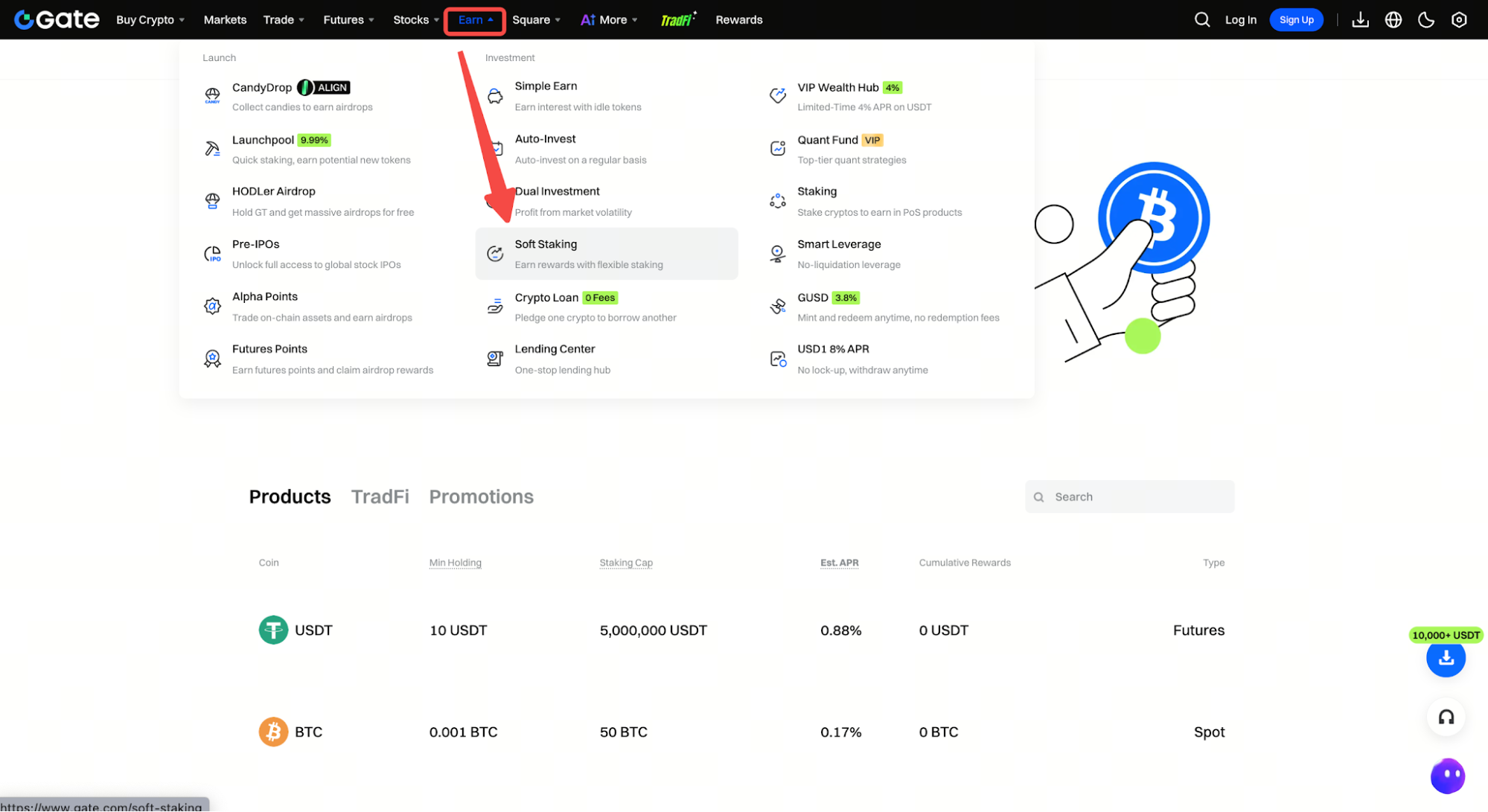
After logging in to Gate, navigate to the Earn section and open the Soft Staking page. Select Activate to enable Soft Staking.
Once activated, the system can automatically check eligible holdings in the designated accounts. If an asset meets the minimum holding requirement and other applicable product conditions, it can be included in the reward calculation.
Unlike fixed-term staking products, users do not need to deposit BTC, ETH, or other supported assets into a separate locked account to stake through the exchange. This makes the participation process considerably simpler than traditional staking workflows that require users to delegate assets or commit them for a specific period.
However, “no lock-up” does not mean that the location of the asset is irrelevant. If a product uses Spot holdings but the user's assets are held entirely in another account, those holdings may not qualify under that product's rules. This setup is more convenient because users do not have to wait for a lock-up period to end.
How to Choose an Eligible Soft Staking Product
On the Soft Staking product page, users can review products based on the assets they already hold. Rather than choosing a token solely because it displays a higher APR, it is generally more useful to first determine whether an existing holding is eligible.
The product list typically displays information such as the asset, minimum holding, Staking Cap, estimated yields, cumulative rewards, and account type.
Current product information provides examples such as:
Asset
Example Min Holding
Example Staking Cap
Account Type
Example Est. APR
USDT
10 USDT
5,000,000 USDT
Futures
0.88%
BTC
0.001 BTC
50 BTC
Spot
0.17%
ETH
0.03 ETH
1,500 ETH
Spot
0.85%
SOL
1 SOL
20,000 SOL
Spot
2.55%
POL
500 POL
300,000 POL
Spot
1.32%
SUI
100 SUI
50,000 SUI
Spot
0.23%
Some Soft Staking or promotional offers can reach up to 8% APR, including up to 8% APR on USD1, though rates are subject to change. These figures illustrate how the products are structured and show the practical value of comparing product details before selecting an option. Supported assets, APRs, minimum holdings, and Staking Caps may change, so users should refer to the current Soft Staking page when participating.
APR should also not be the only factor when choosing a product. For example, a SOL product may display a higher estimated APR than BTC, but SOL and BTC are different underlying assets with different market risks. Soft Staking can fit a broader investment approach, so users should do their own research before participating. Additional research helps users decide whether a product matches their goals, and Soft Staking is more appropriately viewed as a way to improve the utilization of assets users already intend to hold rather than simply a way to pursue the highest displayed APR.
How Are Gate Soft Staking Daily Staking Rewards Calculated?
Gate Soft Staking calculates rewards using eligible average holdings and the applicable APR. The basic formula is:
Daily snapshots of eligible balances start at 8:00 a.m. UTC, and daily reward calculations begin from 08:00 UTC the following day.
Suppose an eligible USDT product has an APR of 1%, and a user's daily average balance for that day is 10,000 USDT. Assuming the entire principal falls within the reward-eligible limit:
10,000 × 1% ÷ 365 ≈ 0.274 USDT
The theoretical daily reward would therefore be approximately 0.274 USDT. Tracking daily average balances is important for monitoring reward performance. This shows how interest is determined for flexible holdings, with compounding depending on the product's reward handling.
Actual calculations also need to account for the minimum holding and Staking Cap. If a product only allows up to 50 BTC to qualify for rewards, a user holding more than 50 BTC should not assume that the entire balance will earn the displayed APR.
Some TradFi products also use tiered APRs. In these cases, the applicable rate depends on the holding tier, so users should follow the specific tier rules instead of multiplying their entire balance by the maximum APR shown on the page.
How to Check Gate Soft Staking Rewards
After Soft Staking is activated, users can view the Cumulative Rewards for eligible assets on the product page and review relevant earning records in their account.
Soft Staking rewards are handled automatically. Users do not need to manually claim their rewards every day. Under the applicable product rules, rewards are distributed daily after activation, typically starting two days later, and payouts are typically paid based on the average eligible holding.
If distributed rewards remain in an eligible account and meet the corresponding product requirements, they are credited to the Spot Account automatically and may also become part of subsequent eligible holdings, depending on the product rules.
If you hold a supported asset but do not see the expected rewards, first check three things: whether Soft Staking has been activated, whether the asset is in the account specified by the product, and whether the average eligible holding meets the minimum requirement.
Can You Still Earn Rewards After Trading or Withdrawing?
Gate Soft Staking allows eligible assets to remain available for trading and withdrawals with full flexibility and liquidity rather than requiring a fixed lock-up.
However, trading or withdrawing assets changes the balance used to calculate rewards.
For example, suppose a user starts the day with 10 ETH and decides to sell 5 ETH later that day. Users can still access their tokens anytime, but the reward calculation is not simply based on the fact that the account held 10 ETH at one point. The system calculates rewards according to the applicable average eligible holding rules.
Moving an asset from an eligible account to another account can also affect its eligibility. This is particularly important because Spot, Futures, CFD, and Stock products can use different Snapshot Accounts.
The “flexible” aspect of Soft Staking therefore means that assets are not subject to a traditional fixed lock-up. It does not mean that trading, withdrawing, or transferring assets has no effect on rewards. Note that selling or withdrawing during the calculation period can reduce rewards. This lets users realize profits or cut exposure without waiting for a lock-up to end, though reward calculations will reflect those balance changes.
How to Use TradFi and Promotional Soft Staking Products
In addition to standard crypto products, the Soft Staking page can include TradFi and Promotions offerings. The basic participation logic remains similar—users need to meet the required holding conditions in the designated account—but the reward asset, snapshot account, and APR structure can differ.
For example, certain TradFi products allow users to hold USDX in a CFD Account and receive USDT rewards. Current product information shows a tiered APR structure:
USDX Holding Range
Example APR
1K–10K
1.80%
10K–100K
2.10%
100K–500K
2.40%
500K–1M
2.70%
Above 1M
3.00%
USD holdings in a Stock Account can use a similar structure, with eligible holdings generating USDT rewards according to the applicable tier.
The important point is that “3.00% Max” does not mean every USD or USDX holding automatically earns 3%. The applicable APR depends on the relevant holding tier and product rules.
Promotional products work somewhat differently because they are tied to specific campaigns. For example, a USD1 promotion may use holdings across the Spot Account and Futures Account to determine eligibility and distribute WLFI as the reward asset. A USDG promotion may instead use Spot Account holdings and distribute rewards in USDG.
Promotional APRs can be substantially different from regular Soft Staking rates, but they may also have specific campaign periods, holding limits, snapshot requirements, and reward conditions. A promotional APR should therefore not be interpreted as the long-term standard return for Gate Soft Staking.
What Common Issues Should You Check When Using Gate Soft Staking?
One common issue is holding an asset in the wrong account. A user may have enough BTC or USDT overall, but if the product calculates rewards from the Spot Account while the relevant assets are held elsewhere, the balance may not qualify. In practice, only supported tokens held in the account specified by the product can qualify for rewards.
Another common issue is falling below the minimum holding. If a SUI product requires at least 100 SUI, for example, the eligible amount of coins must stay above that threshold to satisfy the reward conditions.
Users should also pay attention to the Staking Cap. The displayed APR needs to be understood together with the maximum eligible amount. Holdings above the cap should not automatically be assumed to earn the same APR. Some products may apply lower rates above certain tiers or caps, so check the product details.
Promotional APRs can also cause confusion. Higher rates displayed for USD1, USDG, or other campaign products may be tied to specific event periods and conditions rather than representing a permanent Soft Staking rate.
Finally, although trading and withdrawals are not restricted by a traditional lock-up period, they can change the average eligible holding. Active traders may therefore receive different rewards from what they would estimate using only a single point-in-time account balance for tokens.
Summary
Using Gate Soft Staking involves three main steps: activate Soft Staking, hold the eligible tokens in the required account, and earn staking rewards when the minimum holding and Staking Cap conditions are met. The system then calculates qualifying rewards based on the average eligible holding and applicable APR.
For standard crypto products, users should pay particular attention to whether the product uses Spot or Futures holdings. TradFi and promotional products can introduce additional requirements involving CFD, Stock, or combined Spot and Futures snapshot accounts, as well as tiered APRs and campaign-specific reward structures.
The main convenience of Soft Staking is that users do not need to commit eligible assets to a traditional fixed lock-up. As a convenient way to generate income from idle crypto balances while keeping flexibility, soft staking lets assets remain available for trading and withdrawal, although changes to holdings will affect the average balance used to calculate rewards.
Rather than focusing only on which product displays the highest APR, users should first determine whether an asset they already hold is supported, whether it is in the correct account, whether the balance meets the eligibility requirements, and whether they expect to move or trade that asset frequently. In most cases, supported tokens can remain available without locking, but frequent transfers or trades can still change the average eligible balance.
FAQ
When does Gate Soft Staking start calculating rewards after activation?
Gate Soft Staking begins calculating qualifying rewards once the feature is activated and the user's holdings meet the applicable product and eligibility requirements.
Why am I not receiving Soft Staking rewards even though I hold BTC?
BTC Soft Staking requires users to meet the minimum holding, designated account, and other applicable product conditions. Holdings in the wrong account or an average eligible balance below the minimum may not qualify.
Which account receives Gate Soft Staking rewards?
Qualifying Gate Soft Staking rewards are automatically distributed to the user's Spot Account according to the applicable product rules, so users do not need to claim them manually each day.
Can USDT in a Futures Account participate in Soft Staking?
Certain Gate Soft Staking USDT products can calculate rewards based on eligible USDT holdings in the Futures Account. Users should check the current product page for the applicable minimum holding, Staking Cap, and estimated APR.
Do holdings above the Staking Cap earn the same rewards?
The Staking Cap defines the maximum eligible amount under the corresponding product. Users should not assume that holdings above the cap will continue earning rewards at the same displayed APR.
Can I trade or withdraw assets after activating Gate Soft Staking?
Gate Soft Staking does not impose a traditional fixed lock-up on eligible assets, so users can generally trade or withdraw their funds without restriction and do not need to wait through an unstaking period before accessing them. However, changes in holdings can affect the average eligible balance and therefore the final rewards.
Author: Max
Reviewer(s): Carlton
Disclaimer
* The information is not intended to be and does not constitute financial advice or any other recommendation of any sort offered or endorsed by Gate.
* This article may not be reproduced, transmitted or copied without referencing Gate. Contravention is an infringement of Copyright Act and may be subject to legal action.
A funding rate arbitrage quantitative fund is a specialized investment tool designed for the cryptocurrency market, aiming to generate stable, market-neutral returns through perpetual contracts’ funding rate mechanism. The fund’s core strategy involves simultaneously holding both spot and hedged perpetual contract positions, which utilizes market fluctuations' hedging effect to focus returns on funding rate payments. This approach is ideal for investors seeking consistent returns with lower risk tolerance. In comparison to traditional financial products, funding rate arbitrage funds offer greater return potential. The use of quantitative models enhances decision-making, ensuring efficient and precise capital allocation.
Gate.com has launched a new independent trading section - the Pilot Section. By focusing on finding popular on-chain projects, it cleverly combines the advantages of spot trading and on-chain trading. Not only does it help users participate in on-chain launches without the need for a Web3 wallet, but it also provides users with unparalleled token liquidity, significantly reducing trading slippage and enabling easy buying and selling.
Gate.com Startup is a fundraising platform for blockchain startup projects, allowing users to discover potential projects and buy tokens that are not yet listed on exchanges at a discount or through free airdrops.
## Foreword
The only way to relieve your anxiety might be to get rich. If you bought stocks of companies such as Facebook, Amazon, Apple, Netflix, and Google in the early days of the Internet and have been holding them till today, you must have gained considerable returns by now, if not achieved financial freedom. If you subscribed for an Initial Public Offering (IPO) of a company, the growth in assets was even more impressive, almost tens or even hundreds of times bigger. The companies sell the stock equity to public investors to raise funds, which will then be used to expand their businesses and realize visions while rewarding investors with returns.
However, it is not easy to participate in such early fundraising subscriptions in traditional financial markets. Generally, investors will need to
The Gate Web3 Wallet, independently developed by Gate.com, is a secure and efficient non-custodial cryptocurrency wallet catering to the needs of Web 3.0 users for trading cryptocurrencies anytime, anywhere. It integrates the Web 3.0 lifestyle into everyday life for the masses. Leveraging the Gate Web3 Wallet, users can enjoy one-click trading, cross-chain transactions, NFT purchases, and connectivity with various dApps.
USDe is an emerging synthetic dollar stablecoin developed by Ethena Labs, designed to offer a decentralized, scalable, and censorship-resistant stablecoin solution. This article will provide a detailed explanation of USDe's mechanism, sources of income, and how it maintains stability through a delta hedging strategy and a mint-redeem mechanism. It will also explore the various earning models of USDe, including USDe mining and flexible savings, as well as its potential for providing passive income.
Gate Pay is Gate's integrated Web3 payment suite for global businesses and users. It covers crypto collection, payout, multi-account fund management, checkout, and digital-asset operations, helping teams launch faster and scale cross-border payment flows.