Gate BTC Staking is a yield product for BTC holders who want to put their Bitcoin to work without selling it. Users deposit BTC and receive GTBTC, a yield-bearing token whose value relative to BTC rises as on-chain rewards from Gate’s underlying BTC DeFi strategies accumulate; when they want their Bitcoin back, they can redeem GTBTC for BTC at the current exchange rate.
The term “BTC Staking” here should not be confused with native staking on Proof-of-Stake networks such as Ethereum or Solana. Bitcoin uses Proof of Work and does not offer native PoS validator staking. Instead, Gate BTC Staking sources rewards through Gate’s collaboration with multiple BTC DeFi projects, converts those rewards into BTC, and reflects them through growth in the GTBTC/BTC exchange rate. For long-term BTC holders and crypto investors comfortable with on-chain DeFi risks and more advanced yield products, that structure offers a way to seek additional BTC-denominated returns while maintaining BTC exposure and improving capital efficiency.
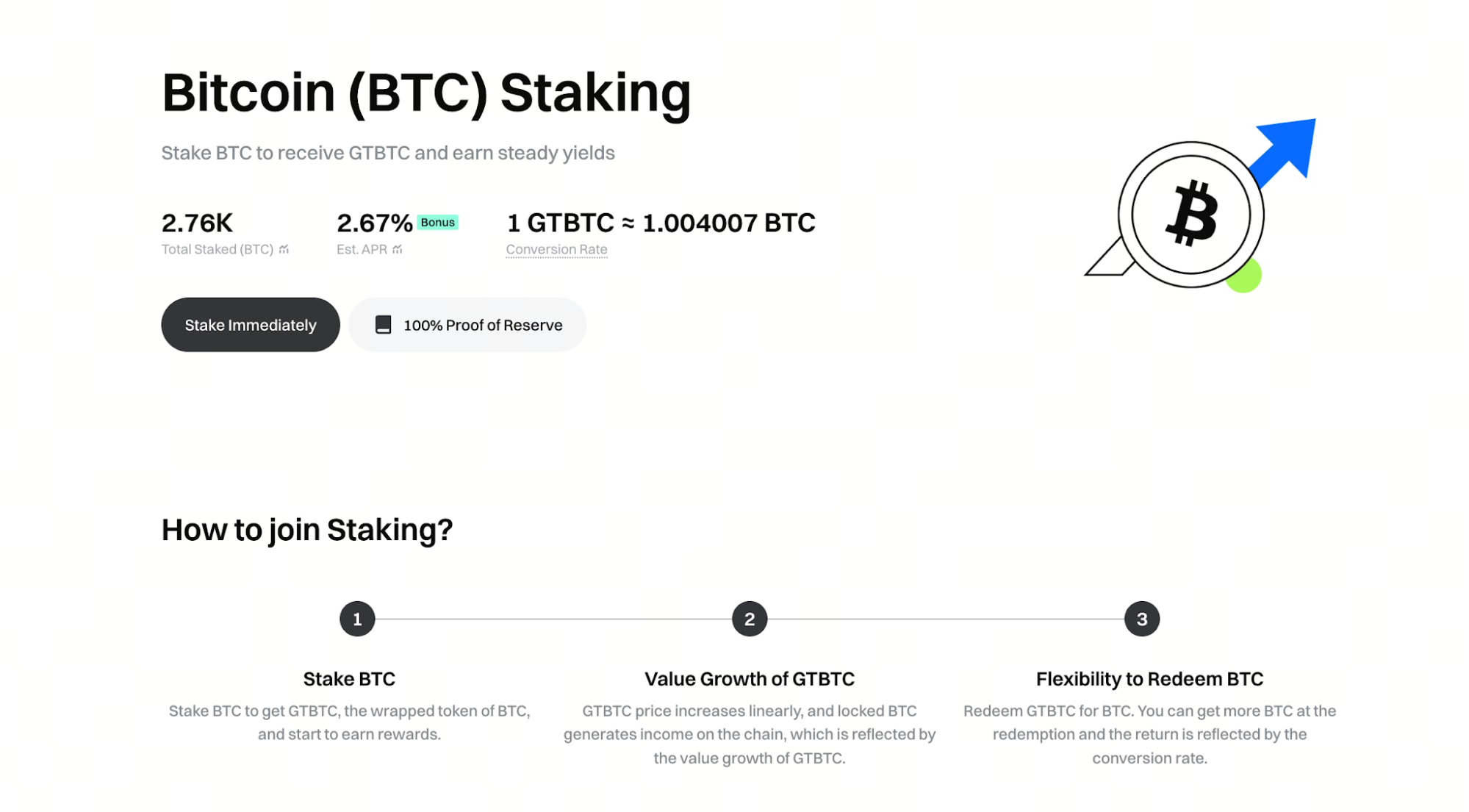
This guide explains how Gate BTC Staking works, what GTBTC represents, where the rewards come from, how the exchange rate changes, how to participate and redeem, how GTBTC can be used, and which risks and practical factors—such as APR and product rules—matter before joining. At the time of this article’s update, the Gate BTC Staking page showed approximately 2.76K BTC in total staked assets, a reference APR of 2.67%, and an exchange rate of approximately 1 GTBTC = 1.004007 BTC. These figures can change with on-chain yields and product rules, so users should always check the latest data on the Gate BTC Staking page before participating.
Key Takeaways
Gate BTC Staking allows users to stake BTC for GTBTC and earn rewards through increases in GTBTC’s redemption value relative to BTC.
GTBTC is a yield-bearing BTC asset generated through BTC Staking and can be redeemed for BTC based on the applicable exchange rate.
Bitcoin itself is not a PoS asset, so Gate BTC Staking is not native Bitcoin network staking.
GTBTC rewards primarily come from BTC DeFi projects that Gate works with, with rewards converted into BTC and reflected in the exchange rate.
The BTC-to-GTBTC exchange ratio is not permanently fixed at 1:1 and can change as rewards accumulate.
The current minimum participation amount is 0.001 BTC, with flexible staking and redemption.
In addition to redemption for BTC, GTBTC can be used in supported trading, investment, and collateral scenarios.
Reference APR, exchange rates, and total staked assets can all change and should not be interpreted as fixed or guaranteed returns.
What Is Gate BTC Staking?
Gate BTC Staking is a BTC yield product on the Gate.com platform within Gate’s on-chain earning ecosystem, acting as a gateway for users who want to put idle Bitcoin to work. It is designed to help long-term BTC holders start staking through a centralized product that lets them earn rewards on idle BTC assets without directly selling them. For users seeking passive income, it offers a way to earn passive income from BTC while keeping exposure to the asset. In that sense, the benefits are centered on helping users improve asset utilization in a more secure way than simply leaving funds unused. As with other crypto staking products, users use BTC in a managed yield structure rather than moving into a different coin.
When users participate, they receive GTBTC based on the applicable BTC/GTBTC exchange rate. GTBTC can be understood as a yield-bearing token associated with a BTC Staking position, representing the right to redeem a corresponding amount of BTC according to the applicable exchange rate.
As the underlying strategies generate rewards, the amount of BTC redeemable for each GTBTC can gradually increase. Compared with simply leaving BTC idle in an account, BTC Staking introduces a potential source of additional BTC-denominated returns while maintaining exposure to BTC-related assets.
However, an important distinction is that “Staking” here describes the product and its yield mechanism rather than a change to Bitcoin’s blockchain consensus mechanism. Bitcoin continues to operate on a Proof-of-Work model for network security, while Gate BTC Staking is a centralized yield product designed to generate rewards from BTC-related DeFi and on-chain strategies rather than native Bitcoin validator rewards.
What Is GTBTC?
GTBTC is Gate’s yield-bearing wrapped BTC asset and the yield-bearing form users receive after they stake BTC, converting idle assets into a representation that can generate additional rewards through staking products in the same way other crypto coins do within similar systems.
When users stake BTC, the system mints the corresponding amount of GTBTC according to the current exchange rate. When users redeem their position, the corresponding GTBTC is burned and the applicable amount of BTC is released. Gate states that the minting and redemption process is executed through audited smart contracts and can be tracked on-chain.
One important difference between GTBTC and a conventional wrapped BTC asset is its yield accumulation mechanism. When the underlying BTC generates rewards, the value is not simply distributed as a separate BTC payment each day. Instead, the rewards are gradually reflected in the form of a rising BTC redemption value for each GTBTC, and many similar centralized yield products compound daily payouts automatically.
For example, if 1 GTBTC initially corresponds to 1 BTC, accumulated rewards may eventually allow 1 GTBTC to be redeemed for more than 1 BTC. At the time of this article’s update, the Gate page displayed the following reference data:
Metric
Current Reference Data
Total BTC Staked
Approx. 2.76K BTC
Reference APR
2.67%
GTBTC/BTC Exchange Rate
1 GTBTC ≈ 1.004007 BTC
Minimum Participation Amount
0.001 BTC
These figures are dynamic and only reflect the status shown on the Gate BTC Staking page when this article was updated.
Where Do Gate BTC Staking Rewards Come From?
This is one of the most important aspects of understanding the product.
BTC itself does not generate native staking rewards in the same way that ETH does through PoS validation. According to Gate’s current product description, Gate works with multiple BTC DeFi projects and deploys BTC into relevant yield strategies, with the resulting rewards converted into BTC.
These BTC-denominated rewards are then reflected through the GTBTC/BTC exchange rate. As rewards accumulate, the amount of BTC represented by each unit of GTBTC may increase, allowing users to redeem GTBTC for the corresponding amount of BTC at the applicable rate.
The process can be simplified as:
BTC → Staking → Receive GTBTC → Underlying strategies generate BTC rewards → GTBTC redemption value in BTC increases
Users evaluating BTC Staking should therefore look beyond the APR displayed on the page. It is equally important to understand where the underlying yield comes from and how GTBTC passes those rewards on to holders.
How Do GTBTC Rewards Accumulate?
The current Gate BTC Staking mechanism is better understood through changes in the GTBTC exchange rate rather than simply as a system that distributes additional GTBTC to users every day.
When the underlying BTC generates on-chain rewards, those rewards are converted into BTC and gradually incorporated into GTBTC’s value. As a result, even if the number of GTBTC tokens held by a user does not increase, the amount of BTC represented by each GTBTC may rise over time.
For example, suppose a user holds 1 GTBTC:
At an exchange rate of 1 GTBTC = 1 BTC, it can be redeemed for 1 BTC.
If the exchange rate later increases to 1 GTBTC = 1.004 BTC, the same 1 GTBTC can be redeemed for approximately 1.004 BTC.
Gate’s current product information indicates that the BTC/GTBTC exchange rate is updated according to the yield cycle, typically around every two to three days. The exchange rate remains unchanged within a cycle and is adjusted at the beginning of the next cycle to reflect newly accumulated on-chain rewards.
Therefore, the user’s BTC-denominated return is primarily reflected in how much BTC each GTBTC can redeem rather than whether the number of GTBTC in the account increases every day.
Why Is GTBTC No Longer Fixed at 1:1 With BTC?
Earlier Gate BTC Staking materials often used “1 BTC = 1 GTBTC” to explain the initial staking mechanism. However, as rewards accumulate, the actual exchange rate between GTBTC and BTC does not remain permanently fixed at 1:1.
The reason is that GTBTC is a yield-bearing asset. As the underlying BTC Staking strategies generate rewards, those rewards accumulate in GTBTC’s redeemable value, causing the amount of BTC represented by each GTBTC to change over time.
At the time of this article’s update, the Gate page showed an exchange rate of approximately 1 GTBTC = 1.004007 BTC, already above the initial 1 BTC level.
This also means that new participants may not necessarily receive GTBTC based on a fixed “1 BTC mints 1 GTBTC” ratio. Instead, the amount of GTBTC received should be calculated using the exchange rate applicable at the time of participation. The same principle applies to redemption: GTBTC is converted back into BTC based on the applicable rate at that time.
When understanding Gate BTC Staking, it is therefore more useful to focus on the idea that GTBTC’s redemption value in BTC can change as rewards accumulate rather than memorizing a fixed 1:1 ratio.
How to Participate in Gate BTC Flexible Staking
The Gate BTC Staking process can be divided into three stages: staking BTC, holding GTBTC, and redeeming GTBTC for BTC when needed.
Users can first visit the Gate BTC Staking page on the Gate.com website or app after they sign in to their account and review the current reference APR, BTC/GTBTC exchange rate, and applicable product rules. The current minimum participation amount is 0.001 BTC, and the mobile app also lets users track product details on the go.
After confirming participation, users stake BTC and receive the corresponding amount of GTBTC based on the applicable exchange rate. While the user holds GTBTC, rewards generated by the underlying BTC strategies are gradually reflected through increases in GTBTC’s redemption value.
When users want to regain access to BTC, they can submit GTBTC for redemption and receive the corresponding amount of BTC based on the applicable exchange rate. Gate BTC Staking offers flexible redemption options rather than a traditional fixed-term lock-up model, though actual wait times for redemption or withdrawal can vary depending on market conditions and product rules.
Because both the APR and exchange rate can change, users should review the latest parameters on the product page each time they stake or redeem rather than relying on figures from older articles.
What Else Can You Do With GTBTC?
GTBTC is not simply a static receipt representing a BTC Staking position.
Gate positions GTBTC as a wrapped BTC asset with multiple potential use cases. In addition to holding GTBTC and benefiting from growth in its BTC redemption value, GTBTC can be used in supported investment and collateral scenarios, and it sits within a broader platform where users can also trade or sell assets through spot and derivatives products.
Gate supports over 2,500 cryptocurrencies, around 4235 spot market pairs, futures trading with both perpetual and delivery contracts, and advanced tools such as trading bots and copy trading.
This means that users participating in BTC Staking do not necessarily need to leave GTBTC completely idle until redemption. Depending on the products and services currently supported, the yield-bearing BTC asset may be used in additional asset-management scenarios, potentially improving capital flexibility.
GTBTC is also part of the Gate Layer ecosystem. Gate positions it as a wrapped BTC asset that can connect BTC liquidity with a broader range of on-chain use cases.
However, different use cases introduce different risks. Using GTBTC as collateral may involve collateral-ratio and liquidation risks, while deploying it in other DeFi products or using it in trading scenarios can introduce broader market, product, smart contract, or liquidity risks. The ability to use GTBTC elsewhere does not mean those additional activities are risk-free.
What Is the Difference Between Holding BTC and Holding GTBTC?
When users hold BTC directly, their gains or losses are primarily driven by changes in the market price of Bitcoin. BTC itself does not automatically pay interest or dividends, so the amount of BTC held does not increase simply because time passes.
Holding GTBTC adds a yield mechanism. GTBTC’s redemption value relative to BTC can increase as underlying rewards accumulate, potentially allowing users to earn additional BTC-denominated returns while maintaining exposure closely related to BTC.
Category
Holding BTC Directly
Holding GTBTC
BTC Price Exposure
Yes
Closely related to BTC
Additional Yield Mechanism
No native yield
Can accumulate BTC Staking rewards
How Returns Are Reflected
Mainly through BTC price movements
Growth in the GTBTC/BTC exchange rate
On-Chain/Product Risk
Mainly BTC and custody-related risks
Additional staking, protocol, and product-mechanism risks
Asset Utility
BTC-supported use cases
Supported trading, investment, and collateral use cases
Neither option is universally better. Users who simply want to hold BTC may prefer the simpler structure of direct BTC ownership, while those looking to improve the utilization of idle BTC and willing to accept additional underlying strategy and product risks may consider GTBTC as an alternative.
How Should You Understand Gate BTC Staking APR?
The Gate BTC Staking page displays a reference APR, but this figure should not be interpreted as a fixed deposit rate.
At the time of this article’s update, the page showed a reference APR of approximately 2.67%. However, actual BTC Staking returns depend on underlying BTC DeFi strategies, reward levels, exchange-rate changes, product rules, and market conditions, so annual percentage yields are variable rather than stable, and future returns may be higher or lower than the current figure.
APR represents an annualized estimate based on the current level of returns. It does not mean that users who participate for one year are guaranteed to receive the same percentage of BTC.
For example, if the product displays a 2.67% APR at a particular point in time, this only represents an annualized reference rate based on current product conditions rather than a guarantee of returns over the next 12 months.
Other earn products on Gate, including gt staking, have been officially live with promotional yields up to 10.49% APR and entry from just 1 GT, but those higher returns are intended for specific products and may change.
For BTC holders, more useful indicators include the current GTBTC/BTC exchange rate, the rate at which that exchange rate changes, the underlying sources of yield, and the redemption mechanism rather than focusing only on APR at a single point in time.
What Are the Risks of Gate BTC Staking and the Importance of Multi Factor Authentication?
The first risk is BTC price volatility. Gate BTC Staking rewards are primarily measured in BTC terms, but Bitcoin’s value in U.S. dollars or other fiat currencies can still rise or fall significantly. Even if a user ends up with more BTC, the fiat value of the position may decline if BTC’s market price falls. Because this product sits on a centralized exchange, users should also note counterparty exposure from custody of user assets and the risk that liquidity can become limited during market stress.
The second risk involves the underlying protocols. Gate BTC Staking generates rewards through BTC DeFi projects and on-chain mechanisms, which may introduce smart contract, protocol, network, and other blockchain-related risks. Gate states that the relevant minting and redemption smart contracts have undergone security audits, but audits cannot eliminate every possible on-chain risk. There is also the possibility of loss if underlying validators, service providers, or connected systems fail.
The third risk is yield variability. The reference APR is not fixed, and the GTBTC/BTC exchange rate changes dynamically according to the underlying yield cycle. Historical returns therefore do not guarantee future results.
GTBTC may also introduce additional liquidity and use-case risks. If users deploy GTBTC for trading, collateral, or other products, they may take on additional market-price, liquidation, liquidity, or product-specific risks.
Gate says its security framework includes a 100% proof of reserve model, a reported 124% reserve ratio, independent third parties that verify assets, two-factor authentication, and cold storage to protect funds, but users still need to manage risk rather than assume full control.
Gate BTC Staking is therefore better understood as a strategy for improving BTC capital efficiency rather than as a source of “risk-free BTC interest.” Gate also highlights global licensing, compliance with applicable regulations, including registration with the financial crimes enforcement network in some contexts, and a Web3 wallet that supports over 100 blockchain networks, but these features do not eliminate product risk.
Summary
Gate BTC Staking provides BTC holders with a way to put their Bitcoin into supported yield strategies. Users stake BTC to receive GTBTC, while rewards generated by the underlying BTC are gradually reflected in GTBTC’s redemption value relative to BTC.
The two most important concepts to understand are GTBTC and the dynamic exchange rate. GTBTC is not a static token permanently pegged to BTC at 1:1. Instead, it is a yield-bearing asset whose redeemable BTC value may gradually increase as rewards accumulate. At the time of this article’s update, the Gate page showed approximately 1 GTBTC = 1.004007 BTC, although this figure will continue to change.
For users who already plan to hold BTC over the long term, BTC Staking can potentially improve the utilization of otherwise idle BTC while maintaining redemption flexibility. However, the reference APR is not guaranteed, and underlying DeFi strategies, BTC price movements, exchange-rate changes, and additional uses of GTBTC can introduce different types of risk.
When deciding whether Gate BTC Staking is suitable, users should therefore look beyond the current APR and understand where the rewards come from, how GTBTC works, when they may need access to their BTC again, and whether they are comfortable with the additional on-chain and product-mechanism risks.
FAQ
What is Gate BTC Staking?
Gate BTC Staking is a BTC yield product that allows users to stake BTC for GTBTC and earn underlying BTC rewards through increases in GTBTC’s redemption value relative to BTC.
What is GTBTC?
GTBTC is Gate’s yield-bearing wrapped BTC asset and BTC Staking token. It can be redeemed for BTC based on the applicable exchange rate and can also be used in supported trading, investment, and collateral scenarios.
Is 1 GTBTC always equal to 1 BTC?
No. GTBTC accumulates underlying staking rewards, so its BTC exchange rate can change over time. At the time of this article’s update, the Gate page showed approximately 1 GTBTC = 1.004007 BTC.
Where do Gate BTC Staking rewards come from?
Gate BTC Staking rewards primarily come from BTC DeFi projects that Gate works with. The resulting rewards are converted into BTC and gradually reflected through changes in the GTBTC/BTC exchange rate.
What is the minimum amount required for Gate BTC Staking?
The current minimum participation amount for Gate BTC Staking is 0.001 BTC. Requirements may change, so users should check the latest product rules before participating.
Can GTBTC be redeemed for BTC?
Yes. GTBTC can be redeemed for BTC based on the applicable exchange rate, which changes dynamically according to the accumulation of underlying on-chain rewards.
Author: Allen
Reviewer(s): Carlton
Disclaimer
* The information is not intended to be and does not constitute financial advice or any other recommendation of any sort offered or endorsed by Gate.
* This article may not be reproduced, transmitted or copied without referencing Gate. Contravention is an infringement of Copyright Act and may be subject to legal action.
Yala is a modular Bitcoin DeFi infrastructure that connects BTC liquidity with multi-chain ecosystems through its YU stablecoin and MetaMint protocol. It enables Bitcoin holders to earn native DeFi yields across EVM and non-EVM networks securely and seamlessly.
Sui is a PoS L1 blockchain with a novel architecture whose object-centric model enables parallelization of transactions through verifier level scaling. In this research paper the unique features of the Sui blockchain will be introduced, the economic prospects of SUI tokens will be presented, and it will be explained how investors can learn about which dApps are driving the use of the chain through the Sui application campaign.
Hyperliquid's vision is to develop an on-chain open financial system. At the core of this ecosystem is Hyperliquid L1, where every interaction, whether an order, cancellation, or settlement, is executed on-chain. Hyperliquid excels in product and marketing and has no external investors. With the launch of its second season points program, more and more people are becoming enthusiastic about on-chain trading. Hyperliquid has expanded from a trading product to building its own ecosystem.
CoW Protocol is an intent-based trading protocol that helps users swap crypto through batch auctions and competing solvers rather than direct on-chain order execution. Its design aims to improve price discovery, reduce MEV exposure, and match compatible orders through Coincidence of Wants when possible.
A stablecoin is a cryptocurrency with a stable price, which is often pegged to a legal tender in the real world. Take USDT, currently the most commonly used stablecoin, for example, USDT is pegged to the US dollar, with 1 USDT = 1 USD.