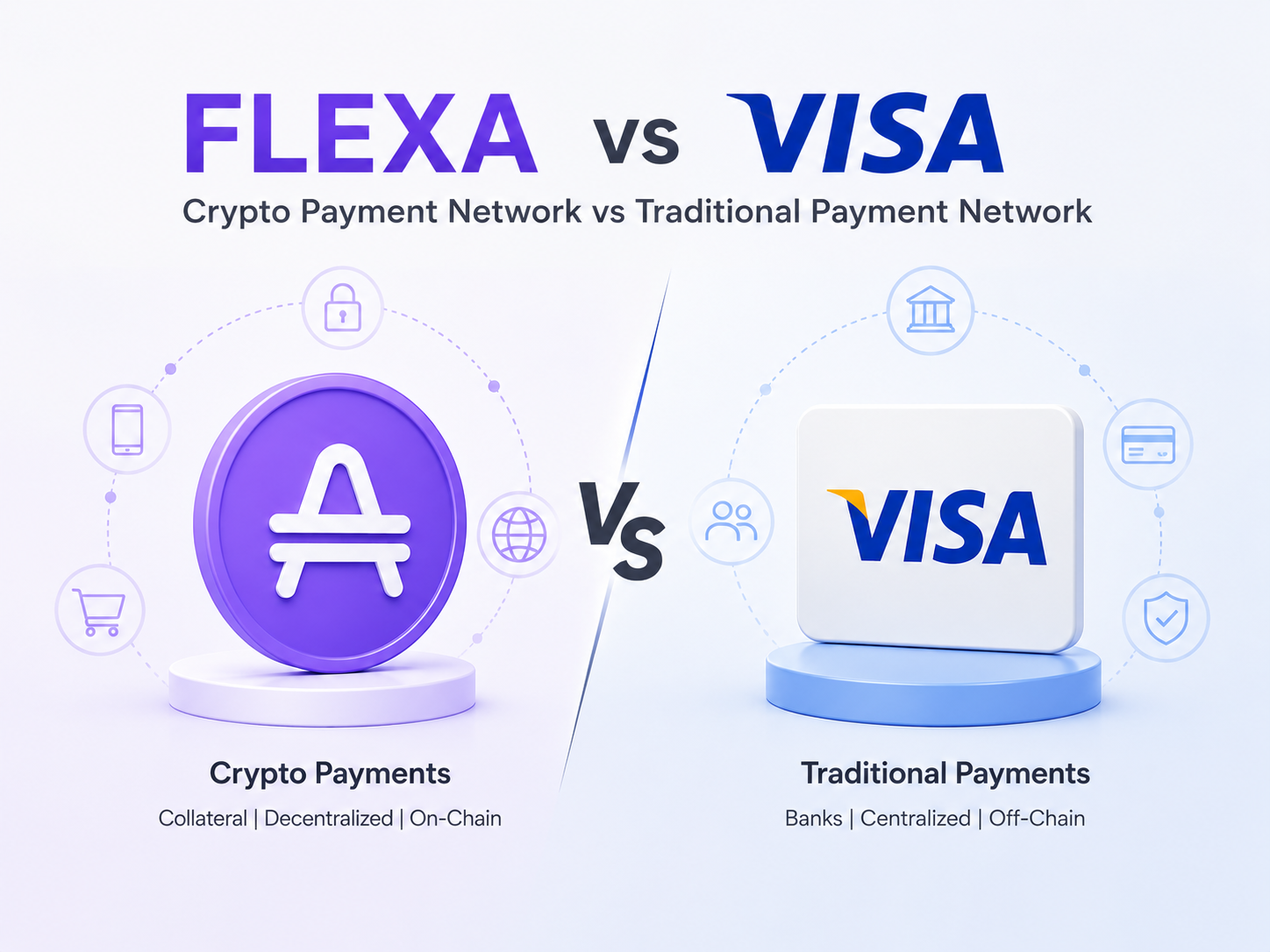
Although both networks aim to deliver fast and secure payment experiences, they differ significantly in transaction confirmation, fund flow, and risk allocation. These differences determine which commercial scenarios each network is best suited for.
Understanding the contrast between Flexa and Visa isn’t about declaring one superior—it’s about grasping how traditional payment systems and on-chain payment networks each solve for efficiency, security, and merchant experience.
What Is Flexa?
Flexa is a digital asset payment network designed for real-world commerce. It uses AMP as on-chain collateral, enabling merchants to securely accept payments before blockchain transactions are fully confirmed. Flexa does not issue a new payment currency—instead, it connects consumers, wallet apps, and merchants in a streamlined flow.
Flexa’s key innovation is separating payment confirmation from on-chain settlement. When a consumer initiates a digital asset payment, AMP instantly collateralizes the transaction, so merchants receive payment authorization without waiting for blockchain finality.
Compared to traditional payment networks, Flexa focuses on solving confirmation delays, payment risk, and multi-chain compatibility in digital asset payments. It functions more as an on-chain payment infrastructure than a standalone payment tool.
What Is Visa?
Visa is one of the world’s largest bank card payment networks, providing clearing and settlement services for consumers, merchants, banks, and payment institutions. Visa itself does not issue cards or hold user funds—it connects issuing banks, acquirers, and merchants to process payment messages and transaction data.
When a consumer swipes a card or pays online, Visa routes the transaction to the relevant financial institutions, which handle authorization, clearing, and final settlement. Visa’s payment system is therefore built on traditional bank accounts, credit frameworks, and fiat currency.
Over decades, Visa has built a global payment network that supports online shopping, in-store purchases, cross-border payments, and corporate transactions.
How Do the Payment Processes Differ?
The most fundamental difference between Flexa and Visa lies in the payment flow. Visa uses a bank card authorization model: banks verify account balances or credit limits, then proceed with clearing. Flexa uses a digital asset model: AMP collateral secures the transaction, then the blockchain completes final settlement.
Visa payments typically involve multiple parties: consumer, merchant, acquirer, Visa network, and issuing bank. The entire process relies on inter-institutional data exchange, making payment confirmation and fund settlement two distinct stages.
Flexa’s payment flow depends more on blockchain and smart contracts. After a consumer initiates a digital asset payment, the system immediately locks an equivalent amount of AMP as collateral. The merchant gets payment confirmation, while the underlying blockchain later completes the final asset transfer.
The table below summarizes the key differences:
| Comparison Dimension |
Flexa |
Visa |
| Payment Asset |
Cryptocurrency |
Fiat currency |
| Payment Confirmation |
AMP collateral guarantee |
Bank authorization |
| Final Settlement |
Completed by blockchain |
Bank clearing system |
| Source of Trust |
Smart contracts and collateral |
Bank credit system |
| Infrastructure |
Blockchain network |
Bank payment network |
Both networks aim for fast payment experiences but achieve it differently. Visa relies on a centralized financial system, while Flexa uses on-chain collateral and blockchain settlement for digital asset payments.
How Do Risk Protection Mechanisms Differ?
Both Flexa and Visa have payment safeguards, but their risk management systems are entirely different. Visa depends on a credit network of banks, issuers, and acquirers. Flexa relies on AMP collateral assets and smart contracts to absorb payment risk.
Visa’s transaction authorization is based on account balances, credit limits, and risk control systems. If fraud, chargebacks, or payment disputes occur, banks and payment institutions handle them according to established rules. This model is mature and stable, but it exposes merchants to chargeback risk and lengthy dispute cycles.
Flexa’s risk protection starts at the moment of the transaction. When a consumer initiates a payment, the system locks an equivalent amount of AMP as collateral, providing credit guarantee. If the underlying blockchain transaction fails to confirm, the protocol uses the collateral to compensate the merchant—no bank involvement needed.
Thus, the core difference is the source of trust: Visa is built on traditional financial institution credit, while Flexa is built on on-chain collateral and smart contract execution.
How Do Fund Settlement Methods Differ?
Payment confirmation does not mean funds have arrived. Payment networks therefore have two stages: authorization and settlement. The differences between Flexa and Visa’s settlement methods reflect the contrast between traditional finance and blockchain infrastructure.
Visa’s fund settlement is handled by the banking system. After payment authorization, funds move through the issuing bank, Visa network, and acquirer before reaching the merchant’s account. The process follows banking rules and may take longer for cross-border payments.
Flexa delegates final settlement to the underlying blockchain. Payment authorization is instantly guaranteed by AMP collateral, while the consumer’s digital assets are later transferred and confirmed on-chain. Payment confirmation and fund settlement are independent, so merchants don’t need to wait for on-chain finality.
The table below outlines the key differences:
| Comparison Dimension |
Flexa |
Visa |
| Settlement Entity |
Blockchain network |
Banks and payment institutions |
| Payment Confirmation |
AMP instant guarantee |
Bank authorization |
| Final Settlement |
On-chain asset transfer |
Bank account fund transfer |
| Settlement Time |
Depends on underlying blockchain |
Depends on bank clearing cycle |
| Intermediaries |
Smart contracts |
Multi-layer financial institutions |
Both models have their strengths. Visa is ideal for fiat currency payments, while Flexa offers a settlement solution for digital asset payments without relying on traditional bank credit.
How Do Merchant Onboarding and Application Scenarios Differ?
Visa has built a global payment network covering virtually every consumer scenario: retail, dining, e-commerce, travel, hotels, and cross-border payments. For most merchants, accepting Visa is the standard for bank card payments.
Flexa primarily serves merchants that want to accept digital asset payments. By integrating Flexa, merchants avoid managing multiple blockchain networks and the risk during payment confirmation. This allows them to support cryptocurrency payments at a lower cost.
As demand for stablecoins and digital asset payments grows, Flexa is especially suited for crypto-native commerce and retailers seeking to add crypto payment options. However, in terms of coverage, bank partnerships, and global merchant scale, Visa still has a more mature market base.
Overall, the two networks are not direct substitutes—they serve different payment systems. Visa represents the traditional financial payment network, while Flexa represents a new generation of blockchain-based digital asset payment infrastructure.
Summary
Both Flexa and Visa aim to improve payment efficiency and merchant experience, but they use fundamentally different architectures. Visa is built on bank credit and traditional financial clearing systems. Flexa uses AMP collateral, smart contracts, and blockchain networks to provide instant credit for digital asset payments.
For those looking to understand crypto payment infrastructure, Flexa offers a model distinct from traditional bank card networks. For traditional commerce, Visa remains one of the most widely adopted and mature payment networks. Going forward, both systems are likely to coexist and serve different payment needs.
FAQ
What is the biggest difference between Flexa and Visa?
The biggest difference is the underlying infrastructure. Visa is built on banks and fiat currency. Flexa uses blockchain and AMP collateral to enable digital asset payments.
Can Flexa completely replace Visa?
No. Flexa primarily serves digital asset payment scenarios, while Visa covers the global bank card payment network. They currently address different payment systems and use cases.
Why does Flexa need AMP?
AMP provides on-chain collateral for each digital asset payment. This allows merchants to receive payment without waiting for blockchain finality, improving efficiency and fund security.
Why don’t Visa payments require collateral tokens?
Visa uses the bank credit system for transaction authorization and risk management. It doesn’t need on-chain collateral like blockchain-based payments do.
How does Flexa complete final settlement?
Flexa’s payment authorization is instantly guaranteed by AMP, while the final settlement is completed by the consumer’s blockchain network. The two are independent.
Which payment network is better for digital asset payments?
For directly using cryptocurrency to make purchases, Flexa is more targeted. For fiat currency and bank card payments, Visa remains the most mature and widely accepted network.