Key Takeaways
-
CME FedWatch is an important tool for monitoring expectations for Federal Reserve interest rates. It uses 30-Day Federal Funds Futures prices to estimate the implied probability of market expectations for the outcomes of future FOMC meetings.
-
The probability of a rate cut is not an official Federal Reserve forecast. FedWatch reflects the pricing of the futures market at a specific point in time, and the probability changes continuously with economic data, policy information, and market trading.
-
In October 2026, the market focus has shifted from rate cuts to holding rates steady or even raising them. Before the October 28 meeting, some market data placed the estimated probability of rates remaining unchanged at around 90%, the probability of a 25-basis-point rate hike at around 10%, and the probability of a rate cut near zero.
-
A rate cut does not necessarily mean that BTC will rise. Bitcoin's price is affected not only by interest rates, but also by real interest rates, the U.S. dollar, market liquidity, risk appetite, and changes in capital allocation.
-
Markets trade changes in expectations, not just final outcomes. If a rate cut has already been fully priced in, BTC may not rise significantly even if the Federal Reserve ultimately cuts rates.
-
FedWatch is best used together with CPI, PCE, nonfarm payrolls, the U.S. Dollar Index, and U.S. Treasury yields. Looking at the probability of a single rate cut alone makes it difficult to assess the direction of the crypto market comprehensively.
Introduction
CME FedWatch is an interest rate expectations analysis tool developed by CME Group. It uses federal funds futures prices to estimate the implied probability of market expectations for the outcomes of future Federal Reserve monetary policy meetings. For investors who follow BTC, ETH, and other crypto assets, FedWatch provides a way to monitor changes in macroeconomic policy expectations and understand why the market may become volatile before an interest rate decision is officially announced.
Federal Reserve monetary policy affects the cost of dollar-denominated funding, bond yields, and risk appetite in financial markets. Crypto assets have also become part of the global risk-asset allocation system. As a result, rate cuts, rate hikes, or unchanged rates can all affect BTC prices through market expectations and capital flows. However, this relationship is not unidirectional. The economic reasons behind an interest rate decision and the market's prior pricing are equally important.
The Federal Reserve held a new FOMC meeting from October 27 to 28, 2026. Against the backdrop of previous policy adjustments and inflationary pressures, market expectations for a short-term rate cut weakened significantly. Attention gradually shifted toward whether rates would remain elevated and whether further tightening could be possible. Starting with the basic principles of FedWatch, this article explains how rate-cut probabilities are formed, how economic data changes market expectations, and how investors should interpret changes in Federal Reserve policy alongside BTC prices.
What Is CME FedWatch, and Why Does the Crypto Market Watch Rate-Cut Probabilities?
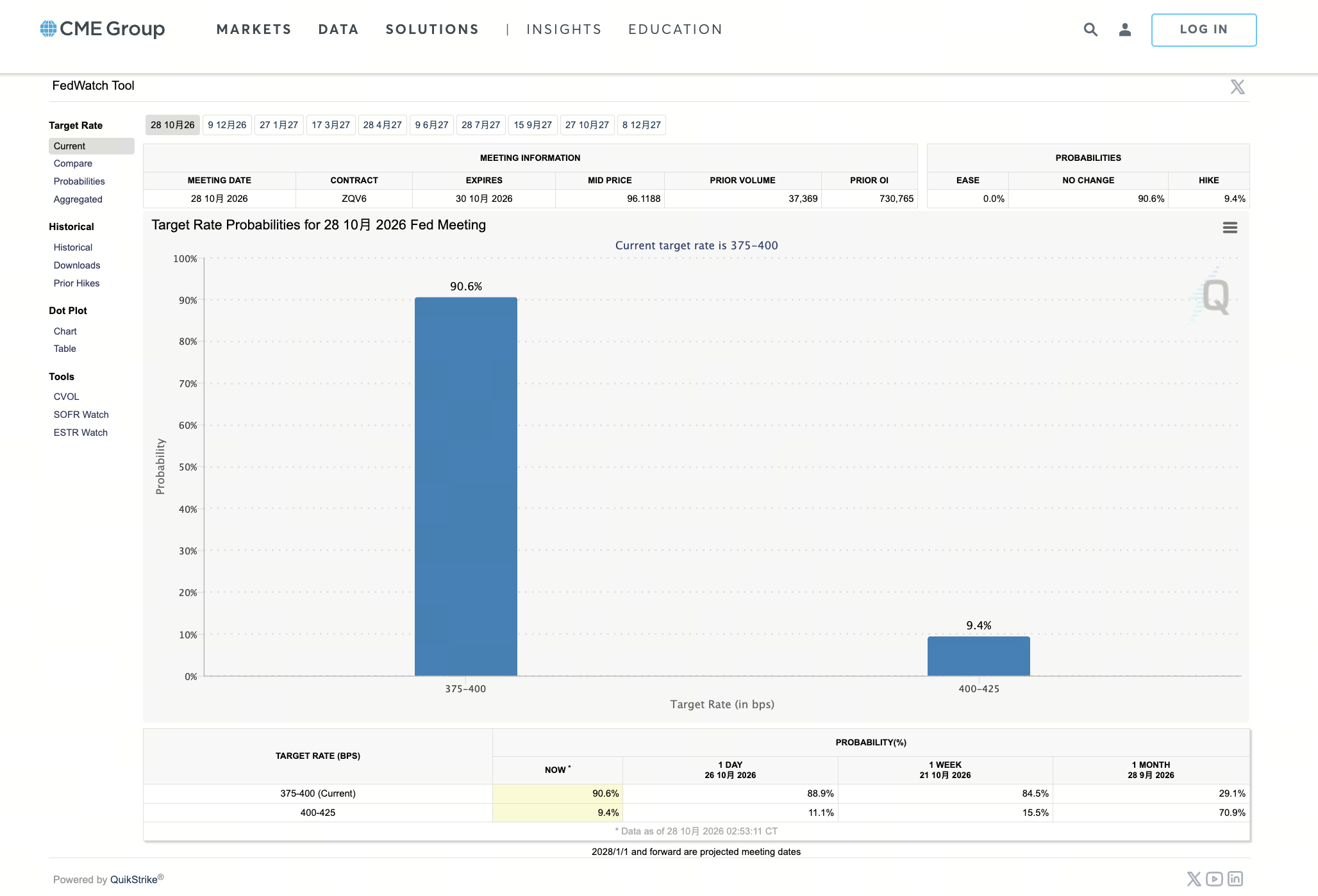
CME FedWatch is a probability analysis tool based on the interest rate futures market. It is primarily used to show the potential interest rate outcomes of future Federal Open Market Committee (FOMC) meetings. Users can view the implied probabilities of the federal funds target rate remaining unchanged, increasing, or decreasing at different meeting dates, and compare how these probabilities have changed over the past day, week, or month.
The Federal Reserve typically influences short-term funding costs in U.S. financial markets by adjusting the federal funds target rate range. Higher interest rates generally mean higher financing costs, while lower interest rates may ease some funding pressures. These changes are gradually transmitted to the Treasury market, commercial bank lending, corporate financing, and global asset pricing.
For the crypto market, the importance of interest rate expectations is mainly reflected in two areas: opportunity cost and risk appetite.
When short-term U.S. dollar interest rates are high, cash-like assets and short-term U.S. Treasuries may offer relatively attractive returns. By comparison, BTC does not generate fixed coupon payments like a bond, so the relative opportunity cost of holding BTC may increase.
When the market expects interest rates to decline, investors may reassess their allocation among cash, bonds, stocks, and crypto assets. If financial conditions become more accommodative, some capital may be allocated to risk assets.
However, this relationship does not always hold. If rate cuts are driven by a severe economic recession or financial market stress, investors may prioritize reducing risk exposure instead of immediately buying BTC.
Therefore, the value of FedWatch is not that it directly predicts whether Bitcoin will rise or fall. Rather, it helps investors monitor policy expectations that affect the broader financial market.
How Are FedWatch Rate-Cut Probabilities Calculated?
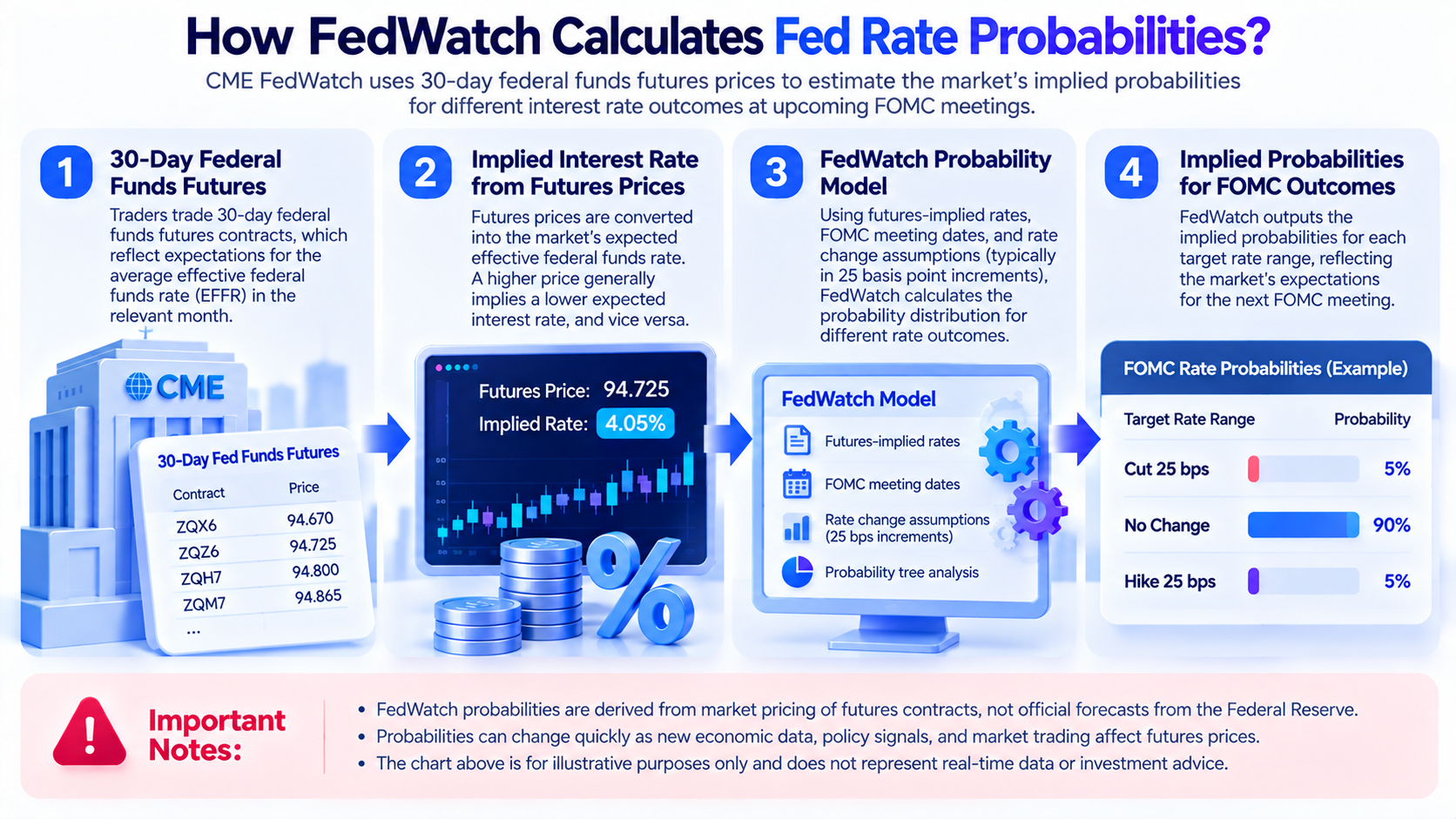
FedWatch's underlying data comes from 30-Day Federal Funds Futures. The pricing of these futures contracts is related to the average effective federal funds rate for the corresponding month, allowing them to reflect market expectations for future short-term interest rates.
The Effective Federal Funds Rate (EFFR) is a statistical measure of the rates at which transactions actually take place in the U.S. federal funds market. It is closely related to the Federal Reserve's published target rate range, but the two are not exactly the same concept.
FedWatch uses futures prices for different months, FOMC meeting dates, and assumptions about rate adjustments to estimate which interest rate outcomes the market considers possible for a given meeting. Its standard calculation method assumes that the policy rate changes in increments of 25 basis points and uses a probability tree to analyze different future rate paths.
For example, assume that the current target rate range is 4.00%–4.25% and that the market is primarily considering two outcomes: rates remain unchanged, or rates are cut by 25 basis points to 3.75%–4.00%.
If the model based on futures pricing shows a 70% probability of a rate cut and a 30% probability of rates remaining unchanged, FedWatch will display these two outcomes as the market's current implied probabilities.
It is important to emphasize that the 70% does not mean that 70% of Federal Reserve officials support a rate cut, nor does it mean that the model can guarantee 70% forecast accuracy. It is simply the distribution of outcomes implied by futures market prices under specific calculation assumptions.
As new economic data is released, futures prices change, and FedWatch probabilities adjust accordingly. This makes FedWatch more suitable for observing dynamic changes in market expectations than for treating it as a fixed forecast.
How Should You Read FedWatch Probabilities for Rate Cuts, Unchanged Rates, and Rate Hikes?
When reading FedWatch, first confirm which FOMC meeting you have selected. Different meeting dates correspond to different policy expectations, so the rate-cut probability for a given month should not be directly interpreted as the probability of a rate cut during the entire year.
Next, distinguish between the target rate range and the direction of the rate change. FedWatch typically displays the probabilities of different target rate ranges. Users need to compare these with the current target range to determine whether the corresponding outcome represents a rate cut, no change, or a rate hike.
Finally, pay attention to historical changes in the probabilities, rather than just the figure at a single point in time.
For example, for the October 28, 2026, FOMC meeting, third-party futures pricing before the meeting showed an implied probability of around 90% that rates would remain unchanged, an approximately 10% probability of a 25-basis-point rate hike, and a rate-cut probability near zero. Slight differences may result from different data update times and calculation methodologies.
If the market assessed the probability of a rate hike at 20% the previous week and that probability has now declined to 10%, this means that the futures market has reduced its pricing of further monetary policy tightening.
This change alone may affect the U.S. dollar, bonds, and risk assets, even if the Federal Reserve has not officially announced any decision.
It is also important to note that the probability of a rate range in a future month is not equivalent to the probability of a rate cut at a single meeting. For example, a high probability of a lower rate range in a future month may include a scenario in which rates were cut at several previous meetings. It does not necessarily mean that the market believes a rate cut will occur at that particular meeting.
Therefore, when analyzing FedWatch, it is best to observe recent meetings, the rate path across the next several meetings, and changes in probabilities over different time periods.
How Do CPI, PCE, and Nonfarm Payrolls Data Change Rate-Cut Probabilities?
The Federal Reserve's monetary policy primarily focuses on two goals: price stability and maximum employment. Inflation and employment data are therefore important factors influencing market interest rate expectations.
The Consumer Price Index (CPI) measures changes in the prices of consumer goods and services. The Personal Consumption Expenditures (PCE) price index is one of the key inflation indicators monitored by the Federal Reserve. Nonfarm payrolls, the unemployment rate, and wage growth help assess the state of the labor market.
When inflation remains above the policy target and the labor market remains resilient, the market may conclude that the Federal Reserve has little need to cut rates immediately. It may even need to maintain higher rates to contain inflationary pressures.
Conversely, if inflation gradually declines while employment growth slows significantly, the market may raise its expectations for future rate cuts.
| Economic Data Change |
Potential Policy Expectation |
Potential Transmission to BTC |
| CPI higher than expected |
Lower probability of a rate cut |
The U.S. dollar and yields may strengthen, putting pressure on risk assets |
| CPI lower than expected |
Higher probability of a rate cut |
Expectations for easier financial conditions may improve |
| Nonfarm payrolls stronger than expected |
Stronger expectations for rates to remain high |
Depends on the combined impact of economic growth and interest rates |
| Nonfarm payrolls weaken significantly |
Rate-cut expectations may increase |
May also raise concerns about an economic recession |
| PCE inflation continues to decline |
Greater room for future easing |
May improve risk appetite, but does not guarantee a rise |
The impact of economic data is not mechanical.
For example, an employment report that is weaker than expected may cause FedWatch to show a higher probability of a rate cut. However, if the market is also concerned that the U.S. economy is entering a recession, stocks and BTC may still decline.
Similarly, a strong employment report may reduce the probability of a rate cut while also indicating resilient economic demand. In some market environments, an improved growth outlook may offset part of the pressure from interest rates.
Therefore, assessing the impact of macroeconomic data on BTC requires answering two questions at the same time: How does the data change expectations for Federal Reserve policy, and how does it change investors' views of economic growth and risk?
Why Could a Federal Reserve Rate Cut Affect the Price of BTC?
Changes in Federal Reserve interest rates generally affect BTC through funding costs, real yields, the U.S. dollar, and market risk appetite rather than directly determining Bitcoin's market price.
The first factor is funding costs. When interest rates decline, the cost of some forms of financing may gradually decrease, and financial market liquidity conditions may improve. For risk assets, this generally makes investors more willing to accept price volatility.
The second factor is asset opportunity cost. BTC does not pay fixed interest, while short-term U.S. Treasuries and cash-like dollar instruments can generate interest. When the yields on these instruments decline, investors may reassess the opportunity cost of holding non-yielding assets such as BTC.
The third factor is the U.S. dollar. If rate-cut expectations cause the dollar to weaken, global investors may adjust their allocation to dollar-denominated assets. However, the relationship between the dollar and BTC is not fixed and is also affected by global capital flows and safe-haven demand.
The fourth factor is market sentiment. Easing monetary policy is generally associated with improved financial conditions. However, if a rate cut occurs during an economic crisis, investors may first increase their cash holdings, reduce leverage, and sell highly volatile assets.
This means that BTC may respond to rate cuts in at least two different ways.
When economic growth remains stable and inflation gradually declines, a rate cut may be viewed as a policy adjustment that supports risk assets.
When the economy deteriorates rapidly and the unemployment rate rises significantly, a rate cut may instead be interpreted as a necessary response to a recession. Even if interest rates decline, BTC may face pressure from risk aversion and deleveraging.
Therefore, BTC's direction is determined not by the rate cut itself, but by the combined relationship between the reason for the rate cut, market expectations, and changes in financial conditions.
Why Might BTC Not Rise When the Probability of a Rate Cut Increases?
There is no necessary relationship between a higher rate-cut probability and a higher BTC price. The main reason is that financial markets typically reflect expectations in advance.
Suppose the market has already priced in a 90% probability of a rate cut one month before an FOMC meeting. During this period, bond yields, the exchange rate of the U.S. dollar, and risk-asset prices may already have adjusted to expectations of a future rate cut.
When the Federal Reserve ultimately announces the rate cut, the decision may not provide new upward momentum if it is consistent with market expectations.
Conversely, if the market originally expected a 50-basis-point rate cut but the Federal Reserve cuts rates by only 25 basis points, the actual outcome may still be viewed as less accommodative than expected, even though the Federal Reserve implemented an easing measure.
This is a common example of an expectations gap in financial markets.
For example, consider the following three scenarios:
| Market Expectation Before the Meeting |
Actual Policy Outcome |
Possible Market Interpretation |
| A 25-basis-point rate cut is widely expected |
Rates are cut by 25 basis points |
Largely in line with expectations |
| A 50-basis-point rate cut is widely expected |
Rates are cut by only 25 basis points |
Less accommodative than expected |
| Rates are widely expected to remain unchanged |
Rates are unexpectedly cut by 25 basis points |
Unexpected policy easing, but the reason must be assessed |
The third scenario deserves particular attention. An unexpected rate cut may appear positive for risk assets. However, if it is driven by significant stress in the financial system, the market may instead interpret it as a sign of increased economic risk.
In addition, BTC prices are affected by spot ETF fund flows, leveraged positions, derivatives liquidations, on-chain capital activity, and industry events. Even if macroeconomic policy expectations improve, other factors may still drive short-term price movements.
Therefore, FedWatch is better suited to helping investors identify changes in macroeconomic expectations than to generating direct buy or sell signals.
Why Should Real Interest Rates, the U.S. Dollar Index, and Treasury Yields Be Observed Alongside FedWatch?
FedWatch shows market expectations for future policy rates, but BTC's macroeconomic pricing is also affected by variables such as real interest rates, the U.S. Dollar Index, and U.S. Treasury yields.
Real interest rates can be simply understood as the actual return on funds after accounting for inflation. If nominal interest rates remain unchanged while inflation expectations decline, real interest rates may rise, increasing the opportunity cost of holding some non-yielding assets.
U.S. Treasury yields reflect the combined market pricing of factors such as future interest rates, inflation, and term risk. Even if FedWatch shows that the probability of a short-term rate cut is increasing, longer-term Treasury yields may rise due to inflation concerns or fiscal factors.
The U.S. Dollar Index (DXY) helps track changes in the dollar relative to a basket of major currencies. A stronger dollar can sometimes put pressure on global risk assets, but this does not mean that BTC and the dollar always have a stable negative correlation.
In practice, these indicators can be observed together.
| Indicator |
What to Monitor |
Significance for BTC Analysis |
| CME FedWatch |
Implied probability of future policy rates |
Monitor changes in policy expectations |
| U.S. 2-Year Treasury Yield |
More sensitive to the near-term policy path |
Assess short- to medium-term rate expectations |
| U.S. 10-Year Treasury Yield |
Long-term rates, inflation, and term premium |
Monitor long-term financial conditions |
| U.S. Real Interest Rates |
Returns after accounting for inflation |
Assess the opportunity cost of non-yielding assets |
| U.S. Dollar Index (DXY) |
Relative strength of the U.S. dollar |
Monitor the global dollar environment |
| BTC Spot ETF Fund Flows |
Changes in some institutional investment demand |
Monitor actual capital allocation |
For example, if FedWatch shows that the probability of a rate cut is increasing, while the 2-year Treasury yield is declining, the dollar is weakening, and BTC spot ETFs are seeing sustained net inflows, multiple indicators may collectively reflect improving risk appetite.
However, if the probability of a rate cut increases while the dollar strengthens due to safe-haven demand, stocks decline, and BTC ETFs see outflows, the market may be focusing more on economic risks than on the potential benefits of easier monetary policy.
This cross-checking can help prevent a single macroeconomic indicator from being mistaken for the sole factor determining BTC prices.
What Is the Difference Between FedWatch and Prediction Markets? Can Rate-Cut Probabilities Be Compared Directly?
Both FedWatch and prediction markets can show the implied probability of an event occurring, but their trading foundations, calculation methods, and market structures differ significantly.
FedWatch is primarily based on federal funds futures prices and uses a specific model to estimate the probability of future interest rate outcomes. Traders directly trade interest rate-related futures contracts rather than simply purchasing an outcome based on whether a meeting will result in a rate cut.
Prediction markets generally establish outcome options around a specific event, with participants trading based on the likelihood of the event occurring. For example, a market may ask whether a particular FOMC meeting will result in a 25-basis-point rate cut or which range the final interest rate will fall within.
Subject to the applicable pricing rules, the price of a prediction market contract can reflect the market's implied probability of a given outcome.
The core differences between the two tools are as follows.
| Comparison Category |
CME FedWatch |
Prediction Markets |
| Data Basis |
Federal funds futures |
Event outcome contracts |
| How Probabilities Are Formed |
Futures prices and model estimates |
Trading prices of event contracts |
| Primary Focus |
FOMC target rate ranges |
Outcomes defined by a specific event |
| Price Influences |
Rate expectations, market pricing, and model assumptions |
Event expectations, liquidity, and trading demand |
| Primary Use |
Monitor monetary policy expectations |
Express and trade views on events |
It is important to note that even if FedWatch and a prediction market both show a 70% probability of a rate cut at a particular meeting, they may not use exactly the same event definition.
For example, FedWatch may show the probability of the target rate range after a meeting, while a prediction market may use whether a rate cut occurs, the size of the rate cut, or the policy outcome at a specific point in time as its settlement basis.
In addition, prediction market prices may be affected by trading fees, liquidity, and bid-ask spreads. Therefore, not every contract price can be directly equated with a strictly defined true probability.
This distinction is particularly important for Gate event market users. When monitoring interest rate-related events, users should first confirm the market question, outcome criteria, deadline, and settlement rules before comparing the market with FedWatch data.
FedWatch can serve as a reference tool for analyzing macroeconomic expectations, but it cannot directly determine the fair price of a particular event market contract.
How Can You Use FedWatch to Build a Macro Market Analysis Framework for BTC?
FedWatch is better suited to building a framework for ongoing macroeconomic analysis than to independently predicting whether BTC will rise or fall on a given day.
-
Confirm the current interest rate environment. Investors need to understand the Federal Reserve's latest target rate range and whether the market is discussing a rate cut, unchanged rates, or a rate hike. The same economic data may have different market impacts during different policy cycles.
-
Monitor changes in probabilities. Rather than recording the rate-cut probability for a single meeting, it is more valuable to compare how that probability changes over a day, week, and month. If market expectations change significantly, it is important to identify the factors driving the change.
-
Identify key economic data. CPI, PCE, nonfarm payrolls, and the unemployment rate may change the market's view of the future policy path. The focus should not only be on whether the data is high or low, but also on the difference between the actual result and market expectations.
-
Cross-check market reactions. Observing whether the U.S. Dollar Index, Treasury yields, U.S. stocks, and BTC are moving in the same direction can help determine whether the market is trading easier monetary policy expectations, improving growth, or economic risks.
-
Incorporate crypto market data. BTC spot ETF fund flows, derivatives funding rates, open interest, and liquidation data may all affect the actual price response after a macroeconomic event.
For example, when FedWatch shows that the probability of future rate cuts is increasing, investors can further assess the following: Is the change driven by declining inflation? Are the dollar and Treasury yields also declining? Has BTC already risen in anticipation? Is leverage in the crypto market high? If multiple factors point in the same direction, the macroeconomic assessment may have greater explanatory value. If the indicators conflict, the market environment should be assessed more cautiously.
The purpose of this framework is not to find an indicator that can guarantee returns, but to help investors understand the macroeconomic logic behind market price movements.
Conclusion
CME FedWatch is an important tool for monitoring expectations for Federal Reserve monetary policy. It uses federal funds futures prices to estimate the implied probabilities of different rate outcomes at future FOMC meetings, allowing investors to observe changes in expectations for rate cuts, rate hikes, and unchanged rates.
However, FedWatch is not an official Federal Reserve forecast and cannot directly determine the direction of BTC prices. Market interest rate expectations continue to change with economic data and trading activity, and the final policy outcome may differ from prior pricing.
For the crypto market, Federal Reserve policy primarily affects asset prices through funding costs, real interest rates, the U.S. dollar, and risk appetite. A rate cut may improve financial conditions, but if it is accompanied by a recession or liquidity stress, it may also trigger declines in risk assets.
Therefore, analyzing the relationship between BTC and Federal Reserve policy requires monitoring policy expectations, the actual economic environment, and capital flows within the crypto market at the same time.
The most important value of FedWatch is not to tell investors that BTC will definitely rise or fall next. It is to help identify how macroeconomic policy expectations are changing and whether those changes have already been reflected in market prices.
FAQ
What Is CME FedWatch?
CME FedWatch is an analysis tool that uses 30-Day Federal Funds Futures prices to estimate the implied probability of interest rate outcomes at future FOMC meetings.
Are FedWatch Rate-Cut Probabilities Published by the Federal Reserve?
No. FedWatch probabilities come from futures market pricing and model calculations. They are not official Federal Reserve forecasts and do not represent the voting proportions of Federal Reserve officials.
Does a 90% Rate-Cut Probability on FedWatch Mean That a Rate Cut Will Definitely Happen?
No. A 90% probability represents the market-implied probability at a specific point in time under specific model assumptions. It may change as economic data and policy information develop.
Why Might BTC Fall When the Probability of a Rate Cut Increases?
If rising rate-cut expectations are driven by recession risks, investors may reduce their allocation to risk assets. In addition, rate-cut expectations may already have been reflected in the price of BTC.
What Does a 25-Basis-Point Federal Reserve Rate Cut Mean?
Twenty-five basis points equals 0.25 percentage points. For example, lowering the target rate range from 4.00%–4.25% to 3.75%–4.00% represents a 25-basis-point rate cut.
Will Higher-Than-Expected CPI Lower the Probability of a Rate Cut?
It may generally lower short-term rate-cut expectations because higher inflation may lead the Federal Reserve to maintain a tighter monetary policy. However, the actual impact also depends on employment, growth, and other economic data.
What Is the Difference Between FedWatch and the Federal Reserve's Dot Plot?
FedWatch reflects the implied expectations of the interest rate futures market. The Federal Reserve's dot plot shows the individual views of Federal Reserve officials participating in the economic projections regarding the appropriate path for policy rates. Neither represents a firm commitment to future interest rates.
Why Does BTC Become Volatile Before the Federal Reserve Announces an Interest Rate Decision?
Financial markets generally trade policy expectations in advance. Changes in economic data and interest rate futures prices may affect the U.S. dollar, Treasury yields, and BTC before the official decision is announced.
Are Rate-Cut Probabilities the Same on FedWatch and Prediction Markets?
Not necessarily. FedWatch calculates probabilities using interest rate futures and a model, while prediction markets form prices through trading in event contracts. Their event definitions, trading structures, and calculation methods may differ.
Can You Predict BTC's Direction by Looking Only at FedWatch?
No. FedWatch is useful for monitoring policy expectations, but it should be combined with real interest rates, the U.S. Dollar Index, Treasury yields, BTC spot ETF fund flows, and the trading structure of the crypto market for a comprehensive analysis.