Does this mean traders must hold their crypto options until they expire? Not necessarily. European-style options can still be closed before expiration when secondary-market trading is available. The restriction applies to when an option can be exercised, not necessarily when a trader can exit a position.
This distinction matters when trading Bitcoin (BTC) and Ethereum (ETH) options, particularly when managing price exposure, hedging existing positions, or responding to market volatility. Understanding how European and American options differ helps traders evaluate their contracts, potential profits and losses, and the risks associated with expiration.
Key Takeaways
-
American options allow early exercise, while European options can only be exercised at expiration. Gate Options follow a European-style structure, meaning holders cannot exercise their contracts before the specified expiration.
-
European-style options can still be closed before expiration. Traders may exit their positions through available market transactions without waiting for the contractual exercise date.
-
Exercise style and settlement method are different concepts. Traders using Gate Options should understand the applicable settlement currency, expiration schedule, and contract specifications before opening positions.
What Is the Difference Between European and American Options?
The primary difference between European and American options is when the holder can exercise the contract.
An American-style option allows its holder to exercise during the permitted period before expiration, including at expiration. A European-style option permits exercise only at expiration.
Both styles give holders contractual rights associated with an underlying asset, such as a stock, index, or cryptocurrency.
A call option gives its holder the right to buy an underlying asset at a specified strike price or receive an equivalent contractual settlement amount.
A put option gives its holder the right to sell an underlying asset at a specified strike price or receive an equivalent contractual settlement amount.
The specific rights and settlement procedures depend on the contract.
European vs American Options Comparison
| Feature |
American Options |
European Options |
| Exercise timing |
Before or at expiration |
Only at expiration |
| Early exercise |
Permitted |
Not permitted |
| Early assignment risk for sellers |
Yes |
No |
| Settlement method |
Cash or physical |
Cash or physical |
| Common markets |
U.S. individual stocks and ETFs |
Many index and crypto options |
| Pricing considerations |
Must account for possible early exercise |
No early-exercise feature |
| Trading before expiration |
Usually possible in listed markets |
Usually possible in listed markets |
| Expiration risk |
Exercise and assignment may occur |
Settlement occurs according to expiration rules |
| Crypto example |
Certain customized or OTC crypto options |
Gate Options |
An option’s exercise style does not determine whether the contract can be traded before expiration or whether settlement occurs in cash or through delivery of an asset.
For Gate Options, the European-style structure means traders must distinguish between closing a position before expiration and receiving the contractual exercise payoff at expiration.
What Are American-Style Options?
American-style options allow holders to exercise their contracts at any permitted time before expiration.
This flexibility gives traders the ability to exercise early when doing so is economically advantageous.
Most standard options on individual U.S. stocks and exchange-traded funds (ETFs) are American-style.
For example, an investor holding an American-style call option on a stock can exercise the option before expiration to acquire the underlying shares at the strike price, subject to the contract’s terms.
However, exercising early is not always the most financially advantageous decision.
An option’s market price generally consists of intrinsic value and extrinsic value.
Intrinsic value represents the immediate economic value of exercising the option.
Extrinsic value reflects factors such as remaining time, implied volatility, and other pricing inputs.
Exercising an option generally forfeits any remaining extrinsic value.
For this reason, selling the option in the market may be more valuable than exercising it early, provided sufficient liquidity exists.
When Might Early Exercise Make Sense?
One situation involves American-style call options on dividend-paying stocks.
A holder of a sufficiently deep-in-the-money call may consider exercising shortly before the stock’s ex-dividend date.
The decision depends on whether the economic benefit of receiving the dividend outweighs the remaining extrinsic value and other costs.
Early exercise can also be relevant to certain in-the-money put options, particularly when their remaining extrinsic value is small and financing considerations make immediate exercise advantageous.
However, early exercise is not automatically beneficial simply because an option is in the money.
For traders selling American-style options, the possibility of early exercise creates assignment risk. This means a short option position may be assigned before the trader originally expected.
What Are European-Style Options?
European-style options can only be exercised at expiration.
Unlike American-style contracts, holders cannot demand the contractual exercise payoff before the specified expiration date.
However, this does not necessarily mean the position must remain open until expiry.
If the option is transferable and an active trading market exists, the holder may sell the contract before expiration to realize gains or reduce exposure.
European-style options are widely used in major index options markets and cryptocurrency derivatives.
Gate Options also follow this exercise structure.
For traders, the main advantage is a fixed exercise schedule. Since European-style options cannot be exercised early, sellers do not face unexpected early assignment.
However, the position’s market value can still change before expiration due to movements in the underlying asset, implied volatility, and time decay.
Example: How European-Style BTC Options Work on Gate
Suppose Bitcoin is trading at $80,000, and a trader expects its price to decline over the next month.
The trader purchases a European-style BTC put option with the following hypothetical terms:
| Contract Detail |
Value |
| Underlying asset |
BTC |
| Current BTC price |
$80,000 |
| Put strike price |
$80,000 |
| Expiration |
One month |
| Premium paid |
$2,000 |
| Assumed exposure |
1 BTC |
| Exercise style |
European |
Because the option is European-style, the holder cannot exercise it before expiration.
However, if the option’s market value increases before expiry, the trader may be able to close the position by selling it, subject to available liquidity and trading rules.
What happens at expiration?
Assume BTC falls to $72,000 at expiration.
The put option’s intrinsic value is:
$80,000 − $72,000 = $8,000
After deducting the original $2,000 premium, the hypothetical net profit is:
$8,000 − $2,000 = $6,000, before fees.
If BTC instead expires at $85,000, the put has no intrinsic value and the trader loses the $2,000 premium.
This example illustrates the expiration payoff of a European-style BTC put. The actual settlement amount on Gate depends on the contract’s settlement currency, multiplier, and applicable settlement rules.
The important distinction is that European-style exercise determines when the contractual payoff can be claimed, while secondary-market trading may allow a position to be closed earlier.
Exercise Style vs Settlement: Why the Difference Matters
Exercise and settlement are related but distinct concepts.
Exercise refers to the holder invoking the rights provided by the option contract.
Settlement refers to how the resulting contractual obligation is fulfilled.
An option may settle through physical delivery or cash payment, regardless of whether it follows an American or European exercise structure.
Physical Settlement
Physically settled options involve delivery of the underlying asset according to the contract’s terms.
For example, exercising a standard physically settled equity call can result in the purchase of shares at the strike price.
The investor must have sufficient funds or margin capacity to complete the transaction.
Cash Settlement
Cash-settled options provide a monetary payment based on the contract’s settlement formula.
For example, a cash-settled index call may pay the difference between the official settlement value and strike price, adjusted for the contract multiplier.
No delivery of the underlying index is required.
Can European Options Be Physically Settled?
Yes. European-style exercise restrictions do not automatically imply cash settlement. Likewise, American-style options are not necessarily physically settled.
This distinction is particularly important in cryptocurrency markets.
Some crypto options settle in stablecoins, while others may settle in cryptocurrency or use different collateral arrangements.
For Gate Options, traders should review the applicable contract specifications to determine how settlement is calculated and which currency is used.
Can You Sell European Options Before Expiration?
Yes, provided the contract can be traded or transferred and sufficient market liquidity exists.
The restriction on European options applies to exercise, not necessarily to secondary-market trading.
For example, suppose a trader purchases a European-style option for $500.
Several days later, the option’s market value increases to $800.
If the trader can sell the contract at that price, the position can be closed for a $300 gross profit before transaction costs.
The trader does not need to wait until expiration.
This distinction is relevant to Gate Options because traders may want to adjust their positions in response to Bitcoin price movements, market volatility, or changes in their expectations.
However, the ability to close a position depends on the trading rules and available market liquidity.
An option may have limited liquidity or wide bid-ask spreads, particularly for certain strike prices or expiration dates.
As a result, the theoretical market value of an option may differ from the price at which a trader can actually close the position.
Are American Options More Expensive Than European Options?
An American option provides all the exercise opportunities of an otherwise identical European option, plus the possibility of early exercise.
Under standard no-arbitrage assumptions, this additional flexibility means an American option cannot be worth less than an otherwise identical European option.
However, this does not mean American options always trade at meaningfully higher premiums.
The value of early exercise depends on several factors, including the underlying asset, interest rates, dividends, strike price, and remaining time until expiration.
For example, under the standard assumptions of a non-dividend-paying stock and nonnegative interest rates, early exercise of an American call is generally not optimal.
In that setting, an American call and an otherwise identical European call have the same theoretical value.
By contrast, early exercise may have greater economic value for certain puts or calls on dividend-paying stocks.
Actual market prices also reflect liquidity, transaction costs, and contract-specific characteristics.
For cryptocurrency options, the absence of conventional stock dividends does not automatically make American and European contracts equivalent.
Financing costs, collateral arrangements, and the economic characteristics of the underlying asset may still influence pricing.
Therefore, traders should evaluate actual contract terms rather than assuming that American options are always more expensive.
How Are European and American Options Priced?
Options pricing models estimate the value of contractual rights under specified market assumptions.
European options are commonly associated with the Black–Scholes–Merton framework.
For conventional European options under the model’s assumptions, closed-form pricing formulas are available.
American options are more complex to value because the holder can choose whether to exercise before expiration.
Pricing approaches may therefore incorporate methods such as binomial trees, finite-difference techniques, or numerical approximations.
These methods account for the possibility of early exercise at different points during the option’s life.
However, exercise style is only one component of option pricing.
Other important factors include the underlying asset’s price, strike price, time to expiration, interest rates, dividends or other carrying costs, and implied volatility.
What Affects the Price of Gate Options?
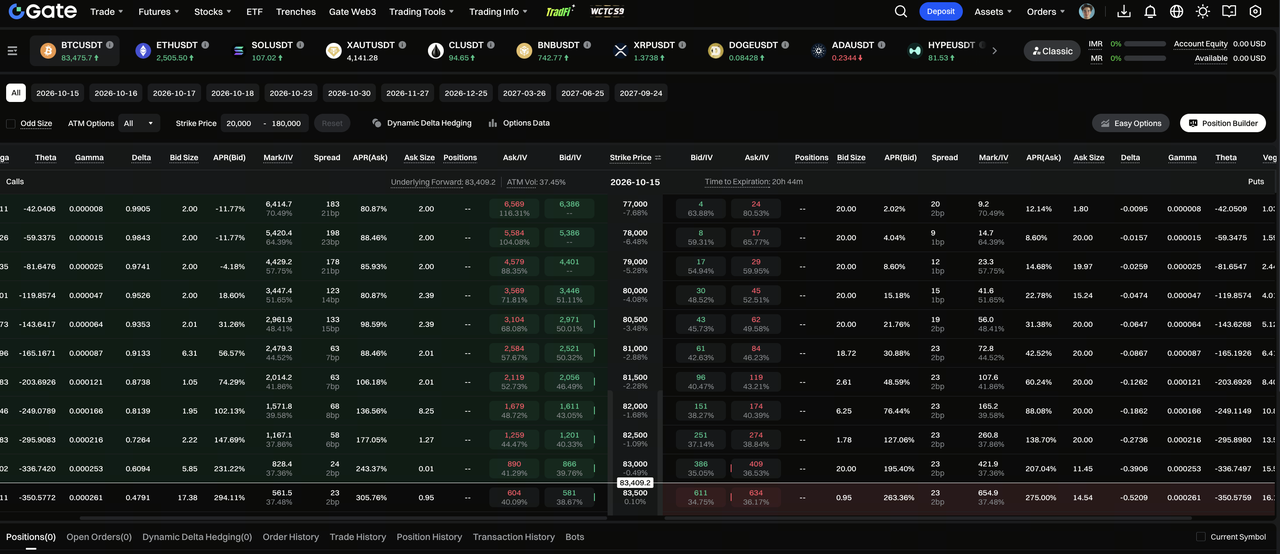
For European-style crypto options such as Gate Options, several factors influence market premiums.
Underlying asset price: Changes in BTC or ETH prices can affect the intrinsic and extrinsic value of call and put options.
-
Strike price: The relationship between the strike price and the underlying asset’s current price influences whether an option is in, at, or out of the money.
-
Time to expiration: Options with more time remaining generally have greater time value, although other factors also affect premiums.
-
Implied volatility: Higher implied volatility generally increases option premiums when other factors remain unchanged.
-
Market liquidity: Bid-ask spreads and available trading depth can affect execution prices.
Traders should also consider settlement currency, collateral requirements, and the contract’s underlying reference price.
These characteristics may influence the economics of a crypto options position even when the exercise style is the same.
How Does Exercise Style Affect Options Trading Strategies?
Exercise style can influence the operational and financial risks associated with options strategies.
The impact is particularly relevant when traders hold short options or combine multiple contracts.
Covered Calls
A covered call involves holding an underlying asset while selling a call option against that position.
With an American-style call, the seller may be assigned before expiration.
This can result in the underlying asset being sold earlier than expected.
The possibility is particularly relevant around dividend dates when early exercise may become economically attractive.
A European-style call removes early assignment risk, although settlement obligations can still arise at expiration.
For crypto traders using European-style options, this fixed exercise schedule can simplify certain aspects of position planning.
However, the economic effectiveness of a covered-call strategy still depends on the premium received, strike price, and underlying asset’s market movements.
Options Spreads
An options spread combines multiple contracts to establish a particular payoff structure.
For American-style spreads, early assignment of a short leg can create an underlying position before the remaining option expires.
This may introduce temporary exposure or additional margin requirements.
European-style options avoid this specific early-assignment problem.
However, they do not eliminate market risk, liquidity risk, or settlement-related obligations.
Traders constructing spreads using crypto options must also consider whether the trading venue supports the required contracts and execution methods.
Protective Puts
A protective put involves purchasing a put option to help offset potential losses in an underlying position.
American-style puts allow the holder to exercise before expiration.
European-style puts provide their contractual exercise payoff only at expiration.
Nevertheless, a European-style put may still be sold before expiration if an active market exists.
For example, a trader holding BTC may purchase a European-style put to establish downside protection over a specified period.
If BTC declines, the put may increase in value and offset part of the loss on the underlying position.
However, the effectiveness of the hedge depends on strike selection, premium, expiration, contract size, and settlement characteristics.
What Are the Risks of European and American Options?
Both option styles involve risks that extend beyond their exercise schedules.
Market Risk
Option values change with movements in the underlying asset, implied volatility, and time remaining until expiration.
A purchased option can lose its entire premium.
An uncovered short option may expose its seller to substantial losses.
Liquidity Risk
Some contracts may be difficult to close before expiration.
Wide bid-ask spreads can also increase trading costs.
This is particularly relevant when trading options with less active strike prices or expiration dates.
Assignment Risk
American-style option sellers may face assignment before expiration.
European-style sellers do not face early assignment, but they remain subject to the contract’s expiration and settlement procedures.
Settlement Risk
Traders must understand whether settlement requires cash payment, delivery of an asset, or another contractual process.
Settlement obligations may affect collateral and margin requirements.
Expiration Risk
The final settlement value may differ from the last price observed during regular trading.
Expiration schedules, settlement-price calculations, and trading cutoffs vary across products.
For Gate Options, traders should review the applicable expiration and settlement procedures rather than assuming that all cryptocurrency options use identical rules.
How Do European-Style Crypto Options Work on Gate?
Gate Options use a European-style exercise structure, meaning the contractual exercise payoff is determined at expiration rather than through early exercise.
This is an important distinction for traders using options to establish directional exposure, manage cryptocurrency holdings, or hedge existing positions.
Trading BTC and ETH Options
Crypto options allow traders to establish positions based on expectations about future cryptocurrency prices.
A call option generally gains value when the underlying asset’s price increases, while a put option generally gains value when the underlying price decreases, assuming other relevant factors remain unchanged.
For example, a trader expecting BTC to appreciate may purchase a call option to obtain upside exposure while limiting the maximum contractual loss to the premium paid.
A trader concerned about a potential BTC decline may instead purchase a put option to establish downside exposure or help hedge an existing holding.
Because Gate Options follow a European-style structure, holders cannot exercise the contracts before expiration.
However, traders may be able to close positions before expiration through available market transactions, subject to trading rules and liquidity.
What Happens When Gate Options Expire?
At expiration, an option’s outcome depends on its strike price, the applicable settlement price, and the contract’s settlement rules.
A call option has positive intrinsic value when the relevant settlement price exceeds its strike price.
A put option has positive intrinsic value when the settlement price is below its strike price.
An out-of-the-money option has no intrinsic value at expiration.
The actual settlement amount depends on the contract’s specifications, including its multiplier, settlement currency, and applicable fees.
European-style exercise does not automatically mean an option must settle in USDT or another stablecoin.
Traders should therefore review Gate’s contract specifications rather than assuming that all crypto options use the same settlement method.
What Should Traders Check Before Trading Gate Options?
Before opening a position, traders should understand the option’s strike price, expiration date, premium, settlement currency, and contract multiplier.
They should also distinguish between exercising an option and closing a position before expiration.
This matters because an option may increase or decrease in market value before expiry due to changes in implied volatility, time decay, and the underlying asset’s price.
For traders using options alongside spot or futures positions, understanding these contract characteristics helps clarify how the hedge may behave under different market conditions.
Are European Options Safer Than American Options?
European-style options are not inherently safer than American-style options.
They eliminate early exercise and early assignment, which can simplify certain aspects of position management.
However, they still expose traders to market movements, volatility changes, liquidity conditions, and settlement obligations.
The level of financial risk depends primarily on the position’s structure.
For example, purchasing a European-style call generally limits the holder’s maximum contractual loss to the premium paid.
Selling an uncovered European-style call can create theoretically unlimited upside loss exposure.
Both contracts have the same exercise style but very different risk profiles.
Similarly, an American-style option does not become inherently riskier merely because it allows early exercise.
The additional flexibility benefits the holder, while the corresponding assignment exposure affects the seller.
For Gate Options users, the European-style structure provides a defined exercise schedule, but it does not eliminate trading risk or guarantee profitability.
Traders should evaluate the complete position rather than treating exercise style as a substitute for risk management.
Conclusion
The main difference between European and American options is when they can be exercised.
American-style options allow exercise before expiration, while European-style options restrict exercise to expiration.
This distinction affects early assignment risk, pricing, and the management of certain options strategies.
For cryptocurrency traders, the distinction is especially relevant because Gate Options use a European-style structure.
Although holders cannot exercise these contracts early, they may still be able to close their positions before expiration through available market transactions.
Understanding how exercise timing differs from settlement and secondary-market trading helps traders evaluate their positions more accurately.
Before trading Gate Options, users should review the applicable contract specifications, including expiration schedules, settlement currencies, and risk requirements.
Frequently Asked Questions
Are Gate Options European or American Style?
Gate Options use a European-style exercise structure, meaning contracts can only be exercised at expiration. Traders may still be able to close positions before expiration through available market transactions, subject to the applicable trading rules.
Can European Options Be Sold Before Expiration?
Yes, if the contract is transferable and a trading market or counterparty is available. European-style exercise restrictions do not automatically prevent secondary-market trading.
Are European Options Always Cash-Settled?
No. Exercise style and settlement method are independent contract features. European options can be cash-settled or physically settled.
Do American Options Have Early Assignment Risk?
Yes. Sellers of American-style options may be assigned before expiration according to the contract’s exercise procedures.
Why Are European Options Common in Crypto Markets?
European-style exercise provides a fixed exercise schedule, which can simplify certain aspects of contract administration and hedging. However, the specific design of crypto options varies by exchange.