A euro stablecoin is a digital asset issued and circulated through blockchain networks with the euro as its value anchor. It is primarily used for on-chain payments, cross-border transfers, transaction settlement, and trading tokenized assets. As the European Union's Markets in Crypto-Assets Regulation (MiCA) is gradually implemented, euro stablecoin issuance is shifting from an early model dominated by crypto companies toward a more institutionalized electronic money and banking framework.
Qivalis is a representative example of this shift. The project involves multiple European banks and aims to launch a euro stablecoin that complies with EU regulatory requirements, providing financial institutions, businesses, and digital asset markets with a new euro settlement tool. Compared with stablecoins issued by a single fintech company, the joint bank issuance model places greater emphasis on the compliance capabilities, payment networks, and institutional customer bases of the existing financial system.
However, bank participation does not mean that a stablecoin automatically complies with MiCA. Requirements related to issuer eligibility, holders' redemption rights, fund safeguarding, asset management, and operational arrangements must still be met. This article uses Qivalis as a starting point to analyze the compliance mechanisms for euro stablecoins under the MiCA framework, the business rationale behind joint bank issuance, and the potential impact of this model on Europe's on-chain financial market.
Key Takeaways
-
MiCA is the EU's unified regulatory framework for crypto assets. It establishes specific requirements for stablecoins linked to a single fiat currency.
-
Stablecoins that maintain a stable value against the euro generally fall under the MiCA definition of electronic money tokens (EMTs). Their issuers must, in principle, be credit institutions or electronic money institutions.
-
Qivalis uses a joint participation model involving European banks and seeks to bring the banking system's compliance, reserve management, and payment infrastructure capabilities into the euro stablecoin market.
-
MiCA focuses not only on whether a stablecoin has sufficient reserves, but also on holders' redemption rights, reserve asset management, disclosures, fund safeguarding, and anti-money laundering requirements.
-
The joint bank issuance model may increase institutional customers' acceptance of euro stablecoins, but it cannot eliminate liquidity, operational, cybersecurity, or cross-border compliance risks.
-
The long-term development of euro stablecoins will depend on actual payment and settlement demand, rather than solely on the number of issuers or the size of token supply.
What Is Qivalis, and Why Are European Banks Choosing to Jointly Issue a Euro Stablecoin?
Qivalis is an electronic money institution headquartered in Amsterdam, the Netherlands. It is supported by multiple European banks and plans to issue a fully reserved stablecoin denominated in euros. Its goal is not simply to launch another crypto trading asset, but to build a euro settlement infrastructure that connects traditional banks, payment service providers, trading platforms, and on-chain financial markets.
Qivalis was established in September 2025. In May 2026, 25 new banks joined the project, expanding its supporting institutions to 37 banks across 15 European countries, including ING, BNP Paribas, BBVA, UniCredit, ABN AMRO, and Rabobank. This cross-bank cooperation structure allows the project to leverage the existing customer networks, payment channels, and compliance experience of its member institutions, rather than relying entirely on a single issuer to build market coverage.
On October 14, 2026, Qivalis announced that it had received authorization as an electronic money institution (EMI) from the Dutch central bank (De Nederlandsche Bank, DNB). Public registration information from the Dutch central bank shows that Qivalis was authorized to conduct activities related to the issuance, distribution, and redemption of electronic money beginning October 13.
This development means that Qivalis has met an important issuer eligibility requirement for issuing euro EMTs. However, obtaining an EMI license does not mean that the stablecoin has been officially issued. As of October 27, 2026, Qivalis still planned to begin issuance in the coming months. The proposed token must also satisfy applicable MiCA requirements, and a crypto-asset white paper must be published.
How Does MiCA Regulate Euro Stablecoins? What Is the Difference Between EMTs and ARTs?
MiCA is the EU's unified regulatory framework for crypto-asset issuance, public offerings, and related services. Its stablecoin rules primarily distinguish between two types of assets: electronic money tokens (EMTs) and asset-referenced tokens (ARTs).
An EMT is a crypto asset that seeks to maintain a stable value by referencing the value of a single official currency. For example, a stablecoin that uses EUR 1 as its value anchor will generally qualify as an EMT. In contrast, an ART may reference a basket of assets, multiple currencies, or another combination of values and is therefore subject to a different set of regulatory requirements.
Although both may be referred to as stablecoins in the market, they differ in terms of issuer eligibility, reserve management, and regulatory obligations.
| Comparison Dimension |
EMT (Electronic Money Token) |
ART (Asset-Referenced Token) |
| Value Reference |
A single official currency |
Multiple assets, currencies, or a combination of values |
| Typical Form |
Euro or dollar stablecoin |
Token referencing a multi-asset basket |
| Issuer |
In principle, must be a credit institution or EMI |
Must satisfy MiCA authorization requirements for ART issuers or applicable exemption requirements |
| Core Regulatory Requirements |
Issuer eligibility, redemption at par value, fund safeguarding |
Reserve assets, redemption rights, governance, and risk management |
| Does This Apply to Qivalis? |
Yes. It plans to issue a euro EMT. |
No. Its proposed product is not an ART. |
For euro EMTs, Article 48 of MiCA requires the issuer, in principle, to be an authorized credit institution or electronic money institution and to notify the competent authority and publish a crypto-asset white paper as required. The article also establishes regulatory notification requirements before a public offering.
This means that a company cannot qualify to publicly offer an EMT in the EU simply by claiming that the token is backed by euro reserves. Compliance depends not only on whether the token maintains a stable price, but also on who assumes the issuance and redemption obligations, who manages the funds, and whether holders have clear legal rights.
What MiCA Compliance Requirements Must Euro Stablecoins Meet?
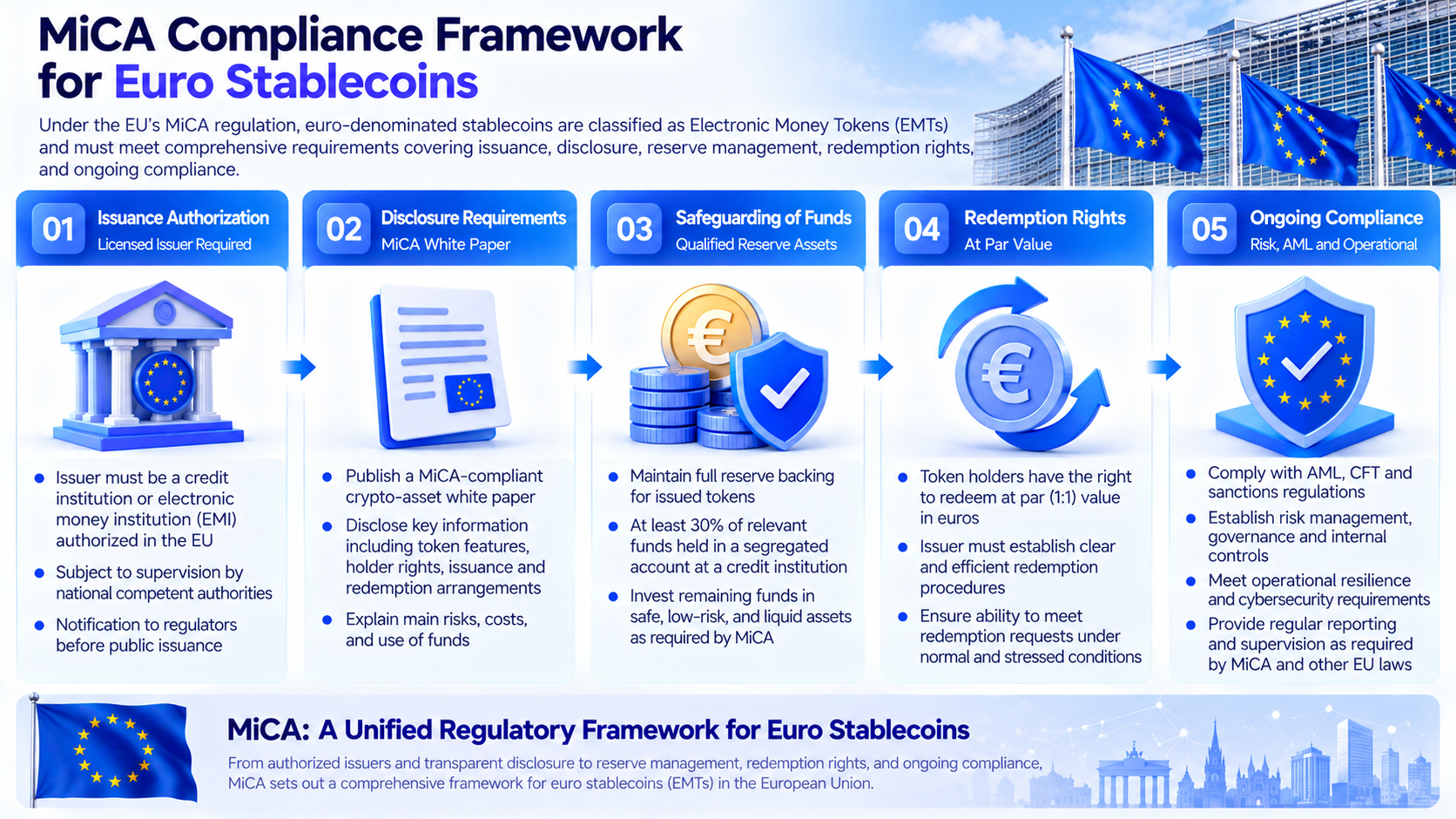
For an institution such as Qivalis that plans to issue a euro EMT, MiCA's requirements apply throughout the token's issuance, circulation, and redemption.
-
Issuer eligibility. The issuer must have the required status as a credit institution or electronic money institution and be subject to the relevant supervision. Qivalis's authorization as an EMI by DNB is an important prerequisite for entering the euro EMT market.
-
Disclosures. The issuer must prepare and publish a crypto-asset white paper that complies with MiCA requirements and describes the token's key features, holders' rights, issuance and redemption arrangements, and related risks. The regulatory notification procedure for a white paper is not the same as a formal issuance license. Investors should not interpret publication of a white paper as a guarantee by the regulatory authority of the token's value.
-
Redemption rights. MiCA requires EMT holders to be able to redeem their tokens from the issuer at par value. For an EMT denominated in euros, the core legal relationship is that holders can claim redemption in euros from the issuer under applicable rules, rather than relying solely on the secondary-market price on exchanges to maintain the peg.
-
Fund safeguarding and asset management. EMT issuers must safeguard received funds in accordance with applicable rules and manage the scope of fund investments and their liquidity. These arrangements are intended to reduce the risk that an issuer will be unable to fulfill its redemption obligations.
In addition, issuers must comply with applicable anti-money laundering, sanctions, operational resilience, and other financial regulatory requirements. MiCA provides the core rules for crypto-asset issuance and services, but it does not mean that an institution can automatically avoid other financial law obligations simply by complying with MiCA.
How Does MiCA Require Euro Stablecoins to Manage Reserve Assets and Redemption Liquidity?
A stablecoin's value anchor generally depends on the issuer's ability to continuously fulfill its redemption obligations. For euro EMTs, regulators focus not only on how many assets the issuer holds, but also on whether those assets are properly safeguarded and whether funds can be provided promptly when large numbers of users request redemptions at the same time.
Article 54 of MiCA establishes investment requirements for funds received and safeguarded by EMT issuers. In general, at least 30% of the relevant funds must be held at all times in separate accounts with credit institutions. The remaining funds must be invested as required in secure, low-risk financial instruments with sufficient liquidity. More stringent requirements may apply to EMTs classified as significant.
It is important to distinguish between full backing and liquidity management. Suppose a euro stablecoin has a circulation volume of EUR 1 billion. Even if the issuer holds eligible assets of equivalent value, it must still ensure that it can mobilize funds promptly in the event of concentrated redemptions. If some assets must be sold before they can be converted into cash, market liquidity and asset settlement times may affect the actual efficiency of redemptions.
In its 2026 analysis of euro stablecoins, the European Central Bank also distinguished between the fund management models of bank and non-bank EMT issuers. The prudential requirements applicable to bank issuers and EMI issuers are not identical. It cannot be assumed that all stablecoins supported by banks use the same reserve structure.
For Qivalis, the project plans to use a fully reserved model. However, the specific reserve composition, asset management arrangements, audit disclosures, and redemption procedures will need to be determined based on the official issuance documents.
How Will Qivalis's Joint Bank Issuance Model Work?
A core feature of Qivalis is its use of an independent issuer in cooperation with multiple banks to connect stablecoin issuance, financial institution distribution, and on-chain settlement.
Unlike a model in which each bank issues its own euro stablecoin, a joint issuance model can build infrastructure around a common token. Participating banks can develop customer services on a unified token system, such as corporate payments, fund transfers, and digital asset settlement, thereby reducing the conversion costs associated with using multiple stablecoins across different institutions.
Qivalis plans to use a B2B2X model. Under this model, the token will first be distributed through banks, trading platforms, payment service providers, and financial market infrastructure participants. These partner institutions will then provide related services to businesses or end users.
Under this structure, Qivalis, as the issuer, will assume the applicable issuance and redemption obligations. Partner institutions may be responsible for customer access, payment services, trading liquidity, and specific use cases. The responsibilities of different partners must be established through formal agreements and regulatory arrangements. The fact that a bank is a supporting institution does not mean that it directly assumes all redemption obligations for the token.
For example, a European company might in the future convert euro funds into an on-chain euro EMT through a partner bank and use it to pay another company. The recipient could choose, based on the available services, to continue holding the token, use it for another on-chain settlement, or redeem it for euros through the relevant channel as required.
This process reflects Qivalis's proposed business model. It does not mean that the token has been listed or that the payment functions described above are already available.
How Does Joint Bank Issuance of a Euro Stablecoin Differ From Issuance by a Single Institution?
In the traditional stablecoin market, many products are led by a single fintech company or specialized stablecoin issuer. The issuer is responsible for token issuance, fund management, and redemption, and establishes a circulation network through trading platforms, payment service providers, and other partners.
The joint bank issuance model seeks to introduce multiple financial institutions at the issuance stage, allowing the product to leverage existing bank customer relationships and payment infrastructure.
| Comparison Dimension |
Joint Bank Issuance Model |
Single-Institution Issuance Model |
| Organizational Structure |
Multiple banks support a common issuer |
A single issuer leads the project |
| Issuance Responsibility |
Legally assumed by the actual issuer |
Legally assumed by the actual issuer |
| Customer Channels |
Can leverage the networks of participating banks and partner institutions |
Relies on channels built or partnered by the issuer |
| Business Focus |
Bank payments, corporate settlement, and institutional finance |
Varies depending on the issuer's positioning |
| Potential Advantages |
Institutional partnerships and distribution coverage |
Centralized decision-making and flexible product iteration |
| Main Challenges |
Cross-institution coordination and governance complexity |
Channel expansion and market competition |
One potential advantage of joint bank issuance is that it can integrate the needs of multiple institutions at the early product design stage. For example, banks in different countries may want a euro stablecoin to support cross-border corporate payments, tokenized securities settlement, or fund transfers for digital asset platforms.
However, the number of participating institutions may also increase coordination costs. Member banks may differ in their risk appetites, technical systems, customer needs, and business priorities. The common issuer must establish clear governance mechanisms.
In addition, bank support does not mean that the stablecoin is jointly covered by deposit insurance or unconditionally guaranteed by all member banks. The rights of EMT holders primarily depend on the actual issuer, applicable laws, and product terms. EMTs should not be treated as equivalent to ordinary bank deposits.
Why Does Europe Need Its Own Euro Stablecoin Settlement Infrastructure?
The global stablecoin market has long been dominated by dollar-denominated assets. Dollar stablecoins have established strong liquidity networks in crypto-asset trading, cross-border fund transfers, and on-chain financial applications. Many trading platforms and DeFi protocols also prioritize dollar stablecoins as units of account or settlement tools.
For European businesses that operate primarily in euros, this may create additional currency conversion needs. For example, if a European company needs to pay another European company through a blockchain, using a dollar stablecoin may require it to first convert euros into a dollar-denominated asset and then convert the funds back into euros when they are received.
If a sufficiently liquid euro stablecoin could be used directly, the transaction may reduce unnecessary foreign exchange exposure and simplify parts of the fund settlement process. However, on-chain transaction costs, stablecoin bid-ask spreads, and fiat on-ramp and off-ramp fees may still apply. It should not therefore be assumed that euro stablecoins will necessarily be cheaper than traditional payments.
For tokenized asset markets, euro stablecoins may also serve as settlement tools for euro-denominated financial products. Suppose a tokenized money market fund is denominated in euros. Using a euro stablecoin for trade settlement could reduce the need to convert between the asset's unit of account and the payment currency.
Qivalis hopes to establish this euro-native on-chain settlement capability through a banking partnership network. However, whether it can achieve broad adoption will still depend on whether trading platforms, payment institutions, businesses, and other financial market participants actually adopt the token.
Can Euro Stablecoins Be Used for Cross-Border Payments and RWA Settlement?
Potential applications for euro stablecoins can be divided into cross-border corporate payments, fund transfers between financial institutions, and settlement of tokenized assets.
In cross-border payment scenarios, a euro EMT can serve as a value transfer tool on a blockchain network. For transactions in which both parties need to use euros, a stablecoin can provide an on-chain transfer method that does not depend on traditional banking hours. However, a complete payment may still involve identity verification, anti-money laundering reviews, recipient access, and fiat currency conversion. Completion of an on-chain transfer does not mean that all payment steps have been completed.
For institutional treasury management, banks and payment service providers can explore using stablecoins to transfer funds between different platforms. Compared with fund transfers that rely entirely on traditional bank account systems, on-chain tokens can be combined with smart contracts to support more flexible automated operations.
In RWA scenarios, euro stablecoins may be used together with tokenized bonds, fund units, or other euro-denominated assets. For example, eligible institutions could explore completing asset delivery and payment settlement within the same technical environment, reducing the need to coordinate operations across different systems.
However, practical applications will still need to address issues such as blockchain interoperability, transaction finality, legal settlement effectiveness, and counterparty eligibility. The fact that a stablecoin can circulate on-chain does not automatically mean that all tokenized securities can use it for regulated settlement.
Therefore, Qivalis's potential value lies not only in issuing a euro token, but also in whether it can establish a reliable connection with existing financial infrastructure.
No. As of October 27, 2026, Qivalis had received EMI authorization from the Dutch central bank, but its euro stablecoin was still in the planning stage. The company stated that issuance was expected to begin in the coming months and would need to comply with relevant MiCA requirements and involve the publication of a crypto-asset white paper.
Before the official issuance, the market will still need to monitor several key issues: which blockchain networks the token will be deployed on, which institutions can subscribe to and redeem it directly, how ordinary users can obtain the token through partner platforms, and whether sufficient liquidity can develop in the relevant trading markets.
Even if the token is officially issued, that does not mean it will immediately achieve broad adoption. The practical value of a stablecoin depends not only on issuer eligibility and reserve assets, but also on whether holders can conveniently obtain, transfer, and redeem the token, and whether payment and trading platforms are willing to support it.
For trading platforms, whether to list a particular euro stablecoin also involves liquidity, technical integration, compliance reviews, and market demand. For corporate customers, the key consideration is whether the token can be effectively integrated with their existing financial systems, bank accounts, and payment processes.
Therefore, Qivalis's EMI authorization is an important development in the institutionalization of euro stablecoins. However, building a mature on-chain euro payment and settlement network will still require product issuance, channel access, and actual use.
What Challenges Do Euro Stablecoins Still Face Under the MiCA Framework?
Market liquidity. Dollar stablecoins have already established relatively mature trading networks in the global crypto market. Euro stablecoins need to attract support from trading platforms, market makers, and payment service providers. Even if the issuer has the required compliance credentials, users may still face higher conversion costs if market depth is insufficient.
Cross-institution operations. Qivalis's joint bank model can help establish a distribution network, but different banks and financial service providers may use different technical systems and internal risk control procedures. Smooth on-chain settlement requires coordination mechanisms covering interfaces, compliance processes, and fund management.
Reserve and redemption management. Issuers must continuously satisfy applicable fund safeguarding requirements and fulfill redemption obligations under both normal and stressed conditions. Even if reserve assets are of high quality, concentrated redemptions may still challenge liquidity arrangements. The European Banking Authority has issued guidance on redemption plans applicable to relevant stablecoin issuers, requiring issuers to establish corresponding arrangements for specific risk scenarios.
Technology and cybersecurity. On-chain stablecoins involve smart contracts, private key management, transaction monitoring, and blockchain network operations. Smart contract vulnerabilities, access management issues, or network disruptions could affect token transfers and the continuity of related services.
Commercial applications. Regulatory compliance provides a legal foundation for stablecoin issuance, but it does not automatically create payment demand. Whether banks, businesses, and trading platforms are willing to change their existing settlement processes will still depend on efficiency, cost, liquidity, and actual business value.
Conclusion
MiCA establishes a relatively clear regulatory framework for euro stablecoins. It brings stablecoins that reference a single official currency within the electronic money token regime and imposes requirements related to issuer eligibility, disclosures, redemption rights, and fund safeguarding.
Qivalis demonstrates a new path for European banks to participate in building on-chain financial infrastructure. Through an independent issuer working with multiple banks, the project aims to apply euro stablecoins to institutional payments, cross-border fund transfers, and tokenized asset settlement.
In October 2026, Qivalis obtained EMI authorization from the Dutch central bank, completing a key regulatory step before formal issuance. However, as of the time of writing, the stablecoin had not yet entered circulation. Its future product launch and market adoption will require continued observation.
From an industry perspective, Qivalis's significance lies not only in the potential emergence of a new euro stablecoin in Europe, but also in the fact that traditional banks are beginning to explore the joint development of an on-chain settlement network. MiCA addresses the institutional foundation for compliant issuance, while liquidity, interoperability, and actual payment demand will determine whether euro stablecoins can develop lasting competitiveness.
FAQ
What Is Qivalis?
Qivalis is an electronic money institution headquartered in Amsterdam, the Netherlands. Supported by 37 European banks, it plans to issue a euro stablecoin that complies with MiCA requirements for on-chain payments and settlement.
Has Qivalis's Euro Stablecoin Been Issued?
As of October 27, 2026, it had not been officially issued. Qivalis had obtained EMI authorization from the Dutch central bank and planned to begin issuance in the coming months.
What Is MiCA?
MiCA is the EU's Markets in Crypto-Assets Regulation. It establishes unified regulatory requirements for crypto-asset issuance, stablecoins, and related services.
Is a Euro Stablecoin an EMT or an ART Under MiCA?
It generally qualifies as an EMT because it references the euro, a single official currency, as its measure of value. ARTs apply to crypto assets that maintain their value by referencing other assets or a basket of assets.
Is a Banking License Required to Issue a Euro Stablecoin?
Not necessarily. In principle, MiCA allows authorized credit institutions or electronic money institutions to issue EMTs. Therefore, a qualifying EMI can also serve as the issuer.
Does MiCA Require Euro Stablecoins to Be Redeemable at Par Value?
Yes. EMT holders have the right to redeem their tokens from the issuer at par value in accordance with applicable requirements. However, the specific redemption channels and procedures must still be understood in conjunction with the product terms.
Are Qivalis's 37 Supporting Banks Jointly Responsible for Redemptions?
This cannot be assumed. Qivalis is an independent issuer, and the actual legal responsibilities must be determined based on the issuance arrangements and relevant agreements. The participation of banks in the project alone does not mean that all member banks jointly guarantee the token.
How Do Euro Stablecoins Differ From Euro Bank Deposits?
A euro stablecoin is an electronic money token on a blockchain. The rights of its holders and fund safeguarding mechanisms are determined by applicable laws and the issuance terms. Bank deposits are liabilities of banks and are subject to different prudential supervision and deposit protection regimes.
Can Euro Stablecoins Be Used for RWA Settlement?
They can serve as potential on-chain settlement tools, but specific applications will also depend on the legal structure of the tokenized assets, trading platforms, settlement rules, and the eligibility of participating institutions.
What Steps Must Qivalis Complete After Obtaining Its EMI License?
It must still complete applicable MiCA white paper notification and publication requirements, establish issuance and redemption arrangements, deploy the technology, and connect with partner channels before it can proceed with the official issuance and use of the token.