However, EIP-1559 does not mean that Ethereum can remain deflationary indefinitely. As Layer 2 scaling networks develop, transaction costs decline, and some on-chain activity migrates to Layer 2 networks, the fee revenue structure of Ethereum's mainnet has changed. When the amount of ETH burned by the network is lower than the new issuance generated by validator rewards, ETH's total supply may continue to increase even when the burn mechanism is operating normally. Recent discussions surrounding the decline in Ethereum's burn volume reflect the market's reassessment of the relationship between network usage, scaling efficiency, and token supply.
Understanding the decline in ETH burn volume requires distinguishing between network transaction activity, fee levels, and changes in token supply. A decrease in burn volume does not necessarily indicate weakening demand across the Ethereum ecosystem, nor can it be used to directly conclude that the price of ETH will decline. This article examines the operating mechanism of EIP-1559 and analyzes how PoS issuance, Layer 2 scaling, Blob fees, and network activity jointly affect ETH's long-term supply structure.
Key Takeaways
- EIP-1559 reduces the supply of ETH by burning transaction base fees, but it does not stop new issuance from PoS validator rewards.
- Whether ETH is deflationary depends on the relative amounts burned and newly issued during a given period, not on whether the burn mechanism exists.
- Lower mainnet Gas fees reduce the amount of ETH burned per unit of Gas, but do not necessarily indicate a decline in overall Ethereum ecosystem usage.
- Layer 2 scaling can reduce users' transaction costs, but may also change mainnet block space demand and the structure of fee burning.
- Blob fees introduced by EIP-4844 also include a burn mechanism, but their fee market operates independently from the regular execution-layer Gas market.
- Investors should consider changes in ETH's net supply, mainnet fees, Blob usage, staking levels, and Layer 2 activity together when assessing changes in Ethereum's token economics.
What Is EIP-1559? How Does the ETH Fee-Burning Mechanism Work?
EIP-1559 is a transaction fee reform mechanism introduced in Ethereum's 2021 London upgrade. Its primary purpose is to improve Gas fee pricing and make transaction costs easier for users to estimate. Under this mechanism, Ethereum transaction fees mainly consist of the base fee and the priority fee. The protocol adjusts the base fee dynamically based on block space demand, and the fee is burned after the transaction is executed. The priority fee is generally paid to the block proposer to incentivize transaction inclusion. Users can also set a maximum fee to prevent the actual payment from exceeding their expectations.
Changes in the base fee are related to block utilization. When transaction demand is high and blocks consistently exceed their target utilization, the Base Fee generally increases. When demand for block space is insufficient, the Base Fee decreases. Ethereum does not burn a fixed amount of ETH. Instead, the burn volume is determined by the actual amount of Gas used and the corresponding base fee. For example, even if two transactions consume the same amount of Gas, they may burn different amounts of ETH if the Base Fee differs when they are executed.
This design connects network demand with changes in ETH supply. Users pay the base fee to execute transactions, and the corresponding ETH is permanently burned rather than transferred to validators or other participants' accounts. However, the primary goal of EIP-1559 is not to ensure that ETH remains deflationary forever. It is to improve how the fee market operates. ETH burning is a monetary supply effect of the mechanism, while the actual burn volume still depends on network usage and fee levels.
Why Is ETH Burn Volume Declining? Does This Mean Network Activity Is Decreasing?
A decline in ETH burn volume is usually related to lower mainnet base fees, but it cannot be simply interpreted as a broad decline in Ethereum ecosystem activity. Burn volume is affected by both the amount of Gas consumed by transactions and the Base Fee level. If the network can process a large number of transactions at lower fees, the amount of ETH burned may decline significantly even if transaction volume remains stable. Conversely, when popular applications compete for mainnet block space, fees may rise rapidly, resulting in substantial burn volume over a short period. DeFi transactions, NFT minting, and other on-chain activities have driven mainnet fees higher during specific periods, but this demand may not be sustainable over the long term.
In November 2026, discussions surrounding the ETH burn mechanism once again attracted attention. Vitalik Buterin recently suggested that a sustained increase in fee burn volume should not be viewed as the primary foundation of ETH's long-term value, because higher burn volume may depend on expensive transaction fees, while a low-cost, scalable network is also important. This view does not mean that EIP-1559 will be removed. Instead, it emphasizes that ETH's value also needs to be based on network security, decentralization, censorship resistance, and practical financial use cases.
Activity across the Ethereum ecosystem is also changing. An increasing number of ordinary transfers, trades, and application interactions are taking place through Layer 2 networks, so users no longer need to pay the full execution cost of Ethereum's mainnet directly for every operation. The mainnet's role is gradually becoming more focused on settlement, data availability, and security. Determining whether the network has genuinely lost demand requires observing mainnet transactions, Layer 2 activity, settlement demand, and application usage together, rather than looking only at how much ETH is burned each day.
Why Doesn't EIP-1559 Guarantee Continued ETH Deflation?
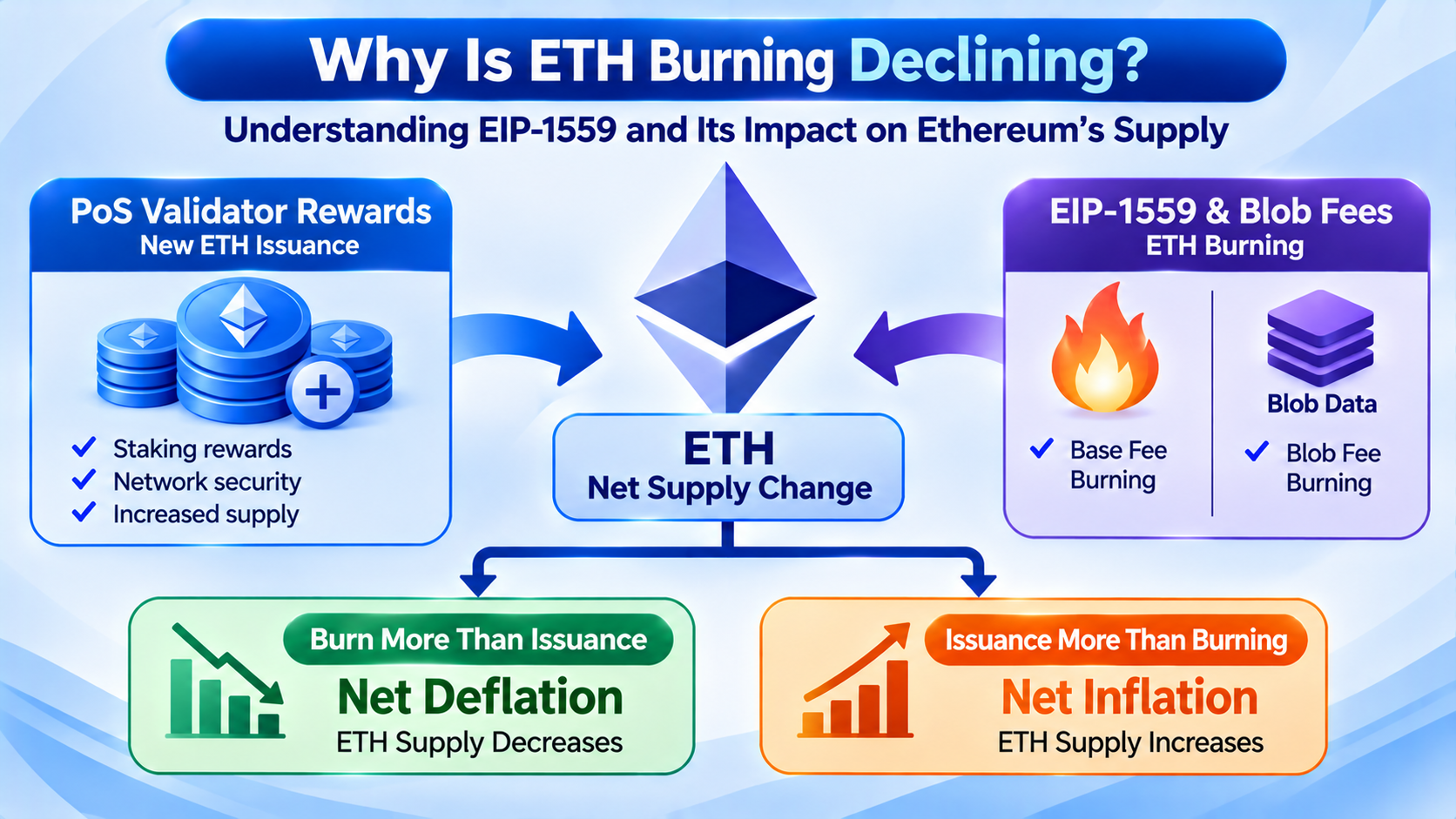
ETH's supply changes are affected by two primary factors: new issuance and burning. New issuance mainly comes from rewards paid to validators under the PoS consensus mechanism, while burning primarily comes from transaction base fees and other applicable protocol fees. When the amount burned during a given period exceeds new issuance, ETH's total supply decreases, resulting in net deflation. When new issuance exceeds the amount burned, ETH's total supply increases, resulting in net inflation. Both situations can occur while EIP-1559 is operating normally.
After The Merge was completed in 2022, Ethereum stopped issuing rewards from its former PoW mining system. New ETH now comes primarily from the PoS consensus layer. This significantly reduced the network's issuance rate and made it easier for transaction fee burning to exceed issuance during certain periods. However, a lower issuance rate does not mean issuance has stopped completely. Validators continue to participate in block proposal and validation and receive protocol rewards. Staking levels, validator reward rules, and network fee levels jointly determine changes in ETH's net supply.
For example, suppose Ethereum issues 1,000 ETH during a given period but burns only 600 ETH. The network would still record a net increase of approximately 400 ETH. If 1,500 ETH were burned during the same period, the net supply would decrease by approximately 500 ETH. These are hypothetical figures used only to explain the mechanism and do not represent the network's current issuance or burn levels. EIP-1559 guarantees that base fees meeting the applicable rules will be burned. It does not guarantee that the amount burned will always exceed validator rewards. Describing ETH as an asset that must remain deflationary indefinitely can overlook the dynamic nature of its supply mechanism.
Why Does Layer 2 Scaling Affect ETH Burn Volume?
Layer 2 is an important part of Ethereum's scaling architecture. It primarily executes or processes large numbers of transactions outside the mainnet and then submits the relevant data or state proofs to Ethereum, enabling lower user transaction costs. Networks such as Arbitrum, Optimism, and Base use different Rollup technologies. For ordinary users, Layer 2 reduces the cost of directly using the mainnet, making payments, trades, and application interactions more convenient. For Ethereum's mainnet, the migration of transaction activity to Layer 2 changes the sources of demand for block space.
In the past, a user conducting a complex DeFi transaction on Ethereum's mainnet might have needed to consume a substantial amount of Gas and pay a high base fee. After executing a similar operation on Layer 2, much of the computation and transaction processing can take place on the Layer 2 network, with the Rollup ultimately submitting the relevant data or proof to the mainnet. The mainnet still performs important settlement and security functions, but it no longer processes every user operation directly. As a result, the relationship between growth in total ecosystem transaction volume and growth in mainnet fees is no longer as direct as it was in the early days.
Scaling also creates an economic issue worth noting: lower network usage costs may bring more applications and users into the Ethereum ecosystem, but this additional activity may not immediately translate into a proportional increase in ETH burn volume. Lower fees can improve the user experience while also reducing fee revenue generated by each transaction. Whether Ethereum can maintain low costs while creating sufficient demand for ETH burning will depend on the scale of Layer 2 activity, mainnet settlement demand, and the development of the data availability market. Successful scaling and continued ETH deflation are not exactly the same objective.
How Do EIP-4844 and Blob Fees Change the Structure of ETH Burning?
EIP-4844 is an important scaling mechanism introduced in Ethereum's 2024 Dencun upgrade. It provides Blob data space for Rollups that is better suited to submitting transaction data in batches. Before this, Layer 2 networks generally had to use a relatively expensive mainnet transaction data storage method. The introduction of Blobs enables Rollups to publish data differently from regular execution-layer transactions, reducing some data availability costs and contributing to lower Layer 2 transaction fees. For Rollups that process large numbers of user transactions, this change helps improve their cost structure and scalability.
Blobs use an independent fee market, and their base fees are also burned. However, these fees are calculated separately from the base fees for regular execution-layer Gas. Regular transactions primarily adjust the Base Fee based on execution-layer block space demand, while Blob fees depend on the supply and demand of Blob data space. When Blob usage is low and data space is relatively abundant, Blob base fees may remain low. Even if Layer 2 networks continue submitting data, the resulting ETH burn volume may be limited. As demand for Blobs increases, the fee mechanism adjusts accordingly, but it cannot be assumed that higher Layer 2 transaction volume will necessarily result in a proportional increase in ETH burning.
This change makes the structure of ETH burning more complex. Investors need to monitor not only fees generated by regular mainnet transactions, but also demand for Blob data and the corresponding fee levels. As Ethereum continues to expand data availability, the network may process more Layer 2 data while maintaining a low unit cost. For users and application developers, this is generally beneficial for expanding usage. From the perspective of ETH supply, however, low-cost scaling may allow burn volume to remain relatively moderate for an extended period. Assessing the impact of EIP-4844 requires considering both scaling efficiency and token economics rather than measuring the success of the upgrade solely by ETH burn volume.
How Does the PoS Staking Level Affect New ETH Issuance?
After The Merge, Ethereum began maintaining network security through the PoS consensus mechanism. Validators participate in block proposal and validation by staking ETH and receive rewards according to protocol rules. Unlike the PoW era, when miners competed for computing resources, PoS security relies primarily on validators' staked assets and the corresponding slashing rules. New ETH issuance mainly comes from consensus-layer rewards, and the amount of rewards is related to the amount of ETH staked, validator performance, and protocol parameters. An increase in the staking level generally raises the network's total reward issuance, but the reward rate per staked ETH does not increase at the same rate.
There is no direct fixed relationship between staking rewards and ETH burning. Even if network transaction activity remains stable, changes in consensus-layer issuance may cause ETH's net supply growth rate to change. Conversely, when mainnet transaction demand increases significantly and the Base Fee rises, burn volume may exceed new issuance over a short period, causing ETH to return to a state of net deflation. PoS issuance and EIP-1559 burning are driven by different mechanisms, and together they determine the final change in supply.
Staking lockups must also be distinguished from token burning. When users stake ETH, those ETH are not permanently removed from the total supply. Staked assets remain ETH within the network, although they are subject to validator exit and withdrawal procedures under certain conditions. Burning means that the relevant ETH is permanently removed from the protocol-recognized supply. The market sometimes associates an increase in staked ETH with a reduction in the supply available for sale, but this is a liquidity analysis and cannot be directly equated with a decline in total ETH supply. Determining whether Ethereum is deflationary still requires observing actual issuance and burn data.
Does a Decline in ETH Burn Volume Mean That Its Price Will Necessarily Come Under Pressure?
A decline in ETH burn volume may weaken some investors' expectations regarding token scarcity, but there is no fixed causal relationship between burn volume and market price. EIP-1559's burn mechanism can reduce the increase in supply. All else being equal, lower net issuance may affect the long-term supply structure. However, the price of ETH is also affected by investor demand, market liquidity, macroeconomic interest rates, institutional capital allocation, the development of on-chain applications, and overall crypto market sentiment. Even if the network enters a state of net deflation, the price may still decline if selling demand increases significantly. Conversely, even if supply grows moderately, the price may rise if demand for the asset expands.
The relationship between fee burning and economic activity on the network also requires careful interpretation. High ETH burn volume may result from active DeFi trading and application demand, but it may also result from short-term speculation, NFT trends, or network congestion. High fees can increase burn volume but may also reduce ordinary users' willingness to use the network. Although low fees reduce the burn contribution of each transaction, they can improve the application experience and create favorable conditions for payments, stablecoin settlement, and other high-frequency use cases. Ethereum's long-term development depends not on maintaining expensive transaction fees, but on supporting more economically meaningful activity while preserving network security and decentralization.
From an investment perspective, ETH's value cannot be attributed entirely to supply contraction. ETH is used to pay network fees, participate in staking, and provide collateral for DeFi. It also serves various economic functions across Ethereum and its broader ecosystem. As stablecoins, tokenized assets, and on-chain financial services develop, the structure of demand for ETH may continue to change. However, the extent to which increased ecosystem activity translates into demand for ETH as an asset still requires specific analysis. Burn volume is an important indicator of network economic activity, but it is not an independent price prediction tool and is even less suitable as the sole basis for determining when to buy or sell.
How Should Investors Assess Whether ETH May Return to Deflation?
Observing ETH's supply trend requires distinguishing short-term fluctuations from long-term changes.
Daily burn volume can be affected by popular applications, market volatility, and temporary network congestion, so it cannot fully reflect the network's overall economic condition. Investors can examine ETH's net supply changes over 7-day, 30-day, and longer periods to determine whether the amount burned has remained above new issuance. If total ETH supply continues to decline during a given period, that period can be considered net deflationary. If supply continues to increase, new issuance exceeded the amount burned during the same period. When using different data platforms, investors should also pay attention to data update times, supply definitions, and whether the statistical periods are consistent.
Fee structures and network activity should also be monitored. Mainnet Base Fee, Gas usage, Blob fees, and demand for Layer 2 data submissions can help explain why burn volume changes.
If mainnet fees decline while Layer 2 transaction volume and data usage continue to increase, this may indicate that activity is migrating to scaling networks rather than contracting across the ecosystem as a whole. Investors can also consider stablecoin supply, DeFi activity, on-chain settlement, and real-world application usage to assess whether Ethereum is developing new sources of demand. Different indicators may have different time lags, and short-term growth in activity may not immediately translate into higher ETH burn volume.
PoS issuance and protocol upgrades also require attention. Changes in staking levels, adjustments to validator reward mechanisms, and future upgrades that may affect the execution-layer or data availability fee markets could all change ETH's long-term supply structure.
When evaluating these changes, investors should distinguish between protocol rules that have already been implemented and designs that remain in the research, discussion, or proposal stage. For long-term investors, whether ETH becomes deflationary in a particular quarter is only one part of the analysis. More important is whether Ethereum can continue attracting genuine economic activity and maintain its role in the on-chain financial system through secure and scalable infrastructure.
Summary
A decline in ETH burn volume does not mean that EIP-1559 has failed. Instead, it reflects changes in Ethereum's fee market and network activity structure. EIP-1559 permanently burns transaction base fees, connecting ETH supply with demand for network block space. However, the mechanism does not guarantee that the amount burned will always exceed new issuance. Since The Merge, PoS has significantly reduced the rate of new ETH issuance. The network has experienced net deflation during certain periods, but as fees decline and activity migrates to Layer 2, ETH may return to a state of net inflation.
Layer 2 scaling and the Blob data mechanism have further changed how network fees are generated. More transactions can be completed at lower cost, which helps expand Ethereum ecosystem usage but does not necessarily produce a proportional increase in ETH burn volume. Low fees and low burn volume do not necessarily indicate that network development is being hindered, and higher burn volume alone cannot prove that the network has greater long-term economic value.
For investors, changes in ETH supply should be analyzed together with network demand, staking issuance, Layer 2 activity, and market capital flows. EIP-1559 is an important component of Ethereum's token economics, but ETH's long-term value still depends on whether the network can continue providing secure, reliable, and genuinely needed blockchain infrastructure. Rather than treating deflation as an inevitable outcome, understanding the dynamic relationship between issuance and burning is more helpful for forming an objective market assessment.
FAQ
What Does a Decline in ETH Burn Volume Mean?
A decline in ETH burn volume means that the amount of ETH permanently removed from supply through mechanisms such as EIP-1559 decreased during a specific period. The primary factors include mainnet Gas usage, base fee levels, and Blob data fees.
Does EIP-1559 Guarantee That ETH Will Always Be Deflationary?
No. EIP-1559 guarantees that base fees meeting the applicable rules are burned, but ETH continues to be newly issued through the PoS consensus mechanism. ETH's total supply decreases only when the amount burned exceeds new issuance.
Why Can ETH Change From Deflationary to Inflationary Again?
When network fees decline and the amount of ETH burned falls below new issuance from validator rewards, total supply may increase. This is a normal state that can occur under Ethereum's existing monetary mechanism.
Does Higher Layer 2 Transaction Volume Mean Higher ETH Burn Volume?
Not necessarily. Layer 2 networks can process transactions in batches and submit data or proofs to the mainnet. Their impact on ETH burn volume depends on mainnet execution fees, Blob data fees, and actual settlement demand. It cannot be estimated simply from the number of Layer 2 transactions.
Are Blob Fees Burned?
Yes. The Blob base fees introduced by EIP-4844 include a burn mechanism, but their fee market operates independently from the regular execution-layer Gas market.
Is Staking ETH the Same as Burning It?
No. Staked ETH remains part of the network's total supply, while burned ETH is permanently removed from supply. The two have different effects on liquidity and token economics.
Does a Decline in ETH Burn Volume Mean That the Price Will Necessarily Fall?
No. Burn volume affects changes in supply, but the price of ETH is also influenced by investment demand, the macroeconomic environment, market liquidity, and ecosystem development, among other factors.