Introduction
When discussing corporate stablecoin payments, people often first think of "paying overseas suppliers with USDC." However, from a transactional technology perspective, this description is overly simplistic. The real change is that corporate payment systems are beginning to view blockchain networks as a schedulable settlement track, integrating stablecoins into existing payment, fund management, and reconciliation processes.
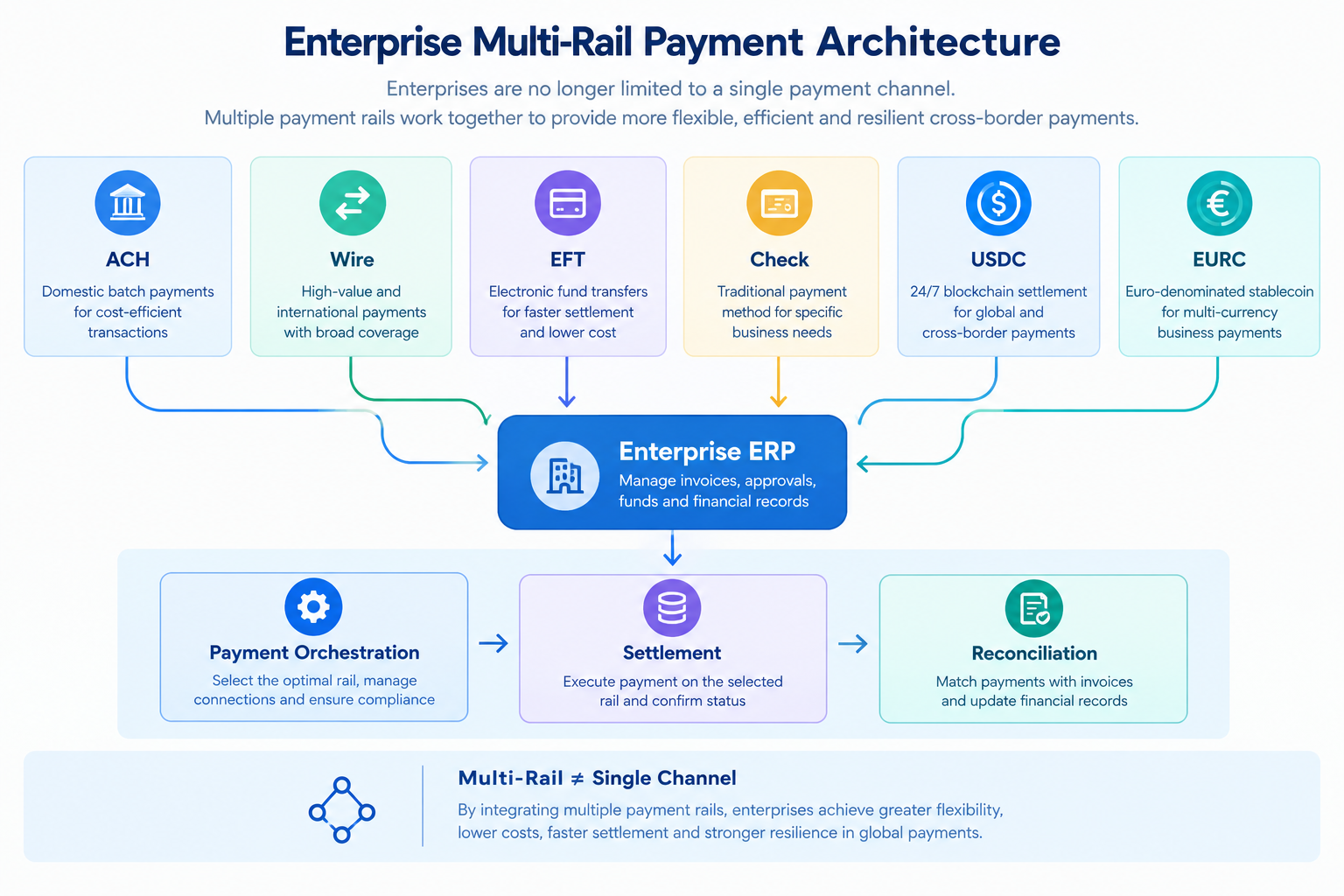
In October 2026, Tereina launched SAP Pay, embedding payment capabilities into SAP Cloud ERP and supporting both traditional payment methods and stablecoin payments. Subsequently, Circle announced a partnership with Tereina to incorporate USDC and EURC into corporate workflows. SAP Pay supports various payment methods, including ACH, EFT, wire transfers, checks, and stablecoins, connecting different payment tracks through payment routing and automated reconciliation.
Therefore, SAP Pay should be understood more as a case of "payment orchestration" rather than just a stablecoin payment product. It demonstrates a new transactional system structure: companies no longer have to choose between the banking system and the blockchain system; instead, they can allow different payment tracks to operate concurrently based on transaction conditions.
Key Points
-
Corporate payments are shifting from a single payment channel to a multi-track payment architecture.
-
One of the most significant technological changes with stablecoins is the provision of 24/7 on-chain settlement tracks.
-
USDC and EURC serve as on-chain settlement assets for USD and EUR, respectively.
-
The payment orchestration layer determines which track a transaction should follow.
-
The key to cross-border payments is not just speed but also liquidity, FX, compliance, and reconciliation.
-
Blockchain solutions like Arc are attempting to become enterprise-grade on-chain financial infrastructure.
-
The USDC capabilities of Gate Pay and Gate US can serve as another observation sample in the crypto payment market.
Why Corporate Cross-Border Payments Need "Multi-Track" Instead of a Single Payment Network
Corporate cross-border payments are inherently complex. A company may need to pay domestic suppliers, overseas suppliers, employees, conduct internal fund transfers, and manage different bank accounts and currencies across various countries.
There is no unified best payment method for these transactions. For some transactions, bank transfers still have mature compliance and account systems; for others, stablecoins can offer different settlement times and fund transfer methods.
Thus, the focus of future corporate payment systems may not be on finding a "best payment network," but rather on establishing a system that can manage multiple payment networks.
SAP Pay exemplifies this approach. SAP's official materials place ACH, EFT, wire transfers, checks, and stablecoins in the same payment environment and emphasize intelligent routing, which selects the appropriate payment track based on transaction conditions.
This means that stablecoins do not need to eliminate bank payments to create value. They can participate as an additional track in the competition, while the corporate payment system decides when to use which track.
Why Stablecoins Can Become New Cross-Border Settlement Tracks
The most significant technological difference between stablecoins and traditional bank transfers is not merely "one is on-chain and the other is not," but rather the relationship between value transfer and payment networks.
Traditional cross-border payments often require multiple financial institutions and payment networks to complete fund transfers, while stablecoins are digital assets that can move within blockchain networks. As long as companies meet the necessary account, compliance, and service conditions, they can use stablecoins as payment assets directly in on-chain settlement processes.
In Circle's description of SAP Pay, USDC is defined as a 24/7 settlement track that can run parallel to existing bank tracks, emphasizing its use for cross-border supplier payments, internal fund transfers, and AP/AR settlements.
This creates a new temporal structure for corporate payments. The banking system can still handle traditional payments, but the blockchain network can provide around-the-clock digital asset settlement tracks. Once connected through a payment orchestration system, companies no longer need to have all transactions follow the same timing and network rules.
This is where stablecoins truly warrant research in the corporate payment field: they do not merely add a payment asset but introduce a different settlement network.
Why USDC and EURC Need to Enter Corporate Payment Systems Simultaneously
Another often-overlooked issue in corporate cross-border payments is the currency of denomination.
If all international payments are conducted in USD, companies may need to handle additional foreign exchange conversions before and after payments. For companies with European operations, the introduction of EURC provides another on-chain settlement asset denominated in euros.
Circle positions EURC as a euro stablecoin, emphasizing its 1:1 exchange with euros, MiCA compliance, and multi-chain availability. EURC can also connect with USDC for on-chain FX and cross-border payment scenarios.
Thus, the combination of USDC and EURC corresponds to a fundamental issue in corporate multi-currency fund management: what companies need is not a globally unified digital currency, but a digital asset system that enables low-friction settlement and conversion between different currencies.
When corporate payment systems can handle USD, EUR, and traditional bank currencies simultaneously, the role of stablecoins begins to expand from "crypto payment assets" to "corporate fund management tools."
Why Payment Orchestration May Become a New Transactional Technology Layer
If companies have multiple payment tracks, a new question arises: who decides which track each payment should follow?
This is the role of the payment orchestration layer.
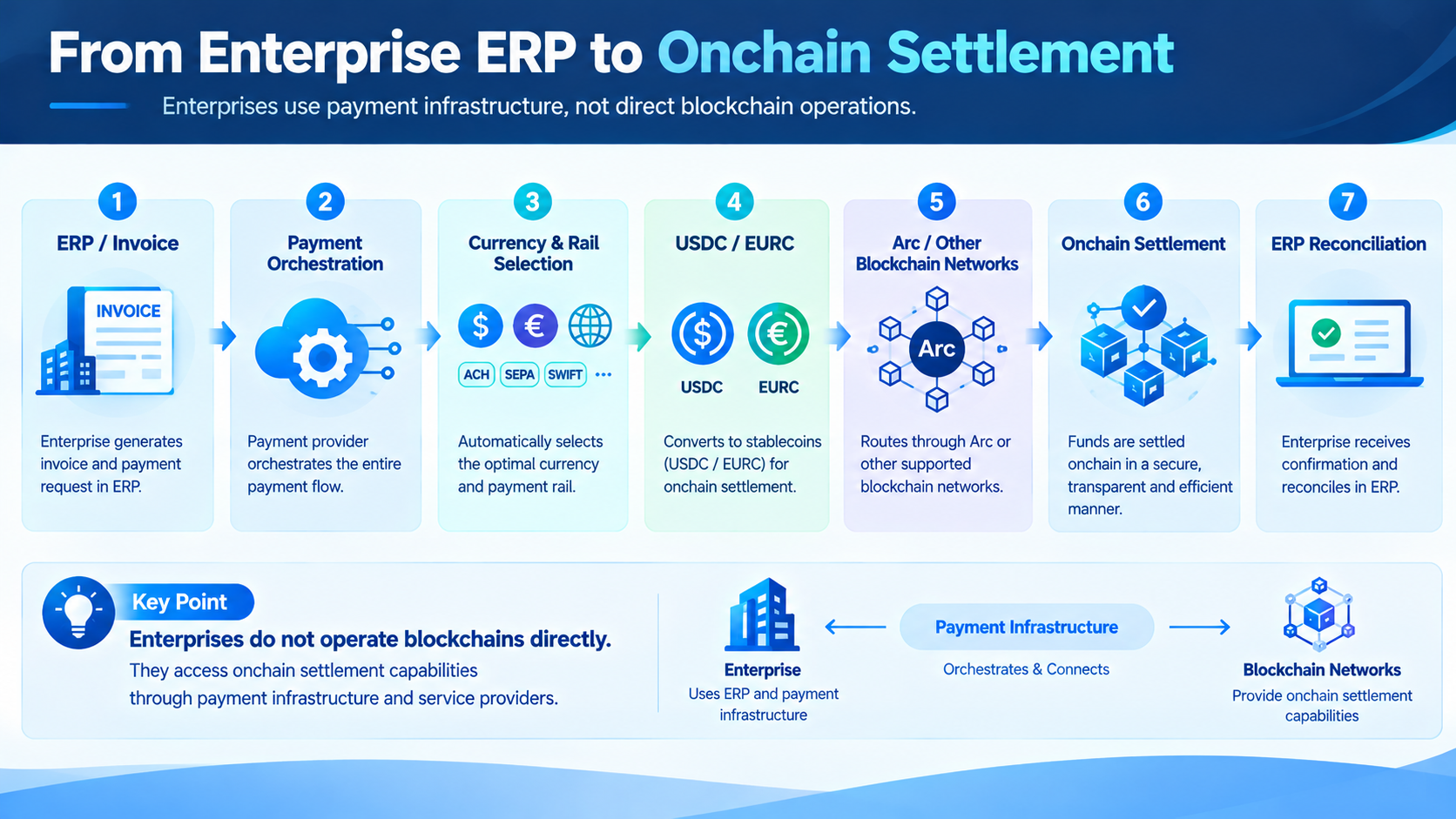
The payment orchestration system needs to read the payment amount, currency, recipient country, recipient information, transaction type, and internal corporate rules, then select the appropriate payment method. After execution, it must return the transaction status to the original ERP system.
SAP's official description of SAP Pay explicitly includes payment orchestration: once payments are initiated from ERP, they can be routed to different fiat or digital currency payment tracks, with execution status returned while connecting to the original business documents.
This is similar to the long-discussed "abstraction layer" in the blockchain industry. Companies should not need to understand the RPC, gas, address formats, and confirmation rules of each chain; instead, they should submit payment requests through a unified interface, with the underlying system responsible for execution.
As this layer matures, the threshold for companies to adopt stablecoins will decrease, as they will see a unified payment interface rather than a complex blockchain infrastructure.
Why the Emergence of Arc is Worth Including in the Corporate Payment Technology Framework
In September 2026, Circle launched Arc Mainnet, positioning it as a Layer 1 designed for financial markets, real-time fund movement, and agentic economic activities. At launch, Arc already had over 100 institutions and ecosystem participants.
This differs from the design goals of traditional general-purpose public chains. Corporate payment scenarios focus on determinism, controllability, settlement efficiency, financial asset support, and institutional participation, rather than merely maximizing general computational capacity.
SAP Pay's stablecoin payment solution has chosen Arc as one of the preferred networks for eligible transactions, allowing Arc to quickly enter the practical application environment of corporate payments. Reports indicate that shortly after SAP Pay's launch, Arc was incorporated into its stablecoin trading architecture.
From a technological evolution perspective, this indicates that corporate stablecoin payments may be forming a new layered structure: the upper layer consists of ERP and payment orchestration, the middle layer includes stablecoins and financial service interfaces, and the lower layer is dedicated to value settlement through blockchain networks.
Why the True Technical Bottleneck of Cross-Border Payments is Not TPS
When discussing payments, blockchain projects often emphasize TPS, block time, and transaction costs. However, for corporate cross-border payments, these metrics are only part of the picture.
Even if a corporate payment can achieve on-chain confirmation in seconds, if the company cannot verify the payment recipient, meet compliance requirements, complete source of funds checks, or automatically match transaction results to invoices, it still cannot use it as a mature payment process.
Therefore, what corporate payment technology truly needs to optimize is the entire transaction lifecycle, not just the speed of individual on-chain transactions.
This lifecycle can be broken down into five stages: payment request, identity and compliance, payment routing, asset settlement, and financial reconciliation. Blockchain primarily optimizes the settlement portion, while ERP, payment service providers, and financial infrastructure handle the other stages.
This also explains why products like SAP Pay emphasize not just blockchain settlement, but also payment automation, automatic reconciliation, customer identity verification and anti-money laundering, and payment orchestration.
How Corporate Stablecoin Payments and Traditional Bank Payments Will Coexist
After stablecoins enter corporate payments, a common misconception is that bank payments will be quickly replaced. However, from a transactional system perspective, a more realistic scenario may be the long-term coexistence of both systems.
Bank payments have mature account systems, regulatory frameworks, and corporate relationship networks, while stablecoins offer on-chain transfer, around-the-clock operation, and the ability to combine digital assets. Under different transaction conditions, companies may require different payment tracks.
Thus, future corporate financial software is more likely to become a unified control layer for different payment networks. Companies only need to handle "I want to complete this payment," while the underlying system determines whether to use ACH, wire, stablecoins, or other payment methods.
This structure bears some similarity to infrastructure abstraction in cloud computing. Companies do not need to know which physical data center the servers are running in; they only need to use a unified service interface. In the future, companies may not need to directly manage each payment network but instead call different settlement tracks through the payment orchestration layer.
Gate's Position in This Payment Technology Framework
Gate's payment products can also be observed within this larger technological evolution.
Gate Pay provides merchants with digital asset collection, disbursement, exchange, settlement, and reconciliation, offering access methods such as cash registers, QR codes, payment addresses, and APIs. It leans more towards merchants and payment infrastructure within the digital asset payment network.
Meanwhile, Gate US has already supported USDC/USD exchanges through Circle Mint, creating a more direct funding conversion path between USDC and USD.
This does not completely align with SAP Pay's corporate ERP path, but both can be understood within the same technological framework: one end addresses how digital assets enter merchant payments, while the other addresses how stablecoins enter corporate financial software. As these systems gradually connect, digital asset payments may transition from standalone crypto products to broader commercial software and financial infrastructure.
What Changes Will Occur in Stablecoin Payments When AI Begins to Participate
Another long-term direction worth observing in SAP Pay is agentic payments.
SAP has already incorporated AI agents into the payment execution development roadmap for SAP Pay. This means that in the future, corporate AI will not only analyze cash flow or generate financial reports but may also trigger payments directly based on pre-set corporate rules.
If this model holds, the programmable features of stablecoins will become even more important. An AI agent can determine whether a payment should be made based on invoice status, supplier information, payment deadlines, fund balances, and corporate policies, then call the payment orchestration layer to select the appropriate payment track.
In traditional systems, after AI makes a payment suggestion, human intervention is often required to execute it in the banking system; however, in a highly automated system, the distance between decision-making and execution may shorten further.
This suggests that future transactional technology may no longer be just "human-operated payment systems," but rather form a closed loop of "business event → AI decision → payment orchestration → stablecoin or bank settlement → automatic reconciliation."
How to Establish a Long-Term Observation Framework for Corporate Stablecoin Payments
When researching corporate stablecoin payments, four dimensions can be observed.
The first dimension is payment tracks. It is essential to observe whether stablecoins truly become a commonly used track beyond bank payments, rather than remaining in the proof-of-concept stage.
The second dimension is fund flow. Whether stablecoin payments can connect corporate fund management, cross-border payments, internal fund transfers, and foreign exchange management will directly impact their position within corporate financial systems.
The third dimension is software integration. If stablecoins must rely on independent wallets, manual operations, and additional reconciliations, the adoption costs for companies will remain high. Conversely, if stablecoins can be directly embedded into ERP, financial software, and payment APIs, the adoption threshold will decrease.
The fourth dimension is settlement networks. Differences among various blockchains in terms of cost, stability, liquidity, compliance infrastructure, and institutional participation will affect their ability to handle enterprise-level payment traffic.
From this perspective, cases like SAP Pay, Circle, Arc, and Gate Pay are not isolated product news but can be placed within a larger technological framework: enterprises are gradually abstracting digital asset payment capabilities into standardized financial infrastructure.
Understanding the Corporate Adoption of Stablecoins Through Multi-Track Payments
The most noteworthy change in corporate stablecoin payments is not that companies are starting to use a new digital currency, but that payment systems are beginning to accept blockchain as a new settlement infrastructure.
In this system, ERP is responsible for business and financial data, payment orchestration selects the path, stablecoins like USDC and EURC facilitate digital value transfer, blockchain handles on-chain settlement, and finally, ERP completes financial reconciliation.
This means that stablecoins do not necessarily need to become the sole solution for all payment scenarios. They are more likely to coexist with traditional payment methods like ACH, wire, and EFT, providing an alternative technical path in specific scenarios such as cross-border payments, around-the-clock settlement, and multi-currency fund management.
As corporate software, stablecoin issuers, payment service providers, and blockchain networks gradually connect, what is truly worth observing is no longer just "which companies start accepting stablecoins," but rather whether stablecoins are becoming a foundational financial capability that corporate software can call upon.
FAQ
What is the difference between corporate stablecoin payments and regular cryptocurrency payments?
Corporate stablecoin payments are typically embedded in ERP, payment approvals, payment orchestration, and automatic reconciliation processes, while regular cryptocurrency payments may only require a wallet address and on-chain transfer, resulting in different system complexities and use cases.
What is multi-track payment?
Multi-track payment refers to the ability of companies to use different payment methods such as ACH, wire transfers, EFT, checks, and stablecoins within the same payment system, selecting the appropriate settlement track based on transaction conditions.
Why do corporate stablecoin payments need payment orchestration?
Because companies face different countries, currencies, and payment networks simultaneously. Payment orchestration can select payment methods based on transaction conditions and return execution results to ERP.
Why are both USDC and EURC suitable for corporate cross-border payments?
USDC provides an on-chain settlement asset denominated in USD, while EURC offers a stablecoin asset denominated in euros. Together, they help companies reduce unnecessary conversion steps in different currency payment and fund management scenarios.
What role does Arc play in SAP Pay?
Arc is a Layer 1 developed by Circle for financial markets and real-time fund movement. SAP Pay's related stablecoin transactions have designated it as one of the preferred networks for eligible transactions, making it a practical case of enterprise-grade on-chain settlement infrastructure.
How does Gate's technical path differ from SAP Pay?
SAP Pay emphasizes payment orchestration within ERP, while Gate Pay focuses more on digital asset payments, merchant collections, and payment infrastructure. Both reflect the trend of digital asset payments evolving from simple wallet transfers to systematic payment services.