Enterprise integration of Open USD (OUSD) means adopting OUSD as a core transactional asset layer on a platform or service, with technical connectivity, compliance alignment, and revenue-participation configuration matched to business role. This execution layer implements the governance structure, three design principles, and 140+ founding-partner network described in Open USD (OUSD).
In enterprise use cases, stablecoins support cross-border settlement, merchant acquiring, and on-chain value transfer, but scaling adoption is often constrained by mint/redeem fees, reserve-yield allocation, and roadmap misalignment with issuers. Open Standard reframes the economic and decision model for enterprise adoption through zero-fee mint/redeem, reserve yields flowing to partners, and collaborative governance.
From a blockchain perspective, OUSD is planned to circulate on Solana, Base, Sui, Tempo, and other networks. Enterprises can combine on-chain settlement, DeFi liquidity, or agentic commerce modules depending on role.
Who is a good fit to integrate Open USD?
Suitable participants span six ecosystem roles: financial institutions, PSPs and merchants, fintech companies, exchanges and DeFi platforms, platforms and marketplaces, and agentic commerce systems. Enterprises with cross-border payments, corporate treasury, on-chain settlement, or large-scale acquiring needs can include Open Standard when evaluating stablecoin infrastructure.
| Role type |
Typical participants |
Core integration needs |
| Financial institutions |
Banks, custodians, asset managers |
Reserve management, compliant settlement, on-chain bridging |
| PSPs and merchants |
Payment processors, card issuers |
Acquiring settlement, faster payouts, cross-border flows |
| Exchanges and DeFi |
Centralized exchanges, lending protocols |
Trading pairs, liquidity, neutral collateral asset |
| Platforms and marketplaces |
E-commerce, remittance networks, wallets |
On/off-ramps, user settlement, multi-market coverage |
The 140+ founding-partner network already includes Visa, Stripe, BlackRock, and Coinbase, indicating that the integration bar targets institution-grade entities with compliance capacity and integration resources.
What does joining Open Standard mean?
Joining Open Standard means adopting OUSD as a core transactional asset on a platform or service, gaining technical documentation, integration support, usage-based revenue-sharing opportunities, and collaborative governance through the partner board. Unlike traditional stablecoins where a single issuer controls the roadmap, Open Standard distributes decision rights across ecosystem partners, with rule changes oriented toward collective interests.
Key changes after joining include: OUSD as the unified value layer for transactions; reserve yields shared across Hold, Mint, and Accept dimensions through the Open Standard partner revenue mechanism; and collective input on fees and compliance strategy via the partner board. Revenue allocation ties to participation dimensions in the network. Ordinary on-chain holders do not directly receive reserve interest.
Integration paths differ by system touchpoints and compliance requirements, but all revolve around four flows: minting, circulation, settlement, and redemption of OUSD.
Financial institutions focus on regulated reserve connectivity and on-chain bridging, keeping on-chain OUSD supply 1:1 with off-chain reserves. PSPs and merchants embed OUSD in acquiring and settlement; the zero-fee, no manual flow-cap design in the OUSD mint and redeem flow lowers marginal cost for large-scale flows. Exchanges and DeFi platforms use OUSD as a neutral base asset for spot trading and lending collateral. Platforms and marketplaces use OUSD as a unified value unit for user funds, enabling fast settlement across multiple chains.
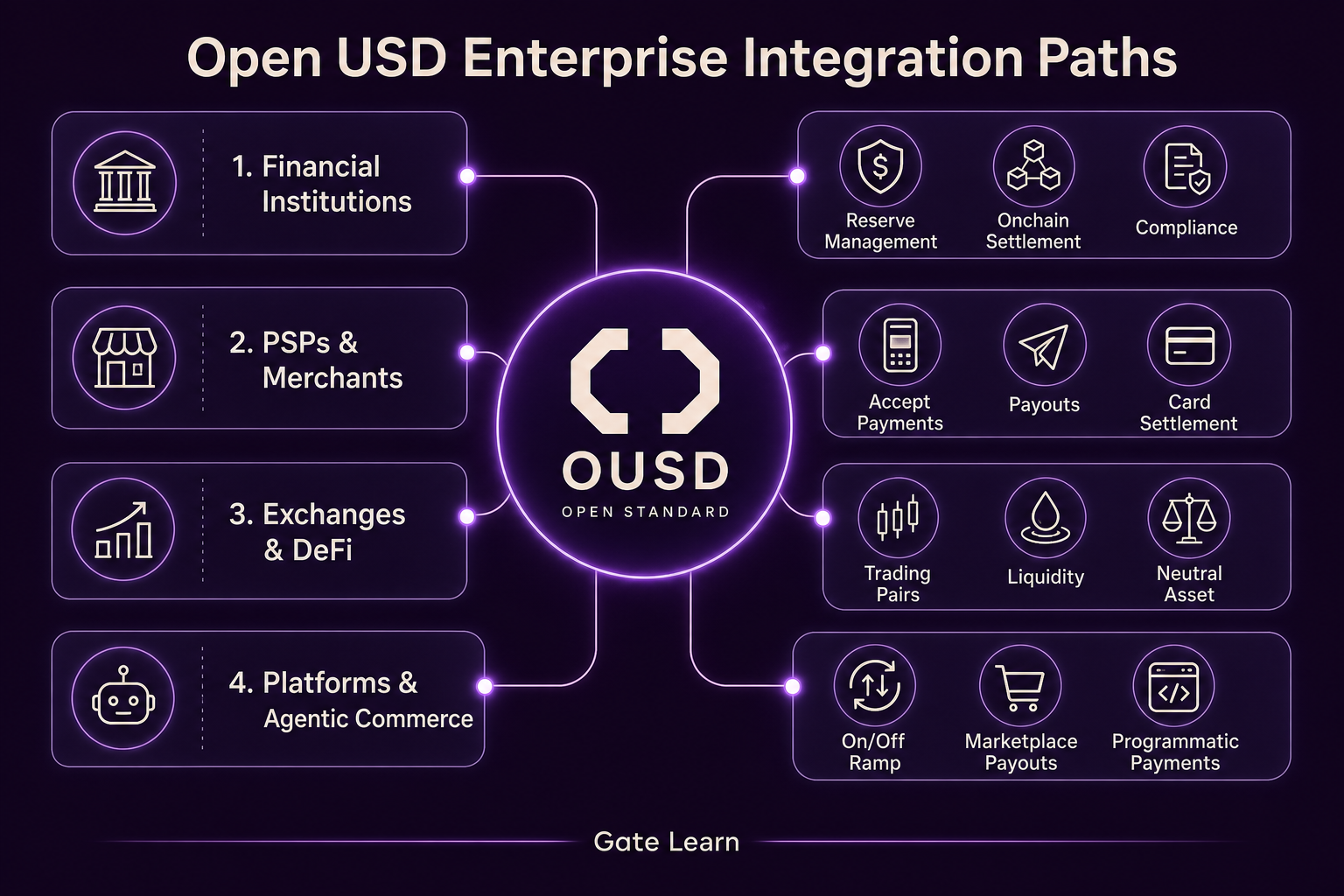
Figure 1. Open USD enterprise integration paths by role: financial institutions, PSPs, exchanges, and platforms connect through different modules around the OUSD hub.
Agentic commerce requires instant on-chain payments initiated by software agents, with higher demands on latency and programmability. One enterprise may combine multiple roles; prioritize integration modules by primary business line.
What do ecosystem examples such as Stripe and Tempo illustrate?
Integration patterns among 140+ founding partners provide reference models. Stripe sets OUSD as the default option for stablecoin-related business, so enterprises on Stripe payment infrastructure can use OUSD as the default stablecoin settlement asset after launch, reducing routing and reconciliation complexity when multiple stablecoins coexist.
Tempo natively supports OUSD, meaning OUSD is issued natively on Tempo from launch, covering payments, liquidity, exchange, and DeFi use cases. The Stripe–Tempo strategy of defaulting to OUSD creates on-chain and off-chain coordination; enterprises in the Tempo ecosystem can use native OUSD directly for payments and DeFi composability.
| Partner |
Integration approach |
Implication for enterprises |
| Stripe |
OUSD as default for stablecoin business |
Payment infrastructure routes to OUSD by default |
| Tempo |
Native OUSD issuance and circulation |
On-chain payments and DeFi can use native OUSD directly |
| Visa / Mastercard |
Founding partners driving card-network interoperability |
Stablecoin and card settlement systems gradually connect |
| Coinbase |
Founding partner for exchange and custody |
Trading, custody, and on-chain circulation with liquidity foundation |
These examples show Open Standard adoption as coordinated layout across payment networks, blockchain infrastructure, and financial institutions. Enterprises can map published partner roles to their existing technology stacks.
What technical and compliance preparation is required?
Enterprises should run technical assessment and compliance alignment in parallel before integration. Technical preparation includes target-chain compatibility, wallet and custody evaluation, mint/redeem API connectivity, and on-chain reconciliation design. Compliance preparation includes local stablecoin rules, AML/KYC alignment, and whether reserve custody meets local standards. OUSD reserves are held at major U.S. financial institutions; cross-border enterprises must also assess local compliance against USD reserve structure.
| Preparation area |
Key checks |
Typical owners |
| Technical |
Chain compatibility, API integration, reconciliation |
Engineering, custody providers |
| Compliance |
AML/KYC, licensing, reserve structure |
Legal, compliance |
| Operations |
Fee models, revenue allocation, user communication |
Finance, product |
Contract addresses, API documentation, and SDKs follow public technical materials at OUSD launch. Timelines vary by role complexity; financial institutions and PSPs often face longer compliance review.
How to verify integration after launch?
After OUSD launch, enterprises should confirm integration health through reserve transparency and on-chain monitoring. Reserve verification relies on periodic reserve disclosures and independent third-party attestations from Open Standard, reconciling total on-chain OUSD supply with off-chain reserves at 1:1. On-chain monitoring includes mint/redeem events, settlement success rates and latency, and per-chain supply in multi-chain deployments.
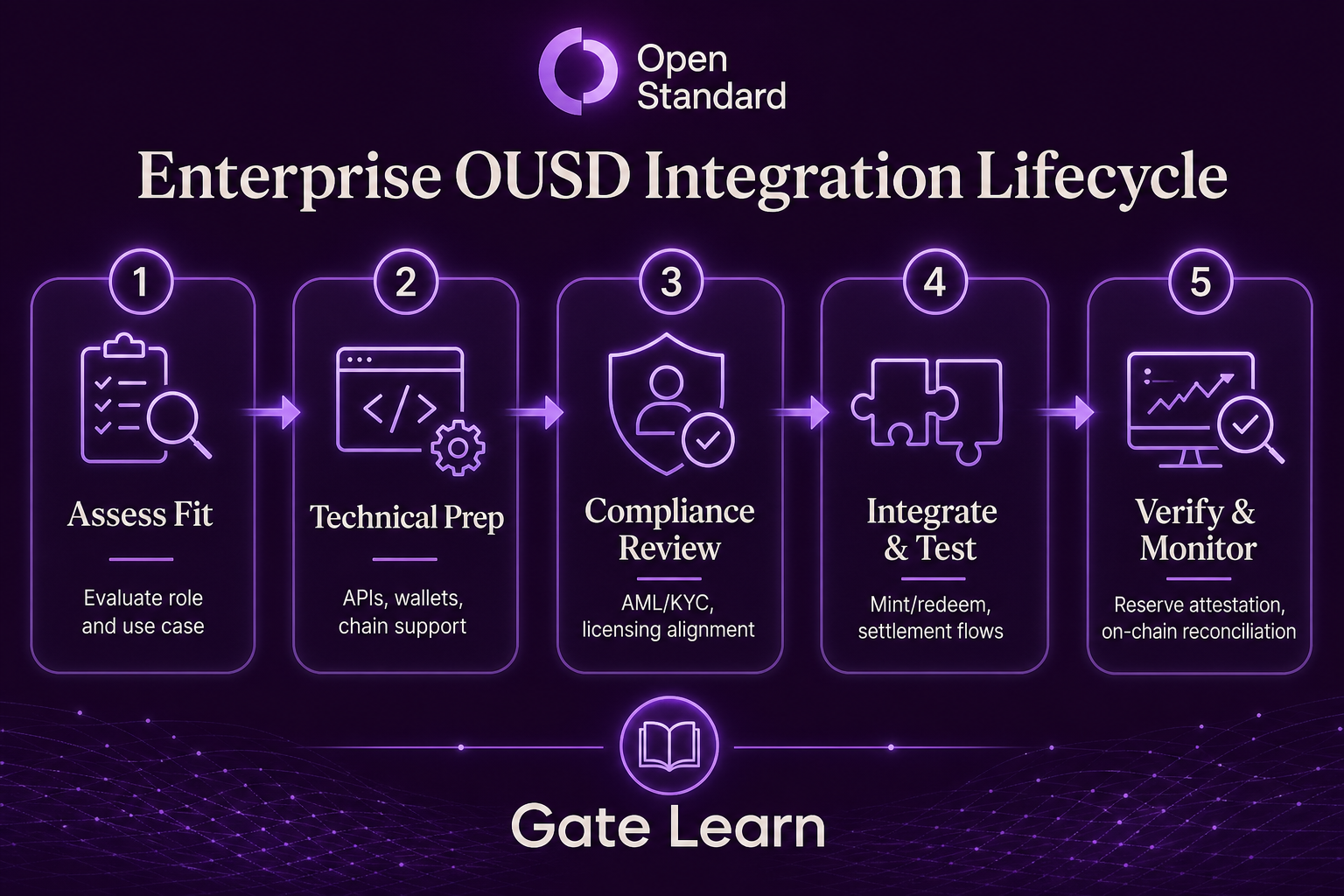
Figure 2. Enterprise OUSD integration lifecycle: five steps from fit assessment and technical preparation through compliance review, integration testing, and launch verification.
Post-launch verification should include periodic reviews, folding OUSD integration into routine treasury and compliance processes. Reserve structure, regulation, and multi-chain deployment may change over time.
Summary
The core path for enterprise Open USD integration is: define integration modules by role (financial institution, PSP, exchange, or platform), complete technical and compliance preparation, adopt OUSD as a core transactional asset, and verify operations through reserve disclosures and on-chain monitoring. Joining Open Standard provides technical documentation, integration support, eligibility for Hold/Mint/Accept revenue sharing, and collaborative governance participation. Ecosystem examples such as Stripe defaulting to OUSD and Tempo native support offer reference patterns by industry; enterprises should independently assess feasibility and risks based on role and regulatory environment.
FAQ
Which enterprises are best positioned to integrate Open USD first?
Enterprises with cross-border payments, large-scale acquiring, corporate treasury management, or on-chain settlement needs are best positioned to evaluate integration first. PSPs, financial institutions, trading platforms, and multi-market settlement platforms align closely with Open Standard’s six ecosystem roles.
What concrete support does joining Open Standard provide?
Members receive technical documentation, integration support, and revenue-sharing opportunities tied to OUSD usage. Allocation links to Hold, Mint, and Accept participation dimensions; reserve yields flow to adoption-driving partners after a small Open Standard management fee.
What does Stripe making OUSD the default stablecoin mean for merchants?
Stripe’s default means enterprises on Stripe payment infrastructure can use OUSD as the default stablecoin settlement asset after launch, reducing multi-stablecoin routing and reconciliation complexity.
What is the technical advantage of Tempo native OUSD support?
Native support means OUSD is issued on Tempo from launch, so enterprises can run payments, liquidity management, and DeFi composability directly without bridging other stablecoins.
What compliance items should enterprises confirm before integrating?
Confirm local stablecoin and payment regulation, AML/KYC alignment, whether reserve custody meets local standards, and Open Standard partner-admission eligibility.
How to confirm OUSD reserves match on-chain supply after launch?
Review periodic reserve disclosures and independent third-party attestations from Open Standard, reconcile total on-chain OUSD supply with off-chain reserves at 1:1, and cross-check against internal OUSD balances.