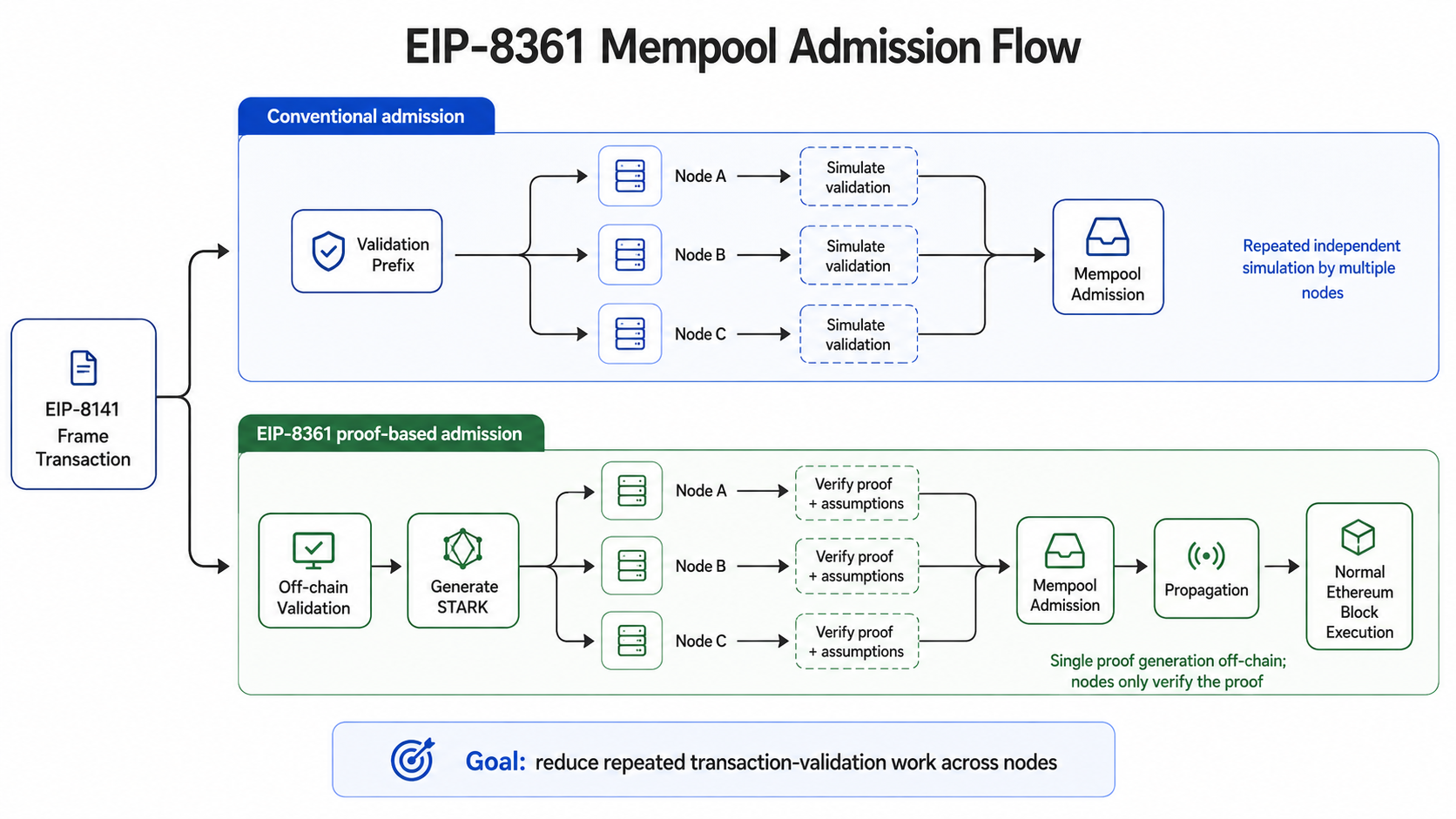
EIP-8361 could change Ethereum mempool validation by allowing certain EIP-8141 frame transactions to carry a succinct STARK proving that their programmable validation logic returned APPROVE. Instead of every receiving node repeating that computation, nodes could verify the proof and its assumptions before admission.
For Ethereum developers, node operators, and technically focused crypto users, this matters because richer account logic can otherwise increase networking workload and restrict transaction propagation. The proposal focuses on mempool admission, not staking rewards, validator issuance, or ETH supply.
The distinction also resolves an important source of confusion. A separate Tapered Issuance Burn draft briefly used EIP-8361 while being submitted in August 2026, but Ethereum editors stated that 8361 was already allocated to Transaction Validity Proofs and assigned the staking proposal EIP-8363 instead. This article therefore explains the actual mempool proposal while clarifying why issuance and staking claims still appear under the EIP-8361 keyword on some sites and older pages.
Key Takeaways
EIP-8361 proposes proof-carrying admission for eligible EIP-8141 frame transactions.
Nodes could verify a succinct validity proof instead of repeatedly executing complex validation logic before admitting a transaction to the public mempool.
The approach aims to reduce duplicated computation while allowing more expressive programmable accounts.
Proof-based admission does not replace normal Ethereum execution or guarantee block inclusion.
Staking ratios, lower issuance, validator reward burns, and the 60.25 million ETH threshold belong to EIP-8363 Tapered Issuance Burn, not the finalized numbering of EIP-8361.
How Could EIP-8361 Change Ethereum Mempool Validation?
Ethereum nodes do not blindly relay every transaction. Before a transaction enters a local mempool and propagates to peers, nodes apply admission checks designed to reject invalid or excessively expensive traffic. A mempool therefore sits between transaction broadcast and eventual block inclusion.
EIP-8141 frame transactions make admission more demanding because authorization, payer selection, and other conditions can be expressed through programmable validation logic. Under simulation-based admission, receiving nodes may have to execute that validation prefix themselves. When the same transaction travels across many peers, similar computational work can be repeated throughout the network.
EIP-8361 Transaction Validity Proofs introduces another approach: execute the validation prefix off-chain, produce a succinct STARK, and propagate that proof with the transaction. A receiving node can then verify the proof and declared assumptions rather than reconstructing the full computation.
EIP-8361 Proof-Based Admission and Node Workload
The proposal moves expensive admission work away from every peer without replacing authoritative Ethereum execution. The proof demonstrates whether the transaction satisfies conditions required for mempool admission; it does not become an on-chain substitute for executing the transaction.
The detailed transaction validity proof process binds the proof to the transaction and relevant assumptions. After verification, a node may admit and relay the transaction. If a validator later includes it in a block, Ethereum still executes it normally, while the admission proof remains networking metadata rather than permanent blockchain state.
What Could Change for Transaction Propagation?
If proof verification is cheaper or more predictable than repeatedly running complex validation, EIP-8361 could allow transactions with richer programmable conditions to propagate without imposing the same execution workload on every peer.
The draft also discusses removing the MAX_VERIFY_GAS constraint for proof-carrying transactions. That could increase access to the public mempool for complex validation schemes while retaining networking-level protection against abusive traffic.
This does not remove every bottleneck. Proof verification consumes resources, assumptions can become stale, and implementations still require compatible anti-spam and gossip policies. Mempool admission also remains distinct from inclusion: validators and builders can still prioritize eligible transactions according to fees, block-space demand, and maximal extractable value.
An Ethereum live price chart can provide market context around major protocol debates, but ETH price trends do not establish whether a mempool mechanism improves node efficiency.
Why EIP-8361 Is Being Confused With Tapered Issuance Burn
The staking statistics circulating under “EIP-8361” describe what is now EIP-8363, a separate Core proposal focused on Ethereum’s current issuance curve. During its August 2026 submission, its authors temporarily self-assigned 8361; Ethereum editors then noted that the number already belonged to Transaction Validity Proofs and reassigned the issuance proposal to EIP-8363.
EIP-8363 proposes a Tapered Issuance Burn in which a growing fraction of idealized validator rewards is burned as the staking ratio rises. Its saturation balance is approximately 60.25 million ETH, close to about half of ETH supply; at that point the burn fraction reaches 100% for the covered consensus rewards.
Contemporaneous August reporting placed approximately 41.1 million ETH, or 33.7% of supply, in staking. At roughly that staking ratio, calculations based on the proposed curve put the reward-burn fraction near 56% if the full taper were applied. The draft nevertheless uses an 18-month transition rather than immediately applying the full economic reduction.
The economic argument behind EIP-8363 is that the current issuance model retains a yield floor even as a growing share of ETH enters staking. Supporters argue that this can continue encouraging additional participation after the network has already accumulated substantial economic security. Under the tapered model, annual issuance is estimated to peak near 0.5% of Ethereum’s total supply around a 20% staking ratio and then fall as more ETH becomes staked.
One supporter scenario estimates that, if validator entry remained near maximum churn with relatively few exits, more than 70 million ETH could be staked by January 1, 2028, exceeding 55% of supply. That is a scenario used in the debate, not a guaranteed forecast.
Supporters argue that lower issuance at high staking ratios could reduce dilution and, when combined with Ethereum’s existing fee-burn mechanisms, increase the conditions under which ETH becomes structurally deflationary. It would be too strong to say EIP-8363 guarantees deflation, because total supply still depends on the relationship between issuance and ETH burned through network activity.
Critics focus on a different pressure point. Reducing consensus-layer income could make operating economics less attractive for smaller validators or some staking approaches, potentially favoring participants with greater scale, other sources of revenue, or access to maximal extractable value. Supporters counter that unchecked staking growth and concentration can itself create long-term risks. The proposal remains a draft under review, so both the mechanism and its economic assumptions remain part of an active Ethereum research debate.
These staking arguments do not alter the answer to the main question: EIP-8361 Transaction Validity Proofs changes proposed mempool admission behavior; EIP-8363 changes proposed validator issuance economics.
Risks and Limitations
EIP-8361 remains a draft. Its security depends on sound proof verification, accurate assumption handling, implementation quality, and appropriate resource limits. Proof generation and verification also have costs, so the mechanism reduces one source of duplicated computation rather than eliminating networking overhead entirely.
A valid admission proof does not guarantee inclusion. Builders and validators still determine which eligible transactions enter blocks, and transaction ordering can continue to interact with fees and maximal extractable value.
The numbering history creates an additional information-verification risk. Search results, social-platform posts, older articles, and cached website content may still call Tapered Issuance Burn “EIP-8361.” Users conducting their own research should therefore check the current EIP record rather than relying solely on an old page, Twitter/X post, advertisements, platform summaries, or automated search insights. Ethereum’s official EIP process identifies Transaction Validity Proofs as 8361 and the issuance proposal as 8363.
Conclusion
EIP-8361 could make Ethereum mempool admission more efficient for programmable frame transactions by replacing repeated validation-prefix simulation with succinct proof verification. Its strongest use case is allowing richer validation logic to propagate without forcing every receiving node to perform the same expensive work.
The staking debate surrounding the keyword comes from a numbering collision, not from the mempool mechanism itself. The 60.25 million ETH saturation balance, tapered validator rewards, approximately 0.5% peak annual issuance, and scenarios involving more than 70 million ETH staked belong to EIP-8363. Keeping those proposals separate is essential for understanding what EIP-8361 would actually change.
FAQ
Does EIP-8361 reduce validator rewards by 56%?
No. The roughly 56% figure refers to calculations for the EIP-8363 Tapered Issuance Burn at a staking ratio near the level reported in August 2026. EIP-8361 Transaction Validity Proofs does not reduce validator rewards.
Does EIP-8361 reach a 100% burn rate at 60.25 million ETH staked?
No. The approximately 60.25 million ETH saturation balance belongs to EIP-8363. At that level, roughly half the ETH supply under the proposal’s reference parameters, its covered consensus-reward burn fraction reaches 100%; EIP-8361 contains no staking-based burn curve.
Is about 41.1 million ETH currently staked?
August 2026 reporting cited approximately 41.1 million ETH, or 33.7% of supply, as staked when discussing the Tapered Issuance Burn proposal. Staked ETH changes over time, so that number should be treated as a dated snapshot rather than a permanent Ethereum parameter.
Could more than 70 million ETH be staked by 2028?
A supporter scenario argued that more than 70 million ETH could be staked by January 1, 2028 if the entry queue remained highly utilized and exits stayed limited. It is a conditional projection used to justify EIP-8363, not a protocol guarantee or an EIP-8361 specification.
Would annual ETH issuance peak near 0.5% under the proposal?
Under the EIP-8363 tapered model, proponents calculate that annual issuance would peak around 0.5% of total ETH supply near a 20% staking ratio and decline as the staking ratio rises. That issuance curve is unrelated to EIP-8361’s transaction validity proofs.
Would the Tapered Issuance Burn make ETH structurally deflationary?
Not automatically. At sufficiently high staking ratios, EIP-8363 would substantially reduce or eliminate covered consensus issuance, making existing fee burns more important to ETH’s net supply change. ETH would be deflationary only when total burn exceeds remaining issuance; the proposal itself does not guarantee that outcome in every period.
What does EIP-8361 actually change?
EIP-8361 proposes transaction validity proofs for mempool admission. An eligible EIP-8141 transaction could carry a succinct STARK so receiving nodes can verify its validation result and assumptions rather than repeatedly executing the complete validation prefix before propagation.
Author: Jared
Disclaimer
* The information is not intended to be and does not constitute financial advice or any other recommendation of any sort offered or endorsed by Gate.
* This article may not be reproduced, transmitted or copied without referencing Gate. Contravention is an infringement of Copyright Act and may be subject to legal action.
Yala is a modular Bitcoin DeFi infrastructure that connects BTC liquidity with multi-chain ecosystems through its YU stablecoin and MetaMint protocol. It enables Bitcoin holders to earn native DeFi yields across EVM and non-EVM networks securely and seamlessly.
Solana faces both opportunities and challenges in its development. Recently, severe network congestion has led to a high transaction failure rate and increased fees. Consequently, some have suggested using Layer 2 and appchain technologies to address this issue. This article explores the feasibility of this strategy.
This article introduces the technical principles, framework, and applications of Zero-Knowledge (ZK) technology, covering aspects from privacy, identity (ID), decentralized exchanges (DEX), to oracles.
Sui is a PoS L1 blockchain with a novel architecture whose object-centric model enables parallelization of transactions through verifier level scaling. In this research paper the unique features of the Sui blockchain will be introduced, the economic prospects of SUI tokens will be presented, and it will be explained how investors can learn about which dApps are driving the use of the chain through the Sui application campaign.
TronScan is the primary blockchain explorer for the TRON network. It allows users to check TRX and TRC-20 transactions, inspect wallet balances, analyze smart contracts, monitor tokens, and view network activity without logging in. By connecting a compatible wallet such as TronLink, users can also transfer assets, stake TRX, vote for Super Representatives, and interact with TRON ecosystem applications.