As blockchain applications expand from asset transfers into AI, data markets, on-chain gaming, and complex financial scenarios, on-chain execution alone can no longer meet performance requirements. Verifiable off-chain infrastructure has thus emerged as the next frontier.
EigenLayer has become important infrastructure for Ethereum's shared security and restaking ecosystem. By allowing ETH and liquid staking assets to reuse security, EigenLayer provides economic guarantees for a broad range of Actively Validated Services (AVS). EigenCloud builds on this security foundation, consolidating fragmented infrastructure capabilities into a platform developers can use directly, forming a complete architecture from the security layer to the application layer within the EigenLayer ecosystem.
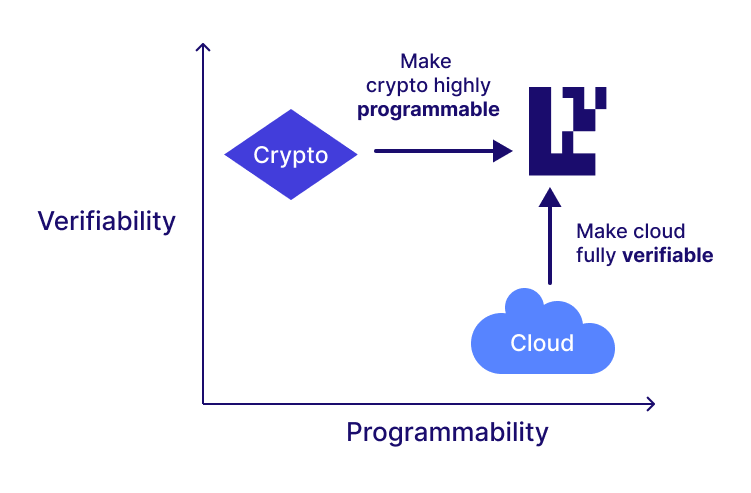
EigenLayer is the underlying shared security protocol, while EigenCloud is a verifiable cloud platform built on top of it. The two serve respectively as the security layer and the service layer. EigenLayer extends Ethereum's economic security to various AVS networks through its restaking mechanism, solving the security challenges faced by new protocols at launch. EigenCloud further encapsulates these security capabilities into data, computation, and verification services that developers can call directly.

In an internet infrastructure analogy, EigenLayer is akin to the underlying network and security system, while EigenCloud resembles a cloud service platform built on top of it. They are not in competition but are complementary, collaborating across the same ecosystem to advance verifiable internet infrastructure.
| Layer |
Role |
Representative Component |
| Security Layer |
Provides shared security |
EigenLayer |
| Service Layer |
Provides verification services |
AVS |
| Platform Layer |
Provides development interfaces |
EigenCloud |
| Application Layer |
Serves end users |
DApp, AI applications |
What Are the Components of the EigenLayer Ecosystem?
The EigenLayer ecosystem consists of four main parts: Restakers, Operators, Actively Validated Services (AVS), and developers/applications. Restakers delegate ETH or liquid staking assets to EigenLayer, providing security for additional networks; Operators run nodes, perform verification work, and receive corresponding rewards.
AVS is the ecosystem's most core component, including data availability networks, preconfirmation networks, oracle networks, AI service networks, and cross-chain bridges. Developers build end-user applications on this infrastructure, finally turning shared security into tangible products and services. The entire ecosystem forms a complete value chain from security provision to application deployment.
Restakers
Restakers connect their already-staked ETH or liquid staking assets to EigenLayer, allowing the same economic security to serve multiple protocols. This mechanism boosts capital efficiency while enhancing new networks' ability to obtain security.
Operators
Operators run nodes, execute verification tasks, and maintain network operations. They can participate in multiple AVS networks simultaneously and earn rewards based on the services they provide.
AVS (Actively Validated Services)
AVS are independent service networks that leverage EigenLayer's security. Unlike traditional blockchains that must build their own validator networks, AVS can directly inherit the economic security provided by EigenLayer, reducing startup costs and operational complexity.
Developers and Applications
Developers use infrastructure from AVS and EigenCloud to build end-user products, including Rollups, AI services, prediction markets, cross-chain protocols, and on-chain financial applications.
Why Was EigenCloud Created?
EigenLayer has already solved the shared security problem, but developers still need to build their own data storage, off-chain computation, and result verification infrastructure when creating applications. For many projects, this increases both development complexity and operational costs.
EigenCloud emerged to lower this barrier. By standardizing capabilities like EigenDA, EigenCompute, and EigenVerify, developers can directly use ready-made services without redesigning underlying systems. In a sense, EigenLayer provides shared security, while EigenCloud provides shared capabilities—together, they form a complete development environment.
This model mirrors the evolution of traditional cloud computing. Developers no longer need to build servers from scratch; they call standardized services. Similarly, EigenCloud aims to free developers from repeatedly building verification infrastructure, letting them focus on application innovation.
What Is EigenCloud's Core Architecture?
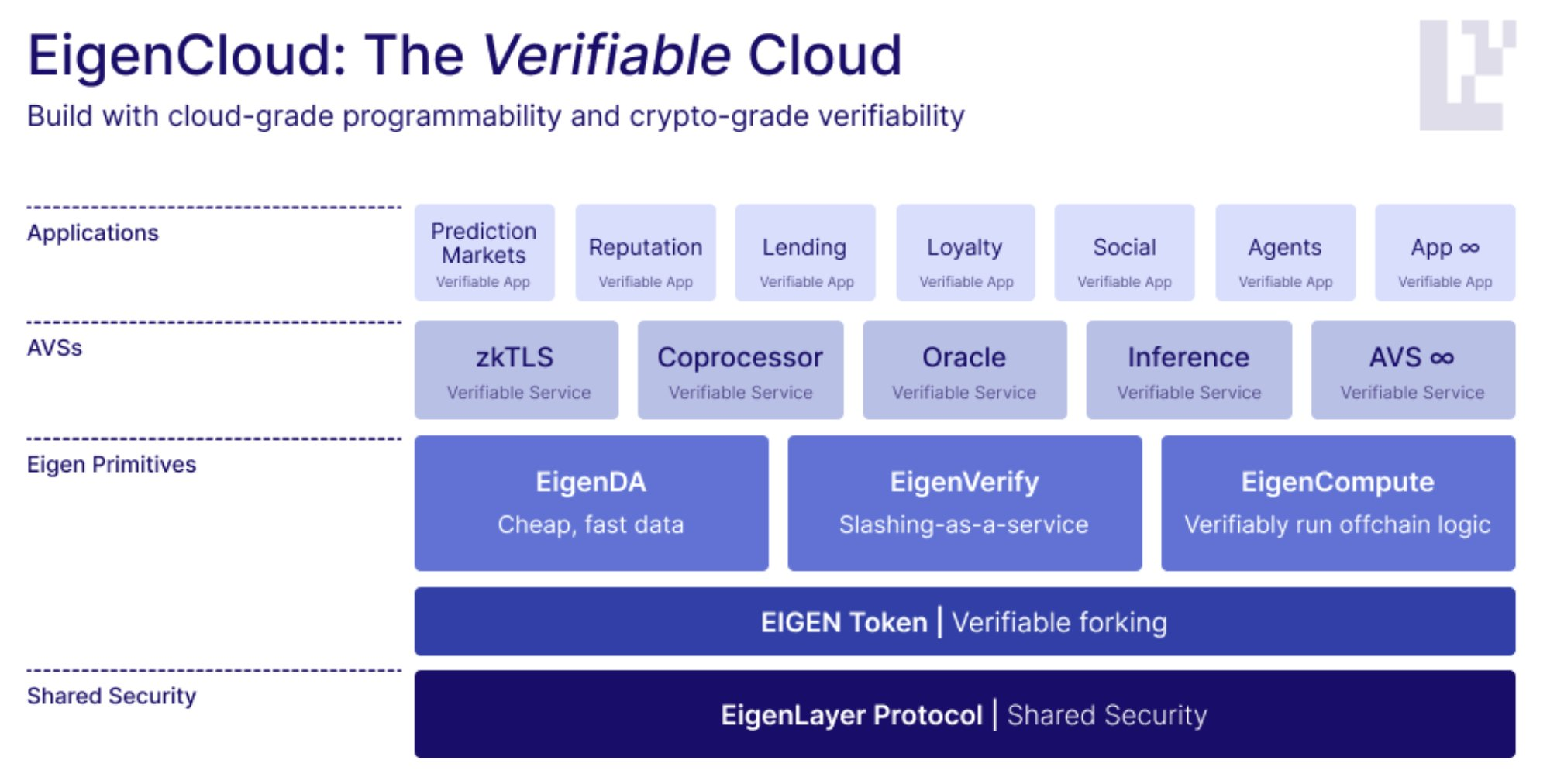
EigenCloud is currently built around three main modules: EigenDA, EigenCompute, and EigenVerify, corresponding to the three critical pillars of data, computation, and verification. This architecture lets developers achieve higher performance and lower costs while maintaining trust.
These three components together form a complete verifiable cloud service system, allowing complex applications to run off-chain while preserving the transparency and credibility that blockchains require.
EigenDA: Data Availability Layer
EigenDA (Eigen Data Availability) handles data storage and propagation, providing data availability services for Rollups and high-throughput applications. Compared to publishing all data to the Ethereum mainnet, EigenDA processes large-scale data at a lower cost.
As the number of Layer2 networks grows, data availability has become a critical component of blockchain scaling. EigenDA is one of the first AVS to achieve large-scale adoption within the EigenLayer ecosystem.
EigenCompute: Computation Execution Layer
EigenCompute provides verifiable off-chain computing power. Developers can run complex logic off-chain and use EigenLayer's security mechanisms to ensure results are trustworthy.
AI inference, on-chain gaming, complex financial models, and data analysis all require substantial computational resources, and these tasks are often unsuitable for direct on-chain execution. EigenCompute enables these applications to balance efficiency and trustworthiness.
EigenVerify: Verification and Dispute Layer
EigenVerify verifies off-chain computation results and re-executes the verification process in case of disputes. When participants challenge a result, the system uses verifiable mechanisms to determine its correctness.
If an operator submits incorrect results or acts maliciously, their staked assets may be slashed. This economic constraint ensures the system's credibility.
How Does EigenCloud Inherit EigenLayer's Security?
EigenCloud does not build its own verification network; it directly inherits EigenLayer's shared security system. After users restake their ETH or liquid staking assets to EigenLayer, operators become eligible to run services and verify results, maintaining system operation through economic incentives.
When operators behave maliciously or submit incorrect results, EigenLayer's slashing mechanism penalizes their staked assets. This means EigenCloud's data, computation, and verification services all rely on Ethereum's economic security without needing to build independent security systems.
The process can be summarized as: users stake assets, operators provide services, AVS or EigenCloud execute tasks, the system verifies, and violations trigger slashing. This mechanism allows EigenCloud to build on Ethereum's existing security foundation.
How Is EigenCloud Different from Traditional Cloud Services?
Although EigenCloud offers data storage and computing capabilities, its design philosophy fundamentally differs from traditional cloud services. Traditional cloud platforms rely on corporate reputation and service level agreements for trust, whereas EigenCloud ensures result trustworthiness through cryptographic proofs, restaking guarantees, and verifiable execution mechanisms.
For developers, traditional cloud services solve resource acquisition, while EigenCloud focuses on result credibility. In scenarios involving AI inference, financial settlements, prediction markets, and on-chain governance, verifiable computation is often more critical than raw computing power.
| Comparison Dimension |
EigenCloud |
Traditional Cloud Services |
| Source of Trust |
Cryptography and economic guarantees |
Corporate reputation |
| Security Mechanism |
Restaking and slashing |
Service agreements |
| Result Verification |
Verifiable |
Not verifiable |
| Data Credibility |
Provable |
Platform endorsement |
| Governance |
Decentralized |
Centralized |
This difference is why EigenCloud is called a Verifiable Cloud.
What Application Scenarios Will EigenCloud Drive?
As blockchain applications grow more complex, many scenarios require off-chain computation with trustworthy results. EigenCloud provides new infrastructure for these needs.
AI, data markets, on-chain gaming, and enterprise Web3 applications are the most representative directions. These scenarios typically involve large data volumes or complex logic, making pure on-chain execution inefficient and costly.
AI Agents
AI inference processes happen off-chain, but results must be trustworthy. EigenCloud can verify AI outputs, improving AI agents' usability in on-chain scenarios.
Prediction Markets
Prediction markets need trusted outcome resolution. EigenVerify provides verification and dispute handling for event outcomes, reducing manipulation risk.
On-Chain Gaming
Game logic often requires extensive real-time computation. EigenCompute handles complex tasks, enabling better performance for on-chain games.
Enterprise Web3 Applications
Enterprises can use EigenCloud to build supply chain management, data sharing, digital identity, and automated business systems, improving data credibility while maintaining efficiency.
Will EigenCloud Replace AVS?
EigenCloud will not replace AVS because they serve different roles. AVS are the basic service units in the EigenLayer ecosystem, while EigenCloud is a unified platform for developers.
Many EigenCloud services still rely on AVS for underlying capabilities. Developers can use EigenCloud directly without integrating multiple AVS networks, reducing integration complexity.
From an ecosystem perspective, AVS are like modular components, while EigenCloud is the integration layer. Both work together to grow the EigenLayer ecosystem, not replace each other.
Summary
EigenCloud and EigenLayer are not independent projects but different layers within the same ecosystem. EigenLayer provides shared security through its restaking mechanism, creating a unified economic guarantee system for AVS networks. EigenCloud builds on this foundation by integrating data, computation, and verification into a verifiable cloud platform developers can use directly.
As blockchain applications expand into AI, off-chain computing, and complex business scenarios, shared security alone is no longer enough. EigenCloud marks the EigenLayer ecosystem's evolution from a restaking protocol to a full infrastructure platform, bringing the vision of a verifiable internet closer to reality.
FAQs
Is EigenCloud an upgraded version of EigenLayer?
No. EigenLayer is the underlying protocol providing shared security and restaking, while EigenCloud is a development platform built on top of EigenLayer. They are different infrastructure layers.
Which is more important: EigenCloud or EigenLayer?
They serve different roles. EigenLayer provides security; EigenCloud provides services. Without EigenLayer, EigenCloud cannot access shared security; without EigenCloud, developers face higher barriers to using EigenLayer.
Is EigenCloud a new blockchain?
No. EigenCloud is not a standalone public chain but a verifiable cloud platform built on EigenLayer and Ethereum's security system, primarily offering data, computation, and verification services.
Does EigenDA belong to EigenCloud or EigenLayer?
EigenDA was originally a key AVS project in the EigenLayer ecosystem and is now a core component of EigenCloud's architecture. It is therefore important infrastructure for the entire EigenLayer ecosystem.
Why does EigenCloud need the EIGEN token?
The EIGEN token mainly coordinates ecosystem incentives, supports security mechanisms, and enables governance. As more AVS and EigenCloud services launch, EIGEN's role in the ecosystem will expand.
What are the main use cases for EigenCloud?
EigenCloud targets AI agents, prediction markets, on-chain gaming, data services, enterprise Web3 applications, and any scenario requiring trusted off-chain computation, providing verifiable data and computing infrastructure.