Perpetual futures have become one of the most important forms of derivatives trading in the crypto market. Compared with traditional spot trading, perpetual futures allow users to take long or short positions with leverage, which is why trading activity tends to be much higher in volatile markets.
In the early DeFi market, decentralized exchanges were mainly built around the AMM model. As demand for derivatives trading grew, however, more protocols began to revisit the order book structure. Against this backdrop, dYdX and Hyperliquid have become two of the most closely watched order book DEXs in the on-chain perpetual futures sector.
A Brief Overview of dYdX and Hyperliquid
dYdX is a decentralized derivatives protocol focused on perpetual futures trading. It currently runs on dYdX Chain, which is built using the Cosmos SDK. The protocol uses an order book model and improves trading efficiency by combining off-chain matching with on-chain settlement.
Hyperliquid is an order book DEX focused on high-performance on-chain perpetual futures trading. Its core features are a self-developed high-throughput trading chain and a low-latency matching system. Hyperliquid’s overall design is closer to an on-chain high-performance trading network, rather than just a single DeFi application protocol.
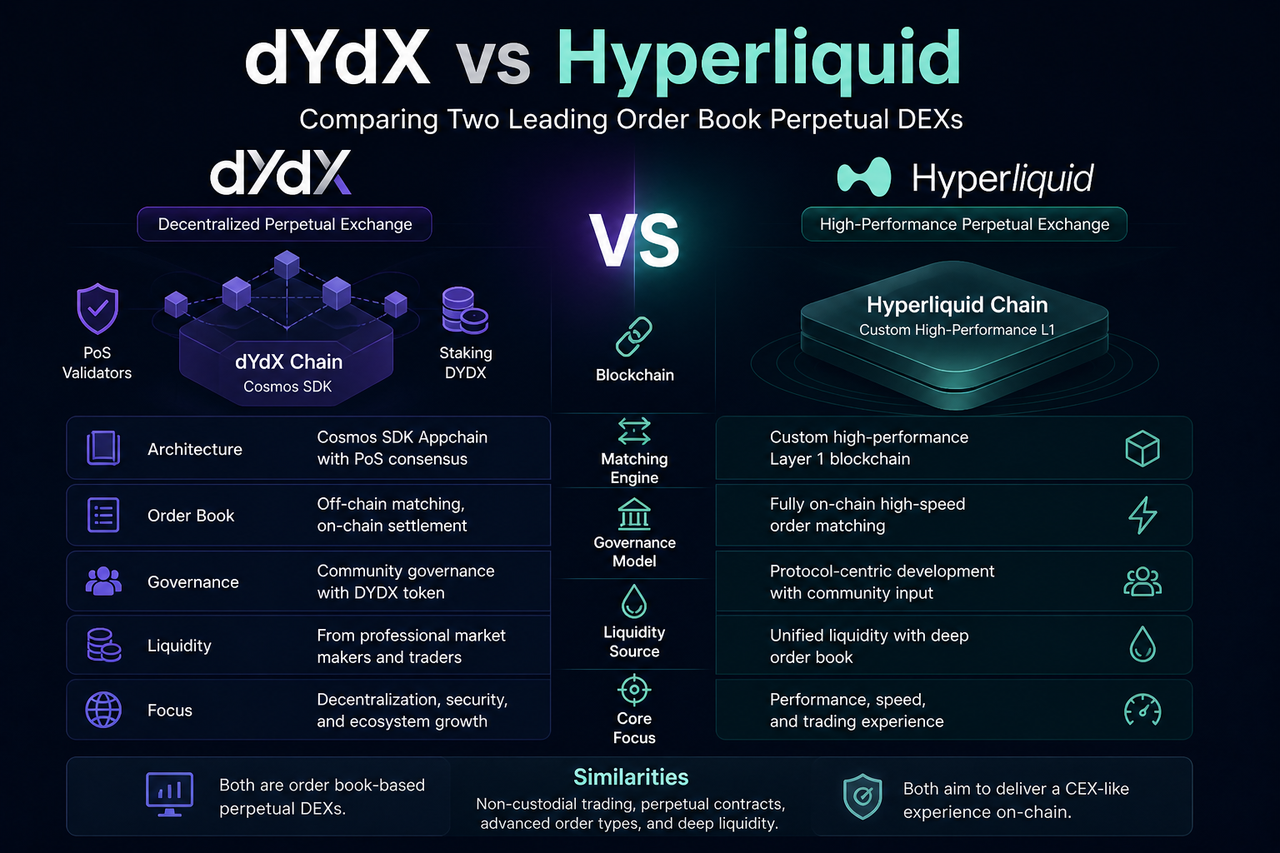
How Do the Underlying Architectures of dYdX and Hyperliquid Differ?
dYdX uses the Cosmos SDK to build an independent appchain and relies on a PoS, or proof of stake, mechanism to maintain network operations. Validator nodes are responsible for transaction ordering, consensus, and on-chain state updates, while DYDX holders can participate in network security through staking.
This structure means dYdX places more emphasis on an open validator network and chain-level governance. Its overall design is closer to a typical blockchain ecosystem structure.
By comparison, Hyperliquid uses a self-developed high-performance chain architecture, with a stronger focus on trade execution efficiency and low-latency matching. Its underlying system has been deeply optimized for order book trading, allowing it to support higher-frequency trading activity.
The core difference is this: dYdX places greater emphasis on decentralized governance and an appchain ecosystem, while Hyperliquid focuses more on trading performance and a unified execution environment.
How Do Their Order Books and Matching Mechanisms Differ?
dYdX uses a structure that combines an off-chain order book with on-chain settlement. Orders are first matched in the matching system, then submitted on-chain for final state updates. This model helps reduce on-chain computation pressure and improves trading throughput.
Hyperliquid places more emphasis on the integrated performance of its matching system, with an overall architecture optimized around low-latency trading. Because its underlying chain and matching logic are deeply integrated, it has certain advantages in order response speed.
From a trading experience perspective, both platforms offer limit orders, stop-loss orders, leveraged trading, and other features. However, Hyperliquid leans more toward an ultra-low-latency trading environment, while dYdX emphasizes decentralized governance and network structure.
How Do the Liquidity Structures of dYdX and Hyperliquid Differ?
dYdX’s liquidity mainly comes from professional market makers and active traders. Its order book depth depends heavily on market participation. Because it uses an order book model, the protocol typically needs continuous order placement to maintain market depth.
Hyperliquid also uses an order book structure, but its trading ecosystem places greater emphasis on unified liquidity and high-frequency execution efficiency. Since its trading environment is built around a single high-performance system, it can offer tighter bid-ask spreads in certain markets.
Even so, the order book model itself requires a high level of market activity, so the liquidity performance of both platforms is still affected by broader market conditions.
How Do the Governance Models of DYDX and Hyperliquid Differ?
DYDX is the core governance and staking token of dYdX Chain. DYDX holders can participate in protocol upgrades, parameter adjustments, and ecosystem governance, while also supporting validator node operations through staking.
This structure means dYdX places more emphasis on community governance and chain-level security mechanisms.
By contrast, Hyperliquid currently focuses more on building its trading products and on-chain execution environment. Its governance structure and ecosystem model differ from those of dYdX. As a result, the market often views the two as on-chain derivatives protocols following different development paths.
Which Users Are dYdX and Hyperliquid Best Suited For?
dYdX is better suited to users who care about decentralized governance, on-chain ecosystem structure, and appchain development. For participants who want to take part in DYDX staking, governance, and long-term ecosystem growth, dYdX’s chain-level structure is a distinctive feature.
Hyperliquid is better suited to users who prioritize high-frequency trading, ultra-low latency, and fast order execution. Because its overall architecture is optimized around trading performance, it has strong appeal in professional trading scenarios.
However, both are high-risk derivatives trading protocols. Users who participate in perpetual futures trading still need to pay close attention to leverage risk and market volatility.
dYdX vs Hyperliquid Comparison Table
| Comparison Dimension |
dYdX |
Hyperliquid |
| Core Positioning |
Appchain derivatives protocol |
High-performance trading chain |
| Underlying Architecture |
Cosmos SDK appchain |
Self-developed high-performance chain |
| Trading Model |
Order book |
Order book |
| Consensus Mechanism |
PoS validator nodes |
Custom high-performance structure |
| Governance Model |
DYDX governance and staking |
More trading system-driven |
| Core Strength |
Decentralized governance and ecosystem |
Ultra-low-latency trading experience |
| Main Use Case |
On-chain derivatives ecosystem |
High-frequency perpetual futures trading |
| User Profile |
Focuses on governance and ecosystem |
Focuses on execution efficiency |
Conclusion
dYdX and Hyperliquid both represent important directions in the development of on-chain order book perpetual DEXs, but they differ clearly in design philosophy and ecosystem structure.
dYdX places greater emphasis on a Cosmos appchain, a PoS validator network, and a decentralized governance system. Its goal is to build a complete on-chain derivatives infrastructure. Hyperliquid, on the other hand, is more focused on trading performance and a low-latency execution environment, aiming to provide a high-frequency trading experience closer to that of a centralized exchange.
As the on-chain derivatives market continues to expand, competition among order book DEXs will further push DeFi infrastructure toward greater specialization, higher performance, and broader diversification.
FAQs
Are dYdX and Hyperliquid Both DEXs?
Yes. Both are decentralized exchanges, and both mainly focus on the perpetual futures trading market.
What Is the Biggest Difference Between dYdX and Hyperliquid?
The biggest difference lies in their underlying architecture and design focus. dYdX places more emphasis on its Cosmos appchain and governance structure, while Hyperliquid focuses more on ultra-low latency and a high-performance trading experience.
Does dYdX Use an AMM?
dYdX mainly uses an order book model rather than a traditional AMM liquidity pool structure.
Why Has Hyperliquid Attracted Attention?
Hyperliquid has attracted market attention because of its high-performance trading experience, low-latency matching, and unified liquidity structure.
What Is the DYDX Token Used For?
DYDX is mainly used for governance, staking, and maintaining network security.
What Are the Advantages of Order Book DEXs?
Order book DEXs are generally better suited to complex trading scenarios such as high-frequency trading, low-slippage execution, and perpetual futures.