Deutsche Bank is one of Germany's major global commercial banks, with operations spanning corporate banking, investment banking, private banking, and asset management. On September 16, 2026, Deutsche Bank announced plans to launch a digital asset custody solution before the end of the year, providing crypto asset safekeeping services to institutional and corporate clients in Europe. On October 16, the bank further disclosed that it expected to launch its initial services within the coming weeks and planned to expand to major financial centers in Asia in 2027. The business still needs to complete the applicable regulatory procedures and technical preparations.
As Bitcoin, Ethereum, stablecoins, and real-world asset tokenization (RWA) increasingly enter institutional investment and corporate treasury management, digital asset custody is evolving from basic private key safekeeping into important infrastructure connecting traditional finance with blockchain networks. For banks, funds, and multinational companies, the ability to hold digital assets securely, meet internal approval requirements, and integrate them into existing financial and risk management systems often matters more than simply gaining access to on-chain transactions.
Deutsche Bank's entry into the crypto custody market not only signals that major commercial banks are beginning to participate directly in building digital asset infrastructure, but also reflects the extension of institutional financial services on-chain. Understanding this strategy requires examining the differences between institutional custody and standard wallets, how banks manage private keys and asset security, the role of Europe's MiCA regulatory framework, and how crypto custody can further connect stablecoins, tokenized deposits, and RWA markets.
Key Takeaways
-
Deutsche Bank plans to launch digital asset custody services in 2026, initially serving institutional and corporate clients in Europe. The specific launch timing depends on regulatory procedures and technical readiness.
-
Initially supported assets include Bitcoin, Ether, and selected stablecoins. The services focus on private key safekeeping, asset segregation, transfer approvals, and institutional-grade security management, rather than providing cryptocurrency trading directly to retail users.
-
Banks' entry into the crypto custody market reflects growing institutional demand for compliant digital asset infrastructure, as traditional financial institutions also seek to integrate blockchain services into their existing operations.
-
Deutsche Bank plans to gradually expand into stablecoin-related services, tokenized deposits, and support for digital securities issuance, positioning custody as infrastructure connecting payments, treasury management, and RWA.
-
Bank custody does not mean assets are without risk. Private key management, smart contracts, operational failures, counterparty credit, and regulatory changes remain key factors that institutions must assess.
Why Is Deutsche Bank Entering the Crypto Custody Market in 2026?
Deutsche Bank's entry into the crypto custody market is not a sudden pivot toward cryptocurrency services, but the result of the gradual development of its digital asset strategy.
As early as 2023, Deutsche Bank partnered with Swiss digital asset infrastructure provider Taurus to explore crypto asset custody and tokenization services. In 2025, further market reports disclosed the bank's plans to launch crypto custody services in 2026, with Bitpanda's technology business also reportedly involved in the development.
In 2026, the plan began moving toward actual deployment. In September, Deutsche Bank formally announced its digital asset custody solution. In October, management further clarified its near-term launch target for the German market and its plans to expand into Asia.
This timeline shows that Deutsche Bank's focus is shifting from technology exploration to commercial services for institutional clients.
The main driver of this shift is growing institutional demand for digital assets. More asset managers, companies, and financial intermediaries are gaining exposure to Bitcoin, Ether, stablecoins, and tokenized securities, but they may not have the capabilities to manage private keys, deploy wallet infrastructure, and maintain on-chain security systems themselves.
At the same time, digital asset custody aligns closely with traditional banks' existing capabilities. Banks have long provided securities safekeeping, asset settlement, account management, and risk control services. Digital asset custody can add support for blockchain assets to these established operations.
For Deutsche Bank, entering this market could generate new revenue from custody and related services while also helping maintain long-term business relationships with institutional clients.
The bank has also incorporated digital asset services into its corporate banking growth strategy, with plans to expand its service offerings through digital financial infrastructure. Crypto custody is therefore not an isolated new product, but part of the extension of its corporate financial services into digital assets.
What Is Crypto Asset Custody, and Why Can't Institutions Rely Solely on Standard Wallets?
Crypto asset custody refers to professional service providers safeguarding and managing private keys, wallet permissions, and transaction execution processes related to digital assets to help clients hold and transfer assets securely.
On blockchain networks, assets are generally recorded at on-chain addresses, while private keys authorize the corresponding transactions. Individual users can manage their own private keys through hardware or software wallets, but this approach often cannot meet the complex internal management requirements of large financial institutions.
For example, an asset management company may need to manage multiple portfolios simultaneously and assign transaction requests, risk reviews, and final approvals to different departments. If a single employee controls the wallet managing all assets, this can create concentrated authority and operational risk.
The core role of institutional custody services is to bring private key management, transaction authorization, asset records, and internal approvals into a unified control framework.
| Comparison Dimension |
Personal Self-Custody Wallet |
Institutional Digital Asset Custody |
| Private Key Management |
The user is responsible |
Managed by the custodian and related security systems |
| Transaction Approval |
Usually authorized by the wallet holder |
Supports multiple approvers and tiered permissions |
| Asset Management |
Primarily for individual accounts |
Supports corporate, fund, and multi-account management |
| Security Mechanisms |
Hardware wallets, seed phrases, and similar tools |
HSMs, hot and cold storage, access controls, and audits |
| Compliance Management |
The user is responsible for relevant obligations |
Can integrate identity verification, transaction monitoring, and compliance processes |
| Main Risks |
Private key loss, phishing, and device security |
Custodian risk, system failures, and operational management risks |
The advantage of institutional custody is not that it eliminates private key risk, but that it reduces the likelihood of a single point of failure through technology, processes, and segregation of duties.
However, using a professional custodian also means clients must assess the provider's operational capabilities, asset segregation arrangements, technical architecture, and legal responsibilities. Custody services themselves do not guarantee the market value of digital assets.
How Does Deutsche Bank's Digital Asset Custody Service Protect Private Keys and Assets?
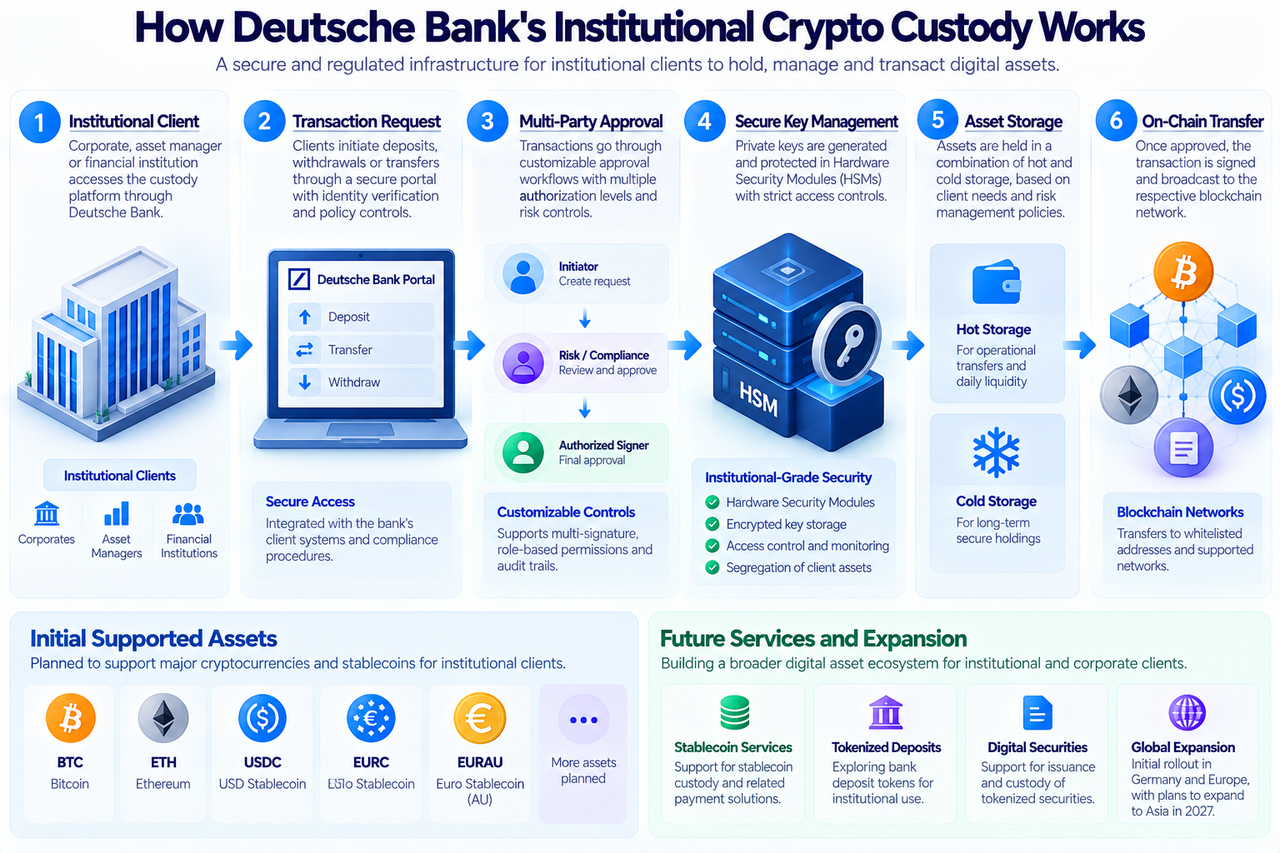
Deutsche Bank's custody solution uses an institutional-grade security architecture that combines private key protection, wallet management, and transaction approvals.
Hardware security modules (HSMs) are an important component. An HSM is a secure device specifically designed to generate, store, and use cryptographic keys. It can restrict critical key operations to a protected environment, reducing the risk of private keys being exposed in general-purpose computer systems.
Deutsche Bank also plans to offer hot and cold storage options. Hot storage generally maintains some network connectivity to facilitate routine transfers, while cold storage emphasizes isolation and secure long-term safekeeping, making it suitable for assets traded less frequently.
Institutions need to combine these approaches based on asset use and the frequency of fund transfers, rather than simply choosing one or the other.
For transaction approvals, Deutsche Bank supports customizable client transfer authorization workflows, including multifactor authentication and multilevel approvals. Institutions can assign different permissions to different personnel based on their management requirements, preventing a single operator from independently controlling large asset transfers.
The platform also emphasizes client asset segregation and provides access through Deutsche Bank's Autobahn corporate financial platform, allowing institutional clients to manage digital assets within a familiar banking environment.
Assets planned for initial support include Bitcoin (BTC), Ether (ETH), USDC, EURC, and EURAU. Actual availability still depends on the product launch, client eligibility, and applicable regulatory requirements.
It is important to note that HSMs, cold storage, and multiple approvals are risk control measures. They cannot fully eliminate system vulnerabilities, internal operational errors, or external attacks. Institutions still need to assess the provider's disaster recovery, auditing, and allocation of responsibilities.
What Role Do Deutsche Bank's Partnerships With Bitpanda and Taurus Play?
Although major commercial banks have mature account management and compliance capabilities, blockchain infrastructure involves specialized technologies such as private key management, on-chain transaction execution, support for multiple networks, and digital asset issuance.
Traditional banks entering the crypto custody market therefore often choose to work with established digital asset technology providers rather than develop every underlying system from scratch.
Taurus is a Swiss digital asset infrastructure provider whose business includes digital asset custody, tokenized asset issuance, and related financial technology. Deutsche Bank partnered with Taurus in 2023 and has also participated in its funding.
Bitpanda provides digital asset infrastructure to financial institutions through its related technology business. Market reports in 2025 identified Bitpanda and Taurus as technology partners involved in Deutsche Bank's custody project.
This partnership model allows banks to combine their client relationships, compliance processes, and risk management capabilities with the blockchain infrastructure of specialized technology companies.
However, outsourcing technology does not mean a bank can transfer all risks to its partners. Institutional clients still need clarity on who is responsible for private key management, system operations, handling abnormal transactions, and asset recovery.
Deutsche Bank previously disclosed that external technology and infrastructure providers would supply certain specific technical components of its custody platform. The actual allocation of responsibilities must be determined by formal service agreements and operational arrangements after launch.
Why Is the MiCA Regulatory Framework Important for European Banks' Crypto Custody Services?
MiCA (Markets in Crypto-Assets Regulation) is the European Union's regulatory framework for crypto asset markets, covering certain crypto asset issuance activities, service providers, and related business activities.
Before MiCA took effect, regulatory arrangements for digital asset services differed across European countries. For financial institutions planning cross-border operations, these differences could increase compliance costs and business uncertainty.
MiCA establishes more consistent rules for crypto asset services that meet the applicable conditions, including client asset protection, organizational governance, disclosure, and service provider obligations.
For Deutsche Bank, the regulatory framework matters not only for obtaining the necessary authorization to operate, but also for integrating digital asset custody with the bank's existing compliance and risk control systems.
For example, institutional clients generally need to confirm whether custody assets are separated from the provider's own assets, how operational failures are handled, and whether cross-border transfers meet relevant regulatory requirements.
A clear regulatory framework helps establish more standardized processes for addressing these questions.
However, MiCA does not mean that all digital assets or services are subject to exactly the same regulation. Tokenized securities may fall under other financial market regulations, and banks must also comply with applicable prudential and anti-money laundering requirements.
Deutsche Bank's custody business therefore still needs to complete the relevant regulatory procedures. As of October 21, 2026, the bank had announced a near-term launch plan, which should not be described as a fully available service.
Why Does Deutsche Bank Plan to Expand Custody Into Stablecoins and Tokenized Deposits?
Crypto asset custody addresses how institutions can hold digital assets securely. For commercial banks, however, the potential value of digital asset services extends beyond safeguarding Bitcoin and Ether.
Stablecoins and tokenized deposits can further connect corporate payments, treasury management, and financial asset settlement.
Stablecoins are generally issued by specialized issuers and backed by cash, short-term government bonds, or other eligible reserve assets. They are already widely used for on-chain payments, crypto asset trading, and fund transfers.
Tokenized deposits are digital representations of commercial bank deposits and generally retain the deposit claim against the issuing bank. Their value basis, access permissions, and redemption arrangements differ from those of typical stablecoins.
| Comparison Dimension |
Stablecoins |
Tokenized Bank Deposits |
| Issuer |
Stablecoin issuer |
Commercial bank |
| Value Backing |
Reserve assets managed by the issuer |
Bank deposit liabilities and the associated banking system |
| Main Uses |
On-chain trading, payments, and fund transfers |
Corporate payments, institutional settlement, and treasury management |
| Access |
Generally available to a broader user base |
Generally subject to bank client eligibility restrictions |
| Core Risks |
Reserve, redemption, and issuer risks |
Bank credit, operational, and legal arrangement risks |
Beyond its initial custody services, Deutsche Bank plans to gradually develop stablecoin-related fund conversion services, tokenized deposits, and support for digital securities issuance.
For corporate clients, these services offer a degree of continuity across business activities. For example, a company could first hold digital assets through the bank's custody platform, then use stablecoins for payments under applicable arrangements or participate in institutional settlement through tokenized deposits.
However, these businesses remain in planning or phased development. Planned tokenized deposit and digital securities issuance services should not be treated as already officially launched.
How Can Crypto Custody Become Infrastructure for RWA and Digital Securities Markets?
Real-world asset tokenization (RWA) refers to representing and managing bonds, fund shares, equity-related rights, and other traditional assets through blockchain technology.
For institutional financial markets, asset tokenization requires more than deploying smart contracts. It also requires addressing asset safekeeping, investor identity management, transaction settlement, and verification of legal rights.
Digital asset custody can provide foundational support for these functions.
For example, after an asset manager issues a tokenized bond, investors need a way to hold the tokens that meets their internal management requirements. Custodians can provide wallet management, transfer approvals, and asset recordkeeping services, helping traditional investors access on-chain securities markets.
In more advanced use cases, digital securities can also be combined with stablecoins or tokenized deposits to coordinate asset delivery and payment more closely.
This mechanism is commonly called delivery versus payment (DvP). It uses transaction arrangements to reduce the risk that one party delivers assets while the other fails to complete payment.
However, the technical ability to execute asset and fund transfers simultaneously does not automatically ensure legal settlement finality. These products must still meet securities regulations, custody rules, and counterparty arrangements.
Deutsche Bank's entry into digital asset custody gives it an opportunity to expand from traditional securities safekeeping into services for tokenized financial assets. The actual scale of the business, however, will still depend on market demand and subsequent product launches.
What Risks and Challenges Does Deutsche Bank Face in Entering the Crypto Custody Market?
Banks' participation in digital asset custody can make these services more accessible to institutional clients, but it does not mean the digital asset market has eliminated its major risks.
First are private key and cybersecurity risks. Even with HSMs, hot and cold storage, and multiple approvals, custody platforms may still face cyberattacks, software vulnerabilities, and internal operational errors.
Second is third-party technology risk. When banks rely on external infrastructure providers, they need to ensure those providers have stable operational capabilities and establish clear mechanisms for security audits and failure response.
Third are legal and regulatory risks. Different digital assets may be subject to different legal frameworks. In particular, the rules for issuing, safeguarding, and transferring stablecoins, crypto assets, and tokenized securities are not entirely the same.
Fourth is market demand risk. Although institutional interest in digital assets is growing, not every company needs to hold cryptocurrency directly. Whether custody can generate sustainable revenue still depends on client numbers, asset balances, and actual transaction activity.
Finally, there is cross-border operational risk. Deutsche Bank plans to expand into Asia after launching services in Germany, but regulatory requirements, client eligibility, and market infrastructure vary across jurisdictions. Replicating the business may require additional compliance and technical investment.
Assessing the maturity of a bank's digital asset custody business therefore requires more than counting the tokens it supports. It also requires examining its security record, actual client adoption, assets under custody, and the stability of related services.
What Does Deutsche Bank's Entry Into Crypto Custody Mean for Bitcoin, Ethereum, and the Industry?
Deutsche Bank's entry into crypto custody primarily reflects traditional financial institutions' efforts to build the capabilities to serve digital asset clients directly.
For Bitcoin and Ethereum, more institutional-grade custody services may lower some of the operational barriers traditional investors face when gaining exposure to these assets. Institutions can obtain infrastructure support through familiar financial service providers without building wallet and private key management systems entirely on their own.
However, launching custody services does not mean the bank will directly buy large amounts of BTC or ETH, nor does it mean institutional capital will necessarily flow into the crypto market.
The implications may be broader for stablecoins and RWA. Banks can connect digital asset custody, fund transfers, tokenized deposits, and digital securities services to provide more comprehensive infrastructure for institutions participating in on-chain financial activities.
At the same time, competition between traditional banks and crypto-native custodians may intensify. Banks have established client relationships and compliance experience, while crypto-native companies have accumulated expertise in on-chain technology, product iteration, and support for multiple networks.
These two types of institutions may both compete and collaborate in the future.
From an industry perspective, Deutsche Bank's strategic shift indicates that digital asset services are gradually evolving from standalone crypto market businesses into a form of financial infrastructure that traditional financial institutions can integrate.
Conclusion
Deutsche Bank plans to launch institutional digital asset custody services in 2026, initially supporting Bitcoin, Ether, and selected stablecoins, with plans to gradually expand into related payment, tokenized deposit, and digital securities services.
The core rationale for this strategy is growing institutional demand for compliant digital asset infrastructure, alongside traditional banks' desire to integrate digital assets into existing account management, fund settlement, and risk control systems.
Compared with standard crypto wallets, bank custody places greater emphasis on private key security, multiple approvers, asset segregation, compliance management, and institutional-grade operational processes. These capabilities can reduce the complexity of institutions building their own digital asset infrastructure, but they cannot fully eliminate technical, operational, and credit risks.
Over the long term, the significance of digital asset custody may extend beyond cryptocurrency safekeeping itself. As stablecoins, tokenized deposits, and RWA markets develop, custody services could become an important link between traditional banks and on-chain finance.
Deutsche Bank's entry into crypto custody does not mean cryptocurrency is replacing traditional banking. Rather, banks are beginning to incorporate blockchain assets into their own financial services. Key developments to monitor include its official launch progress, institutional client adoption, and whether stablecoin and tokenized asset services can achieve meaningful business scale.
FAQ
Why is Deutsche Bank entering the crypto custody market?
The main reasons include growing institutional demand for digital assets, the gradual development of Europe's regulatory framework, and the bank's desire to combine digital asset custody with existing corporate finance, treasury management, and securities services.
Has Deutsche Bank's crypto custody service launched?
As of October 21, 2026, Deutsche Bank planned to launch its initial services within the coming weeks, but the official launch still depended on applicable regulatory procedures and technical readiness.
Which crypto assets will Deutsche Bank support initially?
The announced scope includes Bitcoin, Ether, and selected stablecoins such as USDC, EURC, and EURAU. Actual asset availability and service scope will depend on the official launch arrangements.
How does bank crypto custody differ from standard exchange custody?
Bank custody generally focuses more on institutional account management, compliance requirements, asset segregation, and internal approvals. Exchange custody is often integrated with trade execution, liquidity, and user account services. The actual level of security still depends on each provider's operational and legal arrangements.
Does using bank custody mean crypto assets are completely secure?
No. Bank custody can reduce some risks through professional security infrastructure and management processes, but private key, system, operational, market, and legal risks may remain.
Will Deutsche Bank issue its own stablecoin?
Deutsche Bank plans to expand stablecoin-related services and tokenized deposit operations, but this does not mean it has confirmed plans to issue its own publicly available stablecoin. Specific product structures and launch arrangements still require further confirmation.
Will Deutsche Bank's entry into crypto custody drive BTC and ETH prices higher?
Not necessarily. Institutional custody services may improve market infrastructure, but BTC and ETH prices still depend on factors such as macroeconomic conditions, market supply and demand, capital flows, and investor expectations.
What is the relationship between crypto custody and RWA?
RWA products require secure infrastructure for holding, transferring, and settling tokens. Institutional custody can help traditional financial institutions manage tokenized securities and other on-chain assets, making it an important part of RWA market development.