With the rapid development of large model technology, the AI industry is facing issues such as centralized computing power, closed models, rising training costs, and increasing barriers to innovation. More and more developers are exploring open AI networks, hoping to enable the free global flow of model capabilities, data resources, and computing power supply through blockchain incentive mechanisms and distributed computing architectures. The Open Intelligence network proposed by DeepNode is a new AI infrastructure solution born under this context.
From the perspective of the convergence trend between Web3 and artificial intelligence, DeepNode's value lies not only in distributed GPU scheduling but also in its attempt to incorporate intelligent production capacity into the on-chain economic system. Through the PoWR consensus mechanism, the Dynamic Trust Weights system, and the model marketplace mechanism, DeepNode aims to make AI capabilities a verifiable, composable, incentivizable, and continuously evolving digital resource, providing underlying support for the future open intelligence ecosystem.
DeepNode Core Technical Architecture Analysis
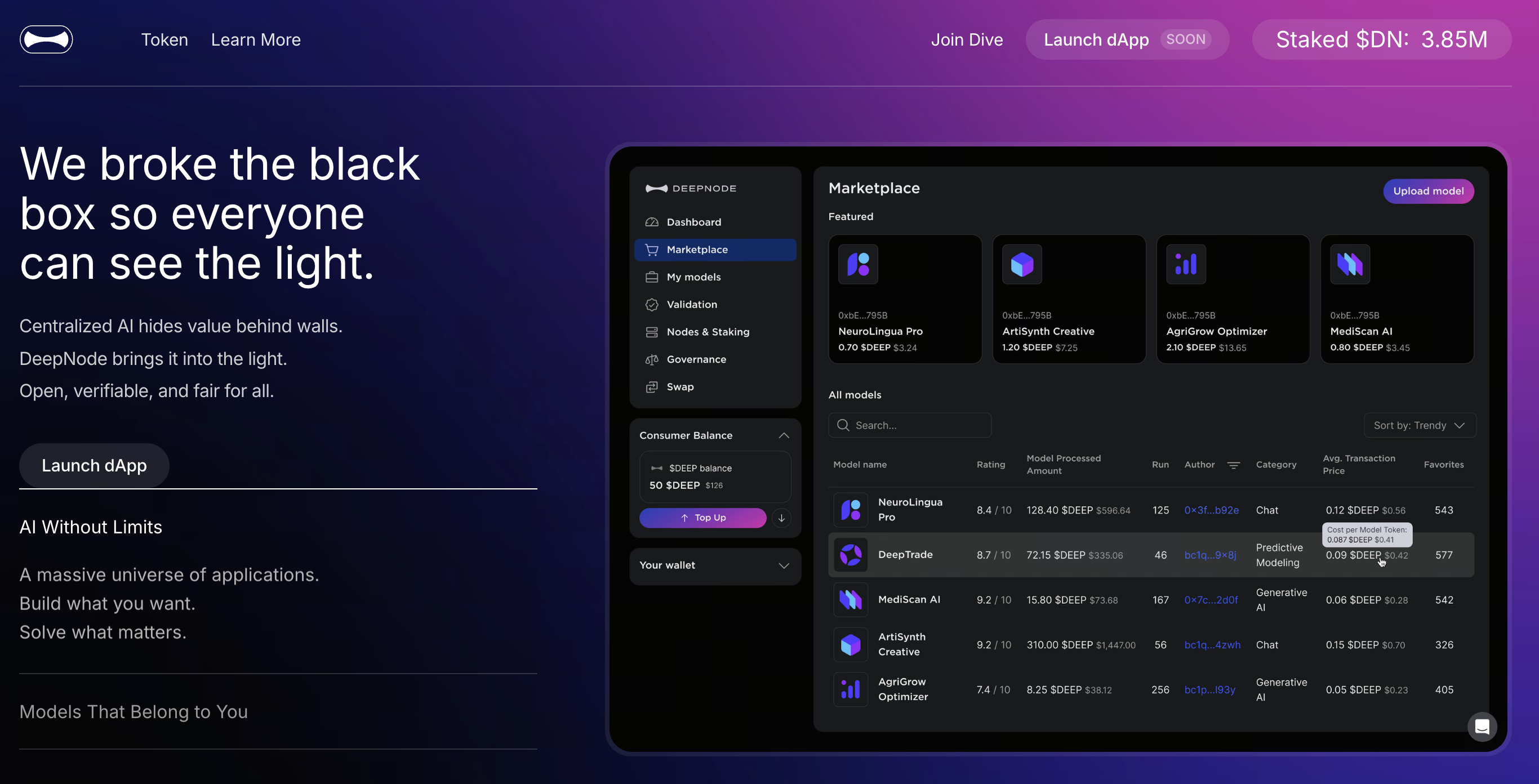
From an overall architecture perspective, DeepNode can be understood as an open intelligent network composed of a model layer, a computing layer, a validation layer, a consensus layer, and an economic incentive layer.
Traditional AI platforms typically use a centralized server architecture. Model training, inference services, data storage, and resource scheduling are all controlled by a single entity. While this model ensures unified management, it also leads to resource concentration, lack of transparency, and high barriers to innovation.
DeepNode, on the other hand, adopts a distributed network design.
The entire system mainly consists of five key components:
-
AI Model Network (Model Layer)
-
Distributed Computing Network (Compute Layer)
-
Validation Network (Validation Layer)
-
PoWR Consensus Layer (Consensus Layer)
-
DN Incentive Economic Layer (Economic Layer)
When a user initiates an AI request, the task is sent to computing nodes in the network for execution, then reviewed by validation nodes for results, and finally value settlement and reward distribution are completed through the consensus mechanism.
This architecture transforms AI services from the traditional platform model to an open network model.
What is Open Intelligence
Open Intelligence is the core design philosophy of DeepNode. If the internet solves the problem of information flow, then Open Intelligence aims to solve the problem of intelligent capability flow. Under the traditional AI system, models are usually held by a few large tech companies. Users can invoke models but cannot truly participate in the value creation process of the models.
Open Intelligence, on the other hand, attempts to establish an open collaborative framework. In this system: models can be contributed openly, computing power can be accessed openly, data can be collaborated openly, revenue can be distributed transparently, and every participant in the network can receive corresponding rewards based on their own contributions.
This mechanism makes AI no longer a closed service but a public infrastructure. As the network scales, more models and nodes continuously join, and the entire ecosystem will form network effects similar to the internet, achieving continuous expansion of intelligent capabilities.
Detailed Explanation of the PoWR (Proof-of-Work Relevance) Consensus Mechanism
PoWR is one of the core innovations in DeepNode's technical architecture. In traditional blockchains, PoW (Proof-of-Work) mainly measures the computing resources contributed by nodes. However, in an AI network environment, measuring only computing power is insufficient.
Because the quality of model inference results is equally important. Therefore, DeepNode introduces the dimension of Relevance. The core logic of PoWR can be summarized as: Computational Contribution × Result Quality × Historical Reputation.
After a node completes a task, the system not only evaluates the resources it consumed but also assesses whether its output is accurate, stable, and meets the task requirements.
For example:
Two nodes complete the same computing task. One node outputs higher quality results, while the other uses more computing power but produces lower accuracy results. Under the PoWR mechanism, the former will receive a higher reward. This design effectively prevents the network from falling into a competition purely based on hardware scale. It also encourages nodes to continuously optimize model performance and service quality. For an open intelligent network, PoWR essentially establishes a value measurement system that balances efficiency, quality, and fairness.
How Model Developers, Validators, and Miners Collaborate
DeepNode's operation relies on the collaboration of three core participants.
Model Developers
Developers are responsible for building and uploading AI models.
These models may include:
-
Large Language Models (LLM)
-
Image Generation Models
-
Multimodal Models
-
Speech Recognition Models
-
Enterprise-specific AI Models
After a model is invoked, developers can receive ongoing revenue.
Thus, the model itself becomes a digital asset that can sustainably generate value.
Workers
Workers are responsible for providing computing resources.
They contribute GPU, CPU, and storage capacity to the network for executing training and inference tasks.
Workers perform the actual computing work.
Once tasks are completed, the system distributes rewards based on task difficulty and contribution level.
Validators
Validators are responsible for reviewing results.
Their main responsibilities include: checking the correctness of task outputs; identifying anomalous behavior; verifying model performance; and maintaining network consensus. Validators need to stake DN to participate in the network. If malicious behavior occurs, their staked assets may be penalized.
These three form a complete production chain: Developers provide models → Workers execute computation → Validators confirm results → Users receive services.
How Dynamic Trust Weights Improve Network Efficiency
Dynamic Trust Weights are an important mechanism used by DeepNode to enhance network performance.
Traditional distributed networks often use static reputation systems, but node performance changes over time, and static scores often fail to accurately reflect the current state of a node. Therefore, DeepNode introduces a dynamic trust mechanism.
The system continuously tracks multiple indicators:
It then generates real-time trust weights for each node.
High-reputation nodes will receive: more task allocation opportunities, higher revenue weight, and greater network influence; while nodes with declining reputation will gradually receive fewer task assignments. This dynamic adjustment mechanism enables automatic optimization of resource allocation. As the network scales, Dynamic Trust Weights will become an important infrastructure for maintaining system efficiency.
How DeepNode Enables Continuous Evolution of AI Models
One of the biggest differences from traditional AI platforms is that DeepNode's model ecosystem has the capability for continuous evolution. Traditional models typically rely on centralized teams to update versions, with long upgrade cycles and limited transparency.
DeepNode, on the other hand, adopts an open collaboration model. Once a model is online: developers continuously optimize the model; users continuously generate feedback data; validators continuously evaluate performance; and the network continuously adjusts resource allocation.
In this process, high-performing models receive more traffic and revenue. Underperforming models are gradually eliminated by the market. This mechanism bears some similarity to natural selection. Models engage in continuous competition, and the network automatically selects better solutions through economic incentives. Ultimately, this drives the entire ecosystem to evolve toward higher performance.
What Challenges Does a Decentralized AI Network Face?
Although open intelligent networks have broad prospects, they still face many practical challenges.
Computing Resources: Training advanced AI models requires large GPU clusters. How to compete with centralized cloud services remains a problem that all decentralized AI projects need to solve.
Model Quality Control: An open network means anyone can upload models. Ensuring model security, reliability, and output quality is a long-term issue for the validation layer.
Economic Incentive Balance: If the reward design is unreasonable, it may lead to node churn or ecological imbalance.
Other challenges include:
These challenges determine that decentralized AI is still in a phase of continuous exploration.
Future Development Directions of DeepNode Technology
With the rapid development of AI Agents, open-source models, and decentralized computing power networks, DeepNode's technology roadmap is also expanding. The following directions may be key focuses in the future.
AI Agent Infrastructure
More and more intelligent agents require continuous access to models and computing resources. DeepNode has the opportunity to become an important underlying support network for the Agent economy.
Multi-Model Collaborative Networks
Future AI applications may no longer rely on a single model; multiple models collaborating to complete complex tasks will become a trend. DeepNode is moving toward model orchestration and intelligent routing.
Stronger On-Chain Verification System
As the scale of AI services expands, the importance of on-chain verification mechanisms will further increase. More automated and intelligent verification networks may emerge in the future.
Enterprise-Grade AI Service Marketplace
Enterprises' demand for private models, dedicated computing power, and trusted AI services continues to grow. DeepNode is expected to expand into the enterprise-level infrastructure domain.
In the long run, the development potential of open intelligent networks comes not only from the Web3 market but also from the growing demand across the entire AI industry for open collaboration models.
Summary
DeepNode is attempting to build a new AI infrastructure network centered on Open Intelligence. Through the coordinated operation of the model layer, computing layer, validation layer, and PoWR consensus mechanism, the network connects developers, miners, validators, and end users, enabling the open flow and value sharing of intelligent capabilities.
Among its components, Dynamic Trust Weights provides a dynamic reputation management mechanism, PoWR establishes a reward system based on quality and contribution, and the open model ecosystem drives the continuous evolution of the AI network. As the decentralized AI track continues to develop, the open intelligent architecture explored by DeepNode is becoming one of the important practical directions for the convergence of AI and blockchain.