As cryptocurrency and blockchain technology continue to expand beyond their original boundaries, the industry's narrative focus is gradually shifting from pure financial speculation toward vertical sectors with the potential to create meaningful real-world change. In recent years, decentralized science (DeSci) has emerged as a notable intersection of Web3 and traditional research systems, attracting attention from global capital and technology enthusiasts. Across recent crypto asset exchange and market observations, such as CoinMarketCap gainers rankings and discussions of liquidity trends, ResearchCoin (RSC) has repeatedly drawn attention, signaling that decentralized research collaboration may be entering a period of reassessment.
Traditional scientific research has long faced structural challenges, including lengthy publishing processes, high barriers to funding access, opaque peer review, and inefficient sharing of research outcomes. Traditional academic publishers have used their dominant positions to benefit from substantial unpaid work by researchers, while expensive subscription fees have restricted the free flow of human knowledge. Leveraging the transparency of blockchain infrastructure, token-based incentives, and smart contract automation, ResearchCoin (RSC) aims to build an open, autonomous academic collaboration network with a robust internal economic cycle for researchers worldwide. For cryptocurrency investors and frontier technology explorers, understanding ResearchCoin is not only important for recognizing opportunities in the DeSci sector, but also provides a focused perspective on how blockchain can reshape the relationships behind human knowledge production. This article examines ResearchCoin's core value proposition and ecosystem development through the lenses of cryptocurrency and tokenomics.
Key Takeaways
-
An in-depth analysis of the macro logic behind the DeSci sector and ResearchCoin's innovative approach to addressing challenges in traditional research
-
A systematic breakdown of RSC's diverse roles as the core token of the ResearchHub platform, including research incentives, peer review, and governance
-
A detailed discussion of sustainable closed-loop tokenomics designed to optimize value capture and long-term returns for research contributors
-
An explanation of how multichain deployment and asset liquidity management can help ResearchCoin reach a broader range of crypto asset users
-
A look at how spot ecosystems on mainstream trading platforms such as Gate can provide investors with secure and convenient access to high-quality DeSci assets
Structural Challenges in Traditional Research and the DeSci Approach
To fully understand the value of ResearchCoin (RSC), it is necessary to first examine the deep-rooted issues in traditional academic publishing and research funding systems. For a long time, the publication, review, and funding of global scientific research have been highly concentrated in the hands of a small number of major commercial publishers. Researchers, typically funded by taxpayers or academic institutions, produce research results without compensation and conduct rigorous peer reviews for others without compensation. Ultimately, their universities or institutions must pay exceptionally high subscription fees to access these publications. This inefficient, closed ecosystem of "double charging" has severely constrained the pace of global technological innovation.
DeSci emerged to introduce Web3's decentralized collaboration, transparent ledgers, and tokenomics into scientific research, fundamentally challenging this monopoly. The core goal of DeSci is not to reject scientific research itself, but to restructure its incentive and distribution mechanisms. Through blockchain, research funding can be transparently crowdsourced through smart contract-based Quadratic Funding, research findings can be published immediately as preprints, and academic reviews and discussions can be transformed into work with immediate economic value through token rewards.
As a leading project in this sector, ResearchCoin was built within this broader transformation. Through the open-source ResearchHub platform, it connects tens of thousands of researchers, scholars, and enthusiasts worldwide within a decentralized network, enabling every small academic contribution to receive transparent and equitable on-chain rewards. This effort to combine borderless scientific collaboration with a cryptoeconomic model gives the RSC token distinctive social value and long-term investment characteristics beyond those of traditional crypto assets.
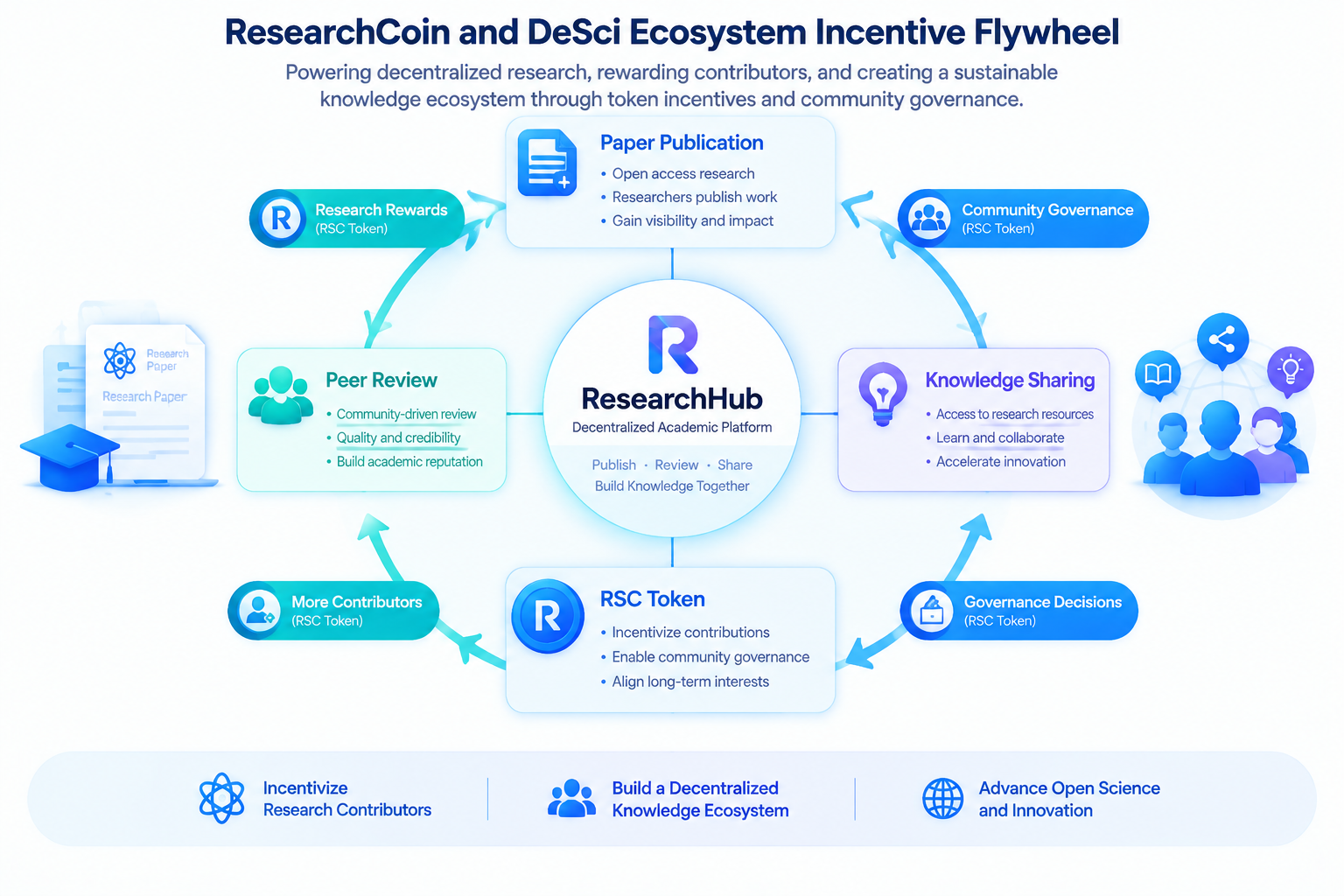
ResearchCoin Tokenomics and the Research Incentive Framework
After establishing the broader rationale behind DeSci, it is necessary to examine the tokenomics and operational mechanisms of ResearchCoin (RSC). In a sustainable decentralized economic network, tokens are not only vehicles for liquidity. They are also core tools for maintaining community engagement, regulating content quality, and distributing governance rights.
First, RSC serves as a measure of research contribution. When scientists, graduate students, or independent researchers worldwide publish valuable preprints on the ResearchHub platform, write insightful peer review reports, identify methodological gaps in existing research, or engage in open and rigorous academic discussions on frontier scientific hypotheses, community members can Upvote their contributions. Based on algorithms and community consensus, the system then automatically distributes a corresponding amount of RSC token rewards. This immediate feedback mechanism fundamentally changes the traditional academic challenge of publication cycles that can last months or even years.
Second, the RSC token plays a central role in platform governance. Token holders can not only benefit from ecosystem development, but also directly participate in the platform's governance proposals. For example, they can help determine the funding direction of the future research funding pool, or Community Treasury, adjust the weighting of token distribution rewards, and optimize the platform's academic review rules. By returning governance rights to frontline researchers, this design enables ResearchHub to continue evolving with the needs of the scientific community while reducing the risks of rent-seeking and corruption that may arise in centralized institutions.
In addition, from the perspective of token supply and demand dynamics, demand for RSC has the potential to rise structurally as high-quality academic discussions increase, the number of verified research users expands, and external academic institutions gradually join the platform. The token's deflationary design and the growth of the platform ecosystem form a positive cycle, establishing a stronger fundamental basis for its value support in the secondary market.
DeSci Growth, Liquidity Development, and Asset Allocation Considerations
As cryptocurrency market narratives continue to rotate, DeSci is gradually evolving from a niche experiment among technology enthusiasts into a core sector receiving broad attention from mainstream capital and leading institutions. Unlike Meme coins driven primarily by market sentiment or traditional DeFi protocols that are highly sensitive to macro interest rate movements, DeSci is anchored in the expansion of human knowledge, biomedical breakthroughs, and fundamental scientific research. It therefore has strong countercyclical resilience and long-term social value.
However, when participating in emerging sector assets, cryptocurrency investors often need to consider liquidity depth, cross-chain friction, and asset security. ResearchCoin has demonstrated a forward-looking approach to multichain ecosystem development. By expanding to mainstream high-performance networks and Layer 2 ecosystems such as Base, it has substantially reduced users' on-chain interaction costs and improved the token's liquidity across decentralized and centralized trading markets.
Throughout this development, mainstream crypto asset trading platforms play an essential bridging role. Using Gate as an example, users can allocate and manage liquidity for core DeSci assets such as RSC through Gate's spot trading market in a secure and convenient way, without navigating complex decentralized bridging processes or taking on unknown smart contract security risks. By trading RSC spot on Gate, users can benefit from deep buy-side liquidity and a smooth trading experience while making long-term value allocations based on their own risk preferences. As the decentralized science narrative gains momentum from both capital and technology, Gate's asset custody and compliance risk management framework provides foundational support for investors seeking exposure to the DeSci sector.
Risk Management, Long-Term Monitoring, and an Investor Decision Framework
Although the DeSci sector has broad potential and ResearchCoin demonstrates a highly disruptive design, rational and prudent risk management remains essential when participating in cryptocurrency secondary markets. Investors should establish a systematic macro and micro analysis framework when planning their asset allocation ratios.
First, it is important to closely monitor the overall maturity of the DeSci ecosystem. Decentralized science remains in an early stage of exploration. Challenges remain in integrating on-chain token incentives with rigorous real-world academic peer review in a compliant and seamless manner, including legal, cultural, and institutional considerations. Investors should assess ResearchHub's actual progress in attracting leading scientists and improving the quality of authentic academic literature on the platform.
Second, investment positions should be managed appropriately. Because tokens in emerging sectors often experience high price volatility during their initial listing periods or shifts in market sentiment, investors should avoid blindly chasing price increases. Strategies such as building positions in stages and setting dynamic take-profit and stop-loss levels through platforms such as Gate may help reduce the psychological pressure caused by sharp short-term price movements.
Finally, investors should continue monitoring the project's actual delivery progress in tokenomics adjustments, multichain ecosystem expansion, and partnerships with external research funds. The long-term intrinsic value of crypto assets can be more fully realized only when the technical roadmap is steadily delivered and the academic community continues to expand.
FAQ
What Is ResearchCoin (RSC), and What Role Does It Play in the DeSci Sector?
ResearchCoin (RSC) is the core token powering the ResearchHub platform and is a representative project in the DeSci sector. It is mainly used to reward scientists for publishing papers, conducting peer reviews, and participating in academic discussions, restructuring traditional research incentives and governance mechanisms.
How Does ResearchCoin Address Challenges in Traditional Academic Publishing?
Traditional academic publishing is often characterized by long cycles, high costs, and limited transparency. Through blockchain-based incentives, ResearchCoin converts research contributions directly into transferable token rewards, reducing intermediary monopolies and accelerating the free circulation and sharing of global scientific knowledge.
How Can Individual Investors Participate in the RSC Ecosystem Through Gate?
Investors can directly buy and sell RSC tokens through Gate's spot market. With the platform's secure custody and deep liquidity support, they can participate in the long-term development of decentralized science while managing operational risks effectively.