DAPPOS and traditional Web3 tool platforms are often compared because both appear to help users complete Web3-related tasks. The difference is that traditional platforms usually ask users to learn tools first, while DAPPOS is positioned around describing goals first and letting the system organize the path to a result.
This comparison matters because many product categories in Web3 can look similar at the surface level even when the user burden is very different. A clearer comparison makes it easier to separate interface style, execution responsibility, and practical suitability.
Key takeaways
- DAPPOS is positioned as a prompt-first AI operating system, while traditional Web3 tool platforms usually depend on manual navigation and configuration.
- Traditional Web3 platforms often require users to understand the tool stack in advance, whereas DAPPOS aims to start from user intent.
- The key comparison is not which model is universally better, but which model fits a given task, user profile, and risk tolerance.
- A conversational interface can reduce setup friction, but it does not automatically eliminate execution complexity or verification needs.
What is DAPPOS in this comparison?
DAPPOS is a Web3 AI operating system built around the idea that users can express goals in plain language and receive usable outputs without navigating several separate tools. In this comparison, DAPPOS represents a prompt-first interaction model rather than a menu-first or script-first one.
That framing matters because DAPPOS is not only a collection of features. DAPPOS is also a claim about how Web3 interfaces should work, with AI acting as the layer that interprets intent and coordinates delivery.
Traditional Web3 tool platforms are products that ask users to move through dashboards, settings, wallets, bridges, scripts, or manual operational flows in order to complete a task. These platforms can be powerful and flexible, but they usually expect the user to understand the structure of the workflow before getting to the result.
Traditional does not mean outdated. It simply means the interaction model usually begins with tools and interfaces, not with a conversational request. That distinction is central to the comparison with DAPPOS.
Many traditional environments are built around development stacks that include wallets, node providers, SDKs, APIs, dashboards, and security tools. Teams use these components to build projects, connect applications, and manage cross-chain or cross-service workflows, but doing so often requires a stronger understanding of how the Web3 ecosystem is assembled.
A builder working in a traditional environment may need to choose node infrastructure, connect wallets, manage asset flows, and coordinate development across several services before the application is usable. That path can be powerful for experienced teams, yet it also explains why prompt-first products such as DAPPOS present themselves as an easier way to use Web3 infrastructure for task execution and application building.
How do the two models differ in user workflow?
The clearest difference lies in workflow order. Traditional platforms often start with tool selection, setup, and configuration, while DAPPOS starts with a natural-language prompt that the system is supposed to translate into a usable path.
This changes where cognitive effort is placed. In a traditional model, the user carries more of the responsibility for mapping goals into steps. In a prompt-first model, the platform takes on more of that translation burden, at least in theory.
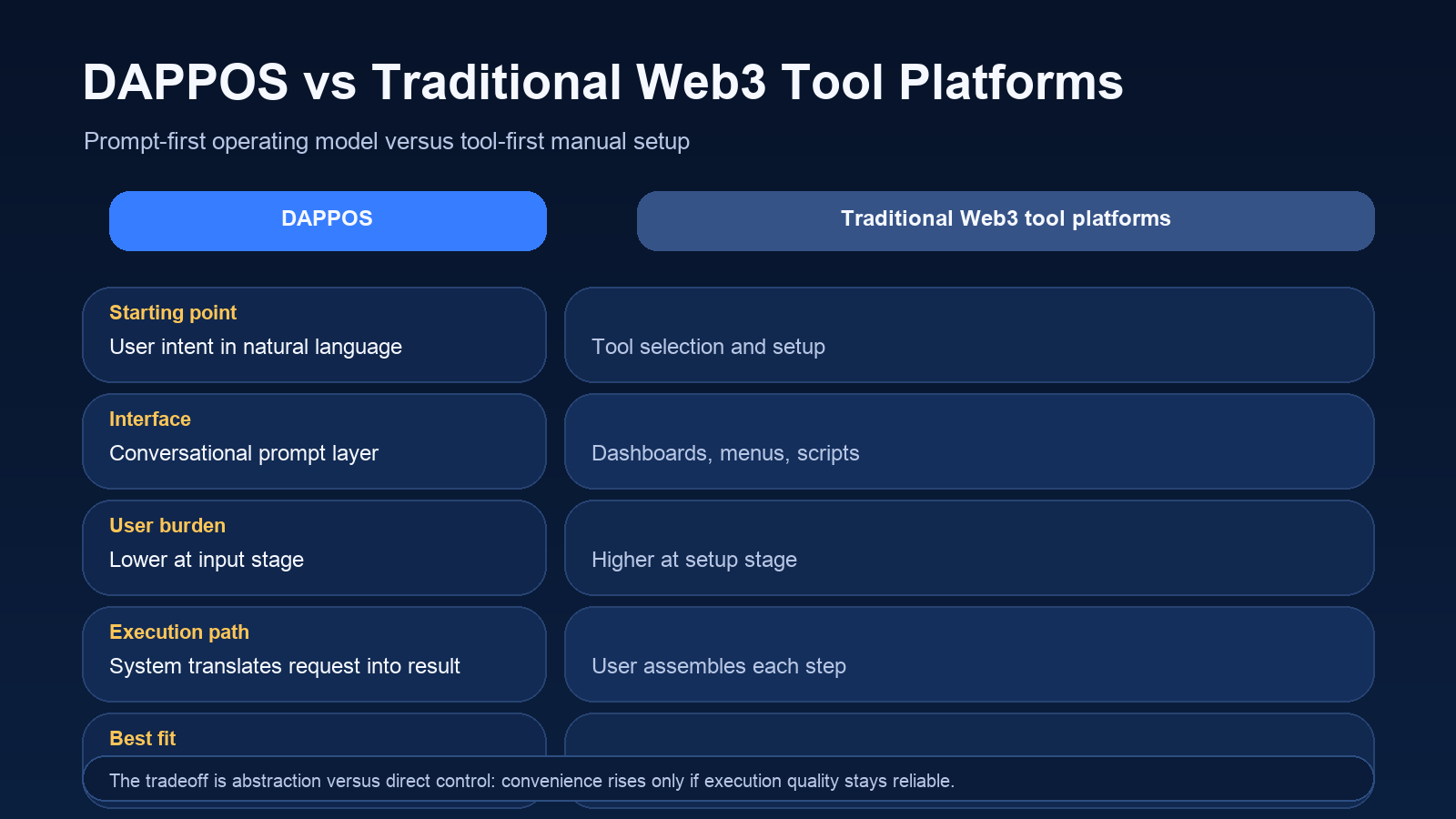
| Dimension |
DAPPOS |
Traditional Web3 tool platforms |
| Starting point |
User intent in natural language |
Tool selection and manual setup |
| Interface style |
Conversational and prompt-driven |
Dashboard, menu, or script-driven |
| User burden |
Lower at the input stage |
Higher at the input and setup stage |
| Output path |
System translates request into result |
User assembles the path to the result |
| Main tradeoff |
Convenience depends on interpretation quality |
Flexibility depends on user skill |
How do they differ in output and execution responsibility?
DAPPOS aims to deliver a more packaged result after interpreting a user request. Traditional platforms usually give users the interfaces and components needed to produce that result themselves.
That means DAPPOS may feel easier at the beginning, while traditional tools may feel clearer when a user wants direct control over each step. The difference is not only technical. It also reflects a different philosophy about how much abstraction a platform should provide.
Traditional platforms can expose more of the underlying development and execution path, which some teams prefer when they are building projects that need auditable control over wallets, nodes, services, and application logic. DAPPOS instead tries to abstract part of that path so that the user can focus on the intended use case, the desired asset or task outcome, and the broader product experience rather than on each low-level setup decision.
That abstraction can be attractive for people who want faster experimentation, but it also changes how responsibility is distributed. The more the platform handles task orchestration, the more users must trust its execution layer, service design, and ecosystem assumptions. This is why the comparison between DAPPOS and traditional tools is really a comparison between guided operating experience and explicit development control.
Users who value speed, guided interaction, and lower setup friction may find DAPPOS more approachable. This can be especially true when the user knows the intended outcome but does not want to manually coordinate every tool and step.
Users who need granular control, already know the workflow, or prefer predictable manual configuration may still prefer traditional Web3 tool platforms. In those cases, direct control can be more important than conversational convenience.
For example, a development team building cross-chain applications may want to manage wallets, nodes, APIs, and security reviews directly because each part of the stack affects how the project behaves in production. A less technical user, by contrast, may prefer a system that reduces setup overhead and presents the service as a clearer operating layer.
What limitations should be considered in this comparison?
A prompt-first interface can make a product more accessible, but accessibility is not the same as reliability. The system still needs to interpret intent correctly, handle edge cases, and produce outputs that are safe and usable.
Traditional platforms also have limits, including higher learning costs and greater operational friction. The comparison is therefore best understood as a tradeoff between abstraction and direct control rather than as a simple ranking of one model over another.
Summary
DAPPOS differs from traditional Web3 tool platforms because DAPPOS begins with user intent and uses AI to map that intent toward a usable result, while traditional platforms usually begin with tools, configuration, and manual workflow design. The most useful comparison is not whether one approach is universally superior, but which model better fits a user's goals, skill level, and need for control.
FAQ
What is the main difference between DAPPOS and traditional Web3 tool platforms?
The main difference is interface logic. DAPPOS starts with a user prompt and aims to translate intent into a usable result, while traditional Web3 tool platforms usually require users to navigate tools and configure the workflow themselves.
DAPPOS is not necessarily replacing traditional Web3 tools. DAPPOS represents a different interaction model that may suit some users and tasks better, while traditional tools may remain more suitable where granular control is required.
Users compare them because both can lead to Web3 outcomes, but the user experience and workflow burden are different. The comparison helps clarify whether convenience, control, or execution visibility matters more in a given context.
Does a prompt-first model make Web3 easier?
A prompt-first model can make Web3 easier at the interface level by lowering setup friction and reducing the need to translate goals into manual steps. However, it does not automatically remove execution complexity or the need to verify results.
Who may benefit most from DAPPOS?
Users who know what they want to achieve but do not want to manually coordinate multiple tools may benefit most from DAPPOS. Users who want detailed manual control may still prefer a traditional platform workflow.