Spear phishing is a type of cyber fraud designed to target a specific individual or group. Unlike ordinary phishing, which sends the same content to a large number of users, spear phishing uses the victim's identity, contact information, account usage habits, or other background information to create a more credible deception and induce the user to disclose sensitive information or perform dangerous actions.
In the crypto industry, the risks of spear phishing deserve particular attention. Trading accounts are directly connected to digital assets, and some on-chain transactions are irreversible. Once a user discloses critical credentials, signs a malicious transaction, or transfers assets to an address controlled by an attacker, recovering the funds can be extremely difficult.
In October 2026, crypto exchange Coinbase disclosed that its third-party analytics service provider, Amplitude, experienced a security incident that affected the contact information of a small number of customers. Coinbase stated that it had found no evidence of unauthorized access to its own systems and that customer assets were not directly affected by the incident. The incident once again highlighted an important issue: even when financial systems are not compromised, user information may still be exposed through third-party channels and become potential material for subsequent targeted fraud.
This article examines the risks associated with personal information exposure, explains how attackers use impersonation, fake security notifications, and malicious authorizations to gradually approach users' assets, and introduces different protective measures for centralized exchange accounts and self-custody wallets.
Key Takeaways
-
Spear phishing is more targeted than ordinary fraud. Attackers may use exposed names, email addresses, phone numbers, and other background information to impersonate exchange customer support, security teams, or familiar contacts.
-
Personal information exposure does not mean that crypto assets have been immediately stolen. Exposed contact information typically does not directly give attackers permission to operate funds, but it may become the starting point for subsequent identity impersonation, social engineering, and account takeover.
-
Third-party service providers can also become entry points for risk. Even if an exchange's core systems have not been breached, data leaks involving external analytics tools, customer support systems, or other vendors may increase users' risk of spear phishing.
-
Account takeover and on-chain wallet theft involve different mechanisms. Centralized exchange accounts mainly face risks involving login credentials, authentication methods, and withdrawal permissions, while self-custody wallets require particular attention to seed phrase exposure, malicious signatures, and token approvals.
-
Two-factor authentication cannot prevent all phishing attacks. One-time verification codes may be submitted after users are deceived, and some malicious third-party app authorizations do not require attackers to obtain the user's password directly.
-
The focus of defense is to disrupt the attack path. Independently verify the source of messages, use phishing-resistant authentication methods, limit withdrawal and authorization permissions, and promptly address unusual logins to reduce the risk that a single information leak will develop into asset loss.
What Is Spear Phishing, and How Does It Differ From Ordinary Crypto Fraud?
The defining characteristic of spear phishing is that attackers design fraudulent content around a specific target rather than relying entirely on randomly distributed messages.
Ordinary phishing may use standardized templates such as "unusual account activity," "reward waiting to be claimed," or "your wallet requires an upgrade" and send the same link to large numbers of users. Although these messages can also cause losses, they typically lack details related to an individual's identity.
Spear phishing messages may include the recipient's real name, commonly used trading platform, partial contact information, or recent public activities. Attackers use these details to make the message appear more credible, causing the victim to believe they are communicating with a real platform employee.
For example, a user may receive an email claiming to be from an exchange's security department. The message may contain the user's correct name, mention the exchange they use, and claim that the account is under investigation for an unusual withdrawal. It may ask the user to complete identity verification immediately or risk having their assets frozen.
These details may make the fraud appear more authentic, but they do not prove that the sender has a legitimate identity.
The differences between spear phishing and ordinary phishing can be summarized as follows.
| Comparison Dimension |
Ordinary Phishing |
Spear Phishing |
| Target |
Large numbers of random users |
Specific individuals or user groups |
| Information Preparation |
Generic fraud templates |
Information related to the target |
| Message Content |
Generalized account reminders |
Identity, platform, or behavioral context |
| Impersonation |
Common platforms or brands |
Platform support staff, acquaintances, or specific employees |
| Primary Objective |
Steal credentials or funds |
Gain trust and induce high-risk actions |
It is worth noting that attackers do not need to possess a large amount of confidential information to carry out spear phishing. Sometimes, an email address associated with a crypto trading account is enough to design a targeted fraudulent message.
Therefore, when determining whether a message is trustworthy, do not rely on whether the other party knows your name, phone number, or the platform you have used. Instead, consider whether their identity can be verified through an independent channel and whether the requested action is reasonable.
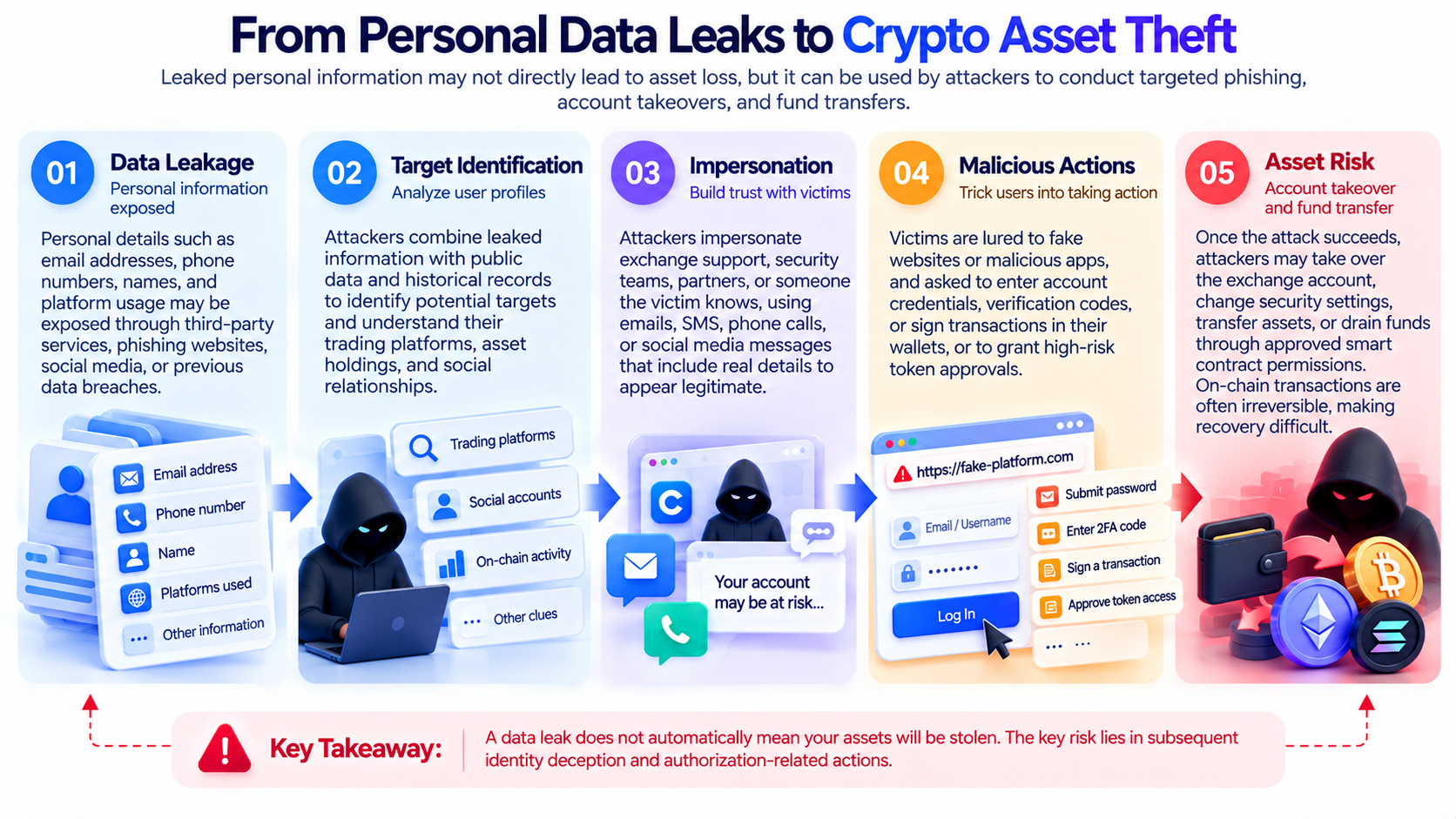
There are usually multiple independent steps between personal information exposure and asset theft. After obtaining a user's contact information, an attacker may first try to determine which exchanges the user has used, then establish contact through impersonated notifications, phone calls, or social messages. Only after the victim believes the false identity might the attacker obtain credentials, obtain malicious authorization, or induce a transfer of funds.
Therefore, exposure of an email address or phone number alone does not mean that an attacker has already gained control of a trading account. However, this information may help attackers reduce the cost of identifying targets. For example, an ordinary email address may not indicate whether its owner holds digital assets. If the email address is associated with customer information from a crypto platform, the attacker may infer that the user has a related account and send a more targeted message.
When attackers further combine this information with public social media content, records from historical data leaks, or other available background information, the fraudulent content may become more specific.
The complete risk path can usually be divided into five stages:
-
Information Exposure: An email address, phone number, or other identity information is exposed through a particular channel.
-
Target Identification: The attacker determines which exchange or wallet service the user may use.
-
Identity Impersonation: The attacker impersonates a trusted entity through email, phone calls, or social messages.
-
Induced Action: The user is asked to log in to a fake website, submit a verification code, authorize an application, or transfer assets.
-
Financial Risk: If the attack succeeds, it may lead to account takeover, malicious signatures, or asset transfers.
This process does not occur in full every time. Most information leaks do not automatically result in financial losses, and some phishing messages are blocked by security systems or identified by users.
The key concern is how attackers use initial information to gradually induce users to bypass their existing account security protections.
Why Can a Data Leak at a Third-Party Service Provider Also Affect Crypto Account Security?
Modern crypto exchanges typically use a range of third-party services, including data analytics, customer support, email notifications, identity verification, and business operations tools. These services can improve platform efficiency, but they also expand the scope of customer information that may be processed and stored. When a third-party vendor experiences a security incident, the affected information may be related to exchange customers, even if the exchange's own trading systems, wallet systems, and core databases have not been breached.
The Coinbase and Amplitude incident in October 2026 illustrates this distinction in risk. The incident involved some customer contact information held by a third-party analytics service provider. Coinbase stated that it had not found evidence of unauthorized access to its own systems and that customer funds were not directly affected. The full details regarding the scope of the incident and the specific data fields involved remained to be clarified.
Therefore, a third-party information leak should not be directly described as the exchange being hacked, nor should it be assumed that attackers have obtained users' passwords, private keys, or permissions to operate funds. However, from a security perspective, third-party incidents may still have indirect effects.
Attackers may use exposed contact information to send spoofed security notifications. After learning about a genuine security incident, users may pay closer attention to their account status and become more susceptible to fake messages about "urgent verification" or "asset protection."
More importantly, a real security incident may be used as the background for a scam. Even if a fraudulent message refers to an event that actually occurred, this does not prove that the sender is a platform employee.
Therefore, exchange security involves not only core financial systems but also third-party data management, customer notification processes, and user identity verification mechanisms.
How Do Attackers Use Fake Customer Support and Security Notifications to Carry Out Spear Phishing?
Fake customer support is one of the common forms of impersonation used in crypto spear phishing. Attackers may impersonate an exchange's security department, claim to have detected an unusual login, suspicious withdrawal, or account freeze risk, and ask users to cooperate immediately. These scams often exploit a sense of urgency, causing victims to act without sufficient verification.
One common scenario is that a user receives a so-called "unusual withdrawal alert." The message claims that someone is attempting to transfer assets out of the account and asks the user to click a link to cancel the transaction. If the user enters their account password on a spoofed website, the attacker may obtain the login credentials. If the user then submits a one-time verification code, the account security risk may increase.
Another scenario involves fake asset protection. An attacker may claim that the user's existing account or wallet has a security issue and instruct the user to transfer assets to a designated "secure address." This claim is clearly dangerous. Legitimate platform security measures should not require users to transfer assets to an external wallet that has not been independently verified based on instructions from an unfamiliar caller or private message. Some attacks may also enhance their credibility by fabricating ticket numbers, customer support identities, or email display names. Even if a message shows what appears to be a genuine platform email address, do not judge its authenticity based solely on the sender name.
For users, the most effective way to check is to stop using links provided in suspicious messages and instead verify the account status through an official website, official app, or trusted customer support channel that the user accesses independently. If a message claims that there is an urgent risk, verify it through an independent channel before taking any action rather than following the steps provided by the sender.
What Steps Does an Attack Typically Involve From a Phishing Message to Account Takeover?
Account Takeover (ATO) refers to an attacker obtaining unauthorized control of an account and potentially accessing sensitive information or operating assets. For centralized crypto trading accounts, attackers typically need to bypass security controls involving login authentication, account recovery, or fund withdrawals. The specific protection mechanisms vary by platform, so obtaining a password does not necessarily mean that an attacker can immediately withdraw funds.
However, a leaked password can still be an important starting point for account takeover.
Attackers may obtain passwords through spoofed login pages, trick users into submitting one-time verification codes, or attempt to log in using credentials that have already been exposed. If a user reuses the same password across multiple services, a data leak at another website may also indirectly increase the risk to the crypto account.
In addition, account recovery processes may be vulnerable to social engineering. For example, an attacker may attempt to impersonate the account holder using personal information or induce the user to make certain security setting changes.
It is important to note that two-factor authentication can significantly improve account security, but different authentication methods do not offer the same level of phishing resistance. SMS verification codes may be vulnerable to number hijacking or code theft through social engineering. Authenticator apps typically reduce reliance on cellular networks, but users may still be tricked into entering the code on a fake website.
By comparison, security keys and Passkeys that comply with the FIDO2/WebAuthn standards generally offer stronger phishing resistance because the authentication process is bound to the identity of the legitimate website. For exchanges that support these features, prioritizing phishing-resistant authentication methods and combining them with withdrawal address whitelists, device management, and unusual login alerts can reduce the impact of a single security control failure.
Why Can an Account Still Be Targeted by Phishing After Two-Factor Authentication Is Enabled?
The primary purpose of two-factor authentication (2FA) is to add an additional identity verification requirement beyond the password. However, it does not mean that all account actions are protected from deception.
Attackers may use fake login pages to trick users into voluntarily submitting verification codes. If users mistakenly believe that they are accessing the real platform, they may provide a dynamic verification code after entering their password.
Some attacks do not directly target login passwords but instead target an established session or third-party application permissions. The OAuth authorization mechanism allows users to grant access to specific account data without providing their password to a third-party application. This mechanism has legitimate uses, but it can also be exploited by malicious applications.
Attackers may impersonate file-sharing, identity verification, or other services and direct users to a genuine third-party authorization page. If users do not check the application's identity and permission scope, they may grant a malicious application access to email, files, or other account data. This risk differs significantly from ordinary password phishing: even if the user later changes their password, previously granted third-party application permissions may not automatically become invalid. Therefore, users must also actively check for and revoke suspicious application authorizations when handling such incidents.
For crypto users, email accounts are particularly important. Email may be linked to exchange security notifications, account recovery, and device verification processes. If a malicious third-party application reads the user's email, the attacker may obtain more account information and make subsequent scams more targeted.
Therefore, protecting a crypto account requires more than securing the exchange login. Users must also protect their linked email account, mobile devices, and third-party application authorizations.
What Different Phishing Risks Do Centralized Exchange Accounts and Web3 Wallets Face?
Both centralized exchange accounts and self-custody wallets may be targeted by spear phishing, but their methods of asset control differ, as do the security controls attackers need to bypass.
Centralized exchange accounts are typically managed through the platform's account systems and asset custody processes. Attackers may try to obtain login credentials, bypass authentication measures, or induce users to initiate withdrawals themselves.
Self-custody wallets are managed by users through their private keys or seed phrases. Attackers do not necessarily need to obtain access to an exchange account. Instead, they may use malicious websites, fake wallet applications, or deceptive signature requests to affect on-chain assets.
| Risk Dimension |
Centralized Exchange Account |
Self-Custody Web3 Wallet |
| Primary Attack Targets |
Login access and withdrawal permissions |
Private keys, seed phrases, signatures, and approvals |
| Common Phishing Entry Points |
Fake customer support and spoofed login pages |
Fake DApps and malicious wallet connections |
| Critical Dangerous Actions |
Submitting verification codes, changing security settings, and transferring funds |
Entering a seed phrase, signing malicious transactions, and granting permissions |
| Common Protective Measures |
Passkey, 2FA, and withdrawal whitelists |
Hardware wallets, signature verification, and approval management |
| Asset Risk Controls |
Platform risk controls and user security settings |
User private key management and on-chain permission restrictions |
For example, a self-custody wallet user may receive a so-called "wallet security upgrade notification" and be asked to visit a designated website and connect their wallet. Connecting a wallet does not necessarily result in asset loss. However, if the user subsequently signs a transaction that can transfer assets or grants a malicious contract excessive token permissions, actual financial risk may arise.
For centralized exchange accounts, users may be deceived by messages about an "account freeze" or "unusual withdrawal." For Web3 wallets, scams often revolve around scenarios such as "claiming an airdrop," "asset migration," or "approval repair."
Therefore, users need to adopt different protective measures based on how their assets are held. No single security setting can cover every crypto trading scenario.
How Can You Build a Multilayer Anti-Phishing Protection System for Crypto Accounts?
An effective anti-phishing system should not rely solely on users' ability to identify fraudulent messages. Instead, it should reduce the likelihood of a successful attack through multiple layers of protection.
The first layer is identity information protection. Users can use a dedicated email address for important crypto accounts and avoid displaying unnecessary contact information or asset details on public social platforms. A dedicated email address cannot eliminate the risk of a data leak, but it can help reduce the degree of information linkage between different services.
The second layer is login authentication protection. Trading accounts should use unique, strong passwords and prioritize Passkeys or hardware security keys supported by the platform. If other two-factor authentication methods are the only available option, users should avoid relying solely on SMS verification codes.
The third layer is fund operation restrictions. On platforms that support withdrawal address whitelists, withdrawal delays, or additional transaction verification, users can enable these features based on their needs. Even if login credentials are exposed, these restrictions may still make it more difficult for attackers to transfer assets.
The fourth layer is device and application management. Users should regularly check account login devices, active sessions, API Keys, and third-party application authorizations, and promptly remove permissions that are no longer used or whose source cannot be confirmed.
The fifth layer is on-chain wallet segregation. A wallet used for everyday interactions can be managed separately from a wallet holding long-term assets. This avoids keeping large amounts of assets in a wallet that frequently connects to unfamiliar DApps.
Users holding significant amounts of assets may also consider using a hardware wallet to manage long-term reserves and checking the transaction information displayed on the device before signing. The purpose of these measures is to reduce the risk of a single point of failure. Even if an attacker obtains some personal information, they should not be able to easily gain complete control over account login, withdrawals, or on-chain fund operations.
When you discover that personal information may have been exposed, first determine what information was leaked rather than immediately assuming that your assets are in danger. If only contact information was exposed, this generally does not mean that your password, private keys, or wallet permissions have been compromised. At this point, increase your vigilance toward unfamiliar calls, emails, and private messages, and check the security settings of important accounts.
If you have entered your password on a suspicious website, immediately change the password for the relevant account using a trusted device and an official access point, and check active login sessions. If you used the same password for other services, address each of those accounts separately as well.
If you have provided a dynamic verification code to an attacker or discovered unusual logins, unknown devices, or changes to security settings, immediately use the platform's official security features to restrict account activity and contact official support channels.
If you previously approved an unknown third-party application to access your email or another account, revoke the relevant authorization. Changing your password alone may not be enough to terminate certain access permissions that have already been granted. For self-custody wallets, the appropriate response depends on the specific risk:
-
Only connected to a suspicious website: Check whether any signatures or approvals occurred. Do not equate the connection alone with asset theft.
-
Signed a suspicious token approval: Check and revoke the relevant permissions in a trusted environment, while assessing whether other risks exist.
-
Private key or seed phrase exposed: Treat the wallet as no longer secure. Create a new wallet using a trusted device and, when possible, transfer any assets that remain under your control as soon as possible.
-
Assets have already been transferred abnormally: Save the transaction hash, addresses, timestamps, and relevant communication records, and contact the relevant platform and applicable law enforcement or anti-fraud channels.
For on-chain asset transfers that have already occurred, revoking a token approval generally cannot automatically recover funds that have already been transferred. Therefore, the focus of post-incident response should be preventing further losses, preserving evidence, and avoiding additional scams. Be especially cautious of so-called "asset recovery experts." After a user experiences a security incident, attackers may again impersonate technical personnel and request fees or wallet credentials to carry out a second scam.
Personal protection is important, but crypto platforms must also reduce risk through data management, identity verification, and controls over unusual fund operations.
-
Platforms should minimize the amount of unnecessary user identity information accessible to third-party services. For analytics tools and business operations systems, data minimization, access controls, and the isolation of sensitive information can reduce the scope of data potentially affected by a single vendor security incident.
-
Platforms need to establish clear security notification mechanisms. When a genuine security incident occurs, users should be able to confirm the relevant information through the official app or a trusted page rather than relying entirely on links in emails or text messages.
-
Account security design should reduce reliance on authentication methods that are easily exploited through social engineering. For high-risk actions, such as changing withdrawal settings, binding a new device, or transferring large amounts of funds, platforms can adopt stricter identity verification and risk checks.
-
Platforms need to continuously monitor unusual logins, device changes, and fund operations. Even if attackers obtain some account information, unusual behavior detection and restrictions on fund operations may help reduce actual losses.
-
Platforms and third-party vendors need to clearly define the scope of data processing, security responsibilities, and incident response mechanisms. Vendor security is not an issue separate from exchange security. It is part of the overall user security system.
As crypto services connect to more external tools, security protection must also extend beyond internal platform systems to cover third-party data processing, customer communications, and the complete process of executing user fund operations.
Conclusion
Spear phishing is one of the significant security risks facing crypto accounts. Compared with ordinary phishing, attackers may use exposed contact information and other background details to create more credible impersonations, making it more difficult for users to identify the scam based solely on the message content.
However, personal information exposure does not mean that an account has already been taken over, nor does it mean that crypto assets will inevitably be stolen. Multiple steps, including identity deception, credential theft, malicious authorization, or asset transfers, usually remain between contact information exposure and actual financial loss.
For centralized exchange accounts, the focus should be on strengthening login authentication, limiting withdrawal permissions, and verifying unusual notifications. For self-custody wallets, users need to protect private keys and seed phrases, verify transaction signatures, and manage smart contract approvals.
At the same time, third-party vendor security, protection of linked email accounts, and platform monitoring of unusual transactions will also become important components of crypto account security.
The key to preventing spear phishing is not ensuring that personal information is never exposed. It is establishing multiple layers of security so that even if attackers obtain some information, they still have difficulty gaining control of the account and assets.
FAQ
What Is Crypto Account Spear Phishing?
Spear phishing is a type of fraud in which attackers use a specific user's identity, contact information, or other background information to impersonate a trusted entity and induce the user to disclose sensitive information or perform dangerous actions.
Can an Exposed Email Address Result in Crypto Asset Theft?
An exposed email address alone generally does not directly result in asset theft, but it may increase the risk of spoofed emails, account recovery scams, and other targeted attacks.
Why Might Users Be Affected Even When the Exchange Was Not Hacked?
Third-party analytics, customer support, or other service providers may also process some customer information. If these vendors experience a security incident, users may face additional phishing and identity impersonation risks.
Why Does a Scammer Know My Name and the Exchange I Use?
This information may come from public sources, historical data leaks, or third-party services. Someone's knowledge of personal information does not prove that they are a legitimate platform employee.
Can I Still Be Phished After Enabling Two-Factor Authentication?
Yes. Attackers may trick users into submitting one-time verification codes or use malicious third-party application authorizations to obtain other account permissions. Passkeys and hardware security keys generally offer stronger phishing resistance.
What Should I Do If I Receive a Text Message About an Unusual Withdrawal From an Exchange?
Do not click links in the text message or call the number it provides. Check your account status through the official app or a trusted access point that you saved independently.
Legitimate platform customer support should not ask you to provide your wallet seed phrase, private key, or password. It should also not ask you through an unfamiliar private message to transfer assets to a so-called secure wallet.
Does Connecting to a Malicious DApp Always Result in Asset Loss?
No. Connecting a wallet alone typically does not grant permission to transfer assets, but subsequent signatures, transaction confirmations, and token approvals may create risks. Check the details of the specific actions involved.
What Should I Do If I Have Entered My Password on a Phishing Website?
Immediately change your password through the official access point, check active sessions and security settings, and confirm whether there are any unusual logins or fund operations. If your linked email account was also affected, address it at the same time.
You can use a dedicated email address, strong passwords, phishing-resistant authentication methods, withdrawal address whitelists, and segregated wallet management. You should also regularly check your devices, API Keys, and third-party application permissions.