Exchange net outflow is an indicator that measures the difference between the value of crypto assets flowing out of and into exchanges over a specific period. It is commonly used to observe user withdrawal behavior, changes in exchange funds, and market liquidity. Because centralized exchanges provide asset custody and trade settlement services, net outflows often attract market attention, particularly after a security incident, abnormal trading activity, or sharp market volatility.
From late October to early November 2026, discussions surrounding exchange fund security and large withdrawals resurfaced across the crypto market. Some trading platforms experienced concentrated withdrawals after security incidents or periods of market volatility, making the relationship between exchange net outflows and solvency a focus of attention. However, does an increase in user withdrawals mean that an exchange lacks sufficient assets? Can a decline in on-chain balances directly prove that a platform has a funding shortfall? How much protection can proof of reserves provide? Answering these questions requires distinguishing between fund flows, assets and liabilities, short-term liquidity, and actual solvency.
Key Takeaways
-
Exchange net outflows do not equal a solvency crisis. Net outflows reflect the difference between asset outflows and inflows over a specific period, while solvency depends on whether the platform has sufficient assets to fulfill its obligations to return customer assets.
-
Large withdrawals can result from multiple factors. Security incidents, market volatility, institutional fund transfers, and users moving assets to self-custody can all cause significant short-term net outflows from an exchange.
-
On-chain net outflows do not necessarily equal actual customer withdrawals. Internal transfers between exchange wallets, inaccuracies in address labeling, and changes in asset prices can all affect how fund flow data is interpreted.
-
Sufficient assets do not mean there is no liquidity risk. Even if an exchange's total assets cover its liabilities, it may still face short-term withdrawal pressure if those assets cannot be liquidated or delivered promptly.
-
Assessing exchange risk requires multiple indicators. Net outflow size, proof of reserves (PoR), assets and liabilities, withdrawal processing status, and market liquidity should all be considered rather than drawing conclusions from a single fund flow indicator.
What Is Exchange Net Outflow, and How Is It Calculated?
Exchange net outflow refers to a situation in which the value of assets flowing out of an exchange exceeds the value of assets flowing into it during a specific period. Suppose an exchange receives $2 billion worth of crypto asset deposits in one day while users withdraw $3.5 billion worth of assets. The exchange's net outflow for that day would be approximately $1.5 billion. Conversely, if deposits total $4 billion and withdrawals total $2.5 billion, the exchange would have an approximately $1.5 billion net inflow. Note that different data platforms may use different conventions for positive and negative net flow values. Some define net inflows as positive, while others display net outflows as positive values separately. Confirm the calculation method before using this indicator.
Exchange net outflows are also commonly measured in two ways. The first is on-chain asset flows, which track assets transferred into and out of identified exchange wallet addresses. The second is customer fund flows, which use the platform's internal account data to track customer deposits, withdrawals, and related fund movements. These two data sets may not fully align because an exchange may transfer assets from one wallet it owns to another, while on-chain address-labeling systems may not accurately identify the transfer as an internal movement. Some on-chain data platforms may also omit exchange addresses that have not yet been identified, resulting in inaccurate calculations.
Therefore, on-chain net outflows are an important clue for observing changes in fund flows, but they do not necessarily equal actual net customer withdrawals. Investors seeking to assess an exchange's operations should also analyze the platform's disclosed fund data, asset reserves, and actual withdrawal activity.
Why Do Exchanges Suddenly Experience Large Withdrawals?
Large withdrawals from an exchange can result from various factors and do not necessarily mean that the platform is experiencing a financial crisis.
Security incidents can prompt users to reassess custody risks. When a platform experiences a hack, system anomaly, or security-related dispute, some users may choose to transfer their assets to personal wallets to reduce their reliance on centralized custodians. This behavior may cause concentrated short-term withdrawals, but users transferring their assets does not mean that the platform previously lacked sufficient assets.
Market volatility can also change how users allocate their assets. Investors may withdraw assets such as BTC and ETH for long-term holding after prices rise, or transfer stablecoins to other platforms or on-chain protocols during a market decline. Market makers, custodians, and large trading clients may adjust their fund allocations across platforms based on trading needs. A single institutional transfer can cause a noticeable change in on-chain fund flows. In addition, an exchange's own hot- and cold-wallet management can affect on-chain fund movements. Some asset transfers are made solely to improve custody security or adjust wallet structures and do not indicate that users are leaving the platform.
Therefore, determining whether withdrawal activity is unusual requires examining the withdrawal amount relative to the platform's assets, the duration of the outflow, whether deposits recover, and whether the platform can process user withdrawal requests normally. A large net outflow on a single day is not enough to prove that a platform has a solvency problem. Persistent changes in fund flows and the platform's actual operating status are generally more informative.
What Is the Difference Between Exchange Net Outflows and a Solvency Crisis?
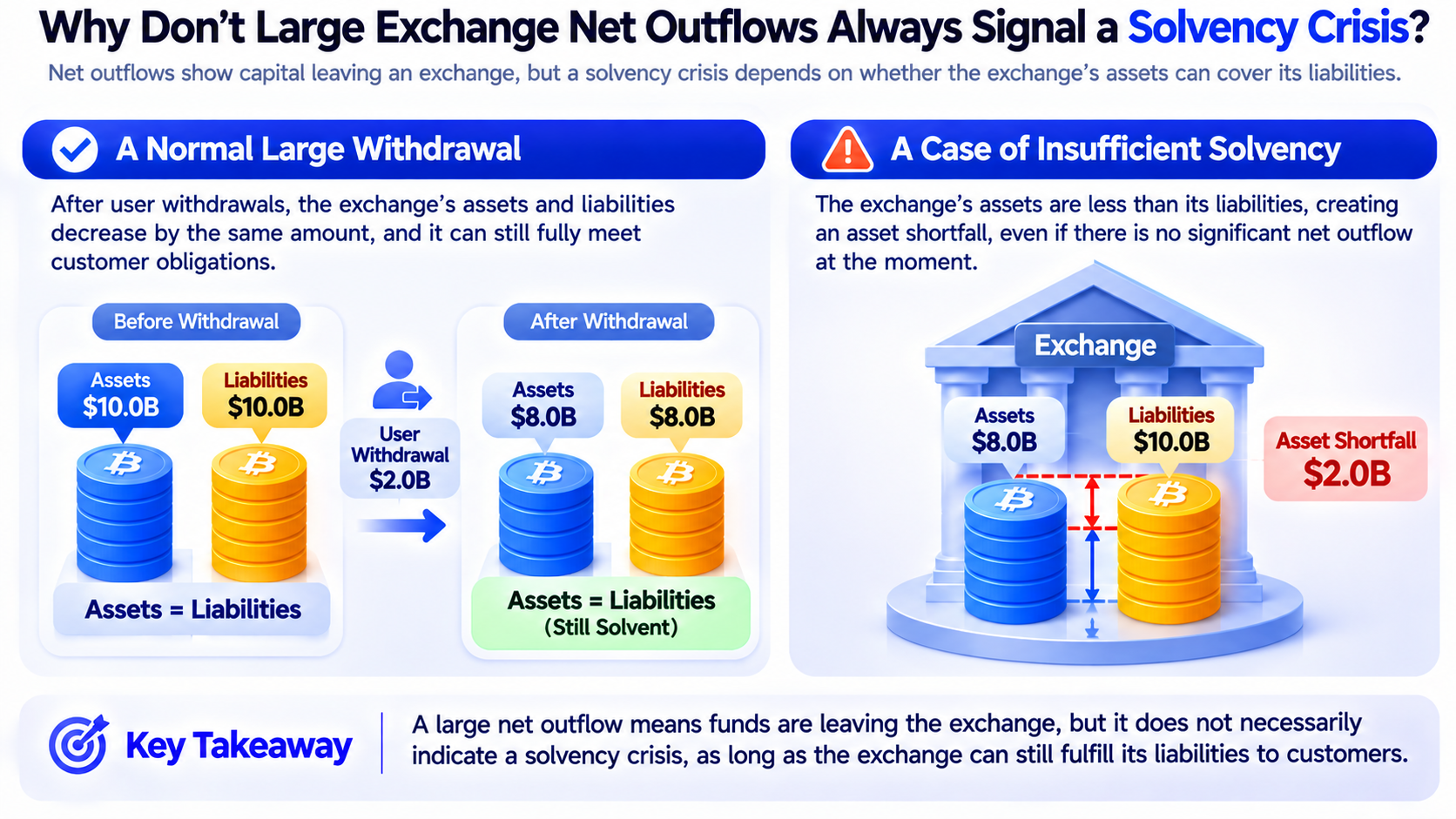
Exchange net outflows measure changes in fund flows, while a solvency crisis concerns whether a platform has sufficient assets to fulfill its liabilities. Suppose an exchange holds $10 billion worth of customer assets and has obligations of the same amount to return assets to customers. If customers withdraw $2 billion and the platform delivers the corresponding assets normally, the customer assets held by the platform and its liabilities to customers may both decline to $8 billion. In this case, although a $2 billion net outflow occurred, the platform did not necessarily incur a $2 billion funding shortfall.
Conversely, suppose an exchange has $10 billion in obligations to return assets to customers but only $8 billion in assets actually available for repayment. The platform could have insufficient assets even if there were no significant withdrawals that day. This shows that net outflows and solvency are two different financial dimensions. The former primarily tracks the direction of asset flows, while the latter focuses on whether assets and liabilities are matched. An exchange's ability to process some withdrawals normally does not necessarily mean that it has long-term, comprehensive solvency. However, large withdrawals alone cannot prove that the platform is insolvent.
| Comparison Dimension |
Large Net Outflow |
Solvency Crisis |
| Core question |
Are funds flowing out? |
Are assets sufficient to cover liabilities? |
| Primary areas observed |
Deposits, withdrawals, and wallet balances |
Assets, liabilities, and asset availability |
| Does it necessarily indicate a funding shortfall? |
No |
A material shortfall may exist |
| Can the two occur at the same time? |
Yes |
Yes |
| Primary risk |
Liquidity pressure and declining confidence |
Inability to fully fulfill repayment obligations |
Why Can an Exchange With Sufficient Assets Still Face Liquidity Pressure?
Solvency and liquidity are related but not identical concepts. Solvency concerns whether assets are sufficient to cover liabilities, while liquidity concerns whether a platform can provide deliverable assets promptly when needed. For example, an exchange may have sufficient total assets, but some assets may be locked for an extended period, used as collateral, or unable to be converted quickly into the assets users want to withdraw. When many users withdraw at the same time, the platform may need to adjust wallet funds, release related asset arrangements, or acquire the required assets through market transactions. If assets cannot be converted quickly enough, the platform may face short-term liquidity pressure.
In addition, different assets cannot simply be treated as fully interchangeable. Even if a platform holds a large amount of BTC, that does not mean it can immediately meet all withdrawal requests for USDT or ETH. Crypto asset price volatility can further affect the liquidation value of assets. This is especially true when market liquidity is limited, as large-scale asset sales may cause significant slippage and result in less funding being received than the assets' book value suggests.
Therefore, assessing an exchange's liquidity requires more than examining the total value of its assets. The composition of its assets, the currencies of its liabilities, asset liquidity, and actual withdrawal processing should also be considered. Sufficient assets are an important foundation for solvency, but the ability to deliver the corresponding assets promptly when users need them is equally important for evaluating the platform's risk management capabilities.
Can Proof of Reserves (PoR) Determine Whether an Exchange Is Safe?
Proof of reserves (PoR) is a mechanism used to display and verify the specific assets held by an exchange. Some exchanges use technologies such as Merkle trees or zero-knowledge proofs to allow users to verify whether their account balances are included in the relevant calculations, while also using publicly disclosed wallet data to observe the platform's asset reserves. PoR can improve asset transparency, but it is not automatically equivalent to a complete financial audit and cannot independently prove that an exchange has no solvency risk.
-
PoR generally reflects a specific point in time. Even if reserves are sufficient at a given point, this does not guarantee that asset losses will not occur in the future.
-
Proving that a platform controls a certain quantity of assets does not fully disclose all of its liabilities. In addition to customer balances, a platform may have borrowings, guarantees, or other financial obligations.
-
Whether assets are subject to collateral arrangements, pledges, or other restrictions also affects actual solvency. Even if a platform discloses its asset reserves, external observers may still find it difficult to accurately determine whether the assets are sufficient to cover all obligations without complete liability information.
PoR also generally cannot directly prove that there are no risks in internal controls, security management, or asset custody procedures. Therefore, PoR is better used as one component of an exchange transparency assessment rather than as standalone proof that a platform is completely safe. Users should consider the scope of PoR coverage, asset and liability information, third-party audits, and the platform's actual operating performance together.
How Can Multiple Indicators Be Used to Assess Exchange Withdrawal Risk?
When observing large net outflows from an exchange, users can establish an analytical framework based on fund flows, reserves, and operational performance.
-
Observe the size of the net outflow and its ratio to the platform's assets. For example, a $1 billion net outflow may have a significantly different relative impact on a platform holding $50 billion in assets than on one holding $2 billion.
-
Determine whether the outflow is persistent. A short-term wave of concentrated withdrawals may result from a single event, while sustained outflows over a longer period may reflect changes in user confidence or market demand.
In addition to the amount of funds involved, users should monitor whether the exchange can process withdrawals normally and whether there are unusual delays, temporary restrictions, or asset delivery issues. PoR, asset and liability information, and trading depth can also provide useful context. If a platform continues to fulfill its obligations to return customer assets normally during a period of large withdrawals and deposits gradually recover afterward, the net outflow does not necessarily indicate a solvency crisis. Conversely, if withdrawals remain restricted, reserve information is opaque, and significant trading abnormalities occur at the same time, users should take a more cautious view of the risks.
| Indicator |
Primary Area Observed |
Potential Significance |
| Net outflow size |
Daily and multi-day fund flow changes |
Determine whether withdrawal pressure is persistent |
| Net outflow as a percentage of assets |
Outflow relative to the reserve size |
Assess the relative scale of the impact |
| Deposit recovery |
Whether fund inflows resume |
Observe changes in market confidence |
| PoR data |
Asset reserves and coverage |
Support the assessment of asset transparency |
| Withdrawal processing status |
Whether unusual delays or restrictions exist |
Observe actual fulfillment capabilities |
| Trading depth |
Liquidity of major trading pairs |
Assess whether market operations are being affected |
It is important to note that no single indicator can eliminate all risks. Data disclosed by platforms, on-chain analyses, and third-party audits may also differ in coverage or timing. During periods of sharp market volatility, changes in asset prices and actual fund flows may affect statistical results at the same time.
How Should Retail Users Interpret Exchange Net Outflow Data?
For retail users, exchange net outflows can help explain market sentiment and changes in fund allocation, but they are not suitable as the sole basis for judging an exchange's safety.
-
Distinguish between user withdrawals and internal exchange transfers. When large on-chain transfers occur, verify the ownership of the addresses and the nature of the transactions to avoid mistaking wallet consolidation or custody adjustments for a mass user exodus.
-
Avoid treating all changes in dollar-denominated balances as actual fund flows. Changes in the prices of assets such as BTC and ETH can also affect the dollar value of an exchange's holdings.
When analyzing changes in fund flows, users should also consider multiple time periods. A single-day net outflow may be affected by a large institutional transaction, while changes in fund flows that continue for several days or even weeks generally warrant further analysis. Users can also assess the situation by considering the platform's PoR, withdrawal operating status, liquidity of major trading pairs, and publicly disclosed risk management mechanisms. When using digital asset services on trading platforms such as Gate, users should likewise understand the difference between centralized custody and self-custody, choose an asset management approach based on their own risk tolerance, and regularly review their account security settings.
Overall, exchange net outflows are better viewed as a starting point for identifying potential risks rather than as a basis for drawing direct conclusions. Only by further analyzing the reasons behind changes in fund flows and the platform's actual assets and liabilities can users more accurately determine whether large withdrawals have developed into a liquidity or solvency risk.
Conclusion
Exchange net outflows reflect the difference between fund inflows and outflows over a specific period, not a direct indication of a platform's solvency. Large withdrawals may result from security incidents, market volatility, institutional transfers, or changes in users' asset allocations. As long as an exchange can fulfill its obligations to return customer assets normally, net outflows alone do not mean that the platform has entered a solvency crisis.
Assessing actual risk requires further analysis of whether assets and liabilities are matched, whether assets can be delivered promptly, whether withdrawals are being processed normally, and whether PoR and other transparency mechanisms provide sufficient information. For investors, exchange net outflows should be treated as a risk-monitoring indicator rather than a direct measure of platform safety or a trading signal for predicting asset prices.
FAQ
Does a Larger Exchange Net Outflow Mean Higher Risk?
Not necessarily. The net outflow as a percentage of the platform's assets, its duration, the status of withdrawals, and the condition of asset reserves must also be considered.
Will Transferring BTC to a Cold Wallet Cause an Exchange Net Outflow?
Usually. If assets are transferred from an address controlled by an exchange to a user's self-custody address, the transfer may be counted as an on-chain net outflow.
Does 100% Exchange Reserve Coverage Mean There Is No Risk?
No. Users must also confirm whether liabilities have been fully accounted for, whether the assets are subject to restrictions, and whether the reserve data is accurate and up to date.
Can Exchange Net Outflows Cause BTC to Rise?
There is no necessary relationship. Asset withdrawals may indicate long-term holding, cross-platform trading, or risk avoidance.
Where Can I View Exchange Fund Flows?
You can refer to data platforms such as CryptoQuant, Glassnode, and DefiLlama, and cross-check their data against the exchange's publicly disclosed PoR and asset information.